Bitcoin and altcoins saw strong double-digit price rebounds after this week’s brutal sell-off, but do technical charts forecast a longer-term recovery, or is today’s rally just a dead cat bounce?

 Live Chat

Bitcoin and altcoins saw strong double-digit price rebounds after this week’s brutal sell-off, but do technical charts forecast a longer-term recovery, or is today’s rally just a dead cat bounce?

Having enjoyed a blockbuster year of venture capital investors ploughing over $25 billion into crypto companies, a 73% uptick from 2025, according to DefiLlama data, crypto startups are banking on an exciting 2026.
The only question now is where exactly will the next big businesses crop up?
From artificial intelligence to geopolitics — that question is hard to answer.
DL News asked five investors about what they’re keeping an eye out for in 2026.
Perpetuals are already the most used financial product in crypto. They’ve been around for years, handle vast amounts of trading, and work even when markets get chaotic.
What’s new is how they’re being used. Instead of just speculating on crypto prices, people are using perps to create synthetic markets tied to real-world assets. That could be inflation data, oil prices, private companies, or other signals people care about but can’t easily trade today.
The key point is you don’t need to actually own the thing you’re trading. You don’t have to move oil barrels or custody shares. That makes it much faster to launch new markets and lets them scale globally from day one.
‘Taken together, 2026 feels less like hype and more like maturity.‘
— Hoolie Tejwani, Head, Coinbase Ventures
A few other shifts are happening alongside this. Crypto’s superpower is enabling 24/7 global markets for anything. Anything that can be tokenised and traded will be, and the lines between trading platforms will blur.
Decentralised finance products are also starting to work together better, with a more intuitive user experience, so we expect new cohorts of users and capital to onboard to DeFi. And as AI systems become more capable, crypto is quietly becoming the way those systems move money and coordinate actions.
Regulation also plays a role. This year was when legislation like the Genius Act helped move crypto out of a legal grey zone. Market clarity is the next big unlock, which we expect to see in 2026.
When clear rules are set, capital gets more patient, and builders can play beyond the next quarter.
Taken together, 2026 feels less like hype and more like maturity.
Founders are thinking long-term, building real infrastructure, and focusing on what actually gets used. That’s usually when things start to stick, and we’re investing in the teams that show up to build with five- to 10-year visions.

Despite lacklustre price performance in 2025, with total crypto market capitalisation down roughly 13% year-to-date, we’ve seen unprecedented improvements in underlying fundamentals.
We expect adoption of stablecoins and other tokenised assets to continue accelerating in 2026 and to represent a secular growth trend over the next one to two decades.
The US government is likely to continue supporting the global export of dollar-backed stablecoins, underpinning a new wave of fintechs and neobanks that deliver better, faster, cheaper financial services.
In parallel, incumbents are beginning to fight back by launching blockchain-enabled products across digital asset custody, cross-border payments, stablecoin issuance, cards, and treasury management, making 2026 a true inflexion point for institutional adoption.
Large banks, asset managers, and broker-dealers increasingly view these efforts as opportunities for growth and margin expansion, replacing legacy rails with modern blockchain infrastructure without requiring end users to materially change existing behaviour.
As more assets move onchain, institutional capital formation should accelerate, creating a supportive backdrop for DeFi, with crypto primitives such as prediction markets, perpetuals, and vaults continuing to gain relevance.
Following a landmark year for crypto mergers and acquisitions in 2025, we expect continued consolidation as incumbents execute on strategic roadmaps.
Venture funding activity is ultimately downstream of new fund formation, which is likely to remain challenging as many institutional allocators remain over-allocated to venture and private equity more broadly.
Finally, after what was the most important year in history for crypto regulation, with the signing of the Genius Act into law in July, attention now turns to advancing a market structure bill in 2026, which will further reinforce institutional adoption.”

Next year is poised to be the year of further institutional adoption in the blockchain arena.
With players like Binance awarded three Abu Dhabi Global Market licenses in the United Arab Emirates, we are confident that the new regulatory clarity emerging across other jurisdictions is a positive indication of what is to come in the new year.
In our experience, good regulation enables innovation and, in turn, allows institutions to participate in the global rise of digital asset markets and correlated industries.
Similarly, crypto exchange Bullish raising $1 billion for its public offering signalled a green light for digital asset companies on Wall Street, which can only stimulate stronger institutional interest that meets their clients’ demand.
We anticipate that growth will continue in other jurisdictions at an even more rapid pace, particularly in regions where the impact of blockchain and frontier technology extends beyond financial market expansions to deeply enable critical industries such as agriculture and health to operate with significant efficiencies.
On the heels of our recently closed African Blockchain fund, backed by well-known leaders such as Circle Ventures, the investment arm of the US-based issuer of the USDC stablecoin, the appetite in emerging markets is more evident than ever.
Our internal research shows that investment in Africa’s blockchain ecosystem is on the rise — with blockchain accounting for over 7% of total venture capital funding and 12.7% of all deals on the continent.
Whilst payments, infrastructure and fintech rails continue to dominate verticals for us at CV VC, we remain deeply committed to the emergence of blockchain technology as the bedrock rail on which better, transparent and verifiable actions can be managed across web3.

In 2026, the smarter money in crypto will follow the places where the technology is interoperable with the rest of finance. There’ll still be plenty of chatter about a possible Bitcoin Act or new waves of spot exchange-traded funds, but the more durable story lies in the plumbing underneath.
In 2026, we’ll see more projects explore product-market fit around risks people already care about. That means more niche assets coming onchain: stocks, gold, intellectual property, even trading cards and GPUs, with global, 24/7 access and the ability to plug straight into DeFi.
The goal isn’t to invent new things to speculate on, but to package familiar risks — rates, oil prices, elections, credit spreads — in intuitive formats that the everyday user can actually navigate to get exposure or hedge.
Stablecoins already move more value than big card networks, and with rulebooks like the Genius Act in the US and sweeping crypto regulations in Europe, called Markets in Crypto-Assets Regulation, banks and brokerages are finally comfortable launching their own stablecoins and tokenised products.
That’s how stablecoins move from trading chips into the default rail for salaries, business-to-business payments and cross‑border trade in a more technology‑driven, compliance‑first environment.
Perpetuals still dominate crypto, but they come with funding fees and a learning curve that favours professional traders. Options can offer cleaner upside or protection without that ongoing drag, especially in simpler, more user‑friendly formats.
Expect to see more click‑once structures, including binary yes-no contracts on events that look and feel closer to prediction markets than traditional options.
Underpinning it all, more of the flow will be machines talking to machines: bots and agents holding balances, paying for services and rebalancing on autopilot. From a VC angle, that means fewer spray‑and‑pray bets on narratives, and more focus on whether a product can work with regulators, institutions, and this emerging machine economy at the same time.

For most of crypto’s history, investors chased infrastructure. That meant faster blockchains, more decentralisation, and cheaper fees.
That phase is largely done.
By 2026, the most interesting investment opportunities will come from what gets built on top of that foundation.
First, I expect a real wave of consumer crypto apps — especially in DeFi — that don’t feel like crypto at all. The tech is finally invisible. Users won’t think about wallets, seed phrases, or gas fees.
They’ll just use products that feel as smooth as Revolut or Robinhood, but happen to run on blockchains underneath. That’s when adoption stops being theoretical.
Second, the line between traditional finance and DeFi will blur fast.
As regulation becomes clearer, particularly in the US, we’ll see more familiar financial products move on-chain: equities, payments, settlement rails.
This isn’t crypto replacing traditional finance. It’s TradFi quietly using blockchain because it’s cheaper, faster, and global by default.
Finally, I’m watching how blockchains become verification layers for AI and robotics.
As machines generate more data and make more decisions, we’ll need neutral systems to prove what happened, when, and by whom.
Eric Johansson is DL News’ managing editor. Got a tip? Email at eric@dlnews.com.
The most significant shift in crypto finance this year isn’t a token launch, a price breakout, or a new blockchain upgrade. Instead, it is the quiet return of the public listing for crypto-focused entities.
Kraken’s Nov. 19 confidential filing for a proposed initial public offering marks the latest step in what is rapidly becoming the industry’s largest capital-markets push since the 2021 bull run.
This move came less than a week after the US exchange secured $800 million across two funding tranches at a $20 billion valuation, drawing investment from institutions rarely seen in crypto rounds, including Jane Street, DRW Venture Capital, Oppenheimer, and Citadel Securities.
The filing caps months of speculation and reopens a debate that had gone dormant after the turbulence of 2022 and 2023. With Circle already public, several crypto firms, including BitGo, Gemini, Bullish, and Grayscale, are also pursuing public-market access, resulting in the sector’s first coordinated IPO cycle.
According to Bitwise CEO Hunter Horsley, this wave could collectively represent nearly $100 billion in market capitalization, a scale few predicted so soon after the industry’s reputational crises.
Thus, Kraken’s entrance into the IPO queue is not simply an individual corporate milestone. It signals a broader transformation in how crypto companies want to be perceived: not as high-growth startups chasing hype cycles, but as durable, cash-flow-generating financial infrastructure businesses capable of operating under public-market discipline.
That shift has implications not only for investors but also for the industry’s competitive structure.
Circle’s debut earlier this year reopened a capital-markets window many believed was sealed shut. Regulatory pressure, the collapse of major offshore exchanges, and an extended market downturn had left investment banks wary of taking crypto firms public.
However, Circle’s strong reception demonstrated that US-regulated companies with audited financials and institutional clients could once again attract long-term capital.
That catalyst was quickly followed by BitGo’s filing, Gemini’s renewed pursuit of a listing, Bullish’s re-entry into the pipeline, and Grayscale’s effort to restructure and list portions of its business.
Notably, the industry has not seen a synchronized public-market movement of this kind since the early Coinbase era.
However, the companies lining up today look materially different.
They operate under stricter compliance regimes, handle custody for major institutions, process large volumes of fiat payments, and service tokenization pilots that now involve traditional asset managers and banks. The result is a group of businesses that increasingly resemble regulated financial intermediaries rather than speculative trading venues.
Kraken’s filing is the clearest proof that the market window is no longer theoretical.
Kraken’s confidential S-1 follows a period of aggressive expansion, strategic acquisitions, and record revenue performance.
Earlier in the year, the exchange reported that it generated $1.5 billion in revenue in 2024 and surpassed that figure within the first three quarters of 2025.
What stands out most is the business model behind those numbers. Kraken raised only $27 million in primary capital before this latest round, meaning most of its growth, infrastructure, and global scaling have been funded by operational cash flow rather than venture backing.
In an ecosystem where many exchanges relied heavily on outside capital, Kraken built a balance sheet that resembles a traditional exchange group with consistent profitability, disciplined spending, and a clear alignment between revenue and operating costs.
Moreover, the new $800 million raise is the largest in its history and brings in strategic partners with deep experience in market microstructure.
Citadel Securities, one of the world’s most influential market makers, committed $200 million and will support Kraken in liquidity and risk management. The involvement of such a firm signals that crypto-market infrastructure is now intersecting directly with the architecture of modern global trading.
At the same time, Kraken has gone on an acquisition streak by purchasing Small Exchange for $100 million to accelerate its derivatives ambitions and acquiring NinjaTrader while building out its xStocks platform for equity trading.
These moves reflect a clear objective of evolving from a crypto-only venue into a multi-asset, globally regulated trading house.
As a result, the company is no longer dependent on spot-trading cycles. Its operations now include derivatives, tokenized assets, equities, staking services, regulated payments, and global clearing. It is expanding into Latin America, APAC, and EMEA while pursuing an increasingly extensive licensing strategy.
In this configuration, a crypto exchange becomes a multi-product, multi-jurisdiction trading system capable of onboarding new asset classes as tokenization advances. This is a departure from the early exchange archetypes that depended heavily on bull markets and speculative volumes.
Instead, Kraken and its peers are structuring themselves as long-term platforms that will eventually bridge traditional and on-chain capital markets.
This transition has implications for investors as well. Public-market listings subject these firms to new levels of scrutiny: quarterly reporting, audited financial statements, transparency in compliance, and operational accountability.
Those pressures may reshape the crypto-exchange landscape by rewarding firms that operate with regulatory discipline and punishing those that do not.
The scale of the crypto IPO wave matters.
Horsley’s estimate of $100 billion in combined valuation reflects a broader realization among investors that crypto is no longer defined solely by speculative assets.
The companies that have emerged in the space, like exchanges, custodians, tokenization platforms, and derivatives venues, now command financial profiles comparable to mid-cap financial-services firms.
This contrasts sharply with the last cycle.
In 2021, listings were often justified by growth curves, user acquisition, and theoretical total addressable markets. In 2025, they are being justified by audited revenue, regulated market infrastructure, licensed operations, and established institutional clients.
Moreover, Kraken’s vertically integrated architecture, which covers custody, clearing, settlement, wallet infrastructure, market data, and exchange matching, mirrors the structure of traditional exchange holding companies such as ICE or TMX.
Circle’s payments and stablecoin rails now handle volumes comparable to those of early fintechs that later became billion-dollar public firms. BitGo’s custody relationships position it as a digital-asset equivalent of a trust-banking provider.
Viewed together, these listings are no longer experimental. They represent an emerging public-market category: digital-asset financial infrastructure.
The return of crypto IPOs signals a clear maturation phase. Exchanges and infrastructure firms are no longer simply competing for retail traders; they are competing to become the backbone of tokenization, cross-border payments, stablecoin issuance, and institutional settlement.
The presence of Citadel Securities as a strategic investor illustrates how deeply traditional market structure players are now engaging with the sector.
Circle’s public listing showed that digital-asset payments and stablecoin infrastructure have achieved enterprise-scale adoption. BitGo’s filing confirms that institutional custody is no longer a niche service but a core component of capital-markets infrastructure.
The industry is moving out of its speculative adolescence and into a period where transparency, regulation, and financial stability determine leadership.
Kraken’s IPO is therefore not just another listing. It is the latest test of whether crypto-native infrastructure can withstand the rigors of the public markets and whether global investors are ready to treat digital-asset platforms as long-term pillars of a new financial system.

Arbitrum’s story right now is one of stillness. The ARB price has barely moved, hovering around $0.3 with a slight dip of -0.34%. For a project once praised as Ethereum’s most promising layer-2 scaling solution, this calm feels almost unsettling. It’s efficient, secure, and well-built, but the spark seems missing.
Arbitrum remains one of Ethereum’s most reliable scaling solutions, but reliability isn’t always thrilling. Although its system processes transactions fast and at low cost, market sentiment has turned bearish. The Arbitrum (ARB) price has stayed flat, with analysts predicting a potential 24% decline to around $0.23 – $0.26 by the fall of the year.The Fear & Greed Index sits deep in the “fear” zone at 26, hinting that traders are playing it safe.
Despite recording 17 green days in the last month, volatility remains mild at just over 7%. The lack of momentum might not be a red flag, but it does tell a story: the excitement has shifted elsewhere. Projects that blend innovation with community engagement, like Funtico’s EV2, are beginning to capture the imagination that Arbitrum once held.
Meanwhile, over in the gaming corner of crypto, something far more alive is taking shape. The EV2 Presale from Funtico is gathering serious attention, with over 95,000 tokens sold and hundreds of early investors joining in. At $0.01 per token and over $955 raised, it’s early enough to feel exciting without feeling risky. Built as a full-scale open-world looter shooter, EV2 seems to be giving crypto investors a new narrative worth watching.
The EV2 Presale isn’t just a funding round, it’s an invitation to a living, breathing world where every match feels personal. Take the Cloaker suit, for instance. It’s built for players who like the thrill of stealth and precision. Cloakers strike from the shadows, vanishing before enemies can react. They don’t just fight; they hunt.
Pair that with the Havoc game mode, a strategic, team-versus-team battle for dominance, and the result is pure adrenaline. Teams fight for control of sacred grounds called “The Pit,” using hidden weapons and artifacts to gain an upper hand. It’s not just about who shoots first, but who thinks faster. In the chaos of Havoc, a well-timed Cloaker strike can turn the tide of the entire match.
Then there’s the Pathfinder suit, designed for players who see the battlefield differently. With its drone companion, it blends healing, shielding, and offense into one smooth rhythm. It’s perfect for those who prefer strategy over brute force, players who guide their team, hold the line, and shape the fight. Every decision matters, and the Pathfinder makes sure every move counts.
The protocol is designed by a team of over a hundred gaming professionals. It combines experience, creativity, and technology to deliver something that actually feels finished. The attention to balance, detail, and player choice shows a commitment that’s rare in early-stage projects.

While ARB price drifts quietly in its comfort zone, EV2 is roaring into the spotlight. It’s not trying to reinvent finance, it’s rewriting entertainment. The presale’s success isn’t just about token numbers; it’s about energy, the kind that pulls people in and keeps them curious.
Arbitrum’s technology remains impressive, no doubt about that. But as investor attention moves toward immersive, playable ecosystems, it’s becoming clear that the next big crypto story might not be DeFi, it might be gaming. And right now, EV2 seems to be the one project willing to prove it.
For More Information about EV2 visit the links below
Website: https://ev2.funtico.com/
Telegram: https://t.me/EV2_Official
Twitter/X: https://x.com/EV2_Official

A painful decline or a renewed rally: what’s next for HYPE?
HYPE – the native cryptocurrency of the decentralized exchange Hyperliquid – was among the crypto sensations this summer, reaching an all-time high price of almost $60 in mid-September.
However, its valuation has retraced substantially since that peak, and one popular analyst believes the downfall might be just starting.
The popular X user, Ali Martinez, analyzed the price performance of HYPE and argued that its chart could be forming a classic head-and-shoulders pattern. He said a drop to $36 will confirm that scenario, which in turn may lead to a collapse to as low as $20.
Hyperliquid $HYPE could be forming a head and shoulders pattern. If confirmed, it projects a move to $20. pic.twitter.com/3lKhj8ppqt
— Ali (@ali_charts) November 3, 2025
As of this writing, HYPE trades at approximately $41, meaning that such a plunge would represent a 50% decline. Another renowned market observer who is rather bearish on the asset is Altcoin Sherpa. The X user told their over 250,000 followers that HYPE’s performance looks “poor” and revealed that they are cutting their position after seeing the latest downtrend.
“Looks like some twap out, slow efficient selling. Not sure what’s going on, but going to just wait for more clarity,” they stated on the social media platform.
Numerous other analysts see the current price level as an ideal buying opportunity. X user Ahmed said they will start accumulating HYPE tokens again, while Crypto Tony promised to do the same if the price dips to $38.40.
Corgil is also optimistic, claiming that the cryptocurrency is just “one announcement away” from reaching a new all-time high before the major token unlock in November. Many industry participants have warned that hundreds of millions of dollars’ worth of HYPE will be released towards the end of the month, which could increase the supply and have a negative impact on the price.
“Everyone with an inch of a brain knows Hyperliquid team will re-lock or come up with something else that would challenge ‘typical’ crypto-project playbook,” Corgil assumed.
Meanwhile, a mysterious crypto trader who usually bets serious sums and has a 100% win rate recently opened a 10x long position on HYPE, sparking speculation that they may know something we don’t.

2025 has been quite the year for digital asset treasury (DAT) companies, especially Bitcoin and Ethereum treasury vehicles. These publicly-traded firms, who accumulate digital assets on their balance sheets, offer retail investors who purchase their shares indirect crypto exposure.
However, a recent report found that retail investors have lost around $17 billion by investing in Bitcoin treasury stocks. According to the firm, the hype surrounding BTC treasuries seems to be coming to an end, with retail investors forced to deal with the losses.
In its market report last week, 10x Research said that the “age of financial magic” is coming to a close for Bitcoin treasury companies. According to the Singapore-based research firm, these treasury companies conjured billions in “paper wealth” by issuing overvalued shares to investors.
According to the analytics firm, it made sense for the treasury firms to offer their shares at a premium as the price of Bitcoin continued to increase. 10x Research noted that the once-celebrated premiums to net asset value (NAV) was an illusion that has left investors with losses while “executives walked away with the gold.”
10x Research mentioned that investors who purchased the overvalued stocks during the Bitcoin treasury boom have collectively lost about $17 billion. According to the research firm, the declining volatility and profits is forcing the treasury companies to make a hard pivot from marketing-driven momentum to real market discipline.

Source: 10x Research
10x Research added:
The next act won’t be about magic—it will be about who can still generate alpha when the audience stops believing.
Unsurprisingly, the performance of Bitcoin-linked stocks has been quite disappointing over the past few months. For example, Strategy’s (previously known as MicroStrategy) MSTR stock has declined by over 20% since August.
The Michael Saylor-led firm announced its latest purchase of Bitcoin between October 6 and October 12. The 220 BTC buy—at an average price of $123,561—brought Strategy’s holdings to 640,250 BTC (worth about $47.38 billion).
As of this writing, the price of BTC stands at around $106,799, reflecting no significant movement in the past day. Following the market-wide crash on October 10, the premier cryptocurrency has struggled to sustain any positive momentum. According to data from CoinGecko, the value of Bitcoin has dropped by more than 4% in the last seven days.

The price of BTC on the daily timeframe | Source: BTCUSDT chart on TradingView
Featured image from iStock, chart from TradingView

Editorial Process for bitcoinist is centered on delivering thoroughly researched, accurate, and unbiased content. We uphold strict sourcing standards, and each page undergoes diligent review by our team of top technology experts and seasoned editors. This process ensures the integrity, relevance, and value of our content for our readers.
A well-followed pseudonymous analyst on X (known as Pentoshi) said Friday he started a small position in HYPE, Hyperliquid’s native token, and will add only if prices drift lower.
In his Oct. 17 post, he wrote that he “nibbled” on spot HYPE below $34, filling about 20% of the position he ultimately wants. Spot means he bought the token itself without leverage, which removes the risk of forced liquidations. He said he’d “load up” nearer $28 and “go hard” sub-$30, a scale in approach that spaces buys across levels instead of committing all capital at once.
The setup, he stressed, sits inside a broader downtrend. By “lower highs,” he means each rebound is failing beneath the prior peak — a classic bearish structure that often resolves with another leg down. When he says there’s “broken market structure,” he’s pointing to damaged support zones and thin order books after last week’s volatility, conditions that can exaggerate moves and produce whipsaws. The takeaway: keep size small, avoid trying to nail an exact bottom, and assume dips can overshoot.
Pentoshi also flagged a potential supply overhang from an unstaking queue. On networks that allow staking, previously locked tokens periodically unlock; if a chunk of those coins is sold rather than restaked, short-term sell pressure can rise. He said he doesn’t know whether a quarter, a third, or less will hit the market, so he’s leaving resting bids below current price and letting the market come to him instead of chasing strength.
He added that a recent ether trade that strayed from his rules “burnt” him a bit — even if a bounce helped — so he’s playing defense: smaller sizing, pre-set bids, and minimal micromanagement of this position in the near term.
Hyperliquid is a decentralized exchange that runs on its own chain and is used mainly for perpetual futures — derivatives with no expiry. Its token, HYPE, serves as both governance and economic stake: holders can vote on upgrades, stake for rewards, and benefit from mechanisms that link trading activity and fees to the token’s value. In short: Hyperliquid is the venue; HYPE is how users share in its growth.
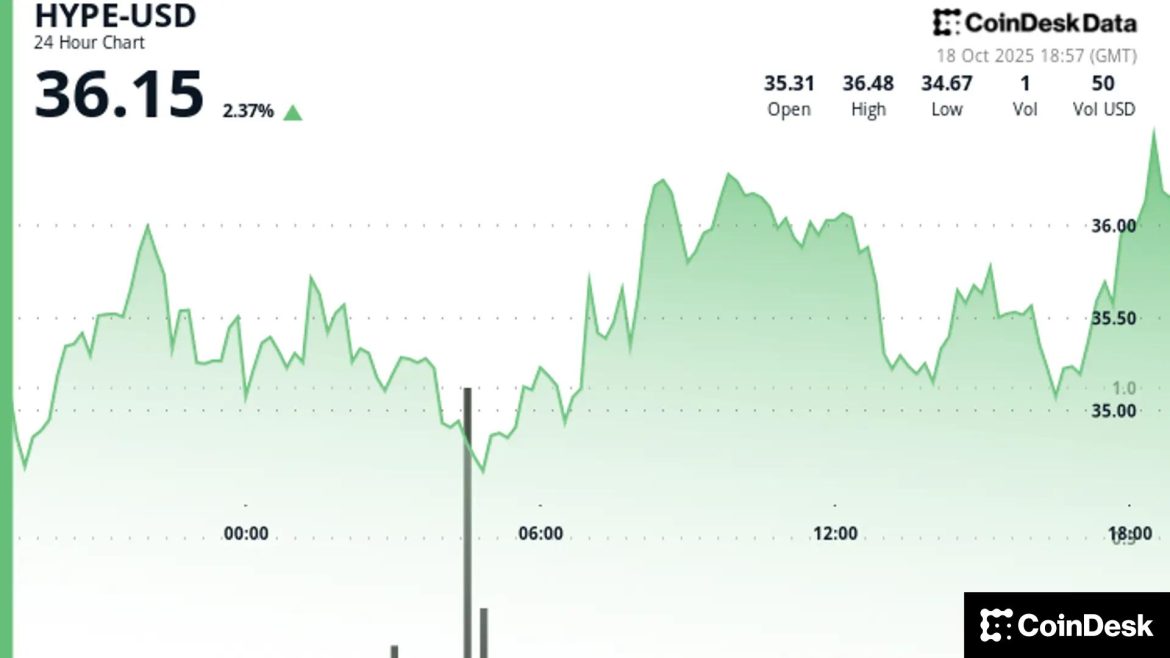
According to CoinDesk Data, just prior to publish time, HYPE was around $36.32, up 2.1% in the past 24 hours.

The total crypto market cap is above $3.7 trillion again, but it’s down by roughly $500 billion in just over a week.
It was another bloody Friday in the cryptocurrency markets, as bitcoin dumped to a multi-month low (on most exchanges) at under $104,000.
The altcoins were smashed even harder, with massive price declines from the likes of ETH, BNB, XRP, SOL, DOGE, and many others.
The overall market-wide calamity began last Friday when BTC dumped from $122,000 to $110,000 or down to $101,000 on exchanges like Binance. It bounced off last weekend and remained above $110,000. It kept climbing at the start of the business week and peaked at $116,000 on Monday and Tuesday.
It faced an immediate and painful rejection at that point, which drove it south to $110,000. Although that support line held at first, the bears kept the pedal to the metal, and it gave on Thursday evening. The landscape only worsened on Friday when bitcoin slumped first to $108,000 and then below $104,000, which became a three-month low (again, on most exchanges).
After such a substantial collapse, came some positive macro news as US President Trump said the tariffs he announced on China last week won’t stand. BTC reacted with an immediate bounce to over $106,000 and has added another grand since then.
Nevertheless, its market cap has slipped to $2.130 trillion, while its dominance over the altcoins is 57.3%.
Although most altcoins have recovered some ground from their lows marked yesterday, the overall picture is still grim. ETH is below $3,900 after a minor decline on a 24-hour scale. BNB has lost the $1,100 support following a 3% drop. TRX, DOGE, ADA, LINK, HYPE, BCH, SUI, AVAX, and HBAR are also in the red, while XRP, SOL, and XLM are with minor gains.
COAI has dumped by another 17% in the past 24 hours, followed by AAVE (-5.3%) and ASTER (-5%). In contrast, ENA has surged by 12.5% followed by TAO (8%).
The total crypto market cap has recovered to just over $3.7 trillion on CG, but it’s still down by roughly $500 billion since last Friday.

LIMITED OFFER for CryptoPotato readers at Bybit: Use this link to register and open a $500 FREE position on any coin!
Disclaimer: Information found on CryptoPotato is those of writers quoted. It does not represent the opinions of CryptoPotato on whether to buy, sell, or hold any investments. You are advised to conduct your own research before making any investment decisions. Use provided information at your own risk. See Disclaimer for more information.
Cryptocurrency charts by TradingView.

The cryptocurrency market witnessed renewed selling pressure on Wednesday, with Hyperliquid (HYPE), SPX6900 (SPX), and Artificial Superintelligence Alliance (FET) among the biggest losers. Over $655 million in liquidations were recorded across the market as tariff tensions between the U.S. and China reignited investor fears, triggering broad declines across major digital assets.
Market sentiment took a hit after U.S. President Donald Trump hinted at potential restrictions on cooking oil trade with China. The geopolitical uncertainty prompted a wave of liquidations, sending Bitcoin (BTC) below $113,000 and accelerating losses across altcoins.
According to CoinGlass, total crypto market liquidations surpassed $655 million in the past 24 hours, with leveraged traders suffering heavy losses. Analysts say the sell-off reflects broader risk aversion and rising volatility ahead of possible macroeconomic policy shifts.
Hyperliquid (HYPE) extended its losses for a second consecutive day, dropping over 1% on Wednesday after a 7% decline on Tuesday. The decentralized exchange (DEX) token has erased most of its early-week gains and now trades dangerously close to a breakdown below the 200-day Exponential Moving Average (EMA) at $38.28.
The S1 Pivot Point level at $36.77 remains a key support zone that helped the token rebound earlier in the week. However, a daily close below this level could open the door for a deeper pullback toward the center Pivot Point near $28.36.
On the technical front, bearish momentum is strengthening. The MACD continues to trend lower in negative territory, while the Relative Strength Index (RSI) at 39 indicates that there’s still room for further downside before reaching oversold levels.
For HYPE to regain bullish traction, analysts say the token would need to climb back above the 50-day EMA at $45.66, with potential resistance near $48.09.
The SPX6900 (SPX) token continued its decline on Wednesday, slipping another 1% and extending its 10% drop from the previous day. The asset has been struggling to recover since Friday’s market crash, and the current pullback threatens to erase Sunday’s short-lived 28% rebound.
If selling pressure persists, SPX could retest the $1 psychological support level, with a potential dip toward the $0.90 zone, last seen on May 31.
The MACD shows a clear bearish divergence, signaling increased selling strength. Meanwhile, the RSI at 46 has fallen below the neutral midpoint, reinforcing a neutral-to-bearish sentiment in the short term.
If the market stabilizes, however, SPX could attempt a rebound toward the $1.65 peak from October 6, though analysts caution that recovery momentum remains weak for now.
The Artificial Superintelligence Alliance (FET) token suffered one of its steepest declines in nearly two years, closing Tuesday at its lowest daily level since 2023. At the time of writing, FET trades slightly above $0.30, after breaking below the S3 Pivot Point at $0.3310.
The next critical support sits near the S4 Pivot Point at $0.2270, where traders expect potential buying interest to emerge. However, the token’s momentum remains firmly bearish — the MACD continues its decline alongside its signal line, while the RSI at 21 indicates deeply oversold conditions.
While such conditions can sometimes precede a short-term bounce, any rebound could face strong resistance at the $0.3310 and $0.4350 levels, corresponding to prior support zones now turned into resistance.
Despite the market-wide correction, analysts note that sharp liquidation events often lead to short-term relief rallies as selling pressure subsides. However, macroeconomic headwinds — including U.S.–China trade uncertainty and broader market risk sentiment — are likely to keep volatility elevated in the near term.
Technical traders are now watching for Bitcoin’s ability to reclaim $115,000 and Ethereum’s hold above $3,800, both seen as key indicators of whether the broader crypto market can stabilize and reverse course.
Post Views: 44


