Sam Altman-backed World has rolled out biometric verification badges for Zoom enterprise users, aiming to combat AI deepfake impersonation and fraud.

 Live Chat

Sam Altman-backed World has rolled out biometric verification badges for Zoom enterprise users, aiming to combat AI deepfake impersonation and fraud.
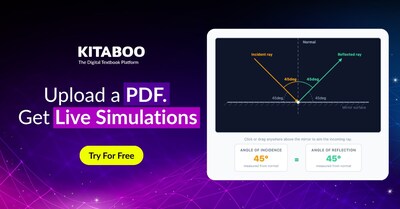
MUMBAI, India, June 26, 2026 /PRNewswire/ — Ten minutes is all it takes for KITABOO’s new AI capability to analyze a standard textbook PDF, isolate the exact concept students struggle with most, and engineer an interactive simulation around that specific learning friction point.
This automated pipeline instantly transforms flat text into an active digital environment: a physics chapter becomes a pendulum a student can control; an algebra lesson shifts into a digital balance scale; and a biology unit evolves into an ecosystem where students manipulate variables to observe cause and effect. The final output is delivered via a single, shareable URL that anyone can access instantly—no user accounts or logins required.
Publishers globally are sitting on years of curriculum content in PDF format. The quality of that content has never been the problem. The production cost of converting it into something genuinely interactive has been. A full conversion project has historically required a specialist team, a vendor engagement, and months of time. Most publishers have done the math and deprioritised it.
KITABOO’s new capability removes that constraint. By introducing an end-to-end automated pipeline, the platform allows publishers to bypass traditional development bottlenecks:
“K12 publishers have spent years building content that students deserve to actually interact with,” said Darshit Shah, K12 Lead at KITABOO. “What took a team and a production budget now takes ten minutes. That changes who can afford to go digital, and when.”
The timing matters. In the US, emergency federal education funding that kept many publisher production pipelines running ended in 2024. In Europe, governments are mandating digital transitions and accessibility compliance, while publishers are expected to absorb the cost from existing resources. The publishers who find a faster, lower-cost path to interactive content this year will be positioned for the adoption windows ahead. Those who wait are extending a gap that is already widening.
Publishers who want to test this with their own content can do so at: kitaboo.com/turn-textbook-into-interactive-learning
About KITABOO
KITABOO is a digital publishing and learning platform. The platform enables K12 publishers, educational institutions, and content providers to create, distribute, secure, and measure digital content across web and mobile platforms. KITABOO serves publishers in more than 25+ countries, supporting over six million active users across 7,000 school districts.
For more information, visit https://kitaboo.com.
Photo: https://web3wire.org/wp-content/uploads/2026/06/KITABOO_Live_Simulations.jpg
View original content to download multimedia:https://www.prnewswire.com/in/news-releases/kitaboo-converts-a-textbook-pdf-into-a-working-student-simulation-in-ten-minutes-with-no-human-involvement-302811517.html

The internet has a bot problem. You know this. Dating apps filled with fake profiles. Concert tickets snatched by automated scalpers before a human can click “buy.” Gaming leaderboards where you’re competing against scripts, not people.
Existing systems verify devices and accounts. But they don’t verify humans. If someone has your phone or your password, they *are* you as far as the platform knows. That’s a real vulnerability. World ID was built to solve this. Nearly 18 million people across 160 countries have already verified their humanness at an Orb.
But at that scale, new requirements emerge. Enterprises need production-grade systems: recoverable if you lose access, compatible with existing security infrastructure. Consumers want something private by default, but also intuitive and portable. The new World ID is built for both.
The upgrade introduces a new architecture. One-time-use nullifiers prevent your interactions from being linked together. No personal data is exposed or stored. And for the first time, you can recover access if you lose your device. That’s a big deal. Previous proof-of-human systems didn’t have recovery. Lose your key, lose your identity. Now World ID supports multi-key authentication, key rotation, and formal session management. That’s what production deployment at scale looks like.
Here’s the kicker. The new World ID introduces something fundamentally new. World calls it “human continuity.”
Today’s security systems can verify that a device is trusted. They can’t verify that the same unique human is behind the device across multiple interactions. World ID now enables that and without compromising privacy. Think about what that unlocks. Deepfake detection on video calls. Authenticity verification for communications. Governance systems that can’t be gamed by bots.
Tinder already integrated World ID globally after a successful pilot in Japan. Yoel Roth, Head of Trust & Safety at Match Group, said it gives users a
“privacy-preserving way to help know the person on the other end is real.”
This is the part I find most interesting. As AI agents act on behalf of real people, proving a verified human stands behind each agent becomes critical. The new World ID lays the protocol-level groundwork for human-backed AI. That’s not a distant future problem. That’s a next-year problem.
World ID is becoming the trust layer for the internet. Not because of hype. Because nearly 18 million verified humans already use it, and the new protocol finally meets enterprise security requirements while remaining private by default. The SDK is now open source. Any app can be a World ID authenticator. And the dedicated World ID app puts proof of human at your fingertips. If you’re building platforms where real humans need to prove they’re real such as dating, events, gaming, AI agents, then this is worth your attention.
Check the docs at docs.world.org. See if it fits.
And if you’re finding this useful, subscribe to our site and YT channel. We dig into these infrastructure shifts every week. We look at what’s real, what’s hype, and what actually matters for your portfolio.

The information discussed by Altcoin Buzz is not financial advice. This is for educational, entertainment, and informational purposes only. Any information or strategies are thoughts and opinions relevant to the accepted levels of risk tolerance of the writer/reviewers and their risk tolerance may be different than yours. We are not responsible for any losses that you may incur as a result of any investments directly or indirectly related to the information provided. Bitcoin and other cryptocurrencies are high-risk investments so please do your due diligence. This post is sponsored by Market Across
Copyright Altcoin Buzz Pte Ltd.


