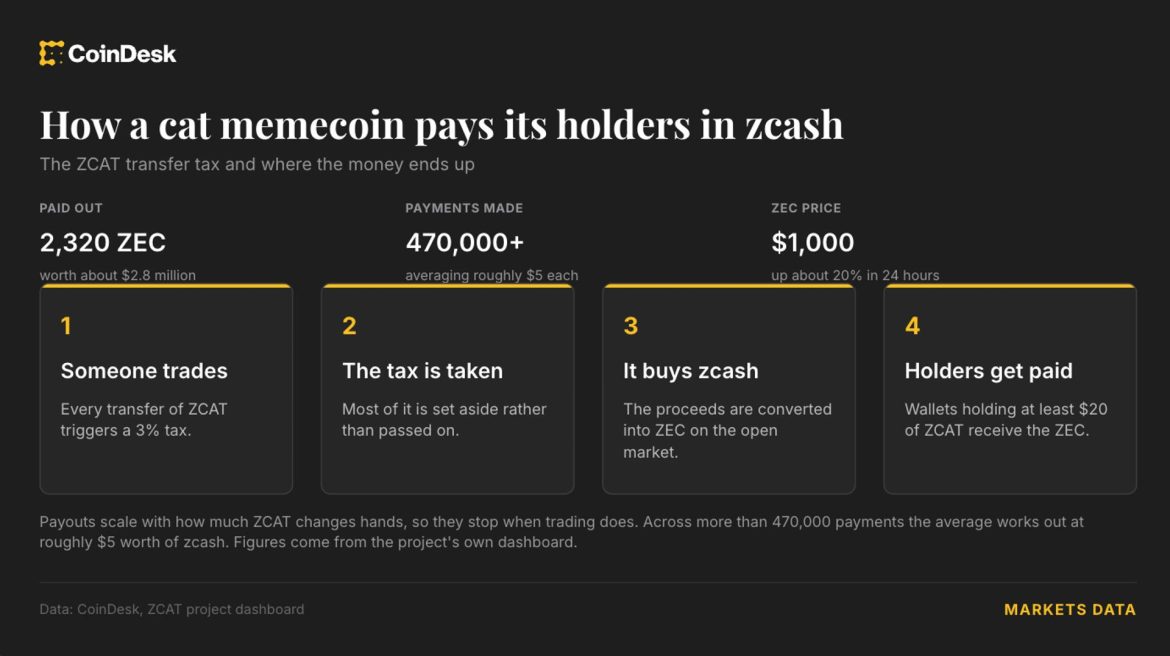
A brand new ZCAT token charges a 3% tax whenever the token moves and uses the proceeds to distribute ZEC to holders, creating an unusual link to one of crypto’s hottest assets.

 Live Chat
A brand new ZCAT token charges a 3% tax whenever the token moves and uses the proceeds to distribute ZEC to holders, creating an unusual link to one of crypto’s hottest assets.

I am William Dexu from Texas, USA. As a software engineer, I would like to share my real-life experience of achieving financial freedom through the FTmining cloud mining platform.
The shift from skepticism to trust
When I first encountered cloud mining last winter, I was—like many others—full of skepticism. “Can this really generate stable returns?” That question made me hesitate for a long time. After two months of in-depth research, I ultimately chose the FTmining platform. As a technical professional, I place great importance on a platform’s technical capabilities and operational stability. After a comprehensive evaluation, I was satisfied with FTmining across the board—particularly regarding security, transparency, and the stability of returns.
Three reasons to choose FTmining
Corporate Credibility:
FTmining is an innovative platform specializing in digital asset management and cloud computing services. It operates within UK and EU regulatory frameworks, adhering to principles of compliance, security, and transparency, while undergoing regular financial and security audits by third-party institutions.
Technical Capabilities:
The platform utilizes the latest generation of mining hardware to ensure a stable hash rate output. Even during periods of global hash rate fluctuation, my earnings have remained relatively stable—a testament to the platform’s technical reliability.
Fund Security:
The platform employs multiple security mechanisms—including bank-grade firewalls, cloud security certifications, multi-signature cold wallets, and an asset segregation system—to provide multi-layered protection for user funds.
Beginner’s Guide
Based on my experience, I recommend that newcomers follow these steps to get started:
Step 1: Easily sign up by visiting the official website: https://ftmining.com
Register an account to receive a $15 welcome bonus and experience the platform’s services without any initial investment.
Step 2: Convenient Deposits
The platform supports BTC, ETH, LTC, USDT, USDC, XRP, SOL, DOGE, and BCH, eliminating the need for cumbersome currency conversions and making deposits and withdrawals more convenient.
Step 3: Choose a Suitable Contract
The platform offers a variety of hash rate contracts, allowing investors to make flexible choices based on their available capital and investment preferences:
For more details about the contracts, please visit the official FTmining website.
Step 4: Automatically Earn Returns
Once the contract takes effect, the system operates automatically; investors can view their earnings in real-time via their personal dashboards and withdraw funds or reinvest at any time.
Professional Perspective
Economics Professor Dejan Horvat commented on this:
“This case illustrates a modern pathway for investing in digital assets. Participating in cloud mining through professional platforms enables individual investors to share in the dividends of the digital economy’s growth with lower barriers to entry and greater security.”
A new chapter in life
Today, this steady income has not only made my family life more comfortable but, more importantly, has given me the courage and freedom to pursue my dreams. I recently resigned from my job and have begun setting up my own technology company. Without this stable passive income, I might never have had the confidence to take that step.
Future planning
I plan to continue optimizing my investment portfolio while using a portion of the returns to support local blockchain technology education initiatives. I hope that by sharing my own experiences, I can encourage more investors in BTC, ETH, and USDT to understand and participate in the digital economy.
Closing Remarks
If you are considering trying cloud mining, my advice is to conduct thorough research and choose a reliable platform. Remember, building wealth is a gradual process. I hope my experience offers you some inspiration.
If you have any questions, you can contact FTmining through the following official channels:
Official Website: https://ftmining.com
Customer Service Email: info@ftmining.com
Storj filed for bankruptcy protection on Sunday. The company says its network still works and STORJ tokens still work. Its owner made similar promises nine months ago.
Storj now wants to hand token holders a slice of the rebuilt company. But a judge must approve that. And creditors get paid first.
Storj Labs filed in a federal bankruptcy court in West Virginia. The case number is 5:26-bk-00512.
Follow us on X to get the latest news as it happens
Chapter 11 is not a shutdown. It lets a company keep trading while a court helps it clear its debts.
Storj says those debts are old. They came from an earlier phase of the business. The company cannot grow its way out of them.
“The business underneath is strong and right-sized. What holds it back are legacy obligations from an earlier chapter.”
That was Kaloyan Raev, Storj’s director of software engineering. He also signed the letter to token holders, not Chief Executive Colby Winegar.
Nothing changes for the token today, Storj says. Data still moves across tens of thousands of storage locations in more than 100 countries.
The company plans to offer holders equity in the new Storj. Equity means part-ownership. The rules for who qualifies have not been written yet.
Those rules will matter. About 143.8 million STORJ trade freely out of 425 million in total. Two-thirds of the supply sits elsewhere.
Bankruptcy also has a payment order. Creditors come before owners. Storj’s letter to token holders admits it can promise intent, not results.
Inveniam Capital Partners announced it was buying Storj on Oct. 22, 2025. It promised no changes to contracts, pricing, or leadership.
“We’re particularly excited to integrate the STORJ token into our ecosystem, driving greater utility and alignment across our platforms.”
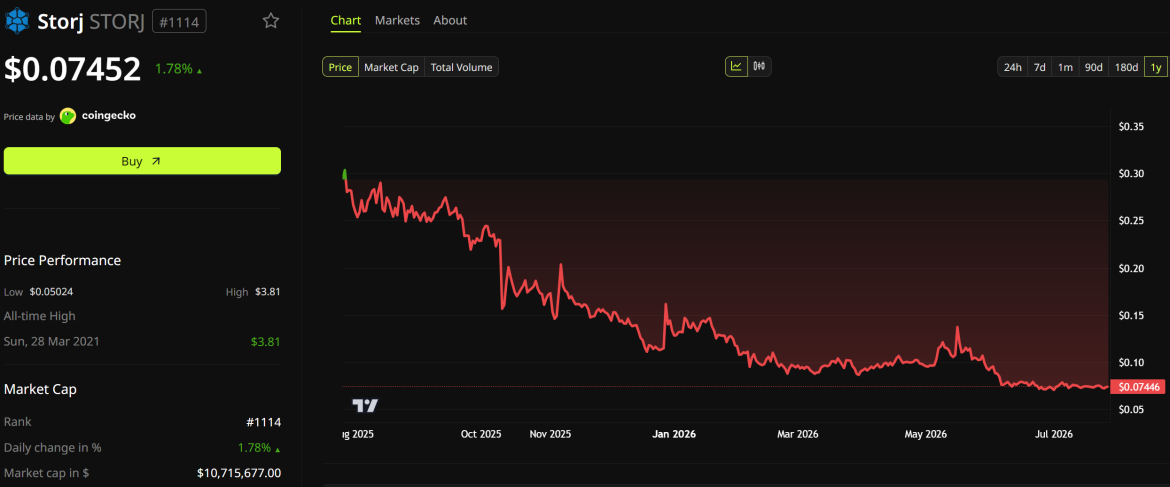
That was Patrick O’Meara, Inveniam’s chairman and chief executive. STORJ traded near $0.1872 that day. It has fallen about 60% since.
A closer warning came this month. MVMT Labs filed Chapter 11 in Delaware on July 15. Its Movement (MOVE) token hit a record low of $0.00964 ten days later.
STORJ has held up so far. It trades near $0.0745, up 1.5% on the day. Volume is $5.6 million and market value is $10.7 million.
The wider sector is soft too. Storage and infrastructure tokens have lagged even as network usage grew.
Storj says it will share court dates as they land. But the fine print of the equity offer will decide what holders actually get.
The post Storj Chapter 11 Raises the Biggest Question for STORJ Token Holders appeared first on BeInCrypto.
Dubai, United Arab Emirates, July 9th, 2026, Chainwire
Bybit, the world’s second-largest cryptocurrency exchange by trading volume, reported that Bybit’s Private Wealth Management (PWM) BTC fund products have recorded a comprehensive annualized return of approximately 4.9% over the past 60 days, with select individual funds delivering 30-day annualized percentage rates exceeding 40%. Through its BTC-invested, BTC-settled fund structure, Bybit PWM’s BTC strategies offers a more advanced allocation solution to users holding larger BTC positions.
Launched in September 2025, Bybit PWM manages over $239 million in assets across over 160 portfolios. In June 2026, Bybit introduced PWM 2.0, expanding direct dashboard access to eligible VIP2+ users and allowing PWM users to customize their wealth solutions with ease.
“BTC continues to trade well below its previous highs in the first half of 2026, leaving many BTC holders weighing how to manage their holdings through a period of volatility. Even for BTC faithfuls, the central question is often not whether to sell BTC for short-term liquidity, but how to keep BTC working while remaining exposed to the asset itself,” said Jerry Li, Head of Earn and Wealth Management at Bybit. ”Our BTC-denominated PWM funds and Earn products are built around that premise, enabling users to invest and settle in BTC while accessing yield.”
Bybit PWM products currently start from a minimum of 10 BTC, positioning the offering toward larger BTC holders. For users who prefer not to subscribe directly with BTC, some PWM funds can also be accessed through USDT, with the flexibility to gradually convert returns into BTC over time.
Beyond PWM, Bybit offers a broader set of BTC yield options intended to serve different types of holders:
No matter the market condition, Bybit’s offerings and diverse BTC strategies reflect an approach to balancing BTC accumulation and yield. Larger holders can pursue PWM’s fund-based allocation, holders with smaller positions can access on-chain yield through fBTC, and users with higher risk appetite can explore structured products such as Dual Asset and Discount Buy.
Terms and conditions apply. For more details on eligibility and potential restrictions, users may visit explore Bybit Earn and Bybit PWM.
#Bybit / #NewFinancialPlatform
About Bybit
Bybit is The New Financial Platform.
We believe every person should have access to every financial opportunity on earth. That’s why we’re building the first intelligent platform that connects anyone, anywhere to the world’s finance.
Trusted by more than 80 million users worldwide, Bybit brings together investing, trading, payments, and wealth-building in a single secure and intelligent ecosystem. Through the combination of AI-powered technology, deep global liquidity, robust security, and transparent operations, Bybit makes global finance more accessible, efficient, and empowering for everyone.
Built for everyone. Powered by intelligence. Open to the world.
Learn more at Bybit.com
For more details about Bybit, please visit Bybit Press
For media inquiries, please contact: media@bybit.com
For updates, please follow: Bybit’s Communities and Social Media
Discord | Facebook | Instagram | LinkedIn | Reddit | Telegram | TikTok | X | Youtube
Head of PR
Tony Au
Bybit
tony.au@bybit.com
Bitcoin
“ETF holders and corporate treasuries are buying 6-month and 1-year puts at $60k or below ($60,000 put, a derivative contract offering protection against potential price slide below that level) as portfolio insurance,” Jean-David Péquignot, chief commercial officer of derivatives exchange Deribit.
This put option works like insurance: It lets buyers sell bitcoin at $60,000 even if the price crashes lower, shielding ETF investors and corporate treasuries with BTC from steeper losses while they hold for the long haul.
Péquignot was responding to questions about surging interest in the $60,000 put. At the time of writing, those contracts had $1.50 billion in open interest – the highest across all strikes and expiries on Deribit. On the exchange, one contract represents one BTC. The platform accounts for nearly 80% of the global crypto options activity.
The surge in interest in $60,000 puts expiring in six months or longer signals deep fears that any price bounce could fizzle fast, paving the way for a sharper drop.
What makes this hedging even more noteworthy is that ETF holders and corporate treasuries own a significant supply of bitcoin.
Investors have poured billions into U.S.-listed spot bitcoin ETFs and similar products worldwide in recent years. The U.S. funds alone have seen inflows of 1.26 million BTC, roughly 6% of bitcoin’s total circulating supply. Meanwhile, publicly listed firms hold about 1.14 million BTC, or 5.7% of BTC’s supply.
Bitcoin has been trading choppy below $70,000, having hit lows near $60,000 early this month, CoinDesk data show. The cryptocurrency has gained nearly 5% since Wednesday to trade near $67,500, but the options market remains unimpressed, with puts continuing to trade at a significant premium to calls or bullish bets.
“While spot price climbed, the 25-delta risk reversal remained stubborn. 30-day puts are still trading at a ~7% volatility premium over calls, signaling that smart money is still paying up for downside protection rather than chasing the pump,” Péquignot said.
He added that volatility may pick up as prices drop below $63,000. That’s because dealers and market makers who create order-book liquidity are “short gamma” at $60,000 or lower.
This means that as prices approach $60,000, these entities may sell more to rebalance their overall exposure to neutral, inadvertently adding to downside volatility.

On-chain data shows the Bitcoin short-term holders continue to capitulate as they are realizing net losses of $0.48 billion every day.
According to data from on-chain analytics firm Glassnode, the Net Realized Profit/Loss has been negative for the Bitcoin short-term holders recently. This indicator measures, as its name suggests, the net amount of profit or loss that BTC investors are harvesting through their selling.
The version of the metric that’s of relevance here specifically tracks this for the short-term holders (STHs), a BTC investor cohort that includes only buyers from the last 155 days.
Statistically, the longer an investor holds onto their coins, the less likely they become to sell them in the future. Since the STHs represent the new entrants into the market, their resilience tends to be low, and they may take part in panic selling during market volatility.
Recently, Bitcoin has faced a major drawdown and the STHs have naturally reacted to it. Below is the chart shared by Glassnode that shows how the 7-day exponential moving average (EMA) of the Net Realized Profit/Loss has fluctuated for this group during the recent volatility.
As is visible in the graph, the Bitcoin STH Net Realized Profit/Loss saw a deep plunge into the negative territory during the price downturn that followed the October high, implying realized losses notably outweighed the profits. In January, the metric recovered toward the neutral mark as the market saw an uplift, but the price drawdown since the end of the month has again taken the indicator to a highly red level.
On February 6th, the STH Net Realized Profit/Loss fell to a value of -$1.24 billion per day, notably lower than the red peak observed last year. Since this low, the metric has risen a bit and today, it’s sitting at -$0.48 billion per day. “While the intensity has cooled, the broader regime still signals a market under pressure, with participants in the base formation phase continuing to capitulate,” explained the analytics firm.
In some other news, the Bitcoin Coinbase Premium Gap has been negative recently, as highlighted by CryptoQuant author IT Tech in an X post.
The Coinbase Premium Gap tracks the difference between the Bitcoin spot price listed on Coinbase (USD pair) and that on Binance (USDT pair). From the chart, it’s apparent that the metric has maintained at red values since mid-December, indicating that Coinbase users have been applying a higher amount of selling pressure than Binance traders.
Coinbase is mainly used by US-based investors, especially the large institutional entities, so this trend can be a sign that there isn’t much demand for BTC among them right now.
Bitcoin has been slipping deeper as its price is now trading around $64,000.
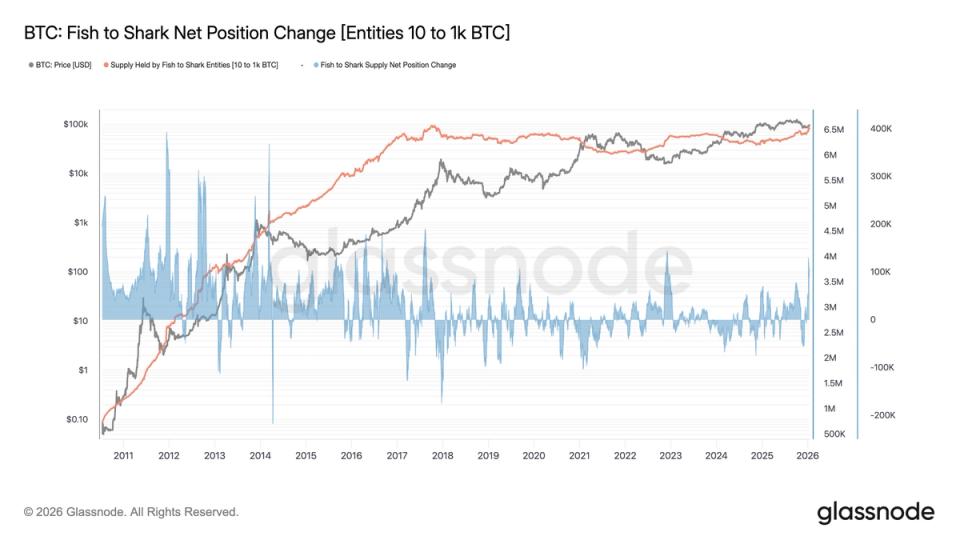
The so-called Fish-to-Shark cohort added 110,000 BTC over the past 30 days, according to Glassnode.

Bitcoin long-term holders showed early capitulation as LTH SOPR dipped below 1.0, signaling some six-month-plus holders sold at a loss.
Bitcoin (BTC) is showing early signs of strain among long-term holders as the LTH SOPR (Spent Output Profit Ratio) recently fell below 1.0, signaling that some holders are starting to sell at a loss.
While isolated, this move reflects growing uncertainty in the market as BTC trades near $92,000 amid mixed technical signals.
This development is significant because those holding BTC for more than six months have historically provided stability during price corrections. Their tentative selling could hint at short-term weakness or a shift in sentiment following months of accumulation.
The Long-Term Holder SOPR measures whether BTC moved on-chain is being sold at a profit or loss. A value above 1.0 indicates profit-taking, while a drop below 1.0 signals capitulation, where holders sell at a loss.
According to analysis shared on January 13 by market watcher Darkfost, the metric for Bitcoin held for more than six months briefly slipped under this threshold. This behavior, they said, is typically associated with bear market phases and points to selling pressure from “younger” long-term holders who bought within the last 9 months and are now in the red.
This development is happening alongside a notable reduction in positions by large investors. As previously reported, addresses holding between 1,000 and 10,000 BTC have parted with 220,000 BTC over the past year, the fastest rate of decline since early 2023.
While the 30-day average LTH SOPR remains positive at 1.18, it sits well below the annual average near 2.0, reflecting an overall drop in realized profits.
The market now presents a clash of narratives. The LTH SOPR hints at strain, but other analysts are pointing to potentially constructive technical patterns. Chartist Egrag Crypto highlighted a “hidden bullish divergence” on Bitcoin’s weekly chart, where price forms higher lows while the RSI momentum indicator makes lower lows, which can precede trend continuation.
Furthermore, the Sell-Side Risk Ratio, a measure of the scale of profits and losses being realized, has returned to levels last seen in October 2023, implying distribution is happening with less conviction.
Looking ahead, the path for BTC appears contingent on a clear break from its current range. Over the past week, it has traded between roughly $90,000 and $92,400, showing modest volatility. In the last 24 hours, the price rose 1.7% to around $92,200, with short-term holders nearing profitability, as noted by investor CW.
Meanwhile, analysts suggest that reclaiming the $92,000–$94,000 zone could trigger renewed buying, but repeated resistance attempts, potentially the eighth or ninth in recent weeks, per Ted Pillows, may exhaust momentum.

Nexo has launched a zero-interest crypto lending product that allows Bitcoin and Ether holders to borrow against their assets through fixed-term loans.
According to a company announcement, the product, called Zero-interest Credit, offers fixed-term loans for users who hold Bitcoin (BTC) and ETH (ETH), with repayment conditions set in advance. Loans are settled at maturity and can be repaid using either stablecoins or collateral, depending on market conditions.
The offering expands a structured lending model that had previously been available only through Nexo’s private and OTC channels, where it facilitated more than $140 million in borrowing during 2025, according to the company.
Borrowers choose the loan size and duration up front, with terms that prevent liquidation before maturity and define the repayment range. At the end of the term, loans can be settled using either stablecoins or collateral, with the option to renew under new terms.
Nexo is a crypto financial services company founded in 2018 that offers crypto-backed loans, trading and savings services to users across 150 jurisdictions.
In April 2025, the company said that it would reenter the US market after withdrawing in late 2022 and settling a case with the Securities and Exchange Commission for $45 million in early 2023.
Related: Babylon receives $15M from a16z Crypto to expand Bitcoin-native lending
Crypto lending has evolved significantly since 2022, when companies such as Celsius and BlockFi were widely blamed for amplifying market contagion and deepening the fallout from the FTX collapse.
In 2025, centralized lenders including Nexo, Ledn, Xapo Bank and Coinbase expanded their crypto lending offerings under more conservative, fully collateralized structures, while decentralized finance (DeFi) protocols also recorded strong growth.
According to DefiLlama data, DeFi lending products grew from about $48.15 billion in total value locked (TVL) on Jan. 1, 2025, to a peak of $91.98 billion on Oct. 7, 2025.
Although the market trended lower following the Oct. 10 crypto liquidation event, activity stabilized in November and total value locked (TVL) currently stands at around $66 billion.
The DeFi lending market is led by Aave, with more than $22 billion in outstanding loans backed by over $55 billion in deposited assets, according to DefiLlama data.
Morpho ranks second, supporting roughly $3.6 billion in outstanding loans backed by about $10 billion in supplied liquidity.
Magazine: How crypto laws changed in 2025 — and how they’ll change in 2026
Solana exhibits an on-chain pattern that appears bearish at first glance but becomes constructive when considered alongside capital flows into regulated investment products.
Over the past month, early Solana holders, investors who accumulated during quieter market phases, have begun moving older coins back into circulation.
For context, Arkham Intelligence analyst Emmett Gallic reported on Oct. 30 that a long-dormant Solana address had recently transferred 200,000 SOL, worth roughly $40 million, to Coinbase Prime. Usually, such transactions often spark concern that a major holder is preparing to sell.
In fact, CryptoQuant data reinforced that perception, showing that large wallets have recently dominated average spot trade sizes on major exchanges. This indicates that older, better-capitalized investors were distributing their holdings into stronger positions.

That behavior isn’t inherently bearish. Across Bitcoin, Ethereum, and Solana, veteran investors tend to sell when liquidity improves, rather than when markets are illiquid.
However, what sets the current cycle apart is the new class of buyers absorbing that supply.
CoinShares’ weekly digital asset fund report indicates that Solana-focused products have garnered approximately $381 million in inflows for the month, bringing their year-to-date flows to roughly $2.8 billion.
That placed Solana behind only Bitcoin and Ethereum as one of the top-performing crypto assets among institutional products, despite the significant market pullback that wiped more than $20 billion from investors’ earlier in the month.
Moreover, this shift has coincided with the debut of several new US-listed Solana investment vehicles.
Indeed, Grayscale’s Solana Trust (ticker: GSOL), which converted into an exchange-traded format on Oct. 29, recorded a modest $1.4 million in first-day net inflows, according to SoSoValue data.
A day earlier, Bitwise’s Solana Staking ETF (BSOL) saw a far stronger debut with $69.5 million in inflows, followed by another $46.5 million on Oct. 29. In fact, trading activity has mirrored that enthusiasm, with BSOL recording $57.9 million in day-one volume and over $72 million the following day.

Considering this, Bloomberg ETF analyst Eric Balchunas described the performance as “a strong sign of institutional demand” for Solana-linked products.
The changing ownership dynamics are strengthening Solana’s market structure rather than weakening it.
While old wallets have been distributing coins, those sales are being absorbed by regulated ETFs and institutional buyers with longer investment horizons. That reduces short-term speculative churn and anchors more stable, programmatic demand.
Price-wise, that handoff helps explain why SOL has held within a $180–$200 range even as broader crypto volatility has risen.
Instead of sharp selloffs, the token has shown controlled consolidation, suggesting that newly created ETF shares are being absorbed faster than they reenter the exchanges. Inflows from Bitwise’s BSOL and Grayscale’s GSOL act as a continuous liquidity sink, effectively tightening the available float in spot markets.
At the same time, the increase in open interest, up from under $8 billion to around $10 billion, has deepened Solana’s derivatives market.

That additional liquidity provides large holders with room to de-risk their positions without triggering outsized price reactions. Together, the two trends create a cushion against volatility: liquidity is broadening even as ownership concentrates among long-term vehicles.
If sustained, this pattern supports a more mature phase of price discovery.
SOL may continue trading sideways in the near term, but with less downside pressure and a more supportive base for future rallies.
However, the key risk is that the ETF inflows will fade below roughly $100 million weekly, while long-term holders continue to distribute. That imbalance could flip the equation, pushing SOL back toward exchange supply and weakening price stability.


