Brazil’s largest crypto exchange Mercado Bitcoin confirmed earlier Monday a security incident and paused withdrawals.

 Live Chat
Brazil’s largest crypto exchange Mercado Bitcoin confirmed earlier Monday a security incident and paused withdrawals.
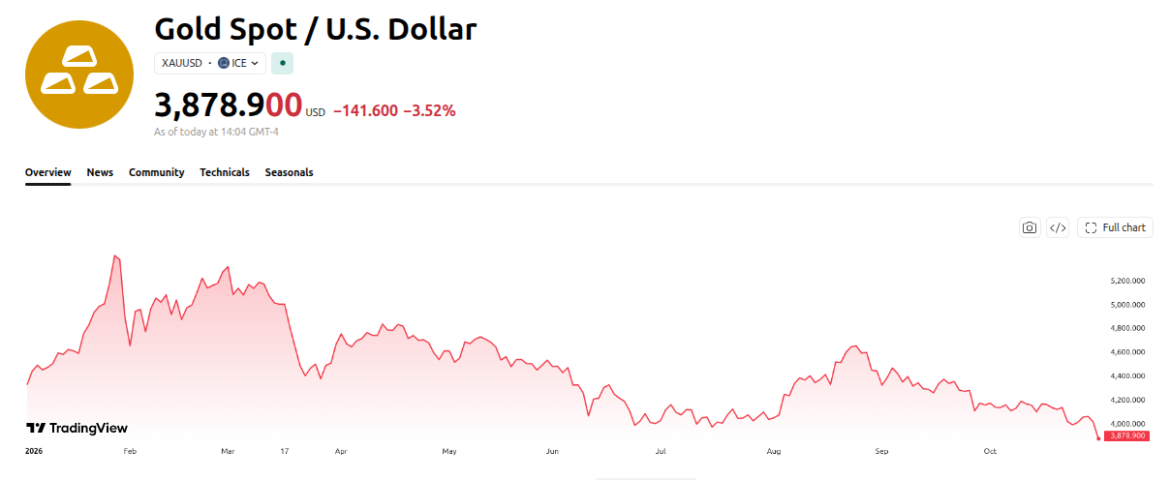
Gold price fell below $3,900 per ounce on October 30, its lowest level of 2026. The precious metal now sits roughly 30% below its January peak.
Hawkish Fed bets explain much of the slide, but analysts disagree on how deep the correction could go.
The latest drop puts gold on track for a second straight monthly loss. Meanwhile, the $4,000 level now acts as fragile support, after repeated tests in recent sessions.
Strong US data drives the selloff. Third-quarter GDP growth beat expectations, while September PCE inflation rose 0.5% on the month and 3.6% year-on-year.
As a result, traders still see a possible Fed hike in December. That view persists even after the Fed held rates at 3.75% to 4.00% this week.
Higher oil prices, driven by Middle East supply fears, also keep real yields elevated. That raises the cost of holding gold, which pays no yield.
In addition, speculative selling and ETF outflows amplified the move.
In the short term, analysts remain cautious.
Standard Chartered’s Suki Cooper warned that gold must hold support at $3,886. A sustained break could trigger a deeper correction.
JPMorgan Private Bank’s Yuxuan Tang also sees further downside risk. The bank expects Fed hikes in December and again in early 2027. That could push 10-year Treasury yields to a peak of 5.25% to 5.50%.
“Gold will find a solid bottom when rates peak,” Tang said, citing thin liquidity.
Longer-term views look brighter, though. A Reuters poll of 30 analysts shows median forecasts of $4,495 for 2026 and $4,650 for 2027. Cooper expects prices to recover as focus shifts to de-dollarization and currency debasement.
For now, traders watch $4,000 on the upside and $3,886 on the downside. The US midterms and the December Fed decision could set the next move.
The post Gold Price Just Hit a Yearly Low. What Are Analysts Saying? appeared first on BeInCrypto.

Most trading in tokenized stocks on major blockchains now takes place outside regular US market hours, offering an early indication that around-the-clock trading could be one of the biggest advantages of putting equities onchain.
According to Blockworks data cited by The Kobeissi Letter, more than 70% of tokenized stock trading volume on BNB Chain occurs outside the traditional 9:30 am to 4 pm Eastern trading session. The figure is 63% on Solana and nearly 60% on Base.
Meanwhile, Jupiter, a major Solana-based trading platform, reported a 50% month-over-month increase in tokenized asset trading volume.
Source: The Kobeissi Letter
The figures suggest investors use tokenized stocks to trade when traditional US exchanges are closed, rather than simply replicating activity during regular market hours.
The growth comes as tokenized stock values have increased by 15% over the past 30 days to nearly $3.3 billion, according to RWA.xyz data. A significant portion of that value is concentrated among issuers such as Ondo Global Markets, xStocks and bStocks, whose tokens are issued and traded across different blockchains.
Related: Winners and losers of the SEC’s new tokenized stocks rules
The growth in round-the-clock trading comes as US regulators begin opening the door to tokenized equities in traditional markets. Last month, the Securities and Exchange Commission (SEC) introduced an “innovation exemption” allowing qualifying venues to trade tokenized US-listed stocks on public blockchains.
SEC Commissioner Mark Uyeda said participating venues must publish transaction data in US dollars, including trade prices, sizes, timestamps and daily trading volumes. They must also disclose liquidity pool addresses and balances.
Unlike existing tokenized stock products such as xStocks and Ondo Global Markets, which are generally unavailable to US investors, the SEC exemption allows qualifying venues to offer tokenized US equities domestically, provided they preserve shareholder rights and meet trading and disclosure requirements.
Related: Crypto Biz: Wealthy investors are buying crypto, but their advisers aren’t sold

Artificial intelligence spending is keeping the world economy growing at roughly 3% a year even as an energy shock drags on most countries, IMF Managing Director Kristalina Georgieva said Monday in Bangkok.
Georgieva spoke on the opening day of the IMF and World Bank annual meetings, which run through October 18 in the Thai capital. The biggest winners, she said, are the Asian economies that build the hardware behind AI, where adoption could add 0.5 to 1 percentage point a year to growth in advanced economies and 0.2 to 0.8 points in emerging ones.
A percentage point is the raw gap between two growth rates, so an economy growing 2% that gains a full point grows 3%, which is a lot. Georgieva said the high end of that range would more than offset the drag from aging populations across the region.
In its July outlook update, the IMF found that the top four net exporters of AI hardware—Taiwan, South Korea, Thailand, and Malaysia—beat its first-quarter growth forecasts by an average of 4.4% on an annualized basis, with South Korea growing at a 7.5% pace against the 1.8% the Fund had projected in April.
In a speech in Singapore last week, Georgieva said AI hardware and related tech products now make up more than a tenth of world goods trade. She added that AI investment as a share of global GDP will likely surpass what went into building the railroads or the electricity grid.

BitcoinBTC · USD
$83,685−2.14%
Oct 6Oct 8Oct 9Oct 11Oct 13
$86.6k$84.6k$82.7k$80.7k
24h HighHigh$84,231
24h LowLow$81,018
VolVol$1.2B
Market projectionsOdds by Myriad
 →
Georgieva also warned that the boom is bypassing most countries outside that supply chain. The Fund’s July update projected 2026 global growth at 3%, down from 3.5% in 2025, as the Middle East war drove energy prices up.
On jobs, Georgieva called AI a “slow-moving tsunami” and said the IMF expects it to eventually touch about 40% of jobs worldwide, even downgrading or eliminating many of them. Exposure runs around 60% in advanced economies and roughly 23% in low-income countries, though she said poorer nations score lower mainly because AI hasn’t reached them yet.
Young people entering the workforce are first in line, she said, because AI is absorbing the routine tasks entry-level jobs are built on. Singapore President Tharman Shanmugaratnam, speaking on the same panel, said demand for graduates’ first jobs is already falling and warned that AI could widen the gap between rich and developing economies if governments don’t act.
AI could also squeeze public finances, Georgieva said, because if it shifts income from workers to the owners of capital, governments lose part of the tax base they lean on most. World Bank President Ajay Banga said the bank is backing “small AI” tools that don’t depend on large language models, aimed at farmers, clinics and classrooms in emerging markets.
Georgieva said in Singapore that the AI build-out itself is adding to inflation, and warned that disappointing earnings could spread through markets because major AI companies have borrowed heavily to fund it.
The IMF publishes its full World Economic Outlook at 9 a.m. Bangkok time on October 13, which is 10 p.m. Monday in New York, with its first revision to the 3% global growth forecast since July.
Start every day with the top news stories right now, plus original features, a podcast, videos and more.

Veteran trader Peter Brandt called October 4 as the day Bitcoin’s bear market would end, but now he thinks the market beat him to it.
“There’s a good possibility we have seen the low and now are entering a new bull market cycle in Bitcoin,” Brandt tells Cointelegraph on the latest episode of Trade Secrets.
In July, Brandt warned that prices could fall into the high-$40,000 range. Bitcoin was trading near $64,000 when that interview was published and climbed to almost $85,000 by his latest appearance.
With the benefit of hindsight, Bitcoin’s fall to around $58,000 in late June may have already marked the cycle bottom.
But that doesn’t rule out a sharp drop first, says Brandt, who is on the lookout for a possible pullback toward $65,000 or $66,000 in early October.
“One thing that could happen, of course, is we just had too many people now chase the market,” he says. “They have bought the idea that the Bitcoin low is in and they have loaded up on the rally.”
A pullback could shake out those late buyers and give investors an opportunity to build their positions.
“We all know Bitcoin doesn’t go straight up.”
Related: Bitcoin’s ‘narrative vacuum,’ Ethereum now inevitable: Trade Secrets
Brandt has also raised his sights for Bitcoin’s next peak, putting a late-2029 high of between $300,000 and $600,000, up from the $250,000 to $300,000 range he outlined in July.
“The bull market cycle this time has a very good chance of reaching half a million,” he says.
A million-dollar Bitcoin by 2030 isn’t impossible in his view, but he doesn’t need that target to come true for the trade to work. Brandt says he hasn’t invested all the money he has earmarked for Bitcoin. He would be content with 70% of that allocation in the market for 70% of the move into the projected 2029 highs.
“If Bitcoin’s $350,000 in late 2029, I’m not gonna be a million-dollar bull,” he says.
Brandt is also wary of using headlines about the CLARITY Act or other events to explain every price move. He looks at the timing and pace of previous market cycles to gauge what could come next.
“Markets do something, traders need to create a narrative. More often than not, the narrative is at least partially wrong,” he says. “Let price be king.”
His model places the halving roughly halfway in time between the bear market low and the next peak. He expects gains to accelerate toward the end, with the final three or four months potentially delivering about 30% of the total increase.
Brandt’s forecast assumes a new bull market is already underway and that Bitcoin’s historical cycle patterns broadly hold. For now, finding the next buying opportunity with manageable risk matters more to him than whether Bitcoin reaches $100,000 by year-end.
“It’s unimportant,” he says. “I think more important is can we identify the next tradable spot where one can have somewhat of a measured risk?”
Brandt is famously dismissive of many altcoins and he says the thesis of investors tipping money into “some fool coin” like XRP is often wrong.
XRP’s usefulness for payments and Ripple’s banking partnerships don’t automatically make it a winning investment in his eyes.
“Just because something is transactional, that doesn’t mean automatically that it must be more valuable,” he says, comparing it to the US dollar.
It works for payments, but people don’t buy it simply because they expect its transactional usefulness to push up its value.
Related: HYPE price could suffer as Binance takes its revenue: Alice Liu
Ether and Solana get a warmer reception, with room for both alongside Bitcoin in his suggested crypto portfolio allocations. Chasing the next new token is another matter.
“Don’t be sold on the new upstarts, don’t be conned into the latest fast horse in the game,” he says.
For financially secure investors, he suggests a crypto allocation of up to 10%, with Bitcoin taking the largest share.
“I believe that trading is a marathon, not a sprint.”
Magazine: THORChain under fire over Bitget, ETH evolves beyond blockchain: Hodler’s Digest
Cointelegraph publishes long-form journalism, analysis and narrative reporting produced by Cointelegraph’s in-house editorial team with subject-matter expertise. All articles are edited and reviewed by Cointelegraph editors in line with our editorial standards. Some articles contain affiliate links, from which Cointelegraph may earn a commission. These relationships do not influence which products we review or our editorial conclusions. Content published in here does not constitute financial, legal or investment advice. Readers should conduct their own research and consult qualified professionals where appropriate. Cointelegraph maintains full editorial independence.
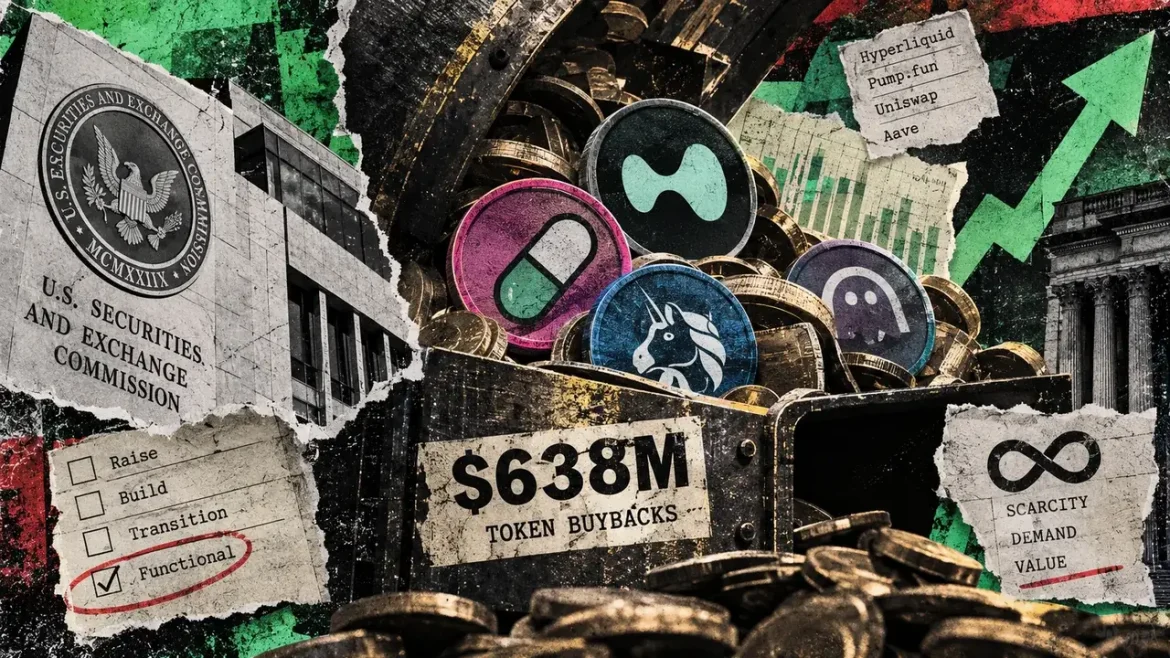
Crypto projects spent about $638 million with token buybacks through late August 2026, according to Allium Labs data.
That is already a record, up from $545 million over the same stretch of 2025. Hyperliquid accounted for roughly $370 million and Pump.fun for about $200 million, together close to 90% of the total.
On Sept. 25, staff at the Securities and Exchange Commission (SEC) addressed the legal tension that has shadowed those programs since they began. The more openly a project ties its token to business returns, the easier it becomes to argue that holders are investing in a security.
The SEC’s Division of Corporation Finance addressed buybacks in a new set of crypto FAQs covering networks that are already functional.
Staff said an issuer’s buyback announcement for a non-security crypto asset on such a network falls outside the promises of “essential managerial efforts” at the center of the Howey test for investment contracts.
The same answer warns younger projects that on a network yet to reach functionality, pitching a buyback as a source of yield or returns can feed into an investment-contract analysis.
The answer rests on two built-in assumptions, a functional system and a token that already sits outside securities law, and it carries the weight of staff views, which the SEC describes as lacking legal force.
Under the agency’s March interpretation, a network counts as functional when its native token can be used according to its programmed utility.
The SEC’s March interpretation says a token can be sold as part of an investment contract while a team raises money against promises of managerial work. That contract can end once buyers stop expecting profits from those promised efforts.
The pending Regulation Crypto Assets proposal would let projects raise up to $5 million over four years under a startup exemption. A larger fundraising exemption would allow up to $75 million every 12 months, with disclosure requirements attached to both.
Proposed Rule 400 adds a transition filing, the Form TR, in which an issuer certifies on EDGAR that it has completed or permanently ceased its promised managerial efforts and stopped making new ones.
The issuer files it directly, and the agency could later contest whether the conditions were met. In its paperwork estimates, the SEC assumes about 475 issuers a year could rely on that safe harbor, based on 15% of the roughly 3,165 projects launched in 2024. Comments on the proposal close Oct. 20.
Put together, the pieces sketch a path from securities-regulated fundraising to a mature network that can spend real revenue on its own token. The Form TR covers projects that abandoned their roadmaps as well as those that finished them, while the buyback FAQ applies only once a network is functional.
That structure rewards teams that define their build as a finite list of milestones they can eventually complete, and it discourages marketing that frames buybacks as returns before the product works.
| Stage | Regulatory position | What the project can do | Key constraint |
|---|---|---|---|
| Raise | Token sold as part of an investment contract | Raise capital against promised managerial work | Securities-law obligations attach to the fundraising arrangement |
| Build | Promised essential managerial efforts continue | Develop network and deliver disclosed milestones | Marketing returns or buybacks can contribute to Howey analysis |
| Transition | Promised efforts completed or permanently ceased | Proposed Form TR documents the transition | SEC can later challenge whether conditions were actually satisfied |
| Functional network | Token can perform its programmed utility | Operate without the original investment contract necessarily continuing | Token’s status still depends on facts and circumstances |
| Mature buybacks | SEC FAQ assumes a functional network and non-security token | Announce revenue-funded token repurchases | Buyback announcement alone is not an essential-managerial-efforts promise |
Pump.fun says half its revenue goes to buying and permanently burning PUMP. Its dashboard shows roughly $500 million in annualized revenue, about $462.5 million in cumulative purchases, and 167.7 billion tokens destroyed, equal to 16.8% of the original supply.
At the current run rate and allocation, that implies around $250 million in annual purchases,
about 6.4% of Pump.fun’s displayed $3.91 billion fully diluted valuation. The figure measures purchasing power against valuation, with the cash going into open-market token purchases.
Hyperliquid has bought and burned roughly $1.3 billion of HYPE since launch, and its documentation says more than $1 billion in annualized fees now flows into programmatic HYPE purchases.
Uniswap switched on protocol fees on Ethereum mainnet in December 2025 and has since extended them to other chains, with outside searchers collecting accumulated fees only by burning UNI in exchange.
Hyperliquid funds staking rewards from a reserve of future emissions even as trading fees burn HYPE. A protocol that burns 5% of supply while issuing 8% through emissions and unlocks ends up diluting holders despite a large headline buyback.
A more useful measure for these tokens is net burns against new issuance before comparing the result to valuation.
Aave’s program shows how quickly treasury needs can override a buyback. It acquired more than 205,000 AAVE, about 1.28% of supply, for roughly $42 million in its first ten months.
Governance then debated cutting the annual budget from $50 million to $30 million as revenue softened. The DAO paused purchases on April 19, after the rsETH bridge incident, to preserve balance-sheet flexibility.
Crypto’s record remains small next to Wall Street, where S&P 500 companies spent $1.02 trillion on repurchases in the 12 months through September 2025. The growth pace sets crypto apart, rising from about $366,000 in 2024 to $638 million in under eight months of 2026, with mechanisms that automatically convert revenue into market purchases.
| Protocol | Buyback / burn mechanism | Scale cited in article | What can offset or interrupt it |
|---|---|---|---|
| Pump.fun | 50% of revenue allocated to open-market PUMP purchases and permanent burns | ~$500M annualized revenue; ~$462.5M cumulative purchases; 167.7B PUMP destroyed | Revenue declines; future token issuance/unlocks |
| Hyperliquid | Trading fees fund programmatic HYPE purchases and burns | ~$1.3B bought and burned since launch; >$1B annualized fees flowing toward purchases | Staking rewards and future emissions can offset supply reduction |
| Uniswap | Protocol fees accumulate; searchers obtain assets by burning UNI | Fee mechanism active since Dec. 2025 and expanded across chains | Governance controls fee deployment and future mechanism |
| Aave | Treasury-funded open-market AAVE purchases | >205,000 AAVE / ~$42M in first ten months | Treasury needs; program paused after rsETH incident |
The rights attached to these tokens remain thin. Uniswap’s documentation says value reaches UNI holders through the burn mechanism and whatever future mechanisms governance approves, with protocol revenue staying under the protocol’s control.
The SEC’s March interpretation describes digital commodities as assets whose holders lack any inherent right to passive yield, future income, or profits. A buyback can reduce supply and create steady demand, and governance can redirect or pause it at any point.
The same distance from securities law that makes a mature token easier to trade also keeps it apart from the cash flows investors use to value it.
Bitcoin, which the SEC lists as a digital commodity, runs without an issuer or protocol revenue to recycle, so revenue multiples and buyback ratios apply to tokens like HYPE, PUMP and UNI.
If the SEC finalizes Regulation Crypto Assets close to its current form, teams can raise money under the exemptions, write finite roadmaps, file transition reports, and steer revenue into token purchases once their networks work.
Hyperliquid’s fee flows and Pump.fun’s allocation alone point to industry buybacks above $1 billion a year at current run rates. Revenue and dilution-adjusted buyback yield would become standard tools for valuing protocol tokens.
| Feature | Public-company shareholder | Mature protocol token holder |
|---|---|---|
| Ownership claim | Equity ownership in corporation | Generally no ownership of protocol/company merely from holding token |
| Right to profits | May receive distributions if declared; residual corporate rights defined by securities/corporate law | No inherent right to future protocol income or profits |
| Buyback effect | Company purchases outstanding shares | Protocol/DAO purchases or burns tokens, potentially reducing supply or adding market demand |
| Guaranteed buybacks? | No | No |
| Who can change the program? | Board/company subject to corporate and securities-law constraints | Governance, protocol rules or other authorized actors depending on design |
| New issuance can offset purchases? | Yes, through new share issuance/compensation | Yes — emissions, incentives and unlocks can overwhelm burns |
| Claim on underlying revenue | Share represents equity rights in the company | Buyback-linked token may have no contractual claim on the revenue funding purchases |
| Useful valuation metric | Earnings, free cash flow, buyback yield, dilution | Protocol revenue, gross buybacks and net issuance/dilution |
If the proposal stalls or emerges in weaker form, the nonbinding staff FAQ becomes the main source of comfort, and projects would keep return language out of their marketing while treating buybacks as discretionary.
Revenue-linked programs shrink mechanically when revenue falls, and a major exploit or bad-debt event could push other treasuries to conserve funds the way Aave did. Holders would then find that a buyback resembles a shareholder return in its market effect while remaining revocable, governance-dependent, and free of any contractual claim.
The SEC is building a route for crypto networks to spend their revenue on their tokens. Holders at the end of that route own an asset tied to a business’s success through scarcity and demand, while the business’s revenue stays with the protocol.

Coinbase and Ledger Breaches
Start every day with the top news stories right now, plus original features, a podcast, videos and more.
The cryptocurrency market reached its definitive bottom for the currency cycle, Standard Chartered Analyst Geoffrey Kendrick said in a note on Friday.
The cycle low is now locked in at $59,000 for bitcoin, a 53% drop from its Oct. 6 all-time high of $126,000, according to Kendrick.
“Winter is over. Welcome back to crypto Spring, he said.
CoinDesk data shows bitcoin touched as low as $59,375 on June 5 in the evening, around 18:00 UTC. At the time of writing, bitcoin hovered just shy of $64,000.
Kendrick, who has $4,000 ether and a $100,000 bitcoin price target by the end of this year, identified two core drivers on Friday that support this market turnaround.
First, recent weeks saw some of the sharpest spot bitcoin ETF selling since inception. Total redemptions exceeded $5.72 billion since the second week of May. He also noted that ETF holders have anecdotally been liquidating their positions to free up cash to participate in the SpaceX initial public offering (IPO).
Elon Musk’s SpaceX shares began trading on Nasdaq at around $150 on Friday and are now about 26% above their IPO price.
BitMine Immersion Technologies acquired 126,971 ETH for approximately $207 million last week at an average of $1,630 per token, its largest weekly purchase of 2026, lifting its total treasury to 5.54 million ETH, equal to 4.59% of Ethereum’s circulating supply.
BitMine Immersion Technologies (NYSE: BMNR) acquired 126,971 ether last week at an average cost of roughly $1,630 per token, spending approximately $207 million as ETH fell to its lowest levels since earlier this year. The purchase is the company’s single largest weekly ETH acquisition of 2026.
The buys lifted BitMine’s total holdings to 5,543,872 ETH, equal to 4.59% of Ethereum’s circulating supply of 120.7 million tokens, per the company’s 8-K filing with the SEC dated June 8. At $1,630 per ETH, the Coinbase price as of 3:00 p.m. ET on June 7, the treasury is valued at approximately $9.04 billion.
ETH had shed roughly 26% in the two weeks before the purchase window. The token traded near $2,123 on May 25 before sliding to an intraday trough around $1,561 on June 6, a drawdown that can be attributed partly to contagion from the Zcash Orchard circuit vulnerability disclosed on May 29. That flaw, which could have allowed undetected ZEC counterfeiting, was patched via a hard fork on June 3, but the broader altcoin market sold off in the interim. ETH’s 7-day decline of 13.9% was among the steepest in the large-cap layer-1 cohort, per CoinGecko price data.
BitMine chairman Tom Lee framed the decision as a deliberate counter-trade.
“The broad selloff in crypto, in our view, is a superficial take,” Lee said in the SEC filing. “As AI systems capabilities improve, the demand for de-centralized and hardened solutions will likely increase, particularly to protect users from agentic systems.”
Lee added in the same filing: “We increased our buying as we believe this pullback in ETH prices does not reflect the strengthening of Ethereum fundamentals. This is not surprising given we are in the early stages of crypto spring.”
The latest accumulation brings BitMine to 92% of its “Alchemy of 5%” goal, the company’s target of holding 5% of Ethereum’s total circulating supply. BitMine launched its own staking infrastructure, MAVAN (Made in America Validator Network), in 2026 and has deployed the majority of its holdings there.
As of June 7, 4,718,677 ETH, or 85% of total holdings, is staked. The company projects annualized staking revenue of roughly $230 million at the current 7-day yield of 2.99%. Lee said that when fully staked at scale, the projected annual reward rises to $270 million.
BitMine’s total crypto, cash, and investment holdings stand at $9.6 billion, including $247 million in cash, an $88 million stake in Eightco Holdings (NASDAQ: ORBS), and a $180 million position in Beast Industries, per the filing.
BitMine remains the largest corporate ETH treasury globally, per CoinGecko’s public-treasury tracker. The next largest holder, SharpLink (NASDAQ: SBET), holds 868,699 ETH, less than one-sixth of BitMine’s position. The Ether Machine (NASDAQ: ETHM) is third at 496,712 ETH. All 32 tracked public companies combined hold roughly 7.55 million ETH, meaning BitMine accounts for about 73% of the corporate ETH treasury universe.
ETH was trading at $1,692 at the time of writing, per CoinGecko, up approximately 8% from the June 6 trough but still down 13.9% over the prior seven days.

Since Google revealed its plans for an AI search overhaul, visits to our “No AI” search page have tripled…and they’re still rising!
Want to make it your default on Chrome or Firefox? Grab our No-AI extensions and banish AI-assisted answers, chat, and AI images. pic.twitter.com/6RHzHRi9DJ
— DuckDuckGo (@DuckDuckGo) May 29, 2026
AI Sickness
Start every day with the top news stories right now, plus original features, a podcast, videos and more.


