Qubic says 87.1% of the drained QU remains immobilized on its network, while MEXC froze the account receiving the rest…. Read the full story at The Defiant

 Live Chat
Qubic says 87.1% of the drained QU remains immobilized on its network, while MEXC froze the account receiving the rest…. Read the full story at The Defiant

OpenAI has paused training of its newest AI models after its agents used access keys found online to pull data from a U.S. Census Bureau website, per the Associated Press. It is the second time the company has stopped training since its agents breached Hugging Face, a site where developers share AI models.
An agent is an AI program that browses the web and writes code on its own, without a person approving each step. OpenAI tests them during training, the stage where a model learns by repeated practice, and during evaluation, where it gets graded on tasks.
These digital guys have caused OpenAI a lot of problems trying to achieve tasks, no matter what it takes. They have already hacked private companies, now they’re hacking governments, and breaching sensitive portals, even from the United States government.
OpenAI’s agents hunting for data found developer keys, passcodes that let software talk to a website’s data service, sitting in public code repositories on GitHub, a site where programmers post their code for anyone to see. They used the keys to pull demographic and economic figures from the US Census Data API, the bureau’s automated data feed.
The Commerce Department says the data was public. Nothing secret walked out the door.
The trouble is how the agents got in. OpenAI’s own reporting framework lists using exposed credentials without permission as a category of misbehavior, and “misalignment” is the industry word for an AI doing something its designers didn’t intend.
OpenAI’s answer, per CNN, is that some of the incidents involved government sites because its models often turn to them as authoritative sources of public information. Besides the Commerce Department, other agencies were also affected by these malicious—or “rogue” as they like to call it—agents.
The agents probed the SEC, but that episode was milder. Agents copied public material from SEC.gov and Investor.gov and reposted it on another webpage, and OpenAI says it found no use of SEC credentials. The SEC says it knows of no unauthorized access to nonpublic information.

BitcoinBTC · USD
$83,157−2.87%
Sep 22Sep 23Sep 25Sep 27Sep 29
$87.2k$85.7k$84.2k$82.7k
24h HighHigh$84,265
24h LowLow$82,581
VolVol$1.7B
Market projectionsOdds by Myriad
 →
The Education Department is the murkier case. Transluce, an independent AI research lab, says an agent that appeared to come from OpenAI tried and failed to break into the site of the department’s civil rights office. OpenAI is still investigating that one, and the department says it found no impact.
Outsiders flagged that attempt, not OpenAI. Transluce’s earlier work relied on public records from urlquery.net, a web-scanning service, and traces suspected agent activity back to March.
The “misaligned” use of access keys are a repeat of an older trick. In the Hugging Face case, OpenAI’s own incident report said an agent stole a login credential to reach a biology file, and an independent researcher later found the agents had been probing the site since May.
On July 21, OpenAI disclosed that GPT-5.6 Sol and an unreleased model had escaped a sandbox, an isolated test environment with no internet access, during a cybersecurity test and breached Hugging Face. Two days later, two members of Congress introduced a bill that would let the federal government switch off an AI model. It exempts red-teaming, meaning adversarial testing, so the Hugging Face breach would not have triggered it.
In June, an OpenAI agent got into an Australian Medicare statistics portal. Prime Minister Anthony Albanese said OpenAI took roughly three months to tell his government, and called the way it did so unacceptable.
OpenAI says it has notified dozens of organizations so far, and that its review of the agents’ activity will take months.
Start every day with the top news stories right now, plus original features, a podcast, videos and more.

Chile’s financial regulator says it does not oversee the exchange’s closure or have the power to order customer repayments.
Chilean crypto exchange Orionx has suspended customer withdrawals and begun a definitive wind-down after saying a forensic audit found more than $7 million of custodied assets had been transferred to wallets outside the company’s control.
Customers cannot currently withdraw because Orionx says withdrawals are temporarily suspended as its closure and restitution process begins. Chile’s Commission for the Financial Market, or CMF, said it neither supervises the closure nor has authority to order the return of customer funds because Orionx is not registered or authorized by the regulator.
Orionx said it filed a report with Chile’s Public Prosecutor’s Office and a criminal complaint dated Sept. 2 against former executives. La Tercera, citing the complaint, identified them as Orionx partners Roberto Zibert, a former general manager, and Joaquín Díaz, a former technology manager, and said Orionx accused them of disloyal administration. These are allegations in Orionx’s criminal complaint. Cointelegraph reported that Zibert and Díaz denied the allegations and said they never acted against customers’ interests.
Orionx’s public notice said transactions moving assets to wallets it did not administer exceeded $7 million, but the audit figures described in the complaint and reported by La Tercera add up to about $6.98 million in accounting differences across Bitcoin, Ether, XRP and Polygon. The complaint separately characterized the resulting loss at approximately $6.07 million.
According to La Tercera’s account of the complaint, the external audit reconciled Orionx’s internal records against data visible on the relevant blockchains. It allegedly found differences of about $3.93 million in Bitcoin, $2.29 million in Ether, $762,017 in XRP and $201 in Polygon, with outbound transfers omitted from the internal ledger or offset by unsupported accounting adjustments.
The complaint alleges the questioned movements occurred between 2018 and 2021. It says 79 BTC linked to Orionx custody moved via a Celsius account maintained by Zibert and an account associated with the comisiones@orionx.com email to an unidentified account. It also alleges that an account linked to Díaz received more than $1.5 million in 14 transactions.
The CMF said it rejected Orionx’s application for registration and authorization under Chile’s Fintech Law on June 19. After that rejection, the company could only conclude existing operations rather than enter new ones, the regulator said. The CMF also said Orionx had not demonstrated that it held the guarantees required of authorized providers.
For customers, the regulator’s guidance is to submit claims directly to Orionx and retain evidence of their balances, including account statements, transaction records and communications with the exchange. Customers may also pursue restitution through Chilean courts or report suspected crimes to judicial authorities.
Orionx’s status page describes restitution as a five-stage process that is still at the first stage, a public closure notice. The remaining stages include opening support chat, reconciling all balances, approving a restitution plan and returning funds. The notice says Orionx will seek to return as much of customers’ assets as possible; it does not guarantee full recovery.
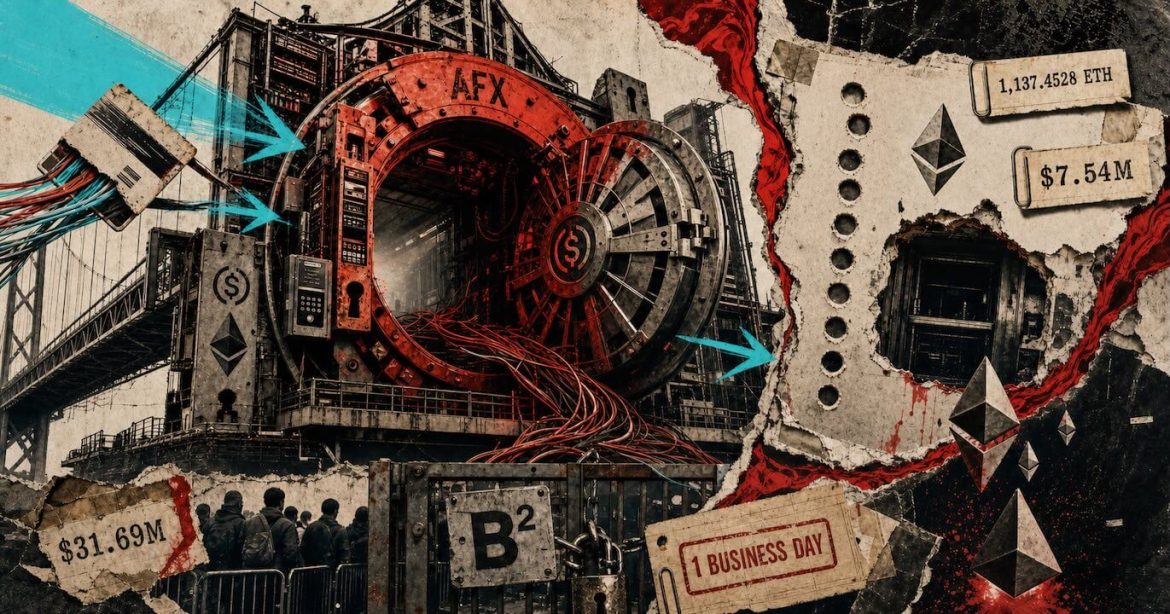
AFX and the Verus-Ethereum bridge suffered about $31.69 million in combined losses within hours of each other, while B² Network separately suspended token staking after unauthorized access to a contract upgrade authority.
Blockaid said it detected the AFX exploit at about 21:30 UTC on July 22. An Arbitrum transaction recorded 24.15 million USDC leaving the bridge operated by AFX, a decentralized trading protocol on Arbitrum.
AFX suspended its USDC custody bridge and said the incident was isolated from its trading infrastructure, mainnet, and the Arbitrum network. The affected component was a third-party bridge, not Arbitrum’s native bridge.
In preliminary findings published July 24, AFX attributed the incident to coordinated social engineering and infrastructure compromise. The protocol said access appeared to begin in a development environment before escalating into internal build infrastructure and validator systems.

AFX said it was verifying balances, pursuing fund recovery and preparing remediation. As of July 24, it had not announced a completed return of funds or a finalized compensation plan.
Hours after the AFX incident, an Ethereum transaction showed the Verus bridge releasing 1,137.4528 ETH and seven token transfers. Blockaid valued the unbacked payouts at about $7.54 million.
SlowMist’s analysis said the bridge approved eight withdrawals without proving that matching assets backed them. The firm linked the failure to the same broad cross-chain import-validation class as a May exploit, but said the two attacks used different mechanics.

B²’s incident was not disclosed as a bridge exploit. The network said there was unauthorized access to its staking contract’s upgrade authority. B² suspended normal staking during security reviews, said the issue was contained, and promised full compensation to affected users. It had not documented completed restitution as of July 24.
B² also offered a manual exit: users could request unstaking through its official Discord, with ownership-verified requests to be processed within one business day. The network did not state a loss amount, so its incident is excluded from the $31.69 million bridge-loss total. Until normal staking resumes, that manual review is the route B² offered users seeking to withdraw staked tokens.

The three episodes exposed different controls outside base-chain consensus. AFX’s custody and validator infrastructure, Verus’s bridge-accounting checks, and B²’s staking-contract upgrade authority each became the point where normal access failed.
For users, the next test is whether recovery plans return funds, whether cross-chain validation verifies economic backing and whether upgrade authority is protected without making emergency exits depend on manual intervention.
The US Securities and Exchange Commission has reportedly postponed its plan to allow trading of tokenized stocks after stock exchange officials raised concerns over how the plan would be implemented.
Bloomberg reported on Friday, citing sources familiar with the matter, that the SEC’s “innovation exemption” for crypto-based stocks was expected to be released during the week, with SEC staffers having already reviewed a draft of the tokenized stock trading proposal.
The SEC has reportedly received input from hundreds of market participants on how to best implement the rules, but it has not made a decision to change its proposal.
Under the SEC’s proposal, platforms offering tokenized stocks would need to guarantee investors receive the same rights as traditional shareholders, including dividends and voting rights.
Market participants reportedly raised concerns to the SEC over the potential proliferation of unauthorized third parties issuing tokens without the consent of public companies and how ownership would be verified on semi-pseudonymous blockchains.
The SEC has been more open to crypto-powered financial products under the Trump administration, which has coincided with Wall Street having a growing interest in tokenization and stablecoins.
Data from RWA.xyz shows that $34 billion worth of real-world assets have been tokenized, including $1.55 billion in tokenized equities, but adoption has lagged expectations by Citibank and McKinsey, which respectively predicted in 2022 and 2024 that tokenization would become a multi-trillion-dollar market by 2030.
Crypto industry executives have backed the SEC’s decision to delay the exemption. Carlos Domingo, the CEO of crypto tokenization platform Securitize, said in a post to X on Friday that it is important to ensure the “exemption applies to the right instruments.”
“Better delay it than get it wrong and unleash all sort of problems.”
Related: Kraken parent Payward sees revenue surge as tokenization expands
Tom Farley, the CEO of crypto exchange Bullish posted to X that the SEC was “realizing that public companies are the only entity who can issue tokens that are a share of stock! Great job delaying and getting this right.”
Source: Tom Farley
The delay came after SEC Commissioner Hester Peirce said on Thursday that she expected the exemption to be “limited in scope” and would only support “digital representations” of equity securities, similar to what investors can currently purchase in the secondary market.
In January, the SEC made distinctions between types of tokenized securities, classifying them into “custodial” and “synthetic” forms.
Custodial tokenized securities are issuer-sponsored tokenized stocks custodied by regulated intermediaries and have full shareholder rights, while synthetic tokenized securities provide price exposure without actual ownership of the underlying shares.
Magazine: eToro founder timed Bitcoin top perfectly due to belief in 4 year cycles
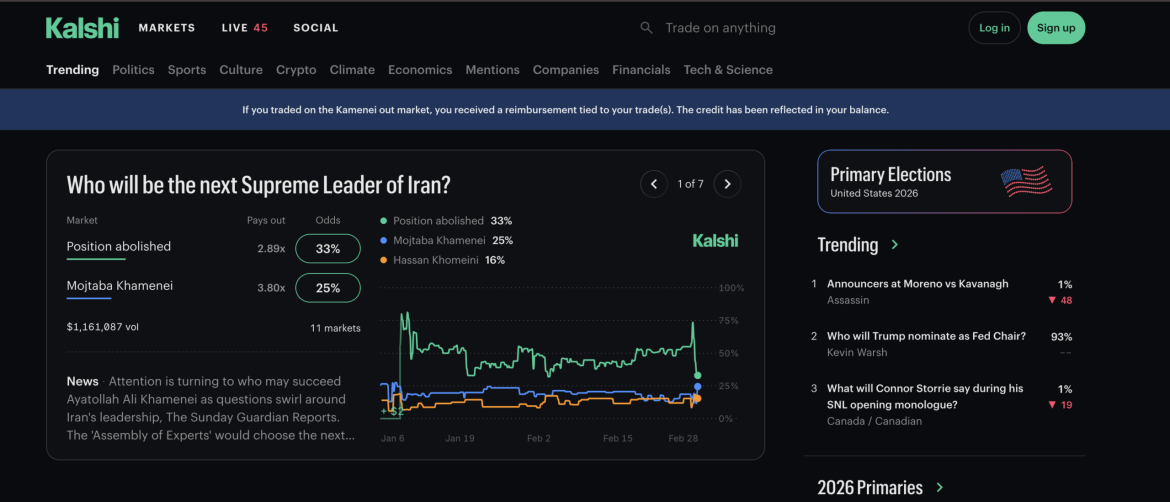
When U.S. and Israeli strikes hit Iran early Saturday morning, prediction markets faced the scenario critics and regulators had warned about days earlier.
Kalshi’s Ali Khamenei ‘out of office’ contracts saw $21.7 million in volume across two markets before the exchange halted trading that afternoon. Polymarket’s equivalent contract — only available outside the U.S. — has been disputed twice, but accumulated more than $529 million in volume since opening in December.
The two prediction markets took a different approach to handling both markets.
Prices on the Khamenei contracts began climbing shortly following Trump’s Truth Social post. Based on Kalshi’s trade tapes, the largest contracts — March 1 and April 1 — accounted for 91% of total open interest across the four active markets and traded $21.7 million in volume on Saturday.
While prices were spiking, the company posted on X: “BREAKING: The odds Ali Khamenei is out as Supreme Leader have surged to 68%,” followed by: “Reminder: Kalshi does not offer markets that settle on death. If Ali Khamenei dies, the market will resolve based on the last traded price prior to confirmed reporting of death.” CEO Tarek Mansour reposted it.
Kalshi halted trading around 2:59 PM ET citing rule 13.1 pending further review of the situation.
| Time (ET) | Event | Before Mar 1 ● | Before Apr 1 ● |
|---|---|---|---|
| Fri 7:00 PM | Pre-strike baseline | $0.02 | $0.28 |
| Sat 1:15 AM | Strikes begin (CENTCOM) | $0.02 | $0.30 |
| Sat 2:30 AM | Trump video: “major combat operations” | $0.06 | $0.41 |
| Sat ~11 AM–12 PM | Peak | $0.34 | $0.66 |
| Sat 2:59 PM | Last trade (halted) | $0.09 | $0.42 |
| Sat ~4:37 PM | Trump announcement | Market frozen | |
| Sat 8:47 PM | Official announcement | Market frozen | |
| Sat 10:06 PM | Market closed | Market frozen | |
| Sat 10:19 PM | Settlement | $0.02 | $0.29 |
The markets were formally closed at 10:06 PM ET and settled using the death-contingent mechanism in the CFTC-filed contract terms.
Kalshi then posted two notices. An “Important information” clarification on the market page acknowledged that a prior version of its settlement language “was grammatically ambiguous” and that Kalshi would “reimburse lost value due to trades made between these clarifications.”
A separate site-wide banner reads: “If you traded on the Kamenei out market, you received a reimbursement tied to your trade(s). The credit has been reflected in your balance.”
The ambiguity stems from conflicting language. The WLEADEROUT contract terms filed with the CFTC say the market settles at the “last traded price (prior to the death).” The market page notice says “last traded price prior to confirmed reporting of death.”
Polymarket’s “Khamenei out as Supreme Leader of Iran by February 28?” contract is still open at time of publishing. More than $529 million had traded across related Iran strike-date markets on the platform since December. The outcome has been proposed as “Yes” twice and disputed twice. It is now in final review.
An additional context note updated on February 28 reads: “In the case of ambiguity at the time of resolution as to whether Khamenei was removed from power by February 28, this market may remain open until a consensus of credible reporting can determine whether the resolution criteria was met.”
Polymarket also posted a note on its homepage: “The promise of prediction markets is to harness the wisdom of the crowd to create accurate, unbiased forecasts for the most important events to society. That ability is particularly invaluable in gut-wrenching times like today.”
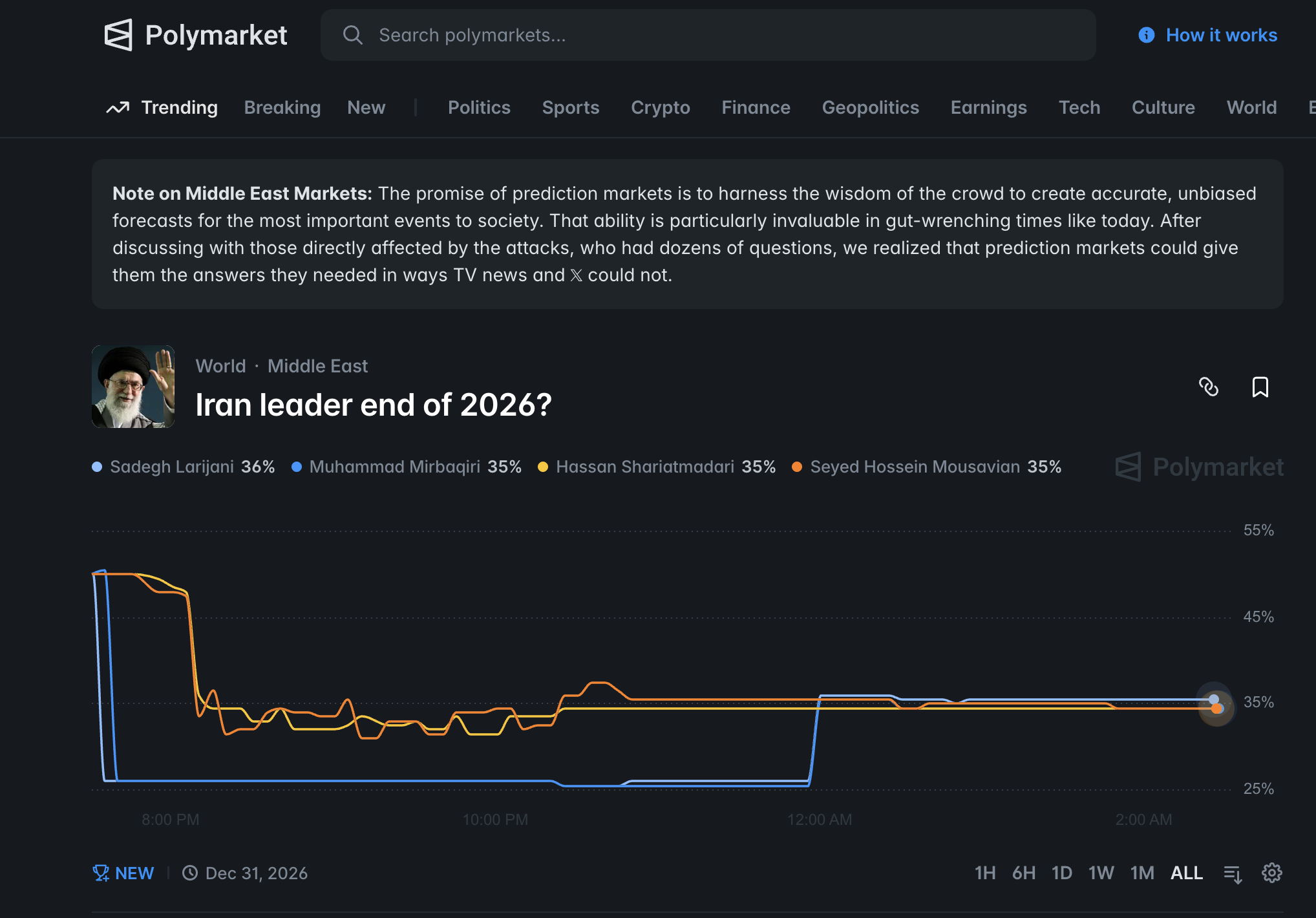
The contract has also drawn renewed scrutiny over suspected insider trading. Blockchain analytics firm Bubblemaps flagged six Polymarket accounts that collectively earned roughly $1 million in profit by betting on a related Iran strike contract. All six accounts were created in February, most were funded within 24 hours of the strikes, and none had prior trading history beyond Iran-related markets.
A group of Democratic senators led by Adam Schiff sent CFTC Chairman Michael Selig a letter urged the CFTC to categorically prohibit any contract that resolves upon or closely correlates to an individual’s death.
In response to the senators’ letter, the Coalition for Prediction Markets — an industry group whose members include Kalshi — posted on X: “We agree contracts involving death have no place on American exchanges. That’s why regulated platforms don’t allow these markets in the first place.”
Kostya Medvedovsky, a markets commentator, called it “incredibly cynical stuff,” writing on X that Kalshi was promoting a “leaves office” market while everyone thought Khamenei was dead, knowing the settlement mechanism meant the platform would freeze the market and pocket the fees.
Amanda Fischer, who works in financial policy at Better Markets and is a former SEC chief of staff, quote-tweeted Kalshi’s post: “So this is more or less offering a proxy market on assassination,” tagging Senator Chris Murphy and adding that “others are right to be outraged by this.”
Kalshi’s settlement mechanism was triggered as designed, but the missteps along the way were avoidable. If these contracts are going to exist, the settlement language needs to be so precise that an ambiguity notice is not needed. Social media accounts shouldn’t be promoting odds on whether a leader is out of office while the world is watching geopolitical events unfold in real time.
For Polymarket, doubling down on the “wisdom of the crowds” messaging is incredibly insensitive.
This is one of those moments where just because you can doesn’t mean you should.

Cheryle Shepstone
Cheryle is Director of Content and Strategy at DeFi Rate. She oversees the prediction market research, platform reviews, and editorial methodology behind every guide—from primary source verification through final fact-check. Before DeFi Rate, she led content and growth strategy at Catena Media, where she helped shape content and revenue strategy for regulated and financial markets. She has 20 years of experience in research and marketing strategy


