NEAR’s House of Stake passed HSP-029, which lowers the network’s maximum annual issuance rate from 2.5% to 1.6% over 24 months.

 Live Chat
NEAR’s House of Stake passed HSP-029, which lowers the network’s maximum annual issuance rate from 2.5% to 1.6% over 24 months.

Cardano’s onchain governance system has approved a new round of treasury allocations aimed at infrastructure and ecosystem development, giving the network another live test of its Voltaire-era decision process.
The important part is not only where the ADA goes.
It is how the decision gets made.
Cardano has spent years building toward a model where ecosystem funding and protocol decisions are increasingly handled through formal community governance.
The latest allocations put that framework to work.
Approved funding is aimed at core infrastructure and developer-focused initiatives, with disbursement structured around milestones rather than one unconditional transfer.
That approach is designed to give governance participants more oversight over whether funded projects actually deliver.
It also makes the treasury a strategic tool rather than simply a pool of ADA waiting to be spent.
Approval does not mean every ADA allocation is immediately released.
Milestone-based funding creates an additional layer between governance approval and full payment.
That is worth emphasizing because treasury votes can otherwise sound like instant transfers.
The broader significance is that Cardano’s governance architecture is now being used for real resource allocation.
That creates the same opportunities and problems faced by other DAOs: voter participation, accountability, technical complexity and the risk of funding projects that fail to produce useful results.
The difference is scale.
Cardano’s treasury and governance system are intended to support a large base-layer ecosystem rather than a single DeFi application.
The latest funding round will therefore be watched as much for execution as for the vote itself.
Voltaire governance becomes meaningful only if approved projects turn treasury capital into infrastructure and applications that users actually value.
Cardano’s approach also differs from governance systems where a small protocol treasury is controlled by a relatively narrow group of token holders. The ambition here is to use governance as a recurring layer for ecosystem-wide funding decisions. That makes process quality important: voters need enough information to judge proposals, milestones need to be measurable and unsuccessful projects need consequences. If those controls work, the treasury can become a long-term growth engine. If they do not, a large funding pool can just as easily become a source of waste and political friction inside the ecosystem.
This article was written by the News Desk and edited by Samuel Rae.

Editorial Process for bitcoinist is centered on delivering thoroughly researched, accurate, and unbiased content. We uphold strict sourcing standards, and each page undergoes diligent review by our team of top technology experts and seasoned editors. This process ensures the integrity, relevance, and value of our content for our readers.
XAO DAO has not yet disclosed the final mechanics or timetable for implementing all the proposed governance changes.
XAO DAO is preparing a series of governance changes for the XRP Ledger over the next two to three months, according to Fabio Marzella, the organization’s co-founder.
The planned changes would let members delegate voting power, adjust quorum rules, and access community mini-grants, as the DAO looks to make participation easier and more representative, at a moment when several XRPL projects have already scaled back or shut down.
Marzella said the first change would introduce wallet delegation, allowing members to hand their voting power to others when they lack the time or expertise to vote on individual proposals.
The DAO is also reviewing its quorum requirements, including how inactive wallets count toward proposal thresholds. The stated aim is to prevent inactive participation from blocking decisions while keeping governance tied to the active community.
Community mini grants are another planned addition. Under the proposal, members would be able to submit smaller initiatives and seek funding for projects that contribute to the XRPL ecosystem.
“These aren’t changes for the sake of change,” Marzella wrote. He said the broader goal is to create a DAO where the community has “the ability to act” rather than simply having a vote.
The timing comes as questions around developer support have grown within the XRPL community. On August 13, Marzella said the shutdown of Gen3’s retail platforms showed that funding developers alone does not solve the problem of building lasting businesses.
Gen3, an XRPL infrastructure team, said on August 12 it would spin down two of its retail products, aigent.run and AxiomProtocol, citing weak user demand and rising infrastructure costs. Gen3 said the platforms will stay live for another month, until September 13, so users can withdraw remaining funds, and that it will keep running its core XRPL infrastructure and take part in the ledger’s amendment process.
Marzella pointed to the Gen3 news as evidence of a bigger problem, arguing that funding developers only solves half the issue if there’s no path from a funded project to a sustainable business. Builder Handy Andy, replying in the same thread, described colleagues quietly calculating how much longer they can keep funding their own work without support, calling it “the last roll of the dice” for some.
The reshuffle comes as XRP closed near a 21-month low this week, and Santiment data shows daily active addresses averaging 35,700 in August, up from 26,400 in July, even though the number of new wallets has stayed almost flat.
That distinction may matter for XAO DAO’s participation plans. More activity among existing users does not automatically mean a larger pool of people taking part in governance.
As it stands, Marzella has not provided a final timetable or detailed voting mechanics for the proposed changes, instead promising that more information will follow as each initiative progresses, leaving the community to see how delegation, quorum changes and mini grants are eventually implemented.

NEAR’s on-chain governance body, House of Stake, passed proposal HSP-027 to eliminate the protocol’s developer gas rebate, a change that will send all network gas fees to be burned rather than partly rebated to smart-contract owners. NEAR co-founder Illia Polosukhin confirmed the outcome Monday,…
NEAR’s on-chain governance body, House of Stake, passed proposal HSP-027 to eliminate the protocol’s developer gas rebate, a change that will send all network gas fees to be burned rather than partly rebated to smart-contract owners. NEAR co-founder Illia Polosukhin confirmed the outcome Monday, calling it a step “to keep NAER Protocol simpler and cleaner going forward.”
Under the current design, 30% of gas fees generated by calls to a smart contract go to that contract’s owner, with the remaining 70% burned. Once implemented, expected around August 2026 with the nearcore v2.14 release, the rebate drops to 0%, so all gas fees are burned, according to a delegate who voted on the proposal. The same account put the final tally at 46 votes representing 4.66 million veNEAR in favor versus two votes representing 1,819 veNEAR against.
NEAR’s developer-relations account had flagged the vote in early July, warning builders “don’t factor this gas bonus into your dApp’s budget anymore.” NEAR’s governance account had described the measure as aimed at reducing “protocol complexity and misaligned incentives for builders.”
Polosukhin, who designed the original rebate to incentivize developers to build reusable components, said the mechanism no longer reflects how most NEAR applications monetize, since projects typically sponsor gas costs and recoup revenue through spreads, subscriptions or ads instead. He also cited an accounting problem: the rebate was hard to distinguish from ordinary user deposits of funds.
Polosukhin framed the vote as a trial run for House of Stake’s authority over NEAR’s core economic parameters, saying it is “a great test” ahead of future proposals and that he was “excited to have explicit governance for economics of $NEAR.” The change makes NEAR’s token issuance more deflationary by removing a carve-out from fee burning, though it does not alter the network’s broader value-capture model.

GnosisDAO’s GIP-151 passed with 215% of the required quorum, 49 votes representing a voting weight roughly 2.15 times the 75,000 GNO minimum threshold.
The proposal authorized a one-time pro rata treasury redemption, allowing GNO holders to surrender tokens in exchange for a proportional share of liquid treasury assets. A passed governance vote on a treasury of this size redefines what governance tokens can be used for.
Until now, a governance token’s value rested on a stack of soft arguments, such as control over protocol direction, fee switches that might get activated, and treasury grants that might boost network growth.
When a DAO can be voted to return assets to holders, the token functions as a probability-weighted claim on the balance sheet, regardless of how it is legally classified.
Background reporting on the earlier GIP-150 redemption push cited a GnosisDAO treasury of roughly $223 million, an estimated redemption value near $170 per GNO, and a market price around $132, a 27% discount.
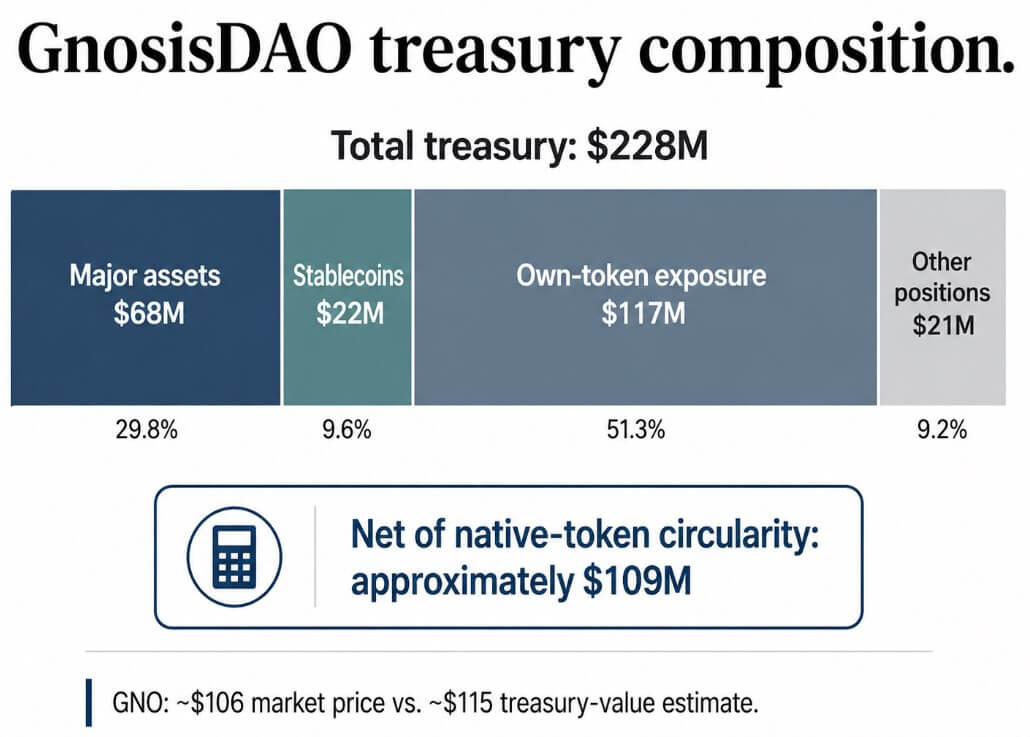
Current DeFiLlama data put the total treasury near $228 million, with approximately $68 million in major assets, $22 million in stablecoins, $117 million in own-token exposure, and $21 million in other positions.
Net of native token circularity, the liquid treasury sits at around $109 million. DeFi analyst Ignas put GNO at approximately $106 against roughly $115 in treasury value per token around the time of GIP-151’s passage.
That discount creates an investable structure consisting of buying tokens below the adjusted treasury value, accumulating governance influence, voting for redemption, and closing the gap.
That is the closed-end fund activism playbook applied to decentralized infrastructure, and Gnosis has now demonstrated it can be executed.
The Investment Company Institute put total closed-end fund assets at roughly $791 billion at year-end 2025, a market large enough to have given rise to decades of activist doctrine around NAV discounts, and DAO treasuries now sit inside that doctrine.
At a GNO price near $104 and a quorum threshold of 75,000 GNO, a position meeting the quorum costs approximately $7.8 million before slippage or opposition. GIP-151’s reported 215% quorum implies an actual voting weight of roughly 161,250 GNO, or about $16.8 million at that price.
Insider blocs, delegation structures, eligibility rules, and organized opposition all affect whether a given position wins a vote, but the numbers show why governance tokens over large liquid treasuries now carry a control premium the market has not historically priced.
The trade generates a straightforward screen: liquid treasury per token, market discount to adjusted NAV, quorum threshold, delegate concentration, foundation or multisig veto risk, treasury composition, and execution path.
DAOs with legally inaccessible, foundation-controlled, or native-token-heavy treasuries stay stranded at their discounts.
| Screen factor | Why it matters | What activists are looking for |
|---|---|---|
| Liquid treasury per token | Determines whether there is real redeemable value | Stablecoins, ETH, majors, low-haircut assets |
| Market discount to adjusted NAV | Defines the potential trade spread | Token price materially below treasury value |
| Quorum threshold | Measures how much voting weight is needed | Low enough threshold for coordinated holders |
| Delegate concentration | Shows whether votes can be influenced | Fragmented delegates or persuadable blocs |
| Insider / foundation control | Determines whether the treasury is practically reachable | Low veto risk from founders, foundations, multisigs |
| Treasury composition | Separates real NAV from paper NAV | Less native-token circularity, fewer illiquid bets |
| Execution path | Tests whether a vote can actually move assets | Onchain execution, clear legal wrapper, defined claims |
| Legal risk | Affects exchanges, holders, and future DAO design | Redemption framed as governance, not investment product |
Traditional DAO governance assumes voters are builders, delegates, users, and participants with operational stakes in the protocol’s future.
Treasury activism imports a different voter through the NAV buyer, who holds governance tokens to extract balance-sheet value and has no particular interest in what the DAO builds next.
A governance forum that used to debate grant allocations, roadmap priorities, and fee-switch parameters now has to answer a prior question: should the DAO retain these assets and, if so, on what terms?
In the bull case, GIP-151 executes cleanly, with liquid assets distributed, illiquid positions handled through a claim token, and legal friction staying contained.
Governance tokens gain a credible new valuation anchor: the probability-weighted right to extract value from the treasury.
Other DAOs with liquid, transparent treasuries and permeable governance face immediate demands to justify why their tokens should trade below the value of the assets they govern. A clean execution could pull GNO toward or briefly above the $115 treasury-value estimate as remaining holders reprice the governance premium.
The bear case runs through execution delays, disputes over eligible supply, heavy haircuts on illiquid assets, or a treasury-defense campaign that exposes insider concentration, leading the market to discount both payout certainty and the post-redemption protocol’s capacity to function.
The wider risk for the DAO market is that several copycat redemption pushes fail simultaneously, demonstrating that most treasury discounts are structurally inaccessible, and the NAV-activism thesis deflates before it fully takes hold.
| Scenario | What has to happen | Likely GNO impact | Broader DAO market impact |
|---|---|---|---|
| Bull case | GIP-151 executes cleanly, liquid assets are distributed, legal friction stays limited | GNO trades closer to or above the ~$115 treasury-value estimate | DAO tokens with clean liquid treasuries reprice higher on redemption optionality |
| Base case | Redemption works, but with delays, haircuts, or limited participation | GNO trades around adjusted treasury value, not full headline NAV | Treasury-rich DAOs face pressure to explain reserves, spending, and governance control |
| Bear case | Execution disputes, eligibility fights, insider resistance, or heavy illiquid-asset haircuts | Market discounts payout certainty and post-redemption protocol value | Most DAO treasury discounts are treated as inaccessible |
| Black swan | Regulatory, exchange, or litigation pressure reframes redemption as security-like behavior | GNO and similar tokens face sharp legal/liquidity discount | Governance tokens split between “usable governance” and “fund-like treasury claim” buckets |
The SEC’s 2026 crypto guidance holds that a non-security crypto asset can still be sold as part of an investment contract when surrounding facts satisfy the Howey test: investment of money, common enterprise, expectation of profits, and reliance on the managerial efforts of others.
Pro-rata treasury redemption gives regulators cleaner facts to run that analysis.
Regulators can now ask more directly whether buyers hold a governance token to participate in protocol decisions or expect returns from a pooled treasury managed and distributed by others.
Legal risk rises sharply if projects, delegates, activists, or market materials frame tokens explicitly as treasury claims.
The distinction between “governance token that enables redemption” and “redeemable treasury interest” is the line that litigation and enforcement will contest.
A second exposure follows from treasury composition. The Investment Company Act applies to issuers whose primary business resembles investing, reinvesting, or holding securities, with a 40% investment-securities threshold embedded in the statute.
A passed redemption mechanism raises the question of whether a DAO that holds ETH, stablecoins, tokenized securities, RWAs, and LP positions, and can be voted to distribute them pro rata, starts to resemble a redeemable asset pool more than an operating network.
The CLARITY Act debate adds a structural wrinkle, as the Senate bill distinguishes between decentralized and centralized platforms, with the latter subject to financial institution-style obligations, including transaction monitoring and suspicious-activity reporting.
A DAO can be genuinely decentralized at the protocol layer while concentrating treasury control in insiders, multisigs, or delegate blocs. Gnosis provides regulators with a real-world example of that gap.
DAO treasuries fund liquidity programs, grants, market-making budgets, protocol contributors, and LP positions.
Redemption votes, whether isolated or part of an activist norm, force treasuries to liquidate assets, such as stablecoin outflows, ETH sales, unwound LP positions, and cut incentive programs.
The total stablecoin market cap is near $314 billion, with Ethereum holding roughly half, according to DeFiLlama. With the Fed holding its target range at 3.50% to 3.75%, the opportunity cost of idle DAO stablecoin reserves is quantifiable and easy to argue in a governance forum.
The risk from Gnosis compounds if five or ten treasury-rich DAOs simultaneously face coordinated redemption campaigns, because the resulting asset sales and incentive cuts run across protocols that share liquidity, validators, and grant recipients.
Rook DAO, Fei/Tribe, and Aragon each demonstrated that DAO treasury conflicts can be resolved through redemption structures.
Aragon’s roughly $115 million ANT redemption came after a protracted governance fight, which the foundation resolved by returning capital to ANT holders. GIP-151 arrived by passing through standard governance, above quorum, without the DAO visibly collapsing first.
That procedural route converts a pattern of isolated governance crises into a repeatable strategic tool.
Every DAO governing a treasury larger than its market cap now trades at a discount that serves as an activist target. Whether DAO structures prove resilient to that, and whether US regulators settle the legal question before the market does, are the forward-looking variables that Gnosis left open.

“In a decentralized governance system, it’s unavoidable to develop politics.”
Rune Christensen explains why DAO governance becomes a struggle for resources, how the “iron law of bureaucracy” emerges, and why Sky redesigned its architecture to survive it.

Injective’s protocol community approved a major tokenomics overhaul on Monday, passing a governance proposal with 99.89% support based on staked voting power.
Injective is a layer-1 blockchain focused on decentralized finance applications, with INJ (INJ) serving as its native token for staking, governance and transaction fees.
The Supply Squeeze proposal (IIP-617) reduces its native token issuance and maintains the network’s buyback-and-burn program, which uses protocol-generated revenue to permanently remove tokens from circulation.
The network said it has removed about 6.85 million INJ from circulation through token burns. The proposal is designed to accelerate tokens removal by aligning reduced issuance with recurring buybacks.
According to an X post from Injective on Monday, the governance changes, which are live, will enable “INJ to become one of the most deflationary assets over time.”
The governance vote follows a prolonged downturn in INJ’s market price amid a broader altcoin sell-off. Over the past year, INJ has fallen nearly 80% and is down more than 90% from its all-time high achieved in March 2024. The token was down about 8% on Monday, according to CoinGecko data.
Community reaction on X after the vote was mostly optimistic, with users framing it as a structural shift rather than a short-term market catalyst.
According to DefiLlama data, at time of writing Injective had $18.67 million in total value locked (TVL) across its DeFi ecosystem, down sharply from peaks above $60 million in 2024.

Related: After bitter vote, Aave founder pitches bigger future for DeFi lending giant
Despite declines in INJ’s price and the network’s total value locked, Injective continued to attract institutional engagement in 2025, spanning regulated investment products, validator participation and new financial market offerings.
In July, Cboe and Canary Capital both filed regulatory applications for a staked Injective exchange-traded fund (ETF), with each seeking to list a fund that would hold and stake INJ to generate rewards through an “approved staking platform.”

Injective also continues to expand its validator set. In February, Deutsche Telekom’s IT services subsidiary, Deutsche Telekom MMS, joined the network as a validator.
More recently, Korea University became the first academic institution to operate a validator and conduct onchain research on the network, according to an announcement on Wednesday.
Magazine: Davinci Jeremie bought Bitcoin at $1… but $100K BTC doesn’t excite him


