The fund will allocate 30% to crypto tokens and 70% to financial services stocks, taking both long and short positions to capitalize on market shifts.

 Live Chat
The fund will allocate 30% to crypto tokens and 70% to financial services stocks, taking both long and short positions to capitalize on market shifts.

Galaxy CLO 2025-1 totals $75 million and brings a private credit deal onchain.
Galaxy revealed on Jan. 15 that it has issued its first collateralized loan obligation (CLO) and tokenized the deal on Avalanche, a Layer 1 blockchain with a total value locked (TVL) of over $1.2 billion.
The instrument, dubbed Galaxy CLO 2025-1, totals $75 million and includes a $50 million allocation from Grove, an institutional credit protocol that operates as a Star, or SubDAO, within the Sky Ecosystem.
A CLO is a structured credit product that bundles corporate loans and sells them to investors across different risk tiers. Galaxy said the transaction will support its lending activities.
Avalanche said the CLO’s debt tranches were issued and tokenized on its network and are listed on INX for qualified investors. The network added that tokenization could enable lower-cost trading and faster settlement, while also improving transparency for investors.
“This transaction marks another meaningful step forward for onchain credit, demonstrating how familiar securitization structures can be brought onchain without compromising institutional standards,” said Sam Paderewski, co-founder at Grove Labs.
Paderewski added that Grove’s investment underscores its focus on supporting onchain tokenized credit products.
The allocation adds to Grove’s activity on Avalanche, according to the announcement. Grove previously deployed $250 million into tokenized real-world assets (RWAs) on the Avalanche network.
The announcement comes as more private credit products move onchain. Avalanche cited other institutional credit products already running on its network, including tokenized funds tied to Janus Henderson’s Anemoy Fund and Apollo’s ACRED.
Private credit remains the largest category in tokenized RWAs, with about $19.1 billion in onchain value, followed by tokenized securities, mainly Treasuries, at roughly $9 billion, according to a December report from RWAio.
AVAX, Avalanche’s native token, was trading around $13.74 on Thursday, down about 6.2% over 24 hours, according to CoinGecko. The token had roughly $388 million in daily trading volume.
Meanwhile, Galaxy (GLXY) shares were up about 13% on Thursday, trading around $31.90, according to Google Finance.
October’s wobble hasn’t broken the cycle, Alex Thorn, Galaxy Digital’s head of research, argues.
The note was first sent to subscribers of Galaxy Research’s Weekly Research Brief and later reproduced on X.
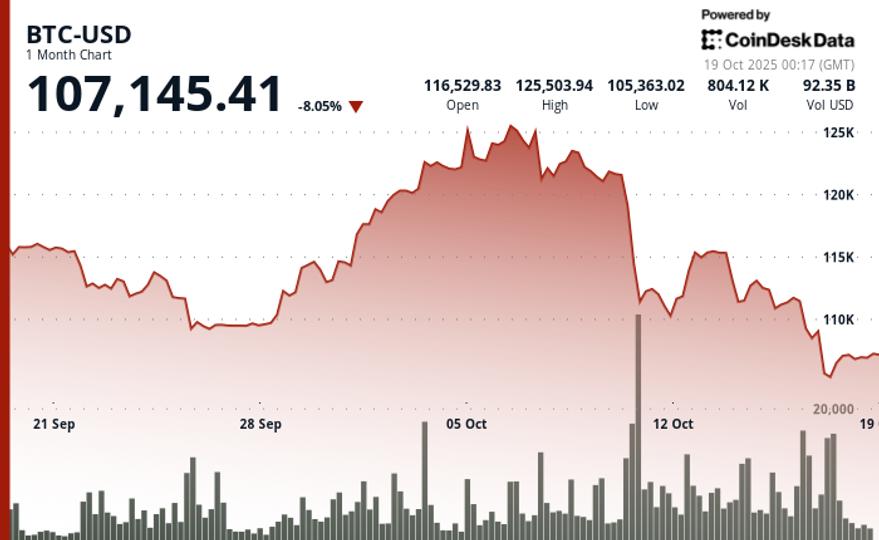
Thorn says the Oct. 10 sell-off began with high leverage slamming into thin order books, then worsened as exchange auto-deleveraging capped some market-maker shorts and thinned liquidity at the worst point. He cites roughly $19 billion of liquidations as bitcoin slid from an Oct. 6 all-time high near $126,300 to an intraday low around $107,000, with ether falling from about $4,800 to roughly $3,500 before markets steadied into the weekend.
Risk appetite faded again as macro jitters resurfaced. Thorn points to softness in chip stocks, a hawkish turn from a Federal Reserve governor, renewed regional-bank worries and geopolitical noise. Classic risk-off markers reinforced the tone, he notes, with gold and silver setting fresh records and the 10-year Treasury yield dipping back below 4%.
He also flags a crypto-specific drag: digital asset treasury companies have cooled. He says that with equity prices down across that cohort, there’s less price-insensitive buying to deploy into crypto, which adds to near-term fragility even after the initial washout.
Medium term, however, Thorn stays constructive and highlights three forces he thinks can power the next leg higher.
First is AI capital spending. He frames the current wave as a real-economy capex cycle led by cash-rich incumbents — hyperscalers, chipmakers and data-center operators — reinforced by significant U.S. policy support, rather than a rerun of a purely speculative dot-com bubble. Corporate budgets and government posture, he argues, point to a long runway.
Second are stablecoins. Thorn points our that dollar-linked tokens continue to gain traction as payment rails, broadening participation, deepening liquidity and anchoring more activity on public chains. He believes those plumbing effects can support the ecosystem even when price action chops.
Third is tokenization. According to Thorn, moving real-world assets and pieces of traditional market infrastructure on-chain is shifting from pilots to implementation, creating fresh demand for block space and for core assets that secure, route and settle that activity. Thorn says that transition benefits platforms tied to that flow.
Within that backdrop, he remains positive on bitcoin’s “digital gold” role amid persistent doubts about fiscal and monetary prudence. He also sees a favorable setup for majors like ETH and SOL tied to stablecoin usage and tokenization, even if near-term rallies risk stalling below prior highs.
The near-term message is caution — respect thinner liquidity, post-crash psychology and a “wall of worry” mood. The medium-term message is resilience: three tailwinds are in place, he says, to keep the trend pointing up once markets finish digesting the shock.


