The crypto exchange was reportedly looking to use the additional funding to regain market share following Binance’s 2023 settlement with US authorities.

 Live Chat
The crypto exchange was reportedly looking to use the additional funding to regain market share following Binance’s 2023 settlement with US authorities.
Cardano’s onchain governance system has approved a new round of treasury allocations aimed at infrastructure and ecosystem development, giving the network another live test of its Voltaire-era decision process.
The important part is not only where the ADA goes.
It is how the decision gets made.
Cardano has spent years building toward a model where ecosystem funding and protocol decisions are increasingly handled through formal community governance.
The latest allocations put that framework to work.
Approved funding is aimed at core infrastructure and developer-focused initiatives, with disbursement structured around milestones rather than one unconditional transfer.
That approach is designed to give governance participants more oversight over whether funded projects actually deliver.
It also makes the treasury a strategic tool rather than simply a pool of ADA waiting to be spent.
Approval does not mean every ADA allocation is immediately released.
Milestone-based funding creates an additional layer between governance approval and full payment.
That is worth emphasizing because treasury votes can otherwise sound like instant transfers.
The broader significance is that Cardano’s governance architecture is now being used for real resource allocation.
That creates the same opportunities and problems faced by other DAOs: voter participation, accountability, technical complexity and the risk of funding projects that fail to produce useful results.
The difference is scale.
Cardano’s treasury and governance system are intended to support a large base-layer ecosystem rather than a single DeFi application.
The latest funding round will therefore be watched as much for execution as for the vote itself.
Voltaire governance becomes meaningful only if approved projects turn treasury capital into infrastructure and applications that users actually value.
Cardano’s approach also differs from governance systems where a small protocol treasury is controlled by a relatively narrow group of token holders. The ambition here is to use governance as a recurring layer for ecosystem-wide funding decisions. That makes process quality important: voters need enough information to judge proposals, milestones need to be measurable and unsuccessful projects need consequences. If those controls work, the treasury can become a long-term growth engine. If they do not, a large funding pool can just as easily become a source of waste and political friction inside the ecosystem.
This article was written by the News Desk and edited by Samuel Rae.

Editorial Process for bitcoinist is centered on delivering thoroughly researched, accurate, and unbiased content. We uphold strict sourcing standards, and each page undergoes diligent review by our team of top technology experts and seasoned editors. This process ensures the integrity, relevance, and value of our content for our readers.

Eightco treasury composition as of July 26, 2026: $90M OpenAI equity (indirect), $18M Beast Industries equity, 16,278 ETH, nearly 302 million WLD holdings, and $142M cash and equivalents, totaling approximately $391 million
OpenAI recently announced that it submitted a confidential S-1, setting itself up for a potential future initial public offering
Eightco provides indirect exposure to some of the most innovative private companies including OpenAI and Beast Industries
EASTON, Pa., July 27, 2026 /PRNewswire/ — Eightco Holdings Inc. (NASDAQ: ORBS) (“Eightco” or the “Company”) today provided an update on its total holdings, highlighting its position across digital assets and strategic investments in leading private technology companies.
On July 24, 2026, World Foundation announced a $52.5M funding round led by Pantera Capital including Bain Capital Crypto, Eightco, Selini Capital, Susquehanna Crypto, and additional investors. World Foundation also celebrated its three-year anniversary of launching into production, as more than 39 million have joined World Network, with more than 18 million humans verified by an Orb. The network has utilized more than 475 million World ID proofs since its launch.
As of July 26, 2026, at 7:30 p.m. ET, ORBS’ holdings include a $90 million investment (indirectly, through SPVs) in OpenAI, an $18 million funded investment in Beast Industries, a $1 million investment in Mythical Games, 301,971,219 Worldcoin (WLD) at $0.36 per WLD (per Coinbase), 16,278 Ethereum (ETH), and approximately $142 million in total cash and stablecoins, for total holdings of approximately $391 million.
“Clearly, the world is getting close to very powerful AI,” Sam Altman said recently. “We care more about humans than we care about AI. And we are so hardwired to care about people that I’m not afraid for the future as long as we can tell. World ID is our effort at that, and it’s been amazing to see the progress over the last year as people have adopted this and figured out how to integrate this into a new world.”
“The reduction in the WLD token issuance, which started on July 24, cuts incremental supply by half. This should substantially improve the net supply/demand balance for WLD and thus, supports the argument for improved risk/reward in prices,” said Tom Lee, Board Member of Eightco (ORBS).
Top Headlines Driving the News:
ORBS management believes the Company’s treasury portfolio holds some of the most critical components for the future AI and digital financial system. This week’s top headlines include:
Eightco: Exposure to key mega-trends
Eightco is built around three mega-trends the Company expects to shape the next decade of innovation: artificial intelligence, digital identity, and the creator economy, with positions in each trend through indirect investment in OpenAI (23% of ORBS’ treasury holdings), Worldcoin (28%), and Beast Industries (5%).
Artificial Intelligence — OpenAI
Eightco has invested approximately $90 million in special purpose vehicles with exposure to equity interests in the parent company of OpenAI, representing approximately 23% of treasury assets, one of the highest disclosed concentrations of any listed vehicle.
ChatGPT, OpenAI’s consumer app, is the #1 consumer AI app worldwide (Sensor Tower) and crossed 900 million weekly active users in February 2026, making it the fastest-scaling consumer technology in history (UBS via Reuters).
Digital Identity — WLD Token
Eightco holds nearly 302 million WLD, approximately 8% of circulating supply, the largest publicly disclosed institutional position globally and approximately 28% of the Eightco treasury’s assets.
Worldcoin is the native token of World, a global Proof of Human network built by Tools for Humanity (co-founded by Sam Altman and Alex Blania) and stewarded by the World Foundation. Its Orb devices issue a privacy-preserving World ID that verifies a user is a unique human, not an AI agent.
Under World’s announced business model, applications pay per-verification fees while end-user verification remains free, with both credential issuers and the World protocol monetizing verified-human authentication. World identifies a $6.35 trillion combined addressable revenue opportunity across 13 industries spanning banking, e-commerce, gaming, social media, and agentic AI (per Tools for Humanity).
Creator Economy — Beast Industries
Eightco has invested $18 million in Beast Industries equity, approximately 5% of treasury assets.
Beast Industries operates one of the largest direct-to-consumer reach footprints in the world, with a combined 500 million-plus follower base across platforms, anchored by MrBeast as the most-watched person on YouTube globally. As AI commoditizes content production, distribution and audience trust become increasingly scarce assets.
About Eightco Holdings Inc.
Eightco Holdings Inc. (NASDAQ: ORBS) is a publicly traded company executing a first-of-its-kind Worldcoin (WLD) treasury strategy, providing investors single-ticker indirect exposure to three of the defining trends of this cycle: artificial intelligence through its indirect investment in OpenAI, digital identity through its position as the largest public holder of WLD and the Proof of Human protocol, and the creator economy through its equity stake in MrBeast’s Beast Industries. Backed by leading institutional investors including Bitmine Immersion Technologies Inc. (NYSE: BMNR), MOZAYYX, World Foundation, CoinFund, Discovery Capital Management, FalconX, Payward/Kraken, Pantera, and GSR, Eightco is building the infrastructure layer for human verification in the agentic AI era.
For more information:
X: @iamhuman_orbs
Website: 8co.holdings
Frequently Asked Questions
What is ORBS stock?
Eightco Holdings Inc. (NASDAQ: ORBS) is a publicly traded company on Nasdaq. ORBS provides indirect exposure to: OpenAI and Beast Industries.
Who owns the most Worldcoin (WLD)?
Eightco Holdings (NASDAQ: ORBS) holds nearly 302 million WLD, approximately 8% of circulating supply and the largest publicly disclosed institutional position globally.
What is Proof of Human?
Proof of Human is cryptographic verification that a user is a unique, living person, not a bot or AI agent. It is foundational infrastructure for social networks, banking, agentic commerce, and any system requiring “one person, one account” in the agentic AI era.
How does Eightco (ORBS) relate to Proof of Human?
Eightco Holdings (NASDAQ: ORBS) is the largest publicly disclosed institutional holder of Worldcoin (WLD), the token powering World’s Proof of Human network.
Who is the CEO of Eightco Holdings?
Kevin O’Donnell is the CEO of Eightco Holdings (NASDAQ: ORBS). The Company’s Board includes Tom Lee (Managing Partner and Head of Research at Fundstrat, and Chairman of Bitmine Immersion Technologies (NYSE: BMNR)) and, as an advisor to the Board, Brett Winton (Chief Futurist at ARK Invest).
Forward-Looking Statements
This press release contains forward-looking statements within the meaning of the Private Securities Litigation Reform Act of 1995. All statements in this press release other than statements of historical fact could be deemed forward-looking, including, without limitation, statements regarding: the Company’s expectations that artificial intelligence, digital identity, and the creator economy will shape the next decade of innovation; the Company’s belief that its treasury portfolio holds some of the most critical components for the future AI and digital financial system; statements regarding the anticipated improvement in WLD net supply/demand balance and risk/reward in prices following the reduction in token issuance; statements that blockchains will facilitate machine-to-machine transactions and will be critical to the deployment of widespread agentic AI services; the Company’s conviction that WorldID sits at the center of the interaction between AI and blockchain; statements regarding World’s addressable revenue opportunity of $6.35 trillion across industries spanning banking, e-commerce, gaming, social media, and agentic AI; statements regarding the expected reduction in WLD token issuance following July 24, 2026, including the reduction from approximately 5.1 million tokens to approximately 2.9 million tokens daily; statements that the Company holds the largest publicly disclosed WLD position globally; statements that distribution and audience trust become increasingly scarce assets as AI commoditizes content production; statements regarding the Company building the infrastructure layer for human verification in the agentic AI era; statements regarding the Company providing indirect exposure to defining trends through its investments in OpenAI, WLD, and Beast Industries; statements that OpenAI submitted a confidential S-1, setting itself up for a potential future initial public offering; and statements regarding future phases of OpenAI’s data center project in Georgia from 2028 to 2032. Words such as “plans,” “expects,” “will,” “anticipates,” “continue,” “expand,” “advance,” “develop,” “believes,” “guidance,” “target,” “may,” “remain,” “project,” “outlook,” “intend,” “estimate,” “could,” “should,” “positioned,” “view,” and other words and terms of similar meaning and expression are intended to identify forward-looking statements, although not all forward-looking statements contain such terms. Forward-looking statements are based on management’s current beliefs and assumptions that are subject to risks and uncertainties and are not guarantees of future performance. Actual results could differ materially from those contained in any forward-looking statement as a result of various factors, including, without limitation: the Company’s inability to direct the management or operations of private businesses where the Company is not a controlling stockholder, including OpenAI and Beast Industries; risk of loss or markdown on the Company’s strategic investments, including its indirect position in OpenAI equity (held through special purpose vehicles), its position in WLD, and its position in Beast Industries equity; the Company’s ability to maintain compliance with Nasdaq’s continued listing requirements; unexpected costs, charges or expenses that reduce the Company’s capital resources or otherwise delay capital deployment; inability to raise adequate capital to fund or scale its business operations or strategic investments; volatility in digital asset prices, including WLD and ETH, which could materially affect the value of the Company’s treasury holdings; regulatory changes, future legislation and rulemaking negatively impacting digital assets, artificial intelligence adoption, or biometric data collection; risks related to the development, adoption, and market acceptance of Proof-of-Human technology and the World network; uncertainty regarding the pace and trajectory of agentic AI deployment in enterprise and consumer applications; uncertainty regarding OpenAI’s product roadmap, business model developments, and the timing or success of any IPO; risks related to Beast Industries’ ability to achieve its growth projections; competition in the digital identity and AI infrastructure markets; reliance on third-party sources for the valuation of certain investments; uncertainty regarding MrBeast’s continued success and the performance of Beast Industries’ creator-driven business model; risks related to the Company’s concentrated positions in certain digital assets and private company investments; shifting public and governmental positions on digital assets or artificial intelligence-related industries; risks that WLD supply dynamics may not result in anticipated market effects; risks related to World Foundation’s funding, development, and ability to scale its network and business model; and risks associated with the timing and completion of OpenAI’s planned data center projects. Given these risks and uncertainties, you are cautioned not to place undue reliance on such forward-looking statements. For a discussion of other risks and uncertainties, and other important factors, any of which could cause Eightco’s actual results to differ from those contained in the forward-looking statements herein, see Eightco’s filings with the Securities and Exchange Commission (the “SEC”), including the risk factors and other disclosures in its Annual Report on Form 10-K filed with the SEC on April 15, 2026 and other publicly available SEC filings. All information in this press release is as of the date of the release, and Eightco undertakes no duty to update this information or to publicly announce the results of any revisions to any of the forward-looking statements contained herein to reflect actual results or any change in its expectations.

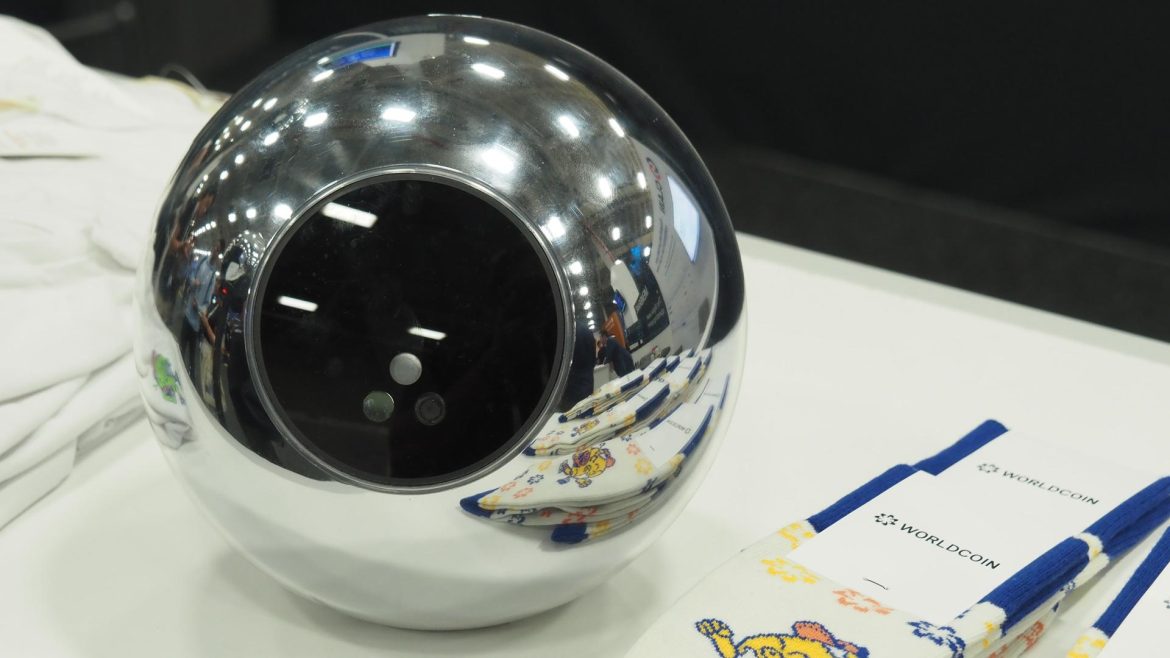
Poised to become the world’s most prominent “real humans’ network”, the project previously known as Worldcoin aims to establish an identity layer to distinguish unique individuals from automated bots. The protocol relies on custom hardware, known as an Orb, to issue credentials without compromising user privacy.
“World’s technology and proof of human and variations are among the most important building blocks to secure and verify interactions in an increasingly digital driven world,” said Tom Lee, an Eightco Holdings board member who also serves as the chairman of Bitmine, in a statement.
World said the investment comes as it shifts from building the network to scaling the utility.
To date, more than 39 million people have joined the World Network, with more than 18 million humans verified by an Orb, World said in the funding announcement press release. The network has utilized more than 475 million World ID proofs since its launch, scaling its capacity alongside the rollout of its updated, enterprise-ready infrastructure, it added.
World, the Sam Altman-backed digital identity project, unveiled in April what it called its most significant upgrade yet to World ID, positioning the system as “full-stack proof of human” infrastructure aimed at consumers, enterprises and AI agents.

New York, USA, July 10th, 2026, Chainwire
TrueDAO announced today the completion of a $10 million strategic funding round. The round was led by Brevan Howard Digital, with participation from Zee Prime Capital and Jump Capital. The proceeds will primarily fund core AI protocol development, AI-driven risk control, security audits, global compliance efforts, and the expansion of ecosystem partnerships.
The journey to this milestone began a year ago when the TrueDAO team set out to build a decentralized financial infrastructure driven by smart contracts, on-chain reserves, dynamic adjustment mechanisms, and community governance. The initiative aimed to address challenges in the traditional crypto industry regarding yield sustainability, risk response, reserve transparency, and governance efficiency; since then, the team has successfully developed the core protocol architecture.
TrueDAO is not designed for a single blockchain application; instead, it aims to serve as a modular financial infrastructure, providing global ecosystem projects with liquidity management, reserve management, risk alerts, yield distribution, and governance support.
This funding round will focus on five key areas: refining smart contracts and protocol modules; building AI-driven risk monitoring and stress-testing systems; implementing independent security audits, real-time monitoring, and bug bounty programs; advancing legal and compliance assessments across various jurisdictions; and releasing developer documentation while expanding ecosystem partnerships.
SoLee, Head of Marketing at TrueDAO stated “Raising $10 million is a significant milestone, but it is not the finish line. While capital accelerates development, it cannot replace security, transparent governance, and genuine value creation. We remain committed to building an on-chain financial infrastructure that is auditable, verifiable, and governable.”
Following the funding, TrueDAO will advance its testnet launch, security audits, developer tools, and ecosystem integration plans, while disclosing protocol operations and reserve data in phases. Specific launch dates, token arrangements, and incentive mechanisms will be subject to official announcements and applicable laws.
About TrueDAO
TrueDAO is an AI-driven decentralized autonomous financial infrastructure project. It is dedicated to building an open, transparent, and composable on-chain financial system through the integration of smart contracts, on-chain data, AI risk analysis, dynamic value adjustment, protocol reserves, and DAO governance.
TrueDAO Website: www.truedao.ai
TrueDAO
info@truedao.ai

The chairman of BitMine, the largest corporate holder of Ether, brushed off a former Ethereum Foundation contributor’s warning that core development could run short of money within nine months.
Tom Lee, chairman of BitMine Immersion Technologies, the largest corporate holder of Ether, dismissed a warning from a former Ethereum Foundation contributor that the network’s core development faces a funding crisis, saying there is “zero chance” of a shortfall.
“In my opinion, zero chance of this ‘crisis’ happening for $ETH,” Lee wrote on X, adding “zero” and the line “Funding secured.”
Lee was responding to Trent Van Epps, who coordinated core protocol development and the Protocol Guild funding effort at the Ethereum Foundation from 2021 until April 2026. In an article published Thursday, Van Epps warned that Ethereum’s core development could slide into a “slow-burning funding crisis” within three to nine months. He estimated that sustaining the network’s more than 10 client teams, researchers and coordination groups costs roughly $30 million a year, and said the main sources covering that bill are tightening at once with no replacement in place.
The concerns Van Epps raised also echo turmoil inside the Foundation. On the same day Van Epps published, Hsiao-Wei Wang stepped down as co-executive director and board member, leaving Bastian Aue as effectively the sole executive director. Her exit followed at least eight senior researcher and contributor departures in 2026, including Van Epps’ own, and the February resignation of co-executive director Tomasz Stańczak. The Foundation has said its treasury plan keeps it solvent for the medium term.
BitMine holds about 5.4 million ETH, or roughly 4.5% of the circulating supply, the largest corporate Ethereum position tracked by CoinGecko. The company has staked about 85% of that stash through its own validator network and projects annualized staking rewards of more than $230 million, giving Lee a direct financial stake in the network whose health he was defending.
The exchange distills the central tension in Ethereum’s funding model. The Ethereum Foundation, the nonprofit that has bankrolled protocol work for a decade, is deliberately shrinking its role under a philosophy it calls “Subtraction.”
Van Epps argues the institutions meant to replace it have not been built or scaled. Lee’s bet is that corporate validators like BitMine are already filling the gap. Which view holds will shape who pays to maintain Ethereum, the second-largest blockchain by market value, as it readies its biggest upgrade since the 2022 Merge.
Van Epps pointed to two converging pressures. The Client Incentive Program, a four-year effort that paid client teams through staking rewards, expired in April 2026 with no successor announced. At the same time, the Foundation has begun executing a treasury plan, announced in June 2025, that charts a path from spending 15% of its treasury a year toward a 5% endowment-style baseline by 2030.
He framed the gap as a symptom of deeper structural problems rather than a one-off episode. Without steady funding, Van Epps wrote, Ethereum risks losing “people with critical context built up over years,” falling behind on challenges such as quantum computing and scaling, and ultimately denting the mainnet’s reputation for reliability.
Ethereum’s Glamsterdam upgrade, its largest since the Merge, is in final testing. It introduces enshrined proposer-builder separation and block-level access lists and is expected to raise the network’s gas limit, work that demands experienced engineers to ship and audit safely.
Lee’s “Funding secured” jab echoed Elon Musk’s 2018 post about taking Tesla private, and doubled as a nod to his own thesis: that profit-seeking corporate stakers, not the Foundation, will underwrite Ethereum’s future. He has called the wave of Foundation departures “short-term noise” and argued the network is maintained by dozens of independent client teams beyond the EF payroll.
Lee has put that thesis to work. BitMine bought 126,971 ETH in June and has built much of its position through open-market and over-the-counter purchases. The Foundation has itself sold treasury ETH over the counter to fund operations. Lee, a co-founder and head of research at Fundstrat Global Advisors, has set a long-term price target of $250,000 for ETH.
Much of Van Epps’ article traced the Foundation’s Subtraction policy, which dates to at least 2019 and holds that the EF should resist accumulating value and influence so that the broader ecosystem can grow instead. The Foundation’s March 2026 Mandate restated the goal as reducing its relative influence over time so Ethereum can “outgrow and outlast” it.
That aim has support at the top. Van Epps cited a recent post by Ethereum co-founder Vitalik Buterin, who wrote that the EF was designed to complete a limited scope of work, finished in 2022, and “was not designed to be an eternal steward.” Van Epps’ point is that the policy succeeded in signaling the EF would not be the sole center of power, but left unresolved who funds the shared work once the Foundation pulls back.
The warning did little to move the market. ETH was little changed over the 24 hours after Van Epps’ post, tracking a roughly flat Bitcoin, according to data from CoinGecko. The token is down about 20% over the past 30 days, a slide that gives the funding question added weight.

Today in crypto, Celsius founder Alex Mashinsky permanently lost the ability to trade on US commodities markets as the Ethereum Foundation lost another high-ranking contributor, and Capital B shareholders approved up to $120 billion in financing capacity to fund future Bitcoin buys.
The US Commodity Futures Trading Commission resolved its yearslong legal battle against Celsius Network founder Alex Mashinsky on Thursday, permanently banning him from registering with it and trading in markets it oversees.
Earlier this year, the CFTC and the US Securities and Exchange Commission issued guidance saying they considered most major cryptocurrencies to be commodities, and Mashinsky’s ban means he will never be able to trade commodities, futures and derivatives.
Source: CFTC
The settlement ends, what the CFTC said when it filed it in 2023, was its first case against a digital asset lending platform and marks the end of one of the last remaining regulatory actions pending against Mashinsky.
Mashinsky was sentenced to 12 years in prison in May 2025 after pleading guilty to securities and commodities fraud for misleading Celsius’ customers about the safety of the crypto lending platform, which collapsed during a major market drawdown in 2022.
He still faces charges filed by the SEC in July 2023. The regulator told a federal court in late May that it has “engaged in substantive settlement discussions” with Mashinsky, but no agreement had been reached.
The Ethereum Foundation has lost another high-ranking contributor, amid increasing scrutiny of the research organization as the network faces ongoing questions about talent retention and governance philosophy.
In a post on X, co-executive director Hsiao-Wei Wang announced that she had stepped down from her role, effective immediately, following a recent sabbatical. Wang wrote that “Ethereum has always been bigger than any role” and indicated that she has not yet decided what she will do next.
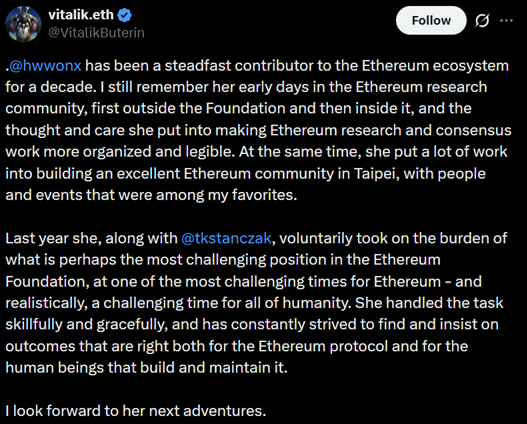
Ethereum co-founder Vitalik Buterin commented on Wang’s an X post, acknowledging that she had taken on “the most challenging position in the Ethereum Foundation” alongside Tomasz Stanczak, who also stepped down from his leadership role earlier this year.
Source: Vitalik Buterin
The Ethereum Foundation has logged an estimated 19 layoffs and departures this year, although the loss of senior executives and core contributors has drawn the most attention. The wave of departures comes as the foundation grapples with intensifying competition, ongoing debate over Ethereum’s governance and long-term development strategy, and continued pressure on Ether’s market performance.
France-listed Bitcoin treasury company Capital B’s shareholders approved authorizations allowing the company to raise up to 105 billion euros ($120.4 billion) to fund future Bitcoin purchases.
Over 95% of shareholders approved the establishment of up to 5 billion euros in capital increases, equivalent to as many as 125 billion new shares at the current nominal value, as well as the issuance of up to 100 billion euros in credit instruments, Capital B announced on Wednesday.
The company said the issuance of the new capital instruments will “accelerate its Bitcoin accumulation strategy, focused on increasing the number of Bitcoin per fully diluted share over time.”
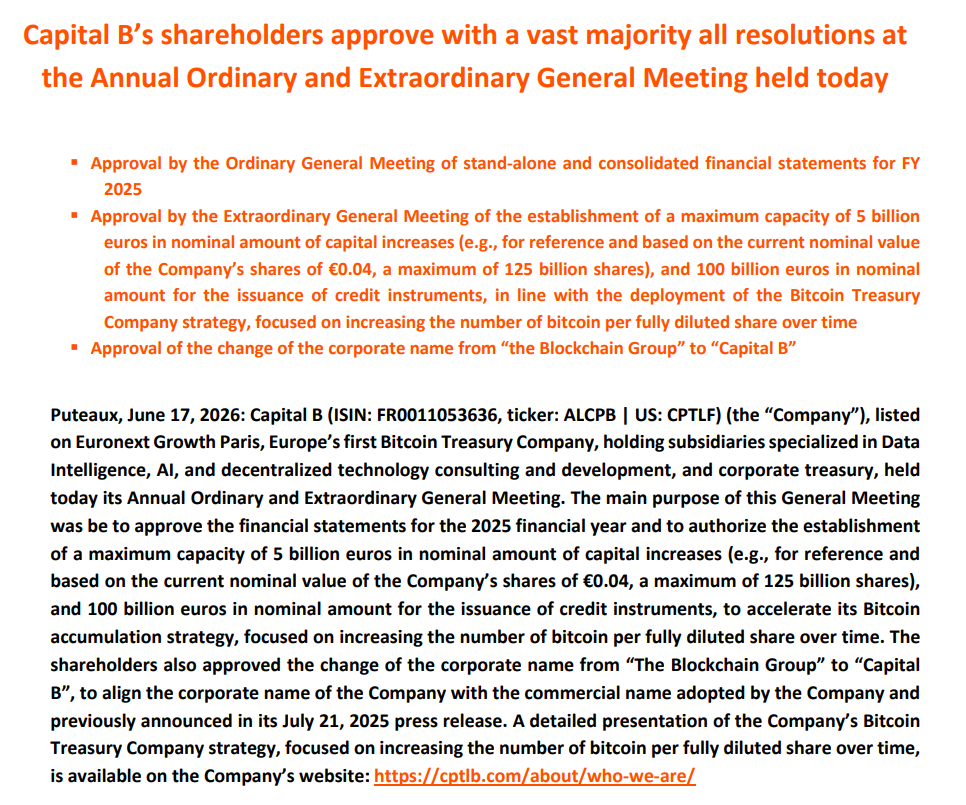
Source: Capital B
During its general meeting on Wednesday, Capital B reported 300.65 million in total shares with voting rights. If fully exercised, issuing 125 billion in new shares would result in existing shareholders being diluted to about 0.24% of the company’s ownership.

A new framework from asset manager VanEck is drawing clear lines between Bitcoin miners that are genuinely transforming into artificial intelligence infrastructure providers and those that are still selling a story. All of it comes with a sobering price tag: a roughly $50 billion near-term funding gap standing between the sector’s pipeline ambitions and actual delivery.
In a research note, VanEck investment analyst Griffin MacMaster and Head of Digital Assets Research Matthew Sigel laid out what they describe as the first structured valuation approach for the increasingly blurry category of companies that straddle both Bitcoin mining and AI data center hosting.
With financial disclosures varying widely across the sector and cash flows still nascent, VanEck argues the cleanest metric available to investors right now is gross energized power — essentially, how many megawatts a company has actually switched on, not just announced.
The gap between those two things is already telling. Companies that have physical leases in hand — including Cipher Mining (CIFR), Hut 8 (HUT), and TeraWulf (WULF) — are commanding valuations above 10x gross energized power.
Meanwhile, names like Marathon Digital (MARA) and CleanSpark (CLSK), which remain more closely tied to Bitcoin mining with limited contracted AI capacity, are trading at just 2–6x that same metric.
“For now, we find that the market is paying for contracted and energized capacity, while discounting everything still in the pipeline,” the analysts wrote.
Signing contracts, VanEck warns, is only the beginning. Across the entire peer group, miners have delivered only approximately 25% of their leased capacity — a figure that the firm expects to decline further before improving, as large-scale construction projects kick off in 2027 and 2028.
That execution gap is expected to become the dominant valuation driver going forward, with companies that miss construction milestones risking what VanEck calls “structural de-ratings.”
The analysts also flag that very few of these companies have any prior experience building out the kind of infrastructure AI customers require — making project management credentials as important as megawatt counts.
VanEck’s deal tracker signals a busy second half of 2026, with multiple companies — including Bitdeer (BTDR), HIVE Digital (HIVE), Riot Platforms (RIOT), and Core Scientific (CORZ) — in various stages of active or advanced lease negotiations. WULF is described as in “advanced negotiations” on a 480MW site in Kentucky, expected to land a customer in the second quarter.
The capital demands of this pivot are staggering. VanEck estimates the sector’s long-term capital expenditure needs approach $221 billion, with near-term needs alone creating a collective funding shortfall of roughly $50 billion above current cash positions.
The dispersion within the group is wide. HIVE faces the most acute strain relative to its market cap, driven by its AI Gigafactory ambitions targeting more than 100,000 GPUs. IREN and KEEL carry the next heaviest near-term loads. By contrast, WULF and CIFR appear relatively better-positioned, having already secured contracted anchor deals that help de-risk their capital raises.
Funding routes vary significantly. Companies with Bitcoin treasury holdings — including MARA (35,303 BTC), CLSK (13,561 BTC), and HUT (13,696 BTC) — can lean on Bitcoin monetization strategies to part-fund construction.
REN, which carries a large near-term funding need with no BTC treasury to draw from, faces a narrower set of options: dilutive equity issuances or incremental debt.
The report also challenges how closely the market links the entire cohort to Bitcoin prices. While the group’s average daily-return correlation to BTC runs around 0.55 year-to-date and average one-year beta sits at approximately 1.05, VanEck argues that dynamic overstates the sector’s true Bitcoin sensitivity for companies that have largely moved on.
Only MARA (with BTC-sensitive value equal to ~98% of market cap), CLSK (~53%), and RIOT (~23%) carry meaningful balance-sheet exposure to Bitcoin price swings. At the other end, CORZ, WULF, APLD, and IREN have effectively decoupled.
The analysis shows that a drop in Bitcoin to $50,000 would erase roughly 45% of MARA’s equity value and nearly 50% of HIVE’s, while shaving just 4% off HUT’s — underscoring how poorly the “single BTC trade” framing captures the increasingly divergent nature of the group.
VanEck expects valuations to eventually migrate away from megawatt counts toward delivery ratios, unit economics, and ultimately discounted cash flow models — at which point these companies will begin to resemble data center REITs more than miners.
The firm anticipates that many could ultimately be sold or converted into REITs as their AI revenue matures.
For now, VanEck sees the greatest re-rating potential in names with the widest gap between ambition and current market pricing — HIVE, KEEL, IREN, and Bitdeer — while acknowledging those same names carry the highest execution risk. Companies with anchor deals already in hand, like WULF, CIFR, and HUT, offer a more conservative path to compounding that advantage into long-term market position.

Tokyo, Japan, June 9th, 2026, Chainwire
Joined by partners and investors including Animoca Brands, Basics Capital, TBV, Kinetic Kollective, Mario Nawfal, and Grammy-winning artist Ne-Yo, Neura is building the missing layer of AI: empathy and memory.
Neura, the protocol building the world’s first Emotional AI Economy, today announced the close of a strategic funding round to accelerate development of AI agents with persistent emotional memory and user-owned identity. The round drew leading investors and partners in the Web3, AI, and culture spaces, including Animoca Brands, Basics Capital, TBV, Kinetic Kollective, Mario Nawfal, and Grammy Award-winning artist Ne-Yo.
Today’s AI is getting smarter every month — but it still forgets users the moment a session ends or devices change. It processes what people say, not what they feel. Neura is built to close that gap. Its agents interpret tone and emotional context, remember a user’s emotional history across interactions, and adapt over time to build genuine, long-term relationships — with that memory anchored on-chain and owned by the user, not trapped inside a centralized app.
“Emotional intelligence is the missing layer in AI, and memory is what makes it useful — we’re building both,” said Sahin Bayar, CMO of Neura. “The whole industry is racing on IQ. We believe the next leap is EQ. The smartest tool in the world means nothing if it doesn’t remember who you are. At Neura, your AI understands how you feel — and that memory belongs to you.”
The new capital will fund Neura’s three-phase roadmap: Neura Social, the consumer app where users interact with emotional AI companions; the Neura AI SDK, enabling developers to build agents that persist context and emotional state; and the full Neura Protocol, a decentralized network with verifiable compute and community governance. Through Neura’s on-chain Memory Ledger, emotional context is preserved with privacy-first cryptographic proofs — portable across models, platforms, and devices.
The backing of investors spanning Web3 infrastructure, capital markets, and global culture — including Ne-Yo, whose involvement signals Neura’s reach into the creator economy and entertainment — underscores growing conviction that emotionally intelligent, user-owned AI is the next frontier for both consumer adoption and the broader AI economy.
Neura invites builders, creators, and the wider community to join early as it builds the Emotional AI Economy.
To learn more, users can visit neura-ai.io.
About Neura
Neura is building the world’s first Emotional AI Economy — a decentralized protocol that gives AI agents empathy, persistent emotional memory, and user-owned identity. Most AI today processes what people say, not what they feel; it forgets users the moment a session ends or devices change. Neura closes that gap. Its agents interpret tone and emotional context, remember a user’s emotional history across interactions, and adapt over time to build genuine, long-term relationships.
Crucially, that memory belongs to the user. Through Neura’s on-chain Memory Ledger, emotional context is anchored with privacy-preserving cryptographic proofs — portable across models, platforms, and even physical embodiments, rather than locked inside one company’s walls. Neura unites trust (blockchain), aligned incentives (tokenomics), and empathy (emotional AI) into a new class of long-lived, community-owned digital agents.
The next leap in AI isn’t IQ. It’s EQ. Users can learn more at neura-ai.io.
CMO
Sahin Bayar
Neura AI
sahin@neura-ai.io


Cardano could lose a core group of scientists if Input Output fails to secure treasury funding for a slate of research and infrastructure proposals that are still awaiting approval.
Last month, Input Output, the development firm behind the Cardano network, revealed that it was seeking $46.8 million to finance its operations for the 2026 development cycle.
However, the funding request has encountered significant resistance as the May 24 voting deadline approaches. A look at the major proposals shows that they face weak support, heavy abstentions, and large blocs of votes left uncast, leaving the network’s technical future hanging in the balance.
The escalating tension prompted a stark warning from Cardano founder Charles Hoskinson, who cautioned that failing to approve the treasury withdrawal could trigger an exodus of top talent and potentially shutter the network’s flagship research laboratory.
The $46.8 million request is fractured across several specialized workstreams, each requiring a 67% ratification threshold from the network’s DReps. As the voting window narrows, almost none are on track for approval.
The largest line item is the Cardano Maintenance Initiative, an ask of more than 62.1 million ADA designed to cover continuous core maintenance from the third quarter of 2026 through the first quarter of 2027.
The proposal covers nine functional areas, including bug fixing, disaster recovery, mainnet monitoring, and incident response.
Despite its critical nature, described by developers as the protective foundation that ensures network uptime and security, the proposal currently holds just 46.58% affirmative votes. A massive 9.25 billion ADA is logged as abstaining, while 45.61% of voting power has yet to weigh in.
Other critical infrastructure proposals are faring even worse. A 10.4 million ADA request to fund Layer 2 scalability solutions, including a data availability solution and the launch of Midgard, the network’s first permissionless optimistic rollup, sits at just 16.08% approval.
Layer 2 architecture is widely considered the only viable path to achieving the 10,000-plus transactions per second and sub-cent fees necessary to attract high-frequency decentralized finance and artificial intelligence micropayments in the current cycle.
A $2.95 million pitch to build “Pogun,” an end-to-end Bitcoin liquidity and credit engine meant to capture a share of the $1.5 trillion Bitcoin asset class, is polling at 19.04% in favor, weighed down by 24.15% active rejections and overwhelming abstentions.
The hesitation among DReps extends to proposals that target developer experience and smart contract capabilities, areas where Cardano has historically struggled to gain ground against rivals like Ethereum and Solana.
A 13 million ADA proposal to bring automated formal verification to decentralized applications has performed the best thus far, but still trails the needed supermajority at 57.79%.
The initiative aims to extend the Blaster verification tool across multiple smart contract languages, lowering the barrier for developers to mathematically prove their code’s correctness.
Similarly, an 11.8 million ADA request to expand the capabilities of Cardano’s native Plutus smart contract language, aimed at reducing script costs and improving expressiveness, is hovering around 32% approval.
A separate 3.6 million ADA pitch explicitly designed to boost developer growth by 30% over the next year, by streamlining onboarding and documentation, sits below 30%.
Also struggling is Project Cayley, a 7.92 million ADA initiative aimed at decentralizing data indexing. Currently, indexing the entire Cardano blockchain dataset requires massive computational resources, a burden that will only grow as the network scales.
Project Cayley introduces decentralized slice indexing, allowing node operators to index only specific portions of the chain. This lowers the barrier to entry and prevents data-serving infrastructure from centralizing around a few well-funded providers.
Yet, the proposal is languishing at 13.83% approval, with nearly 30% of active voters rejecting it outright.
Finally, a 13.1 million ADA proposal that would introduce Babel Fees, allowing users to pay transaction costs in any native asset, such as stablecoins, rather than holding ADA, has garnered nearly 60% support but remains shy of the 67% hurdle.
The upgrade is widely viewed as essential for removing onboarding friction for new users.
For years, Cardano has staked its reputation on rigorous, peer-reviewed academic research and formal methods. This methodical approach has occasionally drawn criticism for moving too slowly, but it has cultivated a fiercely loyal community.
However, the stakes of the treasury vote also appear to be impacting a research-focused proposal called “Cardano Vision 2026: Human Centered, Scalable, Post Quantum Secure – IO Research.”
This proposal seeks nearly 33 million ADA tokens, approximately $8 million, to “preserve Cardano’s evidence-based approach” and “ensure that research outputs translate more reliably into measurable ecosystem growth.”
However, YUTA, a Cardano Drep, stated that the “proposal is a mix of a waste of funds and a potentially excellent proposal for Leios and quantum resistance research.”
In response, Hoskinson stated:
“We are deeply saddened that some Japanese dReps voted against our research proposal…If this proposal does not pass, we want the entire Japanese community to fully recognize that Cardano will lose its scientists, and our lab will be forced to close.”
Hoskinson emphasized that building the organization’s research apparatus took more than a decade and hundreds of millions of dollars.
He warned against dismantling the world’s strongest cryptocurrency research group over “piecemeal funding support,” asserting that the organization’s scientists would simply leave for ecosystems offering greater certainty and professional respect.
He added:
“This doesn’t have anything to do with me. This has to do with destroying the entire core of our ecosystem. Cardano is the science coin. That’s our brand. We spent hundreds of millions of dollars and a decade to earn the right to say that. You don’t throw it away.”
As of press time, the proposal has secured only a 13% support, and its voting is expected to close on June 8.
The funding friction is particularly notable given that Input Output explicitly scaled back its financial demands for this cycle.
The 2026 treasury request represents a nearly 50% reduction from the previous year’s budget, signaling an intent to transition the ecosystem toward long-term self-sufficiency.
Yet, even this tightened fiscal belt has failed to win immediate favor from the newly empowered governance body.
The gridlock illustrates the double-edged sword of Cardano’s decentralized governance era. By placing the keys to the treasury directly in the hands of token holders and elected DReps, the ecosystem has achieved a level of financial decentralization rarely seen in major blockchain networks.
However, the current voting impasse highlights the vulnerability of that model. With large swaths of voting power either abstaining or remaining dormant, funding for vital infrastructure is essentially frozen.
For Input Output, the proposals represent a bare-minimum operational baseline to keep the network secure and competitive. For the DReps, the vote is an exercise in budget discipline and accountability, requiring the software laboratory to justify every dollar.
If the proposals fail to cross the 67% threshold by the May 24 deadline, Cardano faces an unprecedented scenario. Without the requested treasury disbursements, key upgrades could be delayed, and essential maintenance operations may be forced to scale back.
More critically, as Hoskinson warned, the talent pipeline that built Cardano’s sophisticated, academically rigorous architecture could begin to fracture, fundamentally altering the ecosystem’s trajectory.


