Bernstein sees Robinhood’s crypto business shifting toward infrastructure as new products like prediction markets and perps gain ground.


 Live Chat
Bernstein sees Robinhood’s crypto business shifting toward infrastructure as new products like prediction markets and perps gain ground.

Damoon Technology (Europe) AG, trading as Paymonade, becomes one of just 280 firms authorised EEA-wide under MiCA as the bloc’s transitional period closes
VADUZ, Liechtenstein and SINGAPORE, July 16, 2026 /PRNewswire/ — Europe’s crypto industry is undergoing one of the most drastic regulatory consolidations any financial sector has faced in recent years. Before the European Union’s Markets in Crypto-Assets Regulation (“MiCA”) took full effect, the bloc was home to an estimated 3,000-plus registered crypto firms operating under a patchwork of national regimes[1]. Following the close of MiCA’s transitional period on 1 July 2026, only 280 firms hold full EEA-wide authorisation[2] — meaning roughly nine in ten previously operating firms did not convert, either exiting the European market, restructuring, or continuing to operate without a licence in breach of EU law[2].
Among the firms clearing that bar is Damoon Technology (Europe) AG, trading as Paymonade, which has been granted a MiCA licence by Liechtenstein’s Financial Market Authority (“FMA”). The authorisation permits Paymonade to provide regulated crypto-asset services across all 30 states of the European Economic Area under a single passportable licence.
The threshold has proven high even for the industry’s largest, most well-resourced players. Independent analysis of the public register indicates that only a small fraction of the world’s 100 largest crypto exchanges by trading volume currently hold MiCA authorisation[3], and several major global exchanges, along with at least one of the world’s largest stablecoin issuers by market capitalisation, remain absent from the register as of the date of this release[3].
Paymonade is a regulated fiat-to-crypto, and crypto-to-fiat, on-ramp and off-ramp infrastructure provider serving payment providers, fintechs, and cryptocurrency exchanges that need euro and other fiat currency settlement rails. With an annualized transaction volume run-rate of US$1.8 billion as of the first half of 2026, Paymonade ranks among the more substantial fiat on- and off-ramp infrastructure providers operating under the new MiCA regime — particularly among those serving institutional clients such as cryptocurrency exchanges, banks, and fintechs that require seamless, passportable euro and fiat settlement across the full EEA. Their key customers include some of the largest global crypto exchange platforms.
Paymonade is founded and led by Calvin Cheng, a Singapore citizen and former Nominated (appointed) Member of the Singapore Parliament who currently serves as Honorary Consul of the Republic of Serbia to Singapore. He has a track record in highly regulated fintech, including ownership of a Swiss digital asset firm admitted to VQF, a FINMA-recognised self-regulatory organisation, and is a founding shareholder of Longbridge Securities, one of Asia’s largest online securities brokerages. Paymonade’s authorisation adds a Singaporean-founded, Singaporean-led firm to a MiCA register still dominated by European and US-origin entities.
“The era of lightly regulated crypto is ending,” said Calvin Cheng, Founder and Chairman of Paymonade. “Getting this licence over the finish line, at a time when the vast majority of firms in our industry have not, shows the strength of the institution we’ve built. We expect the next generation of leaders in digital assets to be firms that pair innovation with regulatory trust, and we intend to be one of them.”
“Banks, fintechs and exchanges increasingly want one regulated infrastructure partner that can operate across the whole of Europe rather than negotiating market-by-market,” said Milos Winter Bogdanovic, Chief Executive Officer of Damoon Technology (Europe) AG. “We are in active discussions with exchanges, fintechs and banks seeking compliant European fiat infrastructure.”
Paymonade said it intends to double its European headcount over the next 12 months as it onboards new institutional clients, and to increase annualised transaction volume to CHF 6 billion per year by mid-2027.
— ENDS —
About Paymonade
Paymonade is the trading name of Damoon Technology (Europe) AG, a Liechtenstein-based regulated digital asset infrastructure provider specialising in fiat-to-crypto, and crypto-to-fiat, on-ramp and off-ramp, enterprise payment solutions and compliant crypto infrastructure. The company enables banks, fintech companies, payment providers and cryptocurrency exchanges to connect traditional finance with the digital asset economy through scalable and regulated infrastructure across the European Economic Area.
Website: www.paymonade.tech
Forward-Looking Statements
This announcement contains forward-looking statements regarding future business plans, growth objectives and market opportunities. Actual results may differ materially from those expressed or implied due to various risks and uncertainties.
|
[1] Industry estimate cited in trade press reporting on pre-MiCA Virtual Asset Service Provider registrations across the EU/EEA; not an ESMA-audited figure. |
|
[2] The public ESMA register recording all authorised firms is available for verification – ESMA interim MiCA CASP register, most recent update as of the date of this release: https://www.esma.europa.eu |
|
[3] Based on independent tracking of the ESMA MiCA CASP register as of the date of this release; absence does not by itself confirm refusal, and status should be verified directly with ESMA before publication. Journalists are encouraged to consult the register directly for the current list of authorised and non-authorised entities. |

Damoon Technology (Europe) AG, trading as Paymonade, becomes one of just 280 firms authorised EEA-wide under MiCA as the bloc’s transitional period closes
VADUZ, Liechtenstein and SINGAPORE, July 16, 2026 /PRNewswire/ — Europe’s crypto industry is undergoing one of the most drastic regulatory consolidations any financial sector has faced in recent years. Before the European Union’s Markets in Crypto-Assets Regulation (“MiCA”) took full effect, the bloc was home to an estimated 3,000-plus registered crypto firms operating under a patchwork of national regimes[1]. Following the close of MiCA’s transitional period on 1 July 2026, only 280 firms hold full EEA-wide authorisation[2] — meaning roughly nine in ten previously operating firms did not convert, either exiting the European market, restructuring, or continuing to operate without a licence in breach of EU law[2].
Among the firms clearing that bar is Damoon Technology (Europe) AG, trading as Paymonade, which has been granted a MiCA licence by Liechtenstein’s Financial Market Authority (“FMA”). The authorisation permits Paymonade to provide regulated crypto-asset services across all 30 states of the European Economic Area under a single passportable licence.
The threshold has proven high even for the industry’s largest, most well-resourced players. Independent analysis of the public register indicates that only a small fraction of the world’s 100 largest crypto exchanges by trading volume currently hold MiCA authorisation[3], and several major global exchanges, along with at least one of the world’s largest stablecoin issuers by market capitalisation, remain absent from the register as of the date of this release[3].
Paymonade is a regulated fiat-to-crypto, and crypto-to-fiat, on-ramp and off-ramp infrastructure provider serving payment providers, fintechs, and cryptocurrency exchanges that need euro and other fiat currency settlement rails. With an annualized transaction volume run-rate of US$1.8 billion as of the first half of 2026, Paymonade ranks among the more substantial fiat on- and off-ramp infrastructure providers operating under the new MiCA regime — particularly among those serving institutional clients such as cryptocurrency exchanges, banks, and fintechs that require seamless, passportable euro and fiat settlement across the full EEA. Their key customers include some of the largest global crypto exchange platforms.
Paymonade is founded and led by Calvin Cheng, a Singapore citizen and former Nominated (appointed) Member of the Singapore Parliament who currently serves as Honorary Consul of the Republic of Serbia to Singapore. He has a track record in highly regulated fintech, including ownership of a Swiss digital asset firm admitted to VQF, a FINMA-recognised self-regulatory organisation, and is a founding shareholder of Longbridge Securities, one of Asia’s largest online securities brokerages. Paymonade’s authorisation adds a Singaporean-founded, Singaporean-led firm to a MiCA register still dominated by European and US-origin entities.
“The era of lightly regulated crypto is ending,” said Calvin Cheng, Founder and Chairman of Paymonade. “Getting this licence over the finish line, at a time when the vast majority of firms in our industry have not, shows the strength of the institution we’ve built. We expect the next generation of leaders in digital assets to be firms that pair innovation with regulatory trust, and we intend to be one of them.”
“Banks, fintechs and exchanges increasingly want one regulated infrastructure partner that can operate across the whole of Europe rather than negotiating market-by-market,” said Milos Winter Bogdanovic, Chief Executive Officer of Damoon Technology (Europe) AG. “We are in active discussions with exchanges, fintechs and banks seeking compliant European fiat infrastructure.”
Paymonade said it intends to double its European headcount over the next 12 months as it onboards new institutional clients, and to increase annualised transaction volume to CHF 6 billion per year by mid-2027.
— ENDS —
About Paymonade
Paymonade is the trading name of Damoon Technology (Europe) AG, a Liechtenstein-based regulated digital asset infrastructure provider specialising in fiat-to-crypto, and crypto-to-fiat, on-ramp and off-ramp, enterprise payment solutions and compliant crypto infrastructure. The company enables banks, fintech companies, payment providers and cryptocurrency exchanges to connect traditional finance with the digital asset economy through scalable and regulated infrastructure across the European Economic Area.
Website: www.paymonade.tech
Forward-Looking Statements
This announcement contains forward-looking statements regarding future business plans, growth objectives and market opportunities. Actual results may differ materially from those expressed or implied due to various risks and uncertainties.
|
[1] Industry estimate cited in trade press reporting on pre-MiCA Virtual Asset Service Provider registrations across the EU/EEA; not an ESMA-audited figure. |
|
[2] The public ESMA register recording all authorised firms is available for verification – ESMA interim MiCA CASP register, most recent update as of the date of this release: https://www.esma.europa.eu |
|
[3] Based on independent tracking of the ESMA MiCA CASP register as of the date of this release; absence does not by itself confirm refusal, and status should be verified directly with ESMA before publication. Journalists are encouraged to consult the register directly for the current list of authorised and non-authorised entities. |

DeFi lending protocol Edel disclosed a $403,000 exploit that hit the layer where tokenized stocks are trying to become DeFi collateral.
Edel said no depositor would bear losses, and the team would absorb the bad debt, restore affected balances one-to-one, and rebuild the protocol’s oracle architecture for a version two release.
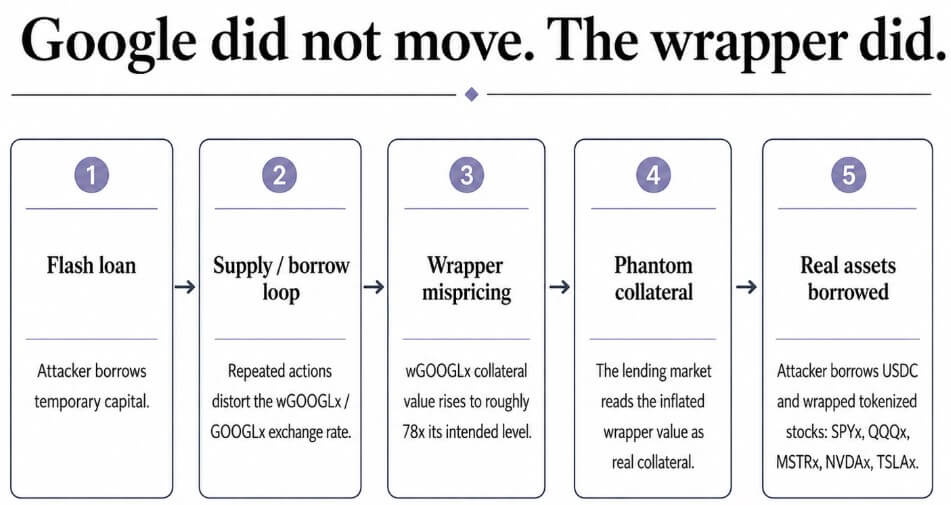
The attack manipulated the exchange rate between wGOOGLx, a wrapped version of Edel’s tokenized Google stock, and GOOGLx, the token it wraps. Edel said the manipulation pushed wGOOGLx’s collateral value to roughly 78 times its correct level.
SlowMist traced the root cause to Edel’s price source, which used latestAnswer() to return an ERC-4626-style vault’s convertToAssets() rate. That conversion rate can be manipulated when an attacker controls enough of the underlying flow, and Edel’s price feed reads it directly.
CertiK described the same flaw from the lending side: the attacker manipulated wGOOGLx’s collateral price, which tracked its GOOGLx balance, then borrowed against the inflated value.
GoPlus noted that the attacker used a flash loan to repeatedly supply and borrow, distorting the wGOOGLx/GOOGLx conversion rate. The inflated collateral then supported real borrowed assets, including 384,215 USDC and wrapped positions in SPYx, QQQx, MSTRx, NVDAx, and TSLAx.
Security firms published different estimates. Cyvers put the loss at roughly $353,000, GoPlus cited about $403,000 in losses and roughly $305,000 in attacker profit, and CertiK put the drained funds at roughly $204,000.
The gap appears to reflect different measurements, including bad debt, gross loss, and net attacker profit.
The disconnect probably comes from each firm measuring something different, such as bad debt, gross loss, or net profit.
The critical failure sat in the exchange rate between the wrapped token and its underlying counterpart, a relationship that Edel’s lending market priced as though it were stable. Alphabet’s share price did not drive the exploit.
RWA.xyz puts tokenized stocks’ onchain value at $1.7 billion, up 2.17% over the past 30 days. Monthly transfer volume sits at $8.92 billion, and holders at over 396,000.
xStocks alone lists more than 100 stocks and ETFs across more than 50 integrated platforms, with over $25 billion in total transaction volume. It describes itself as fully backed and open to plugging into any DeFi protocol without permission.
Backed, the issuer behind xStocks, markets the tokens explicitly for DeFi use: lending tokenized Apple shares or borrowing against them without selling.
Kamino says it became the first major lending protocol to accept tokenized equities as collateral, allowing users to deposit tokens such as SPYx, QQQx, GOOGLx, AAPLx, NVDAx, TSLAx, MSTRx, and HOODx to borrow stablecoins or earn yield.
Robinhood launched stock and ETF tokens for EU customers in June 2025, then opened a public testnet for Robinhood Chain. The network is an Ethereum layer-2 built on Arbitrum, designed around tokenized real-world assets including equities, ETFs, and private assets.
The selling point across all of this is the same: tokenized stocks should move and connect like any other crypto asset. Edel is a reminder that once they move like crypto, they can also break like crypto.
| Market layer | What it enables | Examples from the article | Risk Edel exposed |
|---|---|---|---|
| Access | Users gain exposure to stocks and ETFs onchain. | Robinhood stock and ETF tokens for EU customers; xStocks’ 100+ stocks and ETFs. | Legal and issuer-level backing are necessary, but not sufficient. |
| Trading | Tokenized stocks move across venues, chains, and DeFi platforms. | xStocks across 50+ integrated platforms; $25B+ total transaction volume. | More integrations create more pricing and liquidity dependencies. |
| Collateral | Users borrow against tokenized equities. | Kamino accepting SPYx, QQQx, GOOGLx, AAPLx, NVDAx, TSLAx, MSTRx, HOODx. | Wrapped versions, vault exchange rates, and oracle paths can become attack surfaces. |
| Future derivatives | Tokenized equities become inputs for structured products and leverage. | Implied next phase as collateral markets mature. | A wrapper or oracle failure can spread beyond one lending market. |
A lending market prices several layers, such as the tokenized equity itself, the wrapped version built on top of it, and the exchange rate a vault uses to convert between the two.
It also prices the oracle path that reports a value, the lending market’s own borrowing limits, and whether that collateral can actually be sold during a period of stress. Edel’s exploit sat almost entirely in the wrapper and oracle layers.
Using a tokenized stock as collateral adds a second pricing problem on top of the equity itself. A protocol also has to price every on-chain representation built around that stock, including how a wrapper’s exchange rate behaves under stress. That exposure comes from the collateral integration built around a tokenized stock.
Flash loans, collateral manipulation, and ERC-4626 exchange-rate attacks have all shown up in DeFi exploits before. This exploit’s novelty lies in the asset class these techniques target, and it appears to be one of the first clear tokenized-stock-collateral exploits on record.
In the bull case, protocols spend the next year isolating wrapper risk. That means capping how much collateral in a lending market can come from wrapped tokenized stocks, separating issuer-level prices from wrapper exchange rates, and building oracle paths that a single flash loan cannot move.
Tokenized equities then become credible collateral for conservative borrowing against liquid names like Apple, Nvidia, Tesla, and Google. Edel ends up remembered as the early failure that forced better design before the category scaled.
In the bear case, listings outrun the risk work. More venues accept tokenized stocks as collateral before oracle design and wrapper isolation catch up.
The number of wrapped tokens, bridges, and vaults built around each ticker keeps multiplying faster than anyone can audit them.
Along that path, more exploits in the low hundreds of thousands of dollars continue to surface involving exchange-rate manipulation and thin liquidity. Tokenized stocks have become a security flashpoint over how DeFi protocols use them as collateral.
The first phase of tokenized stocks was access: letting eligible users hold tokenized exposure to names such as Apple or Google. The second phase was trading, which involved making that claim move across chains around the clock.
| Scenario | What has to happen | Market outcome | What Edel becomes in hindsight |
|---|---|---|---|
| Bull case: safer collateral markets | Protocols isolate wrapper risk, cap collateral exposure, separate issuer prices from wrapper exchange rates, and harden oracle paths. | Tokenized equities become credible collateral for conservative borrowing against liquid names like Apple, Nvidia, Tesla, Google, SPY, and QQQ. | An early failure that forced better design before the category scaled. |
| Base case: slower collateral adoption | Lending markets keep tokenized stocks in isolated pools with conservative loan-to-value ratios and tight caps. | Tokenized stocks grow mainly as trading assets, while borrowing use cases expand gradually. | A warning label that slows leverage but does not stop the market. |
| Bear case: listings outrun risk controls | More venues accept tokenized stocks and wrapped variants before oracle design and wrapper isolation improve. | More small-to-mid exploits appear around exchange-rate manipulation, thin liquidity, bridges, and vault accounting. | The first visible sign that tokenized-stock collateral became a security flashpoint. |
Edel arrived at the start of the third phase, collateral, where holding a tokenized stock also allows borrowing against it.
The first two phases of tokenized stocks rewarded whoever listed the most tickers or reached the most chains. The next one rewards whoever can price a wrapped stock correctly under stress, every time.

Open Standard’s Open USD is trying to make the stablecoin yield fight about distribution before the token is live.
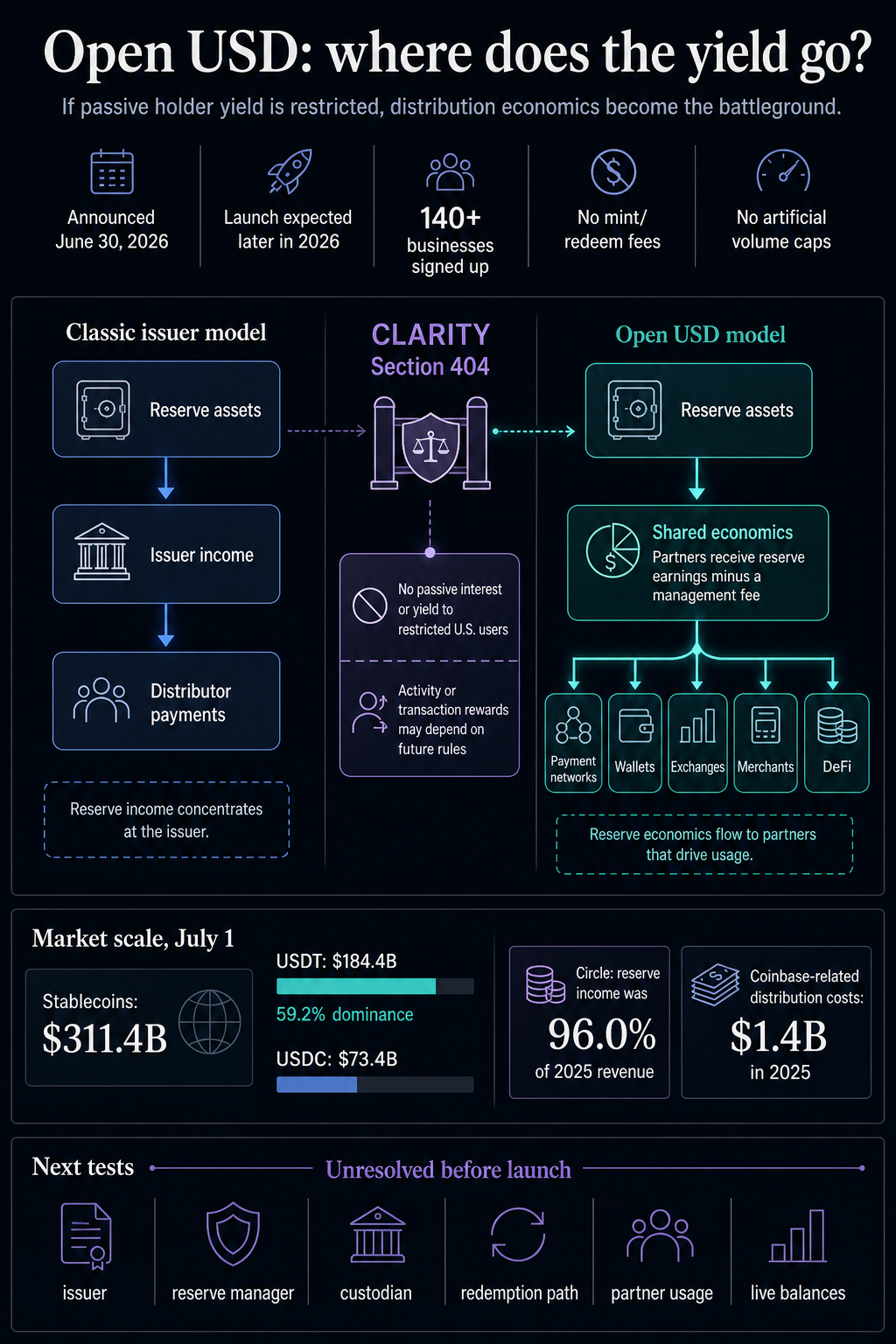
The company announced Open USD on June 30 as a stablecoin for global money movement. Its headline feature is a reserve-sharing model: businesses can mint and redeem at no cost, without artificial volume caps, while partners receive reserve earnings minus a small management fee.
Open Standard also says Open USD will be operated by an independent company with partner-led governance. Founding CEO Zach Abrams framed the product as a stablecoin built by and for the businesses that will use it.
Open USD has yet to show live supply, redemption history, reserve attestations, or a visible place in stablecoin market tables. It is expected to launch later in 2026.
Even so, its stated design points directly at the most contested part of the stablecoin business: reserve economics.
If U.S. rules limit passive yield to stablecoin holders, Open USD‘s bet is that the fight moves elsewhere. Instead of paying users to sit on tokens, the economic value can flow to merchants, payment processors, wallets, exchanges, marketplaces, DeFi venues, and other companies that drive transaction volume.

Open Standard’s pitch is simple in public but aggressive in market structure. It describes Open USD as shared infrastructure and says participants can earn revenue based on usage.
Its announcement lists more than 140 businesses across payments, finance, technology, commerce, and crypto, including Visa, Stripe, Mastercard, BlackRock, BNY, Google, Coinbase, Solana, Base, Aave, Ripple, Fireblocks, Shopify, and DoorDash.
The partner list maps where the economics could flow. Payment networks control merchant access. Exchanges and wallets control where balances sit. Marketplaces control payout flows.
DeFi protocols control liquidity venues, while banks and asset managers control the plumbing for trust, custody, and reserves. If those firms can share in reserve economics, a stablecoin issuer’s traditional advantage becomes a distribution negotiation.
That is why Open USD reads as an attempt to turn stablecoin float into partner compensation. In the classic model, reserve income is the issuer’s economic engine.
In Open Standard’s stated model, most of that value is supposed to return to the companies that adopt and distribute the stablecoin.
The caveat is large. Open Standard’s public materials say reserves are maintained at major financial institutions in compliance with U.S. regulatory requirements, but they have yet to fully identify the legal issuer, reserve manager, custodian, redemption counterparties, or reserve composition.
Those details determine whether the model can satisfy both compliance and marketing teams.
The strongest economic comparison is Circle. Circle’s 2025 Form 10-K says reserve income represented 96.0% of 2025 revenue and that reserve income depends on stablecoins in circulation and the reserve return rate.
The filing also shows that distribution is already expensive. Circle reported $1.4 billion of Coinbase-related distribution costs in 2025 and described allocations to Coinbase tied to USDC held on Coinbase’s platform and broader ecosystem growth.
Coinbase’s 2024 Form 10-K tells the other side of the same arrangement. Coinbase says its stablecoin revenue from Circle is determined by daily income generated from USDC reserves.
That revenue has exposure to USDC market capitalization, platform balances, approved ecosystem participants, deducted expenses, and interest rates.
Those filings make Open USD’s market signal sharper. Reserve economics are already moving between issuer and distributor in USDC’s ecosystem.
Open USD proposes to make that bargain more explicit and more widely available to the companies that can drive usage.

Tether sits in a different category. DeFiLlama stablecoin data showed a total stablecoin market capitalization of near $311.4 billion on July 1, with USDT at around $184.4 billion and 59.2% dominance, while USDC was at around $73.4 billion.
CryptoSlate’s market pages showed a similar gap, with USDT having a far higher 24-hour trading volume than USDC, at $67 billion in exchange volume and $1.5 billion in DEX volume. USDC recorded a sizeable yet smaller $10.8 billion in exchange volume and $1.9 billion in DEX volume.
Tether’s moat extends beyond reserve yield. It is offshore dollar liquidity, exchange integration, settlement habit, and deep trading-pair usage.
Open USD can pressure that over time only if it becomes liquid across venues and geographies. Its earlier challenge is to Circle’s institutional claim that USDC is the default regulated stablecoin rail for businesses that need compliance, transparency, and distribution.

The policy backdrop gives Open USD its opportunity.
Section 404 of the Senate Banking Committee’s Digital Asset Market Clarity Act draft would prohibit covered parties from paying direct or indirect interest or yield tied to payment stablecoin balances to restricted U.S. customers or users.
The same section preserves room for bona fide activity-based or transaction-based rewards under future rules.
That distinction is where Open USD fits the current debate. If law and regulators draw a hard line around passive, deposit-like yields to holders, the market still has to decide whether businesses can be rewarded for actual distribution, transactional activity, or commercial use.
Open USD’s shared-economics model sits in that zone.

Open USD functions as a policy stress test. Its public materials describe partner economics and distribution incentives, while the final treatment of merchant rewards, exchange incentives, wallet rebates, and partner revenue shares depends on law, rulemaking, and program design.
The White House Council of Economic Advisers has argued that a prohibition on yield-bearing stablecoins would do little to protect bank lending while sacrificing consumer benefits.
The Bank Policy Institute has argued the opposite: that yield-bearing stablecoins can reduce deposits and lending after households and businesses adjust their balance sheets.

Open USD leaves that fight open. It changes the underlying business question.
If the law makes passive user yield harder, the next fight may be over whether reserve economics can be paid to the companies that enable stablecoin transactions.
That creates the tension Open USD is built around. A holder reward looks like a consumer finance product; a partner revenue share looks like a commercial distribution arrangement.
The final rules will determine how much distance must exist between those categories, which parties can receive economic benefits, and what disclosures or controls companies need before reserve value can flow back to platforms that originate usage, rather than directly to end users.
That makes rule-writing important for each link in the distribution chain. A payment network, wallet, exchange, or marketplace can all help generate usage, but their incentives may be reviewed differently depending on who receives the payment and whether it reaches restricted U.S. users.
Open Standard’s partner list is unusually strong; reported balances remain the adoption test.
The launch test is practical. The market needs to see who issues Open USD, where the reserves sit, what backs them, how redemptions work, which chains launch first, which partners actually route money through it, and whether balances appear in market data after launch.
Until then, Open USD remains a serious proposal with credible distribution names and the incumbent test still ahead.
The implication is practical. Open USD can pressure Circle by turning USDC’s existing reserve-income bargaining problem into a product feature.
It can pressure stablecoin regulation by showing that yield debates extend beyond the holder’s wallet. It can pressure payment and merchant platforms by giving them a reason to treat the choice of stablecoin as an economic decision, alongside infrastructure and compliance.
The model still has to prove that the partner board, reserve structure, compliance model, redemption path, and actual usage can survive launch.
If that evidence never appears, the announcement remains a warning shot. If it does, the stablecoin war shifts from a fight over which issuer keeps the float to a fight over which network can share it without breaking the rules.


