Bernstein sees Robinhood’s crypto business shifting toward infrastructure as new products like prediction markets and perps gain ground.


 Live Chat
Bernstein sees Robinhood’s crypto business shifting toward infrastructure as new products like prediction markets and perps gain ground.
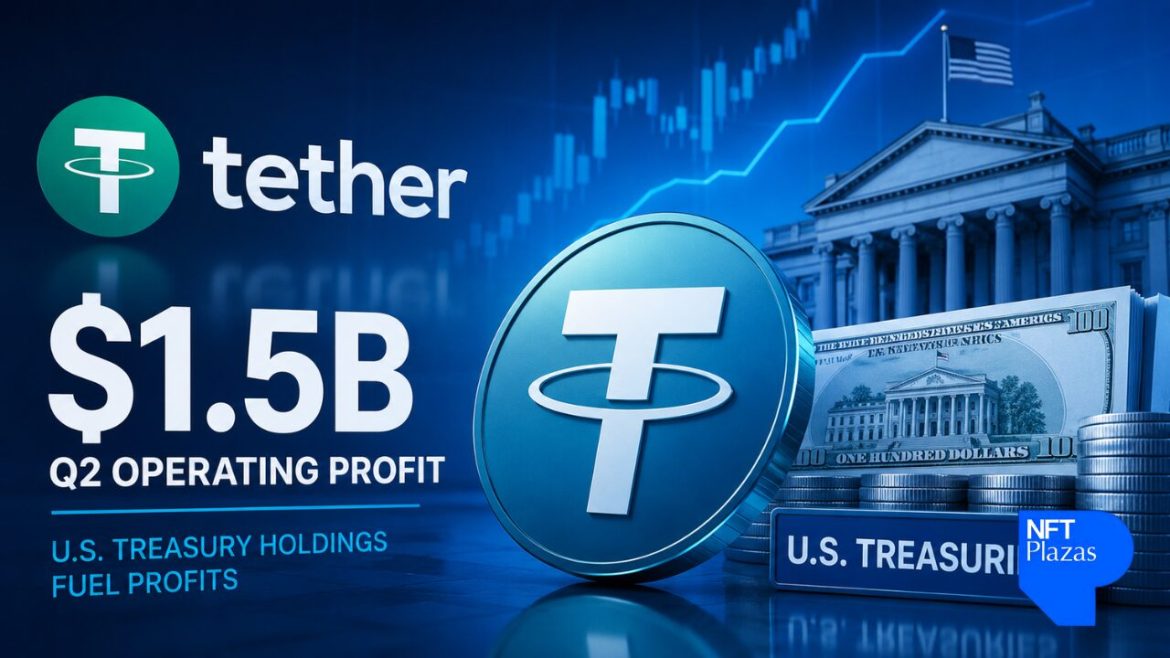
Tether, the issuer of the world’s largest stablecoin USDT, reported $1.5 billion in net operating profit for the second quarter of 2026, as returns from its U.S. Treasury portfolio continued to power earnings despite declines in the value of its Bitcoin and gold holdings.
According to the company’s latest quarterly attestation, verified by BDO, Tether held $187.75 billion in total assets against $183.64 billion in liabilities as of June 30, leaving $4.11 billion in excess reserves backing USDT. However, that reserve cushion fell sharply from more than $8.23 billion reported three months earlier, marking a decline of over $4 billion.

Tether earns $1.5B in Q2 2026
Tether said its earnings were primarily generated from income on U.S. Treasury bills and repurchase agreements (repos), which remain the foundation of its reserve strategy. The company has become one of the world’s largest holders of U.S. government debt among private firms, benefiting from elevated short-term interest rates that continue to generate strong recurring income.
Chief Executive Officer Paolo Ardoino said the second quarter tested Tether’s reserve strategy under difficult market conditions.
He acknowledged that some reserve assets were negatively affected during the quarter but stressed that USDT remained fully backed with more than $4 billion in excess reserves. Ardoino also highlighted Tether’s continued purchases of U.S. Treasuries, a reduction in secured lending exposure to $2.38 billion, and an increase in the company’s gold holdings.
One notable change in the Q2 report was Tether’s decision to report “net operating profit” instead of the “net profit” figure used in previous quarters.
The distinction is significant because operating profit excludes unrealized gains and losses from assets owned by the company, including Bitcoin and gold. Both assets lost value during the second quarter, meaning the reported operating profit does not capture the impact of those market declines.
The shift has drawn attention from industry observers, with some arguing it provides a clearer picture of Tether’s core business performance, while others believe it makes comparisons with previous quarterly reports less straightforward.
Tether continued expanding its reserve assets during the quarter despite falling market prices.
The company increased its physical gold holdings by approximately 14 metric tons, bringing total reserves to around 146.2 metric tons, up from 132.2 metric tons in the previous quarter. However, the value of those holdings declined to $18.84 billion from $19.84 billion as gold prices fell roughly 15% during the reporting period.
Tether also added approximately 1,796 BTC, increasing its Bitcoin holdings to 98,933 BTC. Even so, the reported value of its Bitcoin reserves fell to $5.80 billion, down from $6.62 billion, because the valuation price used in the report dropped to about $58,600 per BTC from $68,200 in Q1.
The lower valuations reflected market prices rather than asset sales, with Tether continuing to accumulate both assets during the quarter.

Tether’s Q2 2026 (left) and Q1 2026 (right) reserve asset reports.
Despite softer conditions across the broader crypto market, demand for USDT remained resilient.
Tether reported that the circulating supply of USDT increased by approximately $446 million during the quarter to $184.6 billion, allowing the company to maintain its position as the world’s largest stablecoin issuer with more than 60% of the global stablecoin market.
The steady growth highlights continued demand for dollar-backed digital assets across cryptocurrency trading, payments, and decentralized finance.
While Tether remained highly profitable, the most closely watched figure in the report was the sharp decline in excess reserves.
The company’s reserve surplus fell from more than $8.2 billion at the end of the first quarter to $4.1 billion by June 30. Tether did not explain the reason for the reduction, prompting questions about how capital was deployed during the quarter.

Tether’s Q2 2026 (left) and Q1 2026 (right) financial reports.
The lower reserve cushion also coincided with declines in the value of Bitcoin and gold, both of which fell by more than 10% during the period. Because Tether reported operating profit rather than net profit, those unrealized losses were excluded from its headline earnings.
Even so, the company emphasized that its assets continue to exceed liabilities by billions of dollars, ensuring that every USDT in circulation remains fully backed.
The latest results reinforce the strength of Tether’s Treasury-focused business model, which continues to generate significant income even during periods of crypto market weakness. At the same time, the shrinking reserve surplus and the company’s shift in reporting methodology are likely to remain key areas of scrutiny as investors and regulators continue to monitor the financial health of the world’s largest stablecoin issuer.

Start every day with the top news stories right now, plus original features, a podcast, videos and more.

Dubai, United Arab Emirates, July 22nd, 2026, Chainwire
Bybit, the world’s second-largest cryptocurrency exchange by trading volume, has launched Stock Earnings Season from July 21 to August 30, 2026, aligned with one of the most concentrated stretches of quarterly earnings reporting on the financial calendar.
Global investors are in full gear as the Q2 earnings season unfolds on Wall Street, bracing for potential gains and corrections of some of the biggest names in tech, AI, and semiconductors. Through the new program, Bybit brings together the community in fostering disciplined trading, encouraging informed decision-making and responsible investing habits.
The program kicks off as Tesla is scheduled to post earnings on July 22, followed by Alphabet on July 23. It continues through a series of high-profile earnings dates over the following six weeks, including Meta, Apple, Amazon, SPCX, Nvidia, Microsoft, Micron and SanDisk, covering the most anticipated earnings announcements for equities traders.
How it works:
Once enrolled, participants can earn points by trading across Bybit’s expansive product suite offering global equities exposure, which includes spot, derivatives, Bybit Alpha, and Bybit TradFi stock CFD trading. Points accumulated over the course of the event count toward a leaderboard, where the top 200 participants will share a reward pool of up to 1 million USDT.
In addition to select airdrop rewards, points can also be redeemed through a rewards store stocked with a Tesla Cybertruck, an iPhone 17 Pro Max, a GeForce RTX 5060 Ti graphics card, Ray-Ban Meta smart glasses, Google AI Ultra membership access, and USDT.
The limited-time event was curated to reflect a broader shift underway across financial markets, as traditional financial assets and crypto trading infrastructure continue to interact and converge. Tokenized equities, stock-related perpetual contracts, and other traditional finance instruments are increasingly moving onto crypto-native platforms, placing a premium on exchanges with deep liquidity, established risk infrastructure and the ability to support both asset classes under one system.
Bybit has continued to expand its TradFi and stock-themed product line alongside its core crypto offerings, positioning itself to serve both crypto-native traders and users engaging with tokenized traditional assets for the first time.
Terms and conditions apply. For more details on eligibility and potential restrictions, users may visit: Stock Earnings Season – Win a Cybertruck
#Bybit / #NewFinancialPlatform
About Bybit
Bybit is The New Financial Platform.
We believe every person should have access to every financial opportunity on earth. That’s why we’re building the first intelligent platform that connects anyone, anywhere to the world’s finance.
Trusted by more than 80 million users worldwide, Bybit brings together investing, trading, payments, and wealth-building in a single secure and intelligent ecosystem. Through the combination of AI-powered technology, deep global liquidity, robust security, and transparent operations, Bybit makes global finance more accessible, efficient, and empowering for everyone.
Built for everyone. Powered by intelligence. Open to the world.
Learn more at Bybit.com
For more details about Bybit, please visit Bybit Press
For media inquiries, please contact: media@bybit.com
For updates, please follow: Bybit’s Communities and Social Media
Discord | Facebook | Instagram | LinkedIn | Reddit | Telegram | TikTok | X | Youtube
Head of PR
Tony Au
Bybit
tony.au@bybit.com
Victoria, Seychelles, June 26th, 2026, Chainwire
MEXC, a pioneer in 0-fee digital asset trading, releases its observations on equity-related futures trading activity around Micron’s (MU) earnings report. Micron posted quarterly revenue of approximately $41.4 billion, significantly exceeding market expectations. Following the earnings release, capital concentrated into AI memory and storage, with notable increases in trading activity across related instruments.
Micron was the most-traded stock and equity index futures instrument on MEXC, with trading volume up approximately 142% from the previous day. SanDisk, SK hynix, and DRAM ETF also recorded volume increases of approximately 83%, 28%, and 35%, respectively. Together, these four AI memory and storage instruments accounted for 44% of the day’s Top 10 equity-related futures volume, underscoring the market’s heightened focus on the sector.
Beyond memory and storage, AI compute and semiconductor names such as NVIDIA and SOXL, as well as index futures including SPX500, NAS100, and US30, also maintained elevated trading activity. The momentum sparked by Micron’s earnings was not confined to AI memory and storage, but extended across compute, semiconductors, and broader U.S. equity indices.
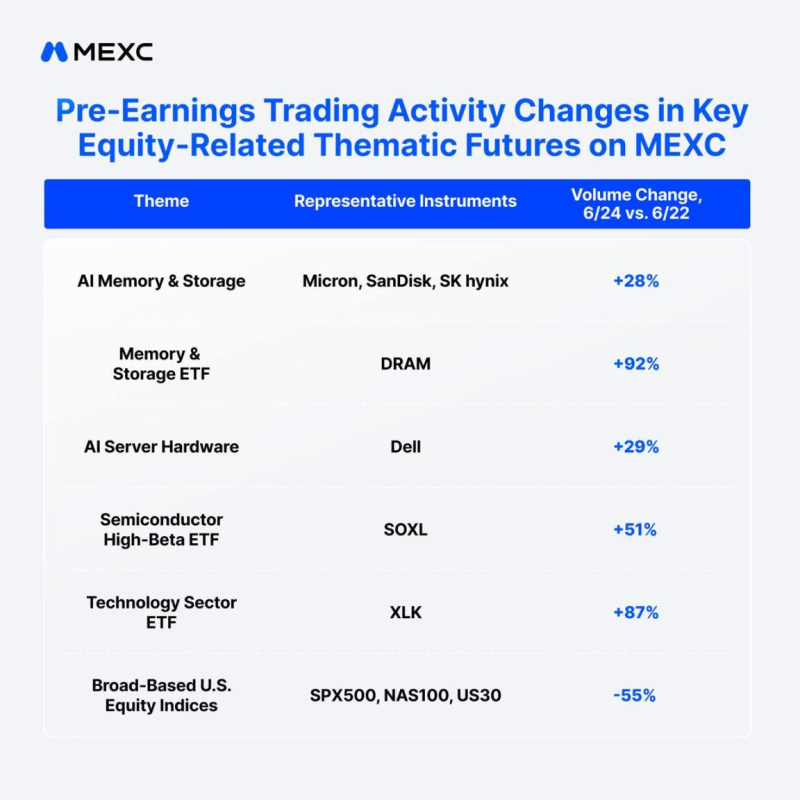
Ahead of the earnings release, thematic trading patterns were already visible on the MEXC platform. From June 22 to 24, AI memory and storage individual stocks (+28%), DRAM ETF (+92%), and SOXL (+51%) all recorded meaningful volume increases, while broad-based U.S. equity index futures declined approximately 55% over the same period. This indicates that capital was not indiscriminately going long on U.S. equities, but had already concentrated on the supply-constrained memory and storage segment ahead of the earnings announcement.
For high-profile macro or earnings events, MEXC futures trading enables users to extend trading opportunities across the full cycle of anticipation, realization, and follow-through — positioning ahead of earnings and responding or hedging immediately after results are released. MEXC offers more than a single-instrument entry point: within a unified account and USDT-margined system, users can flexibly adjust positions across single-stock futures, related supply-chain names, sector and thematic ETFs, and index futures as market themes evolve, without transferring capital between platforms. Combined with a 0-fee structure, the friction cost of switching across instruments is further reduced. Notably, the AI memory and storage sector itself spans three markets — Micron is U.S.-listed, SK hynix and Samsung are Korea-listed, and Kioxia is Japan-listed. MEXC currently covers futures across all three markets, enabling users to build positions across national markets along the same industry logic.
Beyond earnings-driven secondary market trading, MEXC also extends asset discovery to the pre-IPO stage of technology companies. SpaceX (PRE), the first instrument on the platform’s Pre-IPO Launchpad, attracted cumulative subscription volume exceeding US$173 million across two rounds. Since SpaceX completed its IPO on June 12, secondary market prices reached as high as 217 USDT, approximately 67% above the subscription price. This demonstrates that from Pre-IPO subscription through secondary market trading, the entire process offers continuous and sufficient liquidity. Through MEXC, users can participate across different stages of a single core asset on one platform.
As market trading demand becomes increasingly cross-asset and cross-regional, MEXC bridges Pre-IPO, secondary market, and futures trading, connecting globally sought-after instruments to offer users a one-stop U.S. equity trading platform. Going forward, MEXC will continue to identify high-quality assets, enabling global users to capture unlimited opportunities with minimal friction and maximum capital efficiency.
About MEXC
MEXC is the world’s fastest-growing cryptocurrency exchange, trusted by more than 40 million users across 170+ markets. Built on a user-first philosophy, MEXC offers industry-leading 0-fee trading and access to over 3,000 digital assets. As the Gateway to Infinite Opportunities, MEXC provides a single platform where users can easily trade cryptocurrencies alongside tokenized assets, including stocks, ETFs, commodities, and precious metals.
MEXC Official Website| X | Telegram |How to Sign Up on MEXC
For media inquiries, please contact MEXC PR team: media@mexc.com
Risk Disclaimer:
This content does not constitute investment advice. Given the highly volatile nature of the cryptocurrency market, investors are encouraged to carefully assess market fluctuations, project fundamentals, and potential financial risks before making any trading decisions.
MEXC PR team
media@mexc.com

SoFi Technologies reported record fourth-quarter revenue of $1 billion as the US fintech bank reintroduced consumer crypto-based products.
According to its earnings report released Friday, adjusted net revenue rose 37% year-on- year to $1 billion, while GAAP net income reached $173.5 million in the last quarter. Adjusted earnings before interest, taxes, depreciation and amortization (EBITDA) increased 60% to $317.6 million.
SoFi reported total fee-based revenue of a record $443 million for the quarter, and total members grew about 35% to 13.7 million. SoFi added 1.6 million new products in the quarter, driving total financial services products up 38% year over year to 17.5 million. The company logged 63,441 crypto products following its Dec. 22 launch, though that figure reflects activity from Dec. 22–31 and is not representative of a full quarter.
The results come after SoFi’s return to the cryptocurrency market, following a pullback in November 2023.
In June, the company reintroduced crypto trading, allowing customers to buy, sell and hold digital assets. It also rolled out blockchain-powered remittances, which have expanded to more than 30 countries, according to the company.
In December, SoFi launched SoFiUSD, a US dollar–backed stablecoin issued by its banking subsidiary, SoFi Bank.
Related: Nubank wins conditional US approval to form national bank
US banks are increasingly taking pro-crypto steps. In May, several of the largest US banks began discussing a potential joint stablecoin initiative. The report said companies affiliated with JPMorgan Chase, Bank of America, Citigroup and Wells Fargo have held preliminary talks on jointly issuing a dollar-pegged crypto stablecoin.
In October, JPMorgan Chase said it plans to offer cryptocurrency trading, while ruling out direct crypto custody in the near term. Speaking on CNBC’s Squawk Box Europe, the bank’s global head of markets and digital assets, Scott Lucas, said JPMorgan is assessing trading services and potential third-party custodians.
On Jan. 23, UBS began exploring plans to offer crypto trading to its wealthiest clients.The Swiss banking giant would initially allow select private-banking clients in Switzerland to trade Bitcoin (BTC) and Ether (ETH), with a potential expansion to Asia-Pacific and the US at a later stage.
In an X post on Saturday, Coinbase CEO Brian Armstrong said that conversations with bank executives at the World Economic Forum in Switzerland revealed a shift in tone. He said most of the bank CEOs he met were “actually very pro crypto and are leaning into it as an opportunity (some aren’t quite there yet).”
Magazine: Davinci Jeremie bought Bitcoin at $1… but $100K BTC doesn’t excite him

Brian Armstrong, the chief executive of Coinbase Global, brushed off a viral moment from the company’s latest earnings call, writing on X that the episode “was fun” and “happened spontaneously when someone on our team dropped a [prediction markets] link in the chat.”
The comment came a day after Armstrong ended Coinbase’s third-quarter earnings call by deliberately mentioning several crypto buzzwords, instantly deciding the outcome of multiple prediction markets that had been tracking whether he would say them.
lol this was fun – happened spontaneously when someone on our team dropped a link in the chat https://t.co/tQiV3B9jUj
— Brian Armstrong (@brian_armstrong) October 31, 2025
During the call, after discussing the exchange’s financial results, Armstrong said:
“I was a little distracted because I was tracking the prediction market about what Coinbase will say on their next earnings call. And I just want to add here the words Bitcoin, Ethereum, blockchain, staking and Web3 — make sure we get those in before the end of the call.”
That single line settled bets on two platforms — Kalshi and Polymarket — where traders had wagered on whether those terms would be used.
$80,933 in total volume was traded on Kalshi, while roughly $4,000 was traded on Polymarket. The outcome instantly paid those who had bet “yes” and wiped out the opposing side. One Polymarket user described the result as “Absolute cinema moment.”
The quip came at the end of an otherwise solid quarter for Coinbase.
The company’s financials, however, were quickly eclipsed online by Armstrong’s closing words — a moment that briefly turned an investor call into an interactive event for crypto traders.
Both Kalshi and Polymarket promptly resolved the relevant contracts following the call. There has been no indication that either platform viewed the incident as a violation of its rules.
Armstrong’s follow-up post on X confirmed that the decision to speak the words was unscripted, coming only after someone on the team noticed the live wagers.
For most traders, the exchange chief’s remark became a quirky footnote — one that showed how even a few seconds on a corporate call can ripple across the growing world of real-money prediction markets.
James Ding
Oct 16, 2025 21:05
Riot Platforms, a leader in Bitcoin mining, has announced its Q3 2025 earnings call scheduled for October 30, 2025, as the company continues its expansion in data centers and mining operations.
Riot Platforms, Inc. (NASDAQ: RIOT), a prominent player in Bitcoin mining and the development of large-scale data centers, has announced its third quarter 2025 earnings conference call. The call is scheduled for October 30, 2025, at 4:30 P.M. EST, during which the company will discuss its financial results for the quarter ended September 30, 2025, according to riotplatforms.com.
The conference call will be accessible via an audio-only webcast. Interested participants can register through the provided links for both the U.S. and international calls. A replay of the webcast will be available following the conclusion of the call.
Riot Platforms continues to assert its vision of being the world’s leading Bitcoin-driven infrastructure platform. The company operates Bitcoin mining facilities in Texas and Kentucky, with additional electrical engineering and fabrication operations in Denver, Colorado, and Houston, Texas. Riot’s focus remains on a vertically integrated strategy to expand its influence in the digital infrastructure sector.
As the cryptocurrency market evolves, companies like Riot Platforms are strategically positioning themselves to capitalize on the growing demand for high-performance computing and digital currency mining. The company’s ongoing expansion efforts in its mining facilities and infrastructure indicate a robust growth trajectory.
Riot Platforms’ continued investment in infrastructure and technology signifies its commitment to maintaining a competitive edge in the Bitcoin mining industry. The anticipated earnings call will likely provide insights into how these strategic initiatives are impacting the company’s financial performance and future outlook.
Image source: Shutterstock


