Crypto infrastructure providers are drawing renewed investor interest as Wall Street deepens its push into digital assets.
drops
Bitcoin (BTC) extended its two-day decline on Wednesday after the Federal Open Market Committee (FOMC) minutes confirmed the Fed’s decision to hold “the target range for the federal funds rate at 3-½ to 3-¾ percent.”
While the Fed maintains its goal of achieving “maximum employment and inflation at the rate of 2 percent over the longer run,” the FOMC minutes cited the “developments in the Middle East” as factors fueling an environment of “uncertainty” and the Fed stressed its desire to maintain optionality as it evaluates the “risks to both sides of its dual mandate.”
FOMC minutes with new statements in red. Source: CNBC
The Fed’s hold on rates aligned with market expectations, but Bitcoin remained fragile throughout Chairman Powell’s presser.
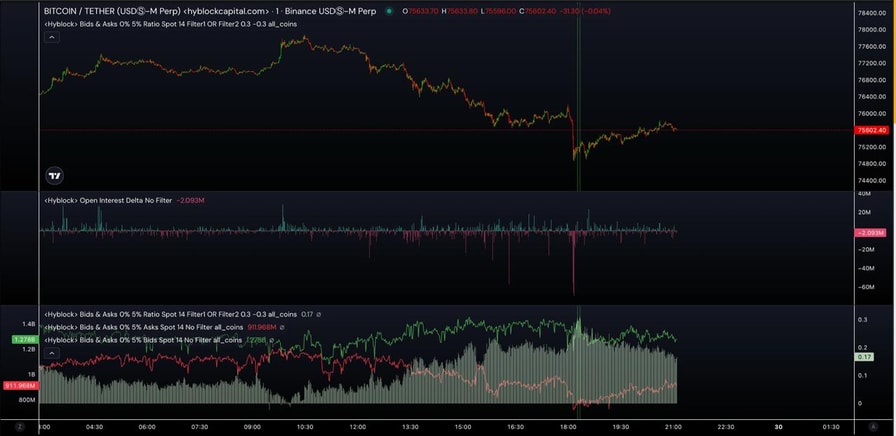
Hyblock CEO Shubh Varma described the price action as “the usual sell the news reaction after the FOMC,” but also noted that BTC “quickly recovered to pre-announcement levels within hours, showing strong underlying conviction.”
Adding data to back his market view, Varma said,
“The global bid ask ratio spiked to 0.3 (one of the highest readings), while open interest fell on the price drop. This is classic post-FOMC position squaring and stop-hunt behavior rather than conviction selling.”

BTC/USDT global bid ask ratio. Source: Hyblock
Will support turn back into resistance?
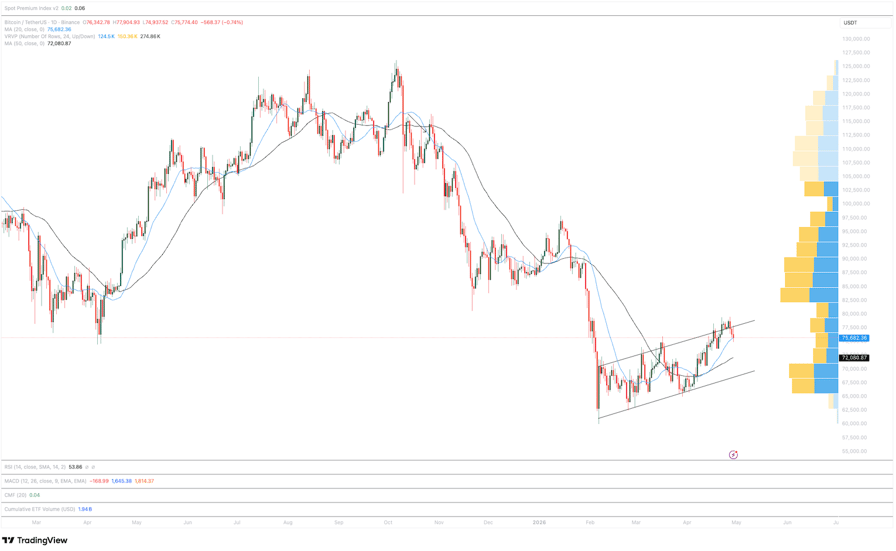
After the FOMC minutes were published, BTC dropped to an intra-day low of $74,937, slightly below the 20-day simple moving average ($75,664) that some traders identified as critical to confirming BTC’s support-resistance flip.
As reported on Monday by Cointelegraph, following the break above the channel resistance on the daily chart, BTC required consecutive daily candle closes above the trendline, followed by a lower support restest in the $76,500 to $75,500 range.

BTC/USDT 1-day chart. Source: TradingView
While all the above have happened, failure to recapture the 20-MA and close above the trendline resistance could be interpreted as a loss of momentum within the bull trend, opening the path for Bitcoin to test the downside boundary of the near-4-month-old channel.
Related: Bitcoin falls as traders cut risk ahead of FOMC: Will Tradfi, spot ETF volumes bolster $70K support?
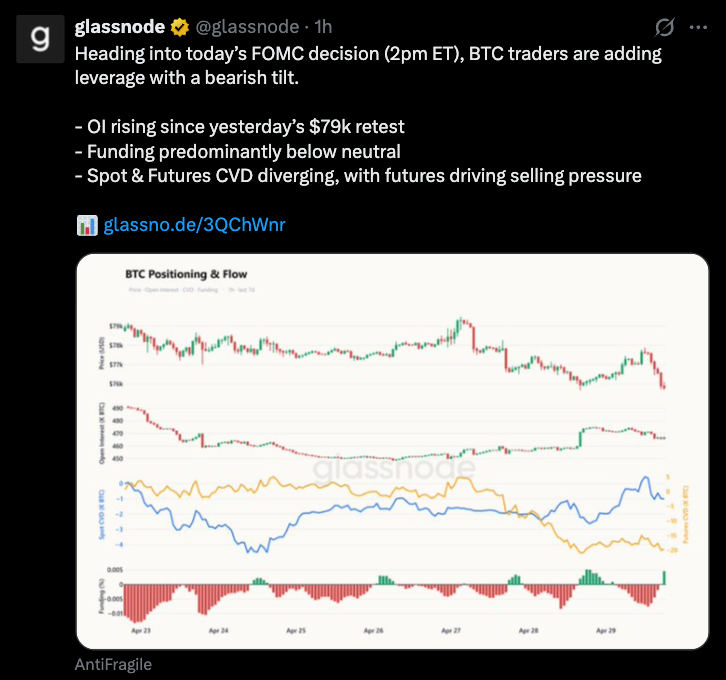
Prior to the Chairman Powell’s presser, Glassnode analysts noticed that Bitcoin traders were adding bearish leverage, citing rising open interest after Tuesday’s rally to $79,000, funding remaining neutral and a divergence between the spot and futures market cumulative volume delta (CVD).

Bitcoin traders turn bearish ahead of FOMC minutes. Source: Glassnode / X
Additional analysis from Glassnode’s The Week Onchain report depicted Bitcoin’s price action as “trapped below market mean,” where $65,000 to $70,000 act as support, but weak demand prevents the formation of sustainable rallies.
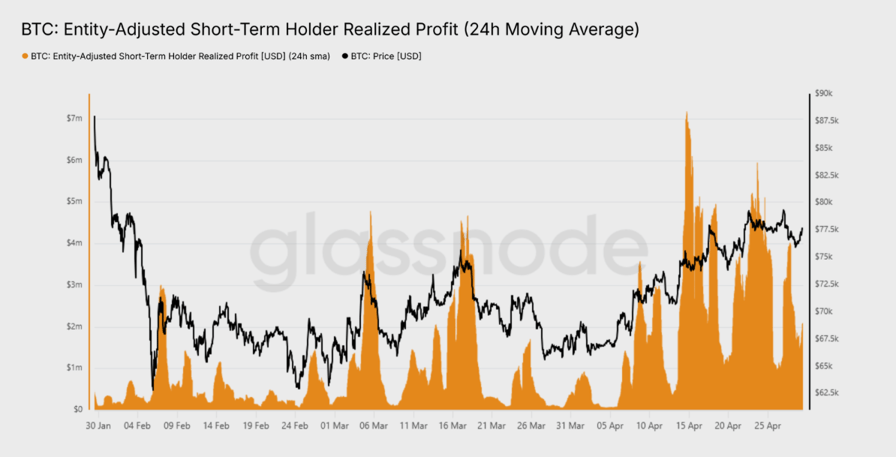
According to the report, Bitcoin failed to overcome its True Market Mean at $79,000 and a surge in short-term holders’ profit taking, along with margin futures flipping net short, has sapped away Bitcoin’s shorter-term bullish momentum.

BTC entity-adjusted short-term holder realized profit. Source: Glassnode
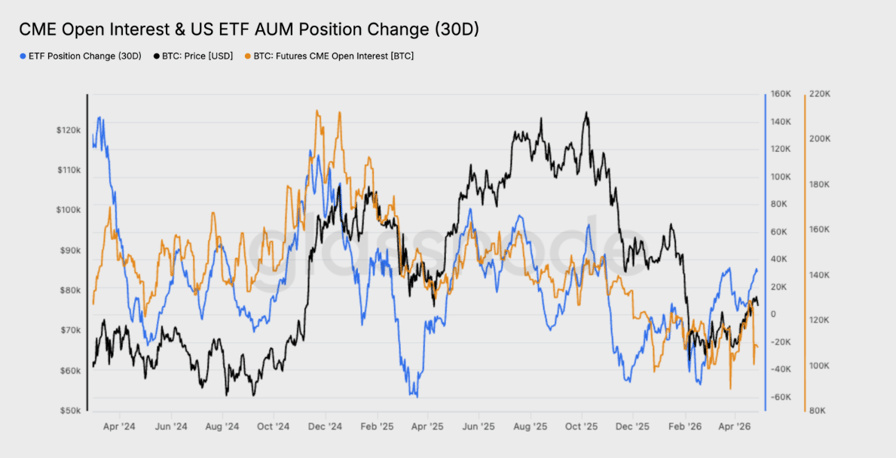
While these factors increase Bitcoin’s sensitivity to a sharper downside move, the analysts said institutional flows into the spot BTC ETFs and rising CME open interest have helped to build a “dense accumulation cluster between $65K and $70K.”

CME open interest, US spot ETF AUM position change. Source: Glassnode
Trump’s DOJ drops probe that stood in way of president’s pick to run Federal Reserve
President Donald Trump’s command of U.S. financial and economic policy may have taken a step closer now that his Department of Justice has backed down from an investigation of Federal Reserve Chair Jerome Powell, meaning his nominee to replace Powell may now have an open path to confirmation.
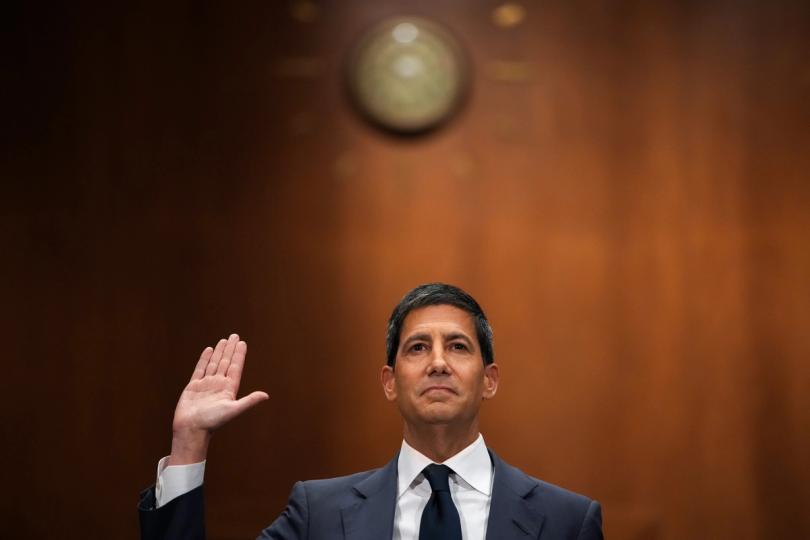
Fed chair nominee Kevin Warsh, whose own considerable wealth includes some crypto-world assets, is awaiting a final vote from the Senate after appearing in a confirmation hearing this week. Trump, who has relentlessly blamed Powell for maintaining overly high U.S. interest rates, chose Warsh to remedy that, but Republican Senator Thom Tillis had promised to block the confirmation as long as the DOJ pressed an investigation against Powell for cost overruns in a Fed building project.
That criminal probe was dropped on Friday, and Attorney General Jeanine Pirro said the DOJ asked the Fed’s inspector general to look into the renovation situation and issue a report. When the news emerged, Kalshi’s prediction betting on Walsh’s confirmation before May 15 shot up from about 30% odds to more than 80%.
“I expect a comprehensive report in short order and am confident the outcome will assist in resolving, once and for all, the questions that led this office to issue subpoenas,” Pirro wrote in a post on social media site X. “Accordingly, I have directed my office to close our investigation as the IG undertakes this inquiry. Note well, however, that I will not hesitate to restart a criminal investigation should the facts warrant doing so.”
Putting his own people atop the Federal Reserve not only equates with Trump’s greater influence over U.S. monetary policy, but it also leaves him with more allies on the Fed board as it makes decisions about financial policy — including implementing rules that govern the crypto industry and stablecoin issuers.
Because of Tillis’ threat, Warsh may have been in a holding pattern as long as the DOJ pursued its investigation, which could have left Powell in charge of the Fed indefinitely, well beyond the May 15 expiration of his term. Now, the Republican-majority Senate may be able to move more quickly toward confirmation of the nominee, who insisted during his hearing that he would act independently of White House direction.
Senator Elizabeth Warren, the ranking Democrat on the Senate Banking Committee that’s considering his nomination, dismissed the move and noted the administration is still pursuing Fed Governor Lisa Cook in court.
“This is just an attempt to clear the path for Senate Republicans to install President Trump’s sock pocket Kevin Warsh as Fed chair,” Warren said in a statement. “Let’s be clear what the Justice Department announced today: They threatened to restart the bogus criminal investigation into Fed Chair Powell at any time while failing to drop their ridiculous criminal probe against Governor Lisa Cook.”
Tillis called Warsh a “great nominee.” In his own posting this week on X, the senator said he’d vote yes on Warsh once the DOJ backs off of Powell:
“I look forward to supporting him out of committee once the DOJ drops their bogus investigation into Chairman Powell that threatens the independence of the Fed.”
The 50% profit level has acted as a rough threshold for market bottoms, and at 59%, the current reading is getting closer to that floor.
The share of Bitcoin (BTC) supply in profit has dropped to around 59%, bringing it close to levels seen during the last bear market.
This comes from data shared by analyst Darkfost, who also pointed out that the number of addresses depositing BTC had dropped to a 10-year low.
Profit Supply Nears Bear-Market Territory
In a post published on X on April 9, Darkfost revealed that the share of Bitcoin supply still in profit was sitting way below the historical average of about 75%.
“Nearly 1 BTC out of 2 is held at a loss,” they wrote.
The analyst made clear the significance of that number, saying that for Bitcoin to maintain upward price pressure, it needed a healthy share of its investors to be sitting on gains. When so many of them are in the red, it shrinks the pool of willing sellers, making it harder to generate organic demand and causing prices to stall.
According to the data, in the past, the 50% mark has acted as a rough threshold for market bottoms, and while the current figure is still above that level, the direction of travel is clear.
Darkfost’s conclusion was direct: the current environment “appears more suited for accumulation than for selling,” with the strategy being to pick up BTC when losses reach extreme levels and only reducing exposure when the profit supply gets near 100%.
Weakening Activity on Exchanges
In a separate update, Darkfost also noted that the number of Bitcoin addresses depositing funds to exchanges had dipped to about 31,000 per day on a 30-day moving average, which is the lowest it has been since 2017.
You may also like:
The on-chain technician attributed the fall to a mix of investor disengagement during a prolonged correction, price levels that give no incentive to sell, and a structural shift toward self-custody and decentralized platforms that has been building since the collapse of FTX.
“Although such an environment is typically unfavorable in the short term, these phases often coincide with periods where selling pressure progressively exhausts itself,” the analyst explained.
Analytics provider Glassnode also made a similar assessment, describing the current market environment as “subdued and low-conviction.” The platform also noted that spot activity was rather soft and that BTC was trading “inside the bear market value zone.”
At the time of writing, the flagship cryptocurrency was changing hands near $71,000 after it retreated from a 3-week high close to $73,000, which had been driven by the announcement of a ceasefire between the United States and Iran, as well as reports emerging that Iran would require ships accessing the Strait of Hormuz to pay for their passage using crypto.
Binance Free $600 (CryptoPotato Exclusive): Use this link to register a new account and receive $600 exclusive welcome offer on Binance (full details).
LIMITED OFFER for CryptoPotato readers at Bybit: Use this link to register and open a $500 FREE position on any coin!
Welcome to the US Crypto News Morning Briefing—your essential rundown of the most important developments in crypto for the day ahead.
Grab a coffee and settle in—markets are moving in ways that leave even seasoned investors squinting at charts. Gold and silver are surging, crypto is wobbling, and Washington’s policy plays are stirring uncertainty. But according to Tom Lee, somewhere in the chaos, a turning point may be quietly forming.
Crypto News of the Day: Tom Lee Says White House Front-Loading Midterm Wins Is Wrecking Markets
Fundstrat Global Advisors’ Tom Lee is sounding a cautious yet optimistic note for crypto investors, arguing that recent turbulence in Bitcoin and Ethereum may be temporary.
Sponsored
Sponsored
Appearing on CNBC’s Squawk Box, Lee attributed the early-year surge in gold and silver prices to Washington, D.C.’s policy maneuvers.
He says the White House’s plays have temporarily “hijacked” risk appetite, creating a “vortex” that drew capital away from crypto despite strong fundamentals.
Gold spiked to $4,954.99 per ounce, a 6.5% daily jump, while silver surged 13.66% to $87.53. This marks the largest single-day gains for both metals since the 2008 financial crisis.
🚨 WARNING: SOMETHING BIG IS COMING!
GOLD: $4,958
SILVER: $87That’s a 6.5% and 14% pump in ONE day.
It’s the BIGGEST daily gain since 2008.
This is a WARNING you gotta understand if you hold stocks, crypto, or anything else.
Know what happened in 2008 to every market except… pic.twitter.com/Rz91UiylyB
— Wimar.X (@DefiWimar) February 3, 2026
Lee tied this frenzy to crypto’s ill-timed deleveraging in October 2025.
“The crypto industry doesn’t have any leverage right now,” he said. “Gold and silver’s performance sucked all risk appetite towards the precious metals trade.”
Lee also highlighted Washington politics as a central driver of market uncertainty. With midterms approaching, he criticized the White House for “deliberately picking more winners and losers early,” front-loading its agenda and keeping markets “hostage.”
Speculation around the next Federal Reserve chair adds further volatility, with Lee warning that markets will test the appointee’s resolve on policy and rates, echoing patterns seen with former chairs Janet Yellen and Jerome Powell.
While the consensus expects Republicans to lose the House, Lee noted that a GOP retention could deliver a “positive surprise.”
Sponsored
Sponsored
Signs Point to a Crypto Bottom Amid Gold and Silver Frenzy
Despite near-term headwinds, Lee sees signals that crypto may be bottoming. Fundstrat advisor Tom DeMark believes “time and price” alignment has been reached, with Bitcoin back above $78,000 and Ethereum nearing $2,300.
Lee added that Ethereum’s active addresses are “going parabolic,” as Wall Street increasingly integrates digital assets.
“All the pieces are in place for crypto to be bottoming right now,” he said, contrasting price weakness with network activity.
This view aligns with analysts’ notes on potential capital rotation, with some highlighting gold’s 11% rebound from recent lows, adding $3.07 trillion, and silver’s 20% surge, reclaiming $800 billion.
Analyst Bull Theory compares this setup to August 2020, when gold topped at $2,075, Bitcoin fell 20%, then rallied 559% over eight months as capital flowed back into risk assets.
With the ISM Manufacturing Index at 52.6%, the analyst suggested a similar rotation may be underway:
“Gold likely topping, and Bitcoin already having corrected, we could now see a rotation into risk-on assets,” they said.
Sponsored
Sponsored
However, not all commentary is bullish. Analyst Wimar.X warns that the metals’ surge signals a “broken system,” echoing pre-crash conditions in 2000, 2007, and 2019.
With the gold-to-silver ratio near 56, they argued that institutions are “exiting the casino,” potentially foreshadowing a 2026 collapse.
Lee, however, emphasized that the broader economic backdrop remains strong. Stocks were up 1% in January, historically correlating to 18% annual S&P gains in similar periods since 1950.
Even as AI and tech valuations may mean-revert, he sees precious metals taking a “breather” as healthy for markets, potentially clearing the way for crypto’s next move.
The question now is whether Washington-driven flows will continue to favor metals or if Bitcoin and Ethereum are ready for a rebound.
Chart of the Day
Sponsored
Sponsored
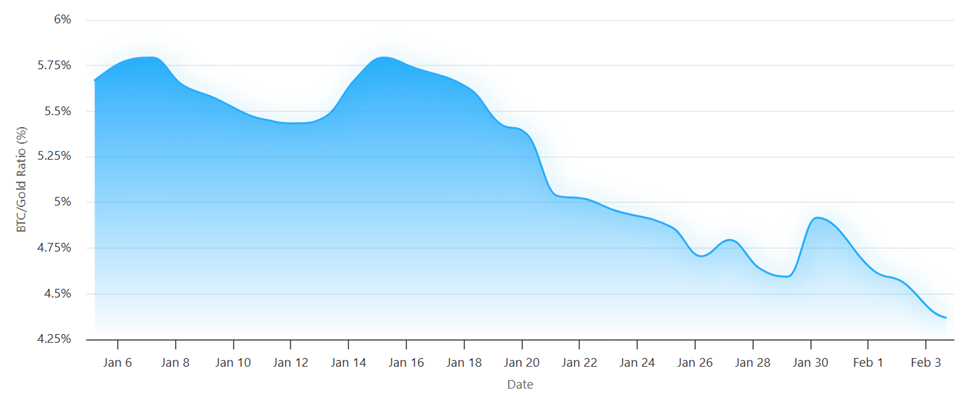
The Gold to Bitcoin dominance ratio compares the market cap of both assets.
Byte-Sized Alpha
Here’s a summary of more US crypto news to follow today:
Crypto Equities Pre-Market Overview
| Company | Close As of February 2 | Pre-Market Overview |
| Strategy (MSTR) | $139.66 | $140.80 (+0.82%) |
| Coinbase (COIN) | $187.86 | $189.53 (+0.89%) |
| Galaxy Digital Holdings (GLXY) | $26.44 | $26.95 (+1.93%) |
| MARA Holdings (MARA) | $9.12 | $9.18 (+0.66%) |
| Riot Platforms (RIOT) | $15.32 | $15.53 (+1.37%) |
| Core Scientific (CORZ) | $17.87 | $18.05 (+1.01%) |
The Securities and Exchange Commission has dropped its lawsuit against Gemini, the crypto exchange founded by twins Cameron and Tyler Winklevoss.
The Winklevoss twins were donors to Donald Trump’s re-election campaign and also backed his family’s business ventures.
In a joint filing on Friday, the SEC and Gemini asked the court to dismiss the lawsuit, which centered on the collapse of an investment product called Gemini Earn, with some investors losing access to their money for 18 months.
New York Attorney General Letitia James sued Gemini in 2023 and accused the company of defrauding investors. To justify dismissing the SEC’s case, the new filing points to a 2024 settlement between New York and Gemini, with investors ultimately receiving “one hundred percent of the crypto assets they had loaned […] through the Gemini Earn program.”
This appears to be a larger pattern of leniency from the Trump administration towards the crypto industry. The New York Times previously reported that the SEC has either dismissed, paused, or reduced penalties in more than 60 percent of the crypto lawsuits pending when Trump took office last year.
Gemini has also filed to go public.
Twenty One Capital Drops in NYSE Debut as Bitcoin Treasury Firms Face ‘Broader Re-Pricing’
In brief
- Twenty One Capital began trading on the NYSE as XXI, bolstered by a big Bitcoin stash after merging with Cantor Equity Partners.
- Shares hovered near $11 on debut day, falling short of the SPAC’s prior close near $14.
- Observers told Decrypt that treasury-heavy firms face shrinking premiums as markets favor clearer business models.
Twenty One Capital began trading on the New York Stock Exchange as XXI on Tuesday after completing its merger with Cantor Equity Partners, entering the market with more than 43,000 BTC worth almost $4 billion already on its balance sheet, primed in a position among the world’s largest public corporate holders of the asset.
Yet its trading debut was met with sharp selling, with XXI shares spending the session at roughly $11, putting it well below Cantor Equity Partners’ final pre-merger close near $14.
Debut trading for XXI aligned with patterns seen across other Bitcoin treasury listings this year, where new entrants have often priced below their pre-merger benchmarks as Bitcoin remains off its highs and premiums in the segment continue to narrow.
The company enters the market backed by Tether, Bitfinex, and a minority investment from SoftBank, with management outlining plans to build financial infrastructure and education products around Bitcoin.
Those efforts remain at an early stage, and investors have been weighing how quickly Twenty One can move from a balance sheet-driven profile to one supported by clear business operations.
DAT firms face “broader re-pricing”
The slide is “part of a larger pattern” in which investors “have grown cautious toward Bitcoin treasury companies and SPAC listings” because of their “tendency to behave like leveraged BTC bets that don’t have proven revenue,” Shawn Young, chief analyst at MEXC Research, told Decrypt.
“Investors now strategically look closely for clearer business models, cleaner governance, and real revenue plans,” he added.
XXI’s debut arrives as a “risk-off climate” continues, with the market “no longer prioritizing these firms the premium like it once did,” Young said.
“The drop isn’t exclusive to Twenty One as it reflects a broader re-pricing of companies that have a ‘we hold a lot of Bitcoin’ approach instead of ‘we generate predictable cash flow’,” he noted.
The stock might remain the same and trade “heavily in line with BTC, at least until the company proves it can build real, sustainable revenue on top of that asset base,” Young said.
The same happened with other SPAC listings, where markets appeared to have “overgrown the phase where a firm could raise capital, buy Bitcoin, and expect its equity to trade above the value of those holdings,” John Murillo, chief business officer at B2BROKER, told Decrypt.
Citing ProCap Financial’s (BRR) similar but “even more brutal” drop at roughly 50-60% this week, Murillo noted how discounts “are becoming the norm.”
“Investors are increasingly unwilling to pay NAV premiums for pure balance-sheet Bitcoin exposure,” Pei Chen, COO and executive director at AI liquidity engine Theoriq, told Decrypt.
This comes as “Bitcoin volatility compresses risk appetite,” with other treasury plays struggling to outperform spot, he explained.
While its sizable holdings and high-profile backing give it “more scale and optionality than most peers,” the long-term upside “won’t come from stack size alone,” Chen said.
“It will hinge on credible execution, transparent governance, and proving it can build durable, revenue-generating businesses on top of its Bitcoin reserve,” he opined.
Other observers say it’s a matter of how effectively the company can use its holdings to build an actual business around them, noting that a large Bitcoin stash alone does not ensure long-term performance.
“What matters is whether they can turn that treasury into real business activity — yield, liquidity, partnerships, or products that generate revenue outside of pure BTC exposure,” Kanny Lee, co-founder and CEO of secondary markets trading protocol SecondSwap, told Decrypt.
Twenty One’s long-term outlook could improve if it builds “real operating fundamentals on top of the treasury,” Lee said. “If not, the stock will likely continue to trade like a leveraged proxy for Bitcoin, and the market already has cleaner ways to get that exposure.”
Daily Debrief Newsletter
Start every day with the top news stories right now, plus original features, a podcast, videos and more.
Ethena’s synthetic-dollar stablecoin USDe saw one of its sharpest monthly contractions yet, while fiat-backed stablecoins like USDT, USDC and PYUSD attracted billions in inflows.
CoinGecko data showed that Ethena’s USDe stablecoin fell from a market capitalization of $9.3 billion on Nov. 1 to a valuation of $7.1 billion on Nov. 30. The token saw roughly $2.2 billion in redemptions, marking a 24% decline in supply in November.
Ethena’s USDe is a synthetic stablecoin that maintains its dollar peg through trading strategies with crypto and futures contracts rather than holding actual dollars. This means that USDe outflows mean that users are either selling USDe on the open market, withdrawing from pools or unwinding their positions on decentralized applications (DApps).
At the time of writing, CoinGecko data shows that the overall stablecoin market cap is at $311 billion. The market remains dominated by US dollar stablecoins, capturing $303 billion of the sector’s total valuation.
USDe outflows follow October depeg
USDe’s November contraction comes weeks after the synthetic stablecoin suffered a depegging event on the crypto exchange Binance. At the time, USDe briefly plunged to $0.65 on the exchange.
Ethena founder Guy Young said that the drop was caused by a Binance-specific oracle issue and not a problem with USDe’s underlying collateral mechanism that backs the asset.
Young said that the USDe token’s minting and redemption functions operated “perfectly” during the incident, with approximately 2 billion tokens redeemed across decentralized finance (DeFi) platforms.
On Oct. 9, USDe market cap hovered at $14.8 billion, making it the third-largest stablecoin at the time. Since then, the stablecoin lost over 53% of its market capitalization.
At the time of writing, CoinGecko data shows that USDe has a total valuation of $6.9 billion, dropping to the fourth spot in the stablecoin market cap rankings.
Related: Lawmakers stumble on stablecoin terms as US Congress grills Fed’s Bowman
Fiat-backed stablecoins grew by $3.2 billion in November
While the synthetic-dollar stablecoin struggled during the month, fiat-backed stablecoins recorded modest but steady gains over the same time period.
Tether’s USDt (USDT) saw a $1.3 billion increase to $184.6 billion, while Circle’s USDC (USDC) climbed to $76.5 billion, adding roughly $600 million to its supply.
PayPal USD (PYUSD) posted the strongest growth among the major dollar-pegged stablecoins, jumping from $2.8 billion to $3.8 billion in November. This marks 1 billion inflow for the month — a 35% month-on-month growth.
DefiLlama data showed that since PayPal PYUSD stablecoin grew by over 216% since September, when it had a market cap of $1.2 billion. This represents a $2.6 billion increase in just three months.
Meanwhile, Ripple’s (RLUSD) stablecoin, which breached a market capitalization of $1 billion for the first time in November, continued its growth throughout the month.
According to CoinGecko, RLUSD went from a $960 million market cap on Nov. 1 to a market cap of $1.26 billion on Nov. 30, marking a $300 million increase.
Magazine: China officially hates stablecoins, DBS trades Bitcoin options: Asia Express
MANTRA Tests Critical Support as OM Price Drops 3.7% Amid Broader Crypto Weakness
Joerg Hiller
Oct 19, 2025 09:30
OM price falls to $0.12 as MANTRA technical analysis reveals bearish momentum building with RSI at 35.51 and trading below key moving averages in thin volume.
Quick Take
• OM trading at $0.12 (down 3.7% in 24h)
• No major catalysts driving current weakness
• Testing support near 52-week lows with RSI oversold
• Following Bitcoin’s broader market decline
Market Events Driving MANTRA Price Movement
Trading on technical factors in absence of major catalysts, MANTRA has declined 3.7% over the past 24 hours as OM price action reflects broader cryptocurrency market weakness. No significant news events have emerged in the past week that would directly impact MANTRA’s fundamentals or trading sentiment.
The current sell-off appears to be following Bitcoin’s recent weakness, with institutional participants showing reduced activity across altcoin markets. Daily trading volume of $4.48 million on Binance spot represents below-average liquidity, suggesting limited conviction from both buyers and sellers at current levels.
Without fresh catalysts to drive momentum, OM price movement has been primarily driven by technical selling as traders react to deteriorating chart patterns and weakening momentum indicators.
OM Technical Analysis: Bearish Momentum Building
Price Action Context
MANTRA technical analysis reveals a concerning setup as OM price trades significantly below all major moving averages. At $0.12, the token sits 85% below its 52-week high of $8.50 and dangerously close to the yearly low of $0.10. The 7-day simple moving average at $0.13 has provided immediate resistance, while the 20-day SMA at $0.15 represents a more significant technical hurdle.
The price structure shows OM following Bitcoin’s broader weakness but with amplified volatility typical of smaller-cap altcoins. Volume patterns suggest institutional interest remains minimal at these levels.
Key Technical Indicators
The RSI reading of 35.51 indicates oversold conditions are developing, though momentum hasn’t reached extreme levels that typically mark significant bottoms. MACD remains in negative territory at -0.0183, with the histogram showing continued bearish divergence as selling pressure persists.
Bollinger Bands positioning reveals OM price in the lower portion of the trading range, with the %B reading of 0.2292 suggesting proximity to the lower band at $0.09. This technical setup often precedes either a bounce or further breakdown depending on broader market conditions.
Critical Price Levels for MANTRA Traders
Immediate Levels (24-48 hours)
• Resistance: $0.13 (7-day moving average and recent breakdown level)
• Support: $0.10 (52-week low and psychological round number)
Breakout/Breakdown Scenarios
A break below $0.10 support could trigger accelerated selling toward the $0.03 level, representing the next major technical support zone. Conversely, a recovery above $0.15 would need to reclaim the 20-day moving average to signal any meaningful bullish reversal attempt.
OM Correlation Analysis
MANTRA continues tracking Bitcoin’s directional moves with high correlation, typical during periods of broad crypto market weakness. The token shows no significant divergence from sector peers, indicating fundamental factors specific to MANTRA aren’t currently driving price action.
Traditional market correlations remain minimal, with OM price movements primarily influenced by crypto-native factors and Bitcoin’s performance rather than equity or commodity market dynamics.
Trading Outlook: MANTRA Near-Term Prospects
Bullish Case
Recovery above $0.13 resistance accompanied by increased volume could signal short-term relief rally toward $0.15-$0.18 range. RSI oversold conditions provide potential for technical bounce if broader crypto sentiment stabilizes.
Bearish Case
Failure to hold $0.10 support risks extended decline toward $0.03 level with limited technical support between current levels. Continued low volume suggests minimal buying interest at these prices.
Risk Management
Conservative traders should consider $0.09 as maximum downside risk, representing roughly 25% below current levels. Position sizing should account for OM’s elevated volatility, with daily ATR of $0.02 representing significant intraday movement potential relative to the $0.12 price level.
Image source: Shutterstock