Sentora has proposed operating independently curated lending markets on Aave V4, starting on Ethereum, with half of the instance's protocol revenue going to the Aave DAO. The Aave Request for Final Comments, or ARFC, remains at the community-feedback stage. It calls for a Snapshot vote followed, if… Read the full story at The Defiant
DAO
BASIS.pro Expands On-Chain Infrastructure with XDC Network Partnership and Zypher DAO as Auto Earn Goes Live
London, United Kingdom, September 16th, 2026, Chainwire
New developments extend BASIS across real-world asset and AI-native infrastructure while introducing automated reward restaking for BTC, ETH, SOL, and PAXG participants
BASIS, the institutional-grade crypto yield and staking platform built on market-neutral execution infrastructure, is continuing to expand its institutional footprint with three new developments: an ecosystem partnership with XDC Network, a collaboration with Zypher DAO, and em-dash (Auto Earn an automated) reward restaking feature now live for BTC, ETH, SOL, and PAXG participants.
Yield Infrastructure Meets Real-World Financial Infrastructure
BASIS and XDC Network have announced a new partnership exploring opportunities at the intersection of crypto yield, real-world assets (RWAs), and the broader on-chain economy. XDC Network is an EVM-compatible Layer-1 blockchain powering payments, trade finance, and real-world asset solutions.
By combining BASIS’s market-neutral yield and staking infrastructure with XDC Network’s high-throughput, enterprise-oriented blockchain, the two teams are exploring how disciplined yield execution can connect with real-world financial infrastructure from tokenized assets to trade-finance ecosystems.
Verifiable AI Meets Market-Neutral Yield
BASIS has also entered into a collaboration with Zypher DAO (Zypher Network), an AI and Zero-Knowledge (ZK) powered Web4 ecosystem building AI-native blockchain infrastructure and intelligent digital economies.
The collaboration brings together Zypher’s verifiable AI and ZK capabilities with BASIS’s market-neutral yield infrastructure, with both teams exploring new possibilities across intelligent finance, verifiable execution, and on-chain asset management.
Auto Earn Automates Reward Restaking
Separately, BASIS has launched Auto Earn, an automated process that restakes eligible unclaimed staking rewards into a user’s existing position every Monday at 00:00 UTC.
Auto Earn touches accrued-but-unclaimed rewards only. It does not create a new position, add a new lock-up, reset the lock-up timer, or change the original maturity date or booster schedule. The feature is enabled by default, and users can turn it off or back on at any time in account settings. Full documentation is available at docs.basis.pro/economics-and-rewards/auto-earn.
About BASIS
BASIS is an institutional-grade crypto yield and staking platform for BTC, ETH, SOL, and PAXG, where participants can earn rewards by staking their assets on basis.pro with rates following the platform’s live Dynamic Reward Rate (DRR), which varies with market conditions and is not fixed or guaranteed. The platform executes market-neutral strategies designed to reduce directional exposure, with capital-preservation controls including risk constraints and circuit breakers embedded across its execution and operating framework. BASIS is operated by BASIS DIGITAL INFRASTRUCTURE LTD, a Seychelles-registered IBC (LEI: 254900IX2F2KCWNSSS64), under ISO/IEC 27001:2022 and ISO/IEC 20000-1:2018 certified management systems, with execution research, systems modeling, and risk design contributed by Base58 Labs, a London-based independent research and engineering institution.
About XDC Network
XDC Network is an EVM-compatible Layer-1 blockchain powering payments, trade finance, and real-world asset solutions.
About Zypher Network (ZDAO)
Zypher Network (ZDAO) is an AI and Zero-Knowledge (ZK) powered Web4 ecosystem building the next generation of AI-native blockchain infrastructure and intelligent digital economies.
Contact
Evan Sinclair
BASIS
press@basis.pro
XRP Ledger’s XAO DAO Plans Major Governance Upgrades to Boost Community Participation
XAO DAO has not yet disclosed the final mechanics or timetable for implementing all the proposed governance changes.
XAO DAO is preparing a series of governance changes for the XRP Ledger over the next two to three months, according to Fabio Marzella, the organization’s co-founder.
The planned changes would let members delegate voting power, adjust quorum rules, and access community mini-grants, as the DAO looks to make participation easier and more representative, at a moment when several XRPL projects have already scaled back or shut down.
XAO DAO Targets Broader Participation
Marzella said the first change would introduce wallet delegation, allowing members to hand their voting power to others when they lack the time or expertise to vote on individual proposals.
The DAO is also reviewing its quorum requirements, including how inactive wallets count toward proposal thresholds. The stated aim is to prevent inactive participation from blocking decisions while keeping governance tied to the active community.
Community mini grants are another planned addition. Under the proposal, members would be able to submit smaller initiatives and seek funding for projects that contribute to the XRPL ecosystem.
“These aren’t changes for the sake of change,” Marzella wrote. He said the broader goal is to create a DAO where the community has “the ability to act” rather than simply having a vote.
The timing comes as questions around developer support have grown within the XRPL community. On August 13, Marzella said the shutdown of Gen3’s retail platforms showed that funding developers alone does not solve the problem of building lasting businesses.
You may also like:
Gen3, an XRPL infrastructure team, said on August 12 it would spin down two of its retail products, aigent.run and AxiomProtocol, citing weak user demand and rising infrastructure costs. Gen3 said the platforms will stay live for another month, until September 13, so users can withdraw remaining funds, and that it will keep running its core XRPL infrastructure and take part in the ledger’s amendment process.
Marzella pointed to the Gen3 news as evidence of a bigger problem, arguing that funding developers only solves half the issue if there’s no path from a funded project to a sustainable business. Builder Handy Andy, replying in the same thread, described colleagues quietly calculating how much longer they can keep funding their own work without support, calling it “the last roll of the dice” for some.
Activity Is Up
The reshuffle comes as XRP closed near a 21-month low this week, and Santiment data shows daily active addresses averaging 35,700 in August, up from 26,400 in July, even though the number of new wallets has stayed almost flat.
That distinction may matter for XAO DAO’s participation plans. More activity among existing users does not automatically mean a larger pool of people taking part in governance.
As it stands, Marzella has not provided a final timetable or detailed voting mechanics for the proposed changes, instead promising that more information will follow as each initiative progresses, leaving the community to see how delegation, quorum changes and mini grants are eventually implemented.
The executable draft adds Security Council oversight of Endowment transactions and narrows the Foundation’s initial token grant to 1 million ENS after delegates called the earlier plan a “governance attack.”
Katherine Wu, chief operating officer of ENS Labs, posted an executable draft Thursday of the proposal to establish an ENS Foundation, dropping a plan to shift the DAO’s operational wallet to the new entity after weeks of delegate opposition to an earlier version of the plan.
The draft, “[Draft] [Executable] Next Era of ENS DAO: Empowering the ENS Foundation,” keeps the DAO’s roughly 54.6 million ENS tokens and its operational wallet, holding an estimated $16 million in ETH and stablecoins, under tokenholder control. The only ENS token transaction in the proposal is a one-time transfer of 1 million ENS, restricted to Foundation employee compensation with multi-year vesting. The Foundation Board would gain administrative control of the roughly $65 million Endowment Safe, with every Endowment transaction now subject to a timelock and a Security Council cancellation right.
The draft follows a temp check Wu published June 19 that proposed a broader transfer of authority. ENS co-founder Nick Johnson, who holds one of the Foundation’s five board seats under the proposal, wrote on X that the changes responded to “difficult questions” and community feedback since that original post. The ENS DAO account summarized the revision as authorizing the Foundation “to administer the Endowment” while tokenholders “retain control over the protocol, remaining DAO-held ENS, the operational wallet, and the appointment and removal of Foundation directors.”
ENS traded at $4.34, up 4.2% over 24 hours, according to CoinGecko. The protocol generated $216,369 in fees over the past 30 days, according to DefiLlama.
Narrower Scope
The June 19 temp check, as The Defiant reported, proposed delegating management of the DAO’s operational wallet, its ENS token holdings and the Karpatkey-managed Endowment to Foundation governance. Thursday’s draft narrows that scope on two of those three fronts. The operational wallet, wallet.ensdao.eth, stays with the DAO, with existing funding streams continuing to draw from it. DAO-held ENS tokens stay under the same onchain mechanism and tokenholder control, apart from the 1 million ENS carve-out; any further use of the DAO’s token holdings would require a separate proposal through ordinary governance.
Only the Endowment Safe moves to Foundation-administered control, and the draft adds a new safeguard there: transactions pass through a timelock by default, and the Security Council can cancel any of them before execution, a check the current structure doesn’t have.
The scaled-back scope follows weeks of delegate opposition to the original temp check. Johnson said in June he would self-delegate his ENS holdings to support the measure, a move Rotki founder Lefteris Karapetsas said left Johnson “essentially becoming the DAO,” and Security Council member Brantly Millegan called the plan “the equivalent of treasury capture by ENS Labs,” The Defiant reported.
Board and Budget Guardrails Unchanged
The proposed five-seat board is unchanged from the temp check: Johnson holds a permanent seat with succession to an ENS Labs representative if he departs, ENS Labs general counsel Alexander Urbelis is nominated as full-time executive director, and independent seats go to A.Capital Ventures partner Kartik Talwar, Prelude co-founder Brett Sun and Aragon CEO Anthony Leutenegger.
Independent directors are compensated 40,000 USDC per year, and any decision on ENS Labs funding requires a majority of independent directors’ approval in addition to a board majority, under the interim conflict-of-interest policy attached to the draft.
The Foundation would receive no operating budget under the proposal until its executive director publishes a budget to the DAO forum, and transfers from the Endowment are capped at $500,000 for standup costs until then.
Part of a Wider Fight
Thursday’s draft is the latest turn in a monthslong dispute over control of ENS DAO’s treasury and governance. After Johnson said he would self-delegate to back the original Foundation plan, he used that same voting power to block an onchain vote renewing the DAO’s Security Council, a multisig empowered to cancel malicious proposals already in the timelock queue, The Defiant reported.
Christoph Jentzsch, who wrote code for the original 2016 “The DAO,” responded by proposing on X that ENS DAO dissolve itself outright. Separately, ENS co-founder Alex Van de Sande has proposed delegating 5 million ENS from the DAO’s dormant community treasury to outside stakeholders, an unrelated reform effort aimed at the same underlying concentration of voting power in the DAO.
GnosisDAO’s GIP-151 passed with 215% of the required quorum, 49 votes representing a voting weight roughly 2.15 times the 75,000 GNO minimum threshold.
The proposal authorized a one-time pro rata treasury redemption, allowing GNO holders to surrender tokens in exchange for a proportional share of liquid treasury assets. A passed governance vote on a treasury of this size redefines what governance tokens can be used for.
Until now, a governance token’s value rested on a stack of soft arguments, such as control over protocol direction, fee switches that might get activated, and treasury grants that might boost network growth.
When a DAO can be voted to return assets to holders, the token functions as a probability-weighted claim on the balance sheet, regardless of how it is legally classified.
Background reporting on the earlier GIP-150 redemption push cited a GnosisDAO treasury of roughly $223 million, an estimated redemption value near $170 per GNO, and a market price around $132, a 27% discount.
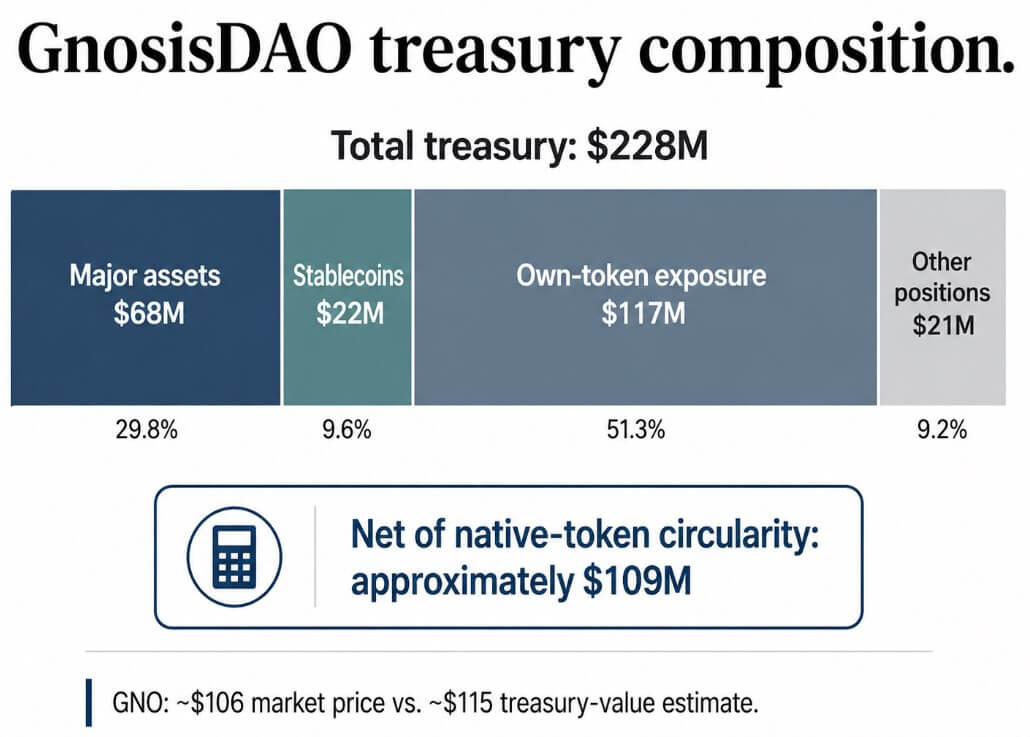
Current DeFiLlama data put the total treasury near $228 million, with approximately $68 million in major assets, $22 million in stablecoins, $117 million in own-token exposure, and $21 million in other positions.
Net of native token circularity, the liquid treasury sits at around $109 million. DeFi analyst Ignas put GNO at approximately $106 against roughly $115 in treasury value per token around the time of GIP-151’s passage.

The trade that GIP-151 validates
That discount creates an investable structure consisting of buying tokens below the adjusted treasury value, accumulating governance influence, voting for redemption, and closing the gap.
That is the closed-end fund activism playbook applied to decentralized infrastructure, and Gnosis has now demonstrated it can be executed.
The Investment Company Institute put total closed-end fund assets at roughly $791 billion at year-end 2025, a market large enough to have given rise to decades of activist doctrine around NAV discounts, and DAO treasuries now sit inside that doctrine.
At a GNO price near $104 and a quorum threshold of 75,000 GNO, a position meeting the quorum costs approximately $7.8 million before slippage or opposition. GIP-151’s reported 215% quorum implies an actual voting weight of roughly 161,250 GNO, or about $16.8 million at that price.
Insider blocs, delegation structures, eligibility rules, and organized opposition all affect whether a given position wins a vote, but the numbers show why governance tokens over large liquid treasuries now carry a control premium the market has not historically priced.
The trade generates a straightforward screen: liquid treasury per token, market discount to adjusted NAV, quorum threshold, delegate concentration, foundation or multisig veto risk, treasury composition, and execution path.
DAOs with legally inaccessible, foundation-controlled, or native-token-heavy treasuries stay stranded at their discounts.
| Screen factor | Why it matters | What activists are looking for |
|---|---|---|
| Liquid treasury per token | Determines whether there is real redeemable value | Stablecoins, ETH, majors, low-haircut assets |
| Market discount to adjusted NAV | Defines the potential trade spread | Token price materially below treasury value |
| Quorum threshold | Measures how much voting weight is needed | Low enough threshold for coordinated holders |
| Delegate concentration | Shows whether votes can be influenced | Fragmented delegates or persuadable blocs |
| Insider / foundation control | Determines whether the treasury is practically reachable | Low veto risk from founders, foundations, multisigs |
| Treasury composition | Separates real NAV from paper NAV | Less native-token circularity, fewer illiquid bets |
| Execution path | Tests whether a vote can actually move assets | Onchain execution, clear legal wrapper, defined claims |
| Legal risk | Affects exchanges, holders, and future DAO design | Redemption framed as governance, not investment product |
How governance changes when capital enters the room
Traditional DAO governance assumes voters are builders, delegates, users, and participants with operational stakes in the protocol’s future.
Treasury activism imports a different voter through the NAV buyer, who holds governance tokens to extract balance-sheet value and has no particular interest in what the DAO builds next.
A governance forum that used to debate grant allocations, roadmap priorities, and fee-switch parameters now has to answer a prior question: should the DAO retain these assets and, if so, on what terms?
In the bull case, GIP-151 executes cleanly, with liquid assets distributed, illiquid positions handled through a claim token, and legal friction staying contained.
Governance tokens gain a credible new valuation anchor: the probability-weighted right to extract value from the treasury.
Other DAOs with liquid, transparent treasuries and permeable governance face immediate demands to justify why their tokens should trade below the value of the assets they govern. A clean execution could pull GNO toward or briefly above the $115 treasury-value estimate as remaining holders reprice the governance premium.
The bear case runs through execution delays, disputes over eligible supply, heavy haircuts on illiquid assets, or a treasury-defense campaign that exposes insider concentration, leading the market to discount both payout certainty and the post-redemption protocol’s capacity to function.
The wider risk for the DAO market is that several copycat redemption pushes fail simultaneously, demonstrating that most treasury discounts are structurally inaccessible, and the NAV-activism thesis deflates before it fully takes hold.
| Scenario | What has to happen | Likely GNO impact | Broader DAO market impact |
|---|---|---|---|
| Bull case | GIP-151 executes cleanly, liquid assets are distributed, legal friction stays limited | GNO trades closer to or above the ~$115 treasury-value estimate | DAO tokens with clean liquid treasuries reprice higher on redemption optionality |
| Base case | Redemption works, but with delays, haircuts, or limited participation | GNO trades around adjusted treasury value, not full headline NAV | Treasury-rich DAOs face pressure to explain reserves, spending, and governance control |
| Bear case | Execution disputes, eligibility fights, insider resistance, or heavy illiquid-asset haircuts | Market discounts payout certainty and post-redemption protocol value | Most DAO treasury discounts are treated as inaccessible |
| Black swan | Regulatory, exchange, or litigation pressure reframes redemption as security-like behavior | GNO and similar tokens face sharp legal/liquidity discount | Governance tokens split between “usable governance” and “fund-like treasury claim” buckets |
The legal exposure that follows
The SEC’s 2026 crypto guidance holds that a non-security crypto asset can still be sold as part of an investment contract when surrounding facts satisfy the Howey test: investment of money, common enterprise, expectation of profits, and reliance on the managerial efforts of others.
Pro-rata treasury redemption gives regulators cleaner facts to run that analysis.
Daily signals, zero noise.
Market-moving headlines and context delivered every morning in one tight read.
5-minute digest 100k+ readers
Free. No spam. Unsubscribe any time.
Whoops, looks like there was a problem. Please try again.
You’re subscribed. Welcome aboard.
Regulators can now ask more directly whether buyers hold a governance token to participate in protocol decisions or expect returns from a pooled treasury managed and distributed by others.
Legal risk rises sharply if projects, delegates, activists, or market materials frame tokens explicitly as treasury claims.
The distinction between “governance token that enables redemption” and “redeemable treasury interest” is the line that litigation and enforcement will contest.
A second exposure follows from treasury composition. The Investment Company Act applies to issuers whose primary business resembles investing, reinvesting, or holding securities, with a 40% investment-securities threshold embedded in the statute.
A passed redemption mechanism raises the question of whether a DAO that holds ETH, stablecoins, tokenized securities, RWAs, and LP positions, and can be voted to distribute them pro rata, starts to resemble a redeemable asset pool more than an operating network.
The CLARITY Act debate adds a structural wrinkle, as the Senate bill distinguishes between decentralized and centralized platforms, with the latter subject to financial institution-style obligations, including transaction monitoring and suspicious-activity reporting.
A DAO can be genuinely decentralized at the protocol layer while concentrating treasury control in insiders, multisigs, or delegate blocs. Gnosis provides regulators with a real-world example of that gap.
The DeFi spillover
DAO treasuries fund liquidity programs, grants, market-making budgets, protocol contributors, and LP positions.
Redemption votes, whether isolated or part of an activist norm, force treasuries to liquidate assets, such as stablecoin outflows, ETH sales, unwound LP positions, and cut incentive programs.
The total stablecoin market cap is near $314 billion, with Ethereum holding roughly half, according to DeFiLlama. With the Fed holding its target range at 3.50% to 3.75%, the opportunity cost of idle DAO stablecoin reserves is quantifiable and easy to argue in a governance forum.
The risk from Gnosis compounds if five or ten treasury-rich DAOs simultaneously face coordinated redemption campaigns, because the resulting asset sales and incentive cuts run across protocols that share liquidity, validators, and grant recipients.
Rook DAO, Fei/Tribe, and Aragon each demonstrated that DAO treasury conflicts can be resolved through redemption structures.
Aragon’s roughly $115 million ANT redemption came after a protracted governance fight, which the foundation resolved by returning capital to ANT holders. GIP-151 arrived by passing through standard governance, above quorum, without the DAO visibly collapsing first.
That procedural route converts a pattern of isolated governance crises into a repeatable strategic tool.
Every DAO governing a treasury larger than its market cap now trades at a discount that serves as an activist target. Whether DAO structures prove resilient to that, and whether US regulators settle the legal question before the market does, are the forward-looking variables that Gnosis left open.
The Aave DAO is voting on a proposal to provide funding to restore Kelp DAO’s rsETH product backing after an April 18 bridge incident, as part of a broader DeFi United ecosystem recovery effort.
Aave’s decentralized governance body is being asked to contribute 25,000 ETH from its treasury to a coordinated recovery effort following the April 18 exploit of Kelp DAO’s rsETH bridge, according to a proposal published Thursday by Aave service provider TokenLogic.
The contribution would make Aave the largest single donor to a coalition called “DeFi United,” which also includes EtherFi, Lido, Ethena, Mantle, Ink Foundation, BGD Labs, and several individual contributors. Together, the group is working to restore the full backing of rsETH and protect users across affected Aave V3 markets.
The April 18 attack drained 152,577 rsETH from Kelp’s LayerZero bridge adapter, creating an original shortfall of approximately 163,183 ETH. Subsequent recoveries have reduced that figure: Kelp froze tokens worth roughly 43,168 ETH, the Arbitrum Security Council froze 30,766 ETH held by the attacker, and liquidations of the hacker’s positions on Aave and Compound are expected to recover an additional 14,168 ETH. The residual funding gap currently stands at approximately 75,081 ETH.
To close that gap, the proposal outlines a funding stack combining public donations totaling 14,570 ETH, a 30,000 ETH credit facility from Mantle, and the requested 25,000 ETH from the Aave DAO treasury.
Executing the recovery requires placing the full 120,015 ETH into the LayerZero lockbox upfront. Because several recovery streams are not yet liquid, short-term bridge loans are being arranged separately to cover the timing gap.
The proposal also authorizes Aave Labs to pledge DAO assets and future protocol revenue as collateral to secure funding arrangements. The proposal notes the plan depends on external actions including Kelp reopening withdrawals, LayerZero reopening its bridge, and the Arbitrum Security Council releasing frozen funds.
The proposal is currently in the community feedback stage before proceeding to a Snapshot vote.
Sources: Aave Governance | Aave Twitter | DeFi United
This article was generated automatically by The Defiant’s AI news system from publicly available sources.
Kelp DAO Exploit Sparks Aave Liquidity Crunch, $6.2 Billion Withdrawal Panic
In brief
- Aave users struggled to withdraw funds from Aave after attackers borrowed with stolen rsETH on the platform, spiking a core market’s so-called utilization rate.
- The funds were plundered from a LayerZero-powered bridge, in what onlookers described as DeFi’s biggest exploit so far this year.
- Early Sunday, DefiLlama’s 0xngmi said Aave had faced $6.2 billion in net withdrawals, while Spark’s monetsupply.eth pointed to “negative secondary effects.”
Less than a day after attackers drained $291 million in crypto from infrastructure linked to decentralized finance project Kelp DAO, users on Aave, one of DeFi’s most battle-tested protocols, struggled to withdraw funds amid a liquidity crunch.
A bridge that typically allows users to move an asset called rsETH from one network to another was exploited on Saturday, prompting Aave to freeze markets tied to the token, which attackers had used to borrow funds from the platform, the lending protocol said in an X post.
Meanwhile, Kelp DAO said in an X post that it had “paused rsETH contracts” across Ethereum’s mainnet and several layer-2 scaling networks as it investigates suspicious activity.
Earlier today we identified suspicious cross-chain activity involving rsETH. We have paused rsETH contracts across mainnet and several L2s while we investigate.
We are working with @LayerZero_Core, @unichain, our auditors and top security experts on RCA.
We will keep you…
— Kelp (@KelpDAO) April 18, 2026
The attackers’ activity on Aave caused the so-called utilization rate of a core lending pool to spike to 100%, signaling that users who previously deposited Ethereum and wrapped Ethereum have been left with little to no liquidity to withdraw, Aavescan data showed.
An hour before Aave locked down the markets, blockchain security firm PeckShield flagged a transaction showing 116,500 rsETH, worth $291 million at the time, flowing to a fresh wallet.
The attackers didn’t abscond with rsETH that had been maliciously released from the bridge. Rather, they used Aave to borrow regular funds, creating “massive bad debt,” Francesco Andreoli, head of developer relations at Consensys and MetaMask, said in an X post. (Disclaimer: Consensys is one of many investors in an editorially independent Decrypt.)
Aave’s governance token plunged to $90.13 on Sunday, a 16% decrease over the past day, according to CoinGecko. Ethereum fell 2% to $2,300 over the same period.
As users struggled to withdraw from Aave, they began borrowing against their deposits in stablecoins, straining the liquidity further as a sign of “negative secondary effects,” said monetsupply.eth, the pseudonymous head of strategy at DeFi project Spark, in an X post.
The Kelp DAO exploit and ensuing fallout on Aave prompted a massive wave of withdrawals from several DeFi protocols, even those that were unaffected, according to 0xngmi, the pseudonymous co-founder of data provider DefiLlama. On a net basis, users had yanked $6.2 billion from Aave alone by early Sunday, they said in an X post.
The Aave situation is bad and getting worse. Multiple other pools are hitting 100% utilization, leaving lenders stuck and the protocol at risk of further bad debt.
Lending rates have increased to 10-15%, a notable increase but still not an appropriate reward for the perceived…
— Quit (@0xQuit) April 19, 2026
With contagion appearing to spread, DeFi’s latest exploit provides “a lot of ammo” for critics skeptical of systems that seek to replace traditional financial intermediaries with code, Salman Banei, general counsel at Plume, a network focused on tokenization, said in an X post.
Kelp DAO issues rsETH, a liquid staking token that allows users to earn Ethereum staking and EigenLayer restaking rewards. It acts as a tradeable “receipt” for Kelp DAO depositors. The Kelp DAO bridge was built on top of infrastructure designed by LayerZero, a protocol that allows DeFi applications to send messages and transfer assets across blockchains.
Stacy Muur, a noted blockchain researcher, said in an X post that the exploit appeared to rely on a single point of failure. She wrote that a “phantom” message used by attackers essentially tricked Kelp DAO’s bridge into releasing rsETH on Ethereum without removing a corresponding amount of tokens from circulation on Ethereum layer-2 Unichain.
Nonetheless, some onlookers were eager to find a path forward, including crypto entrepreneur and Tron founder Justin Sun. He attempted to negotiate, arguing that the attackers would ultimately struggle to spend the stolen funds.
“How much [do] you want?” he asked them in an X post. “It’s simply not worth it to sacrifice both Aave and Kelp DAO and let them go down over this hack.”
Daily Debrief Newsletter
Start every day with the top news stories right now, plus original features, a podcast, videos and more.
The battle for control of Aave, the $52 billion decentralized lending giant, has escalated from a debate over interface economics into an open civil war regarding governance legitimacy.
What began as a dispute over $10 million in annualized swap fees and brand ownership has, in the last 24 hours, mutated into a bitter procedural fight between the protocol’s decentralized autonomous organization (DAO) and its development arm, Aave Labs (also known as Avara).
At the center of the storm is a Snapshot vote scheduled to run from Dec. 22 through Dec. 26. The ballot proposes transferring Aave’s “soft assets”, including its trademarks, domain, and social handles, from Aave Labs to the DAO.
However, the mechanism of the vote itself has triggered a crisis. The proposal was pushed to the ballot not by its author, but by the very entity it seeks to regulate: Aave Labs.
This has forced the industry to choose between two competing visions of the future: the democratic idealism of the DAO, or the ruthless efficiency of the corporate entity that built the throne.
The outcome will determine not only who controls the protocol’s URL but also whether a decentralized collective can effectively run a multibillion-dollar software business.
‘Disgraceful’ tactics and hijacked proposals
The chaos began when the “ARFC: Token Alignment” proposal appeared on Snapshot.
While the author listed was Ernesto Boado, co-founder of BGD Labs (a key service provider for the protocol), Boado immediately disavowed the action, claiming his identity was used without consent to force a premature vote.
In a sharply worded rebuke, Boado stated:
“To be very clear: This is not, in ethos, my proposal. Aave Labs has (for whatever reason) unilaterally submitted my proposal to vote in a rush, with my name on it, and without notifying me at all. If asked, I would not have approved it.”
Boado, who is widely respected for his technical contributions to the Aave protocol, framed the move as a violation of governance norms. He said:
“It was not my intention to submit the vote while the community was still having a healthy discussion around it, with valuable points appearing continuously. It breaks all codes of trust with the community. Public governance is supposed to be for, even if hard sometimes, open discussion. Trying to rush a vote is disgraceful.”
Meanwhile, the vote’s acceleration has also drawn sharp rebukes from governance stewards like Marc Zeller, founder of the Aave Chan Initiative.
Zeller described the maneuver as a “hostile takeover attempt,” noting that it was timed during the holiday season—a notoriously low-participation window for institutional voters—and snapshotted before the opposition could mobilize.
He pointed out:
“Official Aave communication channels relayed this debate only after escalation to Snapshot.”
However, Aave Labs and its founder, Stani Kulechov, have defended the move as a necessary acceleration of a stalled governance process.
Kulechov stated that the community has shown significant interest in the proposal discussion and has, thus, it was “time for tokenholders to weigh in and vote.”
He also dismissed the procedural complaints, arguing that five days of forum debate were sufficient and that the community was fatigued.
He wrote:
“People are tired of this discussion and getting into a vote is the best way to resolve, this is governance [at the] end of the day.”
The case against ‘pure’ decentralization
While delegates focus on procedural fouls, a growing chorus of industry veterans is rallying to defend Aave Labs, arguing that the DAO’s push for “ownership” is a fundamental misunderstanding of why Aave succeeded in the first place.
Nader Dabit, the director of developer relations at EigenLayer, offered a blistering critique of the proposal, reframing the narrative from one of liberation to one of self-sabotage.
He said:
“The recent proposal is framed as decentralization, but in practice it would handicap the entity most responsible for Aave’s success, and it looks almost like a coordinated power grab.”
Dabit’s argument strikes at the uncomfortable truth of the DeFi sector: despite the rhetoric of decentralization, market dominance is almost always the result of centralized execution.
He argued that Aave would have been outcompeted several years ago if it had been run exclusively by the DAO. He noted:
“The protocol operated like a DAO. Labs operated like a company. That division of labor and resources has worked extremely well while competitors with ‘purer’ governance models stalled, failed, or disappeared.”
The core of this defense is operational reality. Building world-class software is difficult; building it by committee is nearly impossible.
Dabit furthered that DAOs are “incapable of shipping competitive software, or even being competitive at anything attempting to resemble an actual, real business.” This is because every decision would require a governance proposal, which would result in “every fast-moving opportunity [dying] in a forum thread while competitors are actually executing.”
Dabit also posited that by stripping the company of its assets and revenue streams, the DAO will destroy the incentive structure that keeps the talent locked in. He warned:
“Handicapping Labs and treating it like it should not share in any of the upside of the protocol is, in the long run, bad for the DAO itself. Weakening that relationship doesn’t decentralize Aave, it actually makes it much worse.”
This view suggests that the $10 million in annualized interface revenue that the DAO is fighting to capture, which is money currently flowing to Aave Labs via swap routing fees, is the price of competence. It is the R&D budget that keeps the engineers employed and the product shipping.
The $52 billion gamble
As the vote proceeds over the Christmas holiday, the stakes are far higher than the specific bylaws of the “Token Alignment” proposal. The market is watching to see if Aave will cannibalize its own growth engine in the name of ideological purity.
The DAO’s argument is legally and ethically sound: the protocol creates value, so it should own the brand. The $10 million in revenue leaking through the interface belongs to token holders. If Aave Labs wants to run a business, it should do so as a service provider, not a landlord.
However, the counter-argument is pragmatic and financially lethal. Aave arrived at a “natural, high-functioning equilibrium” over the years, resulting in a 60% market share of all crypto lending.
Uprooting that arrangement to solve a philosophical dispute over “ownership” risks introducing friction into a machine that is currently printing money.
If the measure passes, the DAO must prove it can manage the complexities of trademarks, legal wrappers, and software monetization without a CEO’s unified vision. If it fails, the community must accept that in the world of high-finance crypto, “decentralization” has a limit, and that limit is the front door.
For now, all the issues have caused AAVE’s price to waver. According to CryptoSlate’s data, the digital asset is down around 20% over the past week, trading at $157 as of press time.