Blockchain data reviewed by CoinDesk shows wallets tied to North Korea’s Lazarus Group sold more than $30 million in bitcoin on the platform in the last three weeks alone.


 Live Chat
Blockchain data reviewed by CoinDesk shows wallets tied to North Korea’s Lazarus Group sold more than $30 million in bitcoin on the platform in the last three weeks alone.

Start every day with the top news stories right now, plus original features, a podcast, videos and more.

The planned rule would cover advisers and investment companies and clarify digital-asset custody, following the withdrawal of a separate 2023 proposal.
The Securities and Exchange Commission’s proposed rewrite of custody rules for investment advisers and investment companies entered White House review on Aug. 25, placing a new crypto-focused framework into regulatory review after the agency withdrew a separate 2023 safeguarding proposal.
The SEC’s 2026 regulatory agenda says the planned rule would clarify how investment advisers and investment companies can custody crypto assets under Commission requirements. The current adviser rule covers client funds and securities and generally requires a qualified custodian to maintain them in separate client accounts or accounts held by an adviser as agent or trustee.
The new agenda covers both investment adviser client assets and investment-company fund assets, and says the SEC intends to remove burdens from provisions it considers outdated. The separate 2023 proposal focused on registered investment advisers, would have expanded the custody rule to all client assets and proposed additional protections involving segregation and custodian insolvency.
OIRA’s current-review data lists RIN 3235-AN46, “Amendments to the Custody Rules,” at the proposed-rule stage with an Aug. 25 date. The SEC agenda identifies the same RIN as an SEC action under the Investment Advisers Act and Investment Company Act.
The OIRA entry and SEC agenda provide no proposed rule text. A 2025 White House order says agencies must continue following Executive Order 12866 processes for submitting regulations to OIRA for review. For this SEC action, the public records currently show the review entry and the agenda description, not the draft’s provisions.
The agenda says advisers and investment companies have raised questions about holding crypto assets in compliance with current custody requirements. It does not specify which entities would qualify to custody crypto, what controls would apply or which existing provisions the SEC would remove.
The earlier safeguarding proposal, issued in February 2023 under a different regulatory identifier, would have retained qualified custodians while broadening the adviser rule beyond funds and securities to all client assets, including crypto. It also proposed protections intended to segregate client assets and protect them if a custodian became insolvent, alongside updated recordkeeping requirements.
The Commission formally withdrew that proposal in June 2025 and said any future regulatory action in the area would require a new proposed rule. The current agenda targets October 2026 for a notice of proposed rulemaking and lists no legal deadline.
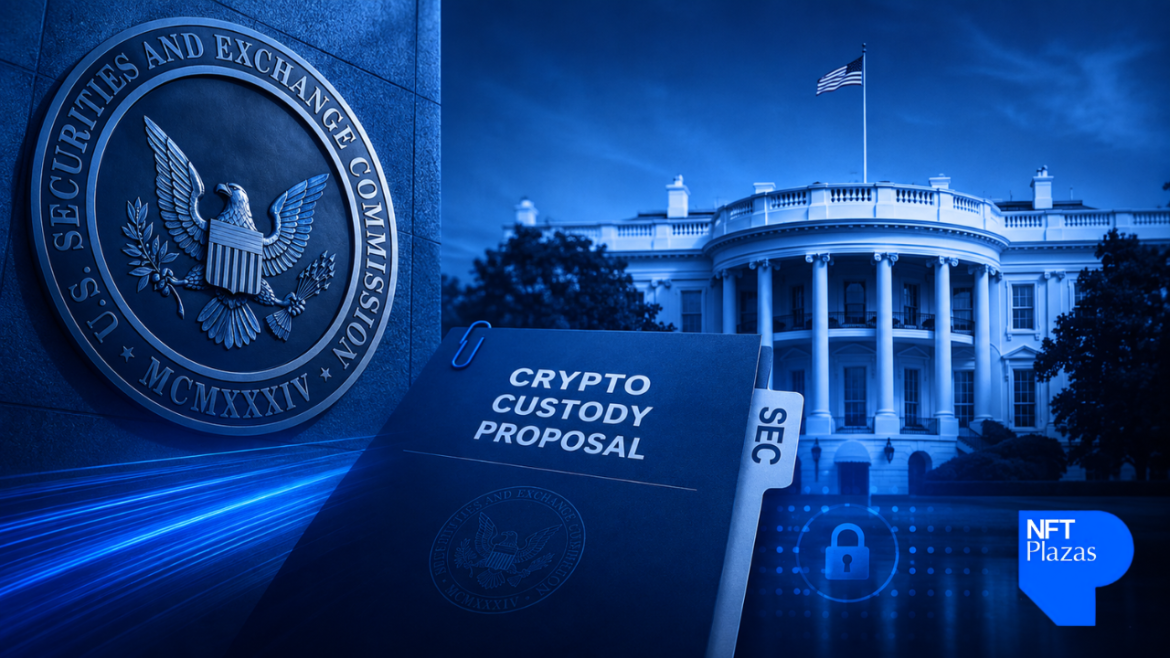
The U.S. Securities and Exchange Commission (SEC) has taken another step toward rewriting how investment advisers and funds can hold clients’ crypto assets, sending a new custody proposal to the White House for regulatory review.
The proposal, titled “Amendments to the Custody Rules” was submitted to the Office of Information and Regulatory Affairs (OIRA), part of the Office of Management and Budget (OMB), on August 25. The filing remains confidential, meaning the market does not yet know the precise changes the SEC is considering.
Still, the filing offers some clues about where the agency is heading.
The SEC’s regulatory agenda says the proposal would modernize custody requirements under the Investment Advisers Act of 1940 and Investment Company Act of 1940, including rules governing crypto assets. It also aims to address questions from investment advisers and investment companies about how digital assets can be held while complying with existing custody requirements.
Importantly, the proposal is classified as “Deregulatory” under Executive Order 14192. That does not reveal the substance of the coming rule, but it strongly suggests the SEC is looking to reduce regulatory burdens rather than impose another layer of restrictions. The agency also describes outdated provisions as candidates for removal where they are no longer necessary to protect investors given changes in markets and asset-holding practices.
The SEC’s current timetable targets October 2026 for publication of a proposed rule. That would begin a public comment period before the agency could consider a final version. The timing, however, is not guaranteed. The proposal is currently pending OMB review, and the SEC has previously missed regulatory deadlines by months.

The SEC has sent proposed crypto custody rule changes to the White House for review
The new effort marks a sharp change from the SEC’s approach under former Chairman Gary Gensler.
In 2023, the agency proposed expanding its custody requirements through what became known as the Safeguarding Rule. The proposal would have required investment advisers to keep client assets, including crypto, with qualified custodians meeting specific regulatory standards.
For traditional securities, that framework was relatively straightforward. Qualified custodians generally included banks and trust companies, registered broker-dealers and certain futures commission merchants.
Crypto created a much more difficult problem.
Many digital-asset platforms did not fit neatly into the existing definition of a qualified custodian, leaving advisers uncertain about how they could offer crypto exposure while remaining compliant. Gensler argued at the time that advisers could not simply assume crypto platforms qualified because of the way many of those businesses operated.
The proposal drew heavy criticism from both the financial and crypto industries. Opponents warned that the requirements could make crypto custody too expensive or impractical, particularly for smaller investment advisers. The Small Business Administration also raised concerns about the potential impact on small businesses.
The SEC ultimately withdrew the Safeguarding Rule in June 2025 after it failed to reach final approval during Gensler’s tenure.
The regulatory landscape has changed considerably since then.
One of the biggest differences is the growing number of financial institutions seeking permission to provide digital-asset custody services.
Crypto companies and financial firms have increasingly pursued bank and trust charters, giving the industry a broader pool of institutions capable of handling digital assets within the U.S. financial system. That development could give the SEC more flexibility as it considers how custody rules should apply to crypto.
The agency has also taken smaller steps to address the issue.
In September 2025, the SEC issued a no-action letter allowing certain state-chartered trust companies to serve as qualified custodians for digital assets under specified conditions. Those conditions included due diligence, independent audits, internal controls, asset segregation and restrictions on rehypothecation.
More recently, the SEC used another no-action approach to address custody arrangements involving Franklin Templeton’s OnChain Fund, showing that regulators are already experimenting with ways to accommodate digital assets within existing frameworks.
The new proposal could take those developments further by establishing broader rules rather than relying on individual regulatory relief.
The custody initiative is part of a much larger shift under SEC Chairman Paul Atkins, who has made clearer and more accommodating crypto regulation a central priority.
The agency has been working on rules covering token offerings, crypto market structure, broker-dealer activities and tokenized securities. In March, the SEC also issued an interpretation clarifying how federal securities laws apply to certain crypto assets and transactions, describing the move as part of its effort to provide greater regulatory certainty.
The custody proposal is particularly important because custody sits at the foundation of institutional crypto adoption. Asset managers may be willing to offer digital-asset products, but they still need a compliant way to safeguard those assets, manage private keys and demonstrate control to regulators and clients.
For now, the most important detail is what the SEC has not revealed.
The draft remains behind closed doors at OIRA, where it could be reviewed or revised before returning to the SEC. If the agency follows its current schedule, the market could get its first detailed look at the new framework in October.
After the failed 2023 approach, the next proposal will show whether the SEC has found a workable middle ground between investor protection and the practical realities of institutional crypto custody.

Costa Rica, August 28, 2026 — Frogbet, a new cryptocurrency casino and sportsbook, has officially
launched at frogbet.com, debuting a catalog of 70 original games developed entirely in-house alongside
more than 7,000 titles from providers including Pragmatic Play, Hacksaw Gaming and BGaming.
Every Frogbet original is provably fair, allowing players to cryptographically verify the outcome of any
bet at any time. The proprietary catalog spans in-house slots, eight blackjack variants, poker, and a full
range of instant games including Mines, Dice, Plinko, Crash, Limbo and Keno — none of which are
available on any other platform. According to the team, Frogbet’s proprietary slots are the first original
games in the industry to ship with built-in bonus buys, letting players purchase direct entry into feature
rounds.
The originals suite is built around a high-volume betting engine. Players can place up to 100,000 instant
bets in a single click, with all rounds settled immediately, and a built-in strategy builder lets players
define their own rules and automate their play hands-free.
“Original games are usually a side menu at crypto casinos — at Frogbet they are the product. We
built all 70 games ourselves, made every one of them verifiable, and then built the tools serious
players actually want: bonus buys on originals, six-figure batch betting, and a strategy builder.
And when you win, the money is in your wallet in seconds, not days,” said a Frogbet
spokesperson.
Withdrawals are processed instantly, 24 hours a day, with payouts typically reaching players’ wallets
within seconds of the request. The platform is fully crypto-native, supporting deposits and withdrawals
in more than 50 cryptocurrencies including BTC, ETH, USDT and SOL, and pairs the casino with a
complete sportsbook offering live in-play betting.
New players receive a 150% deposit match plus 100 free spins on their first deposit. Ongoing
promotions at launch include a $10,000 Weekly Race, a $500 Daily Raffle and a Weekly Jackpot
Lottery. Frogbet’s six-tier VIP program runs from Bronze to Elite with weekly cashback of up to 25%,
and rakeback that accrues on every bet and can be claimed every 15 minutes. Through the platform’s
VIP Transfer program, players who hold VIP status at another casino can wager $500, share their
current level with support via live chat, and be upgraded to the matching Frogbet tier instantly.
“The crypto gambling audience has become the most sophisticated betting audience in the world.
They check the seeds, they hunt bonus buys, they automate strategies. Frogbet is built for exactly
that player,” the spokesperson added.
Frogbet’s originals lobby, sportsbook and full game catalog are live now at frogbet.com.
About Frogbet
Frogbet is a crypto-native online casino and sportsbook offering 70 provably fair original games built
in-house, more than 7,000 titles from leading providers, a full sports betting product, and instant
cryptocurrency withdrawals, 24/7. Frogbet is intended for players aged 18 and over. Players are
encouraged to gamble responsibly. Learn more at frogbet.com, or follow Frogbet on X at
x.com/frogbetcom and on Telegram at t.me/frogbetcom.

After what feels like a lifetime in the making, the SEC’s proposed new Regulation Crypto Assets rules could finally make public token sales easier in the United States.
The proposal would allow qualifying issuers to raise up to $75 million during any 12-month period, and potentially allow projects to return to investors to raise more funds year after year as they build out their networks.
That could create a new, staged model for token fundraising, and potentially make early allocations more attractive to investors betting on higher valuations later.
But before you put the champagne on ice, it’s unlikely to bring back the freewheeling initial coin offering mania of 2017, according to Lee Reiners, a Duke University lecturing fellow and financial regulation expert. He tells Magazine:
“My initial view is that the $75 million exemption could make public token offerings more feasible, but it is unlikely to produce a return to the ICO boom.”
The Securities and Exchange Commission’s proposal, unveiled Aug. 18, creates two exemptions for certain investment contracts involving crypto assets.
SEC Proposes New Regulation Crypto Assets. Source: SEC
The first is a one-time exemption for startups for offerings of up to $5 million over four years, and the second is a larger fundraising exemption allowing up to $75 million in each 12-month period.
Related: MiCA cracks down on USDT in Europe… but no one else cares
The latter is modeled in part on Regulation A and comes with disclosure and ongoing reporting requirements.
Does the rolling nature of the $75 million limit mean a project could simply raise $75 million, build for a year, then come back for another $75 million?
The answer appears to be yes.
Drew Hinkes, partner at Winston & Strawn, tells Magazine the 12-month limitation would allow for “serial raises” of $75 million every 12 months, “provided they are actually distinct offerings.”
So what’s the catch?
Lilya Tessler, partner and leader of Sidley’s Global FinTech and Blockchain group, says that while “nothing prevents an issuer from relying on the exemption more than once,” each raise “isn’t automatic.”
Subsequent raises would require filing a new offering statement and undergoing an SEC staff review, and issuers would have to keep filing annual and semiannual reports. They would also need to “disclose what the issuer raised under the exemption in the prior 12 months so the cap can be verified,” Tessler says.
Still, the proposed rules offer a substantial upgrade from the status quo. A project seeking $225 million in total, for example, could potentially raise the funds in chunks and return to investors later with a more developed network — and a higher valuation.
That raises another obvious question. Could the $75 million ceiling make early token allocations more sought-after, unleashing a frenzy of get-rich-quick-induced FOMO in the first round?
Possibly. Reiners says that’s one potential outcome:
“If investors expect a successful issuer to conduct later offerings at a higher valuation, an initial allocation may become more attractive precisely because it is limited.”
However, that’s not dissimilar to how many token and equity sales are currently structured. SpaceX sold fewer than 5% of its total equity during the recent IPO. “Scarcity in both token sales and exempt securities offerings of traditional securities long predate this proposal — issuers have always been able to limit round sizes and can continue to do so,” says Tessler.
Non accredited investors also won’t be able to go “all in” on any one token sale like they have in the past. Tessler says the SEC’s proposal limits them to buying “10% of the greater of their income or net worth,” regardless of which round they participate in.
Related: White hat hacker recovers $2M from faulty 2016 ICO smart contract
There are other reasons not to expect 2017 to return — not least because a generation of crypto investors have been burned by the extravagant promises and terrible tokenomics of previous ICOs. Up to 90% of projects funded via ICOs between 2017 and 2019 ended up failing. Reiners points out that fundraising markets are “shaped by investor appetite, token economics, liquidity, custody, and the reputational damage left by the last ICO cycle.”
The SEC estimates that around 130 offerings would use the two new exemptions each year, and around 475 issuers will potentially use the broader investment contract safe harbor. That’s less of a tsunami and more of a steady trickle.
SEC proposed long-awaited regulation for primary token issuance. Source: Galaxy.
But the SEC proposal is still very positive for token issuers trying to navigate a legal minefield around securities laws in the US — the kind Tezos and Telegram would have chewed their right arms off after their multimillion-dollar US securities-law battles.
Rather than force issuers to self-evaluate whether their offerings fit within existing securities law frameworks, the SEC is proposing an explicit regulatory pathway for raising capital. As crypto lawyer Jake Chervinsky says, “not one day too soon.”
There are some potential minefield though. The SEC’s proposal says the investment contract associated with a crypto asset can continue to transfer to subsequent purchasers in secondary market transactions until the crypto asset separates from the issuer’s representations or promises.
In other words, if the team selling a non-security token suggest that investors in the secondary market can reasonably expect to profit from essential managerial team efforts, then it could become subject to an investment contract.
Related: ‘We refused to do an ICO’: The truth behind Canton’s tokenomics
Hinkes sees that creating a potential problem:
“If a transaction of a non-security covered crypto asset causes the transfer of the investment contract from cryptoasset seller to cryptoasset buyer, there is a risk that the sale of the crypto asset would be viewed as a securities transaction.”
That could become a problem for exchanges and other trading venues.
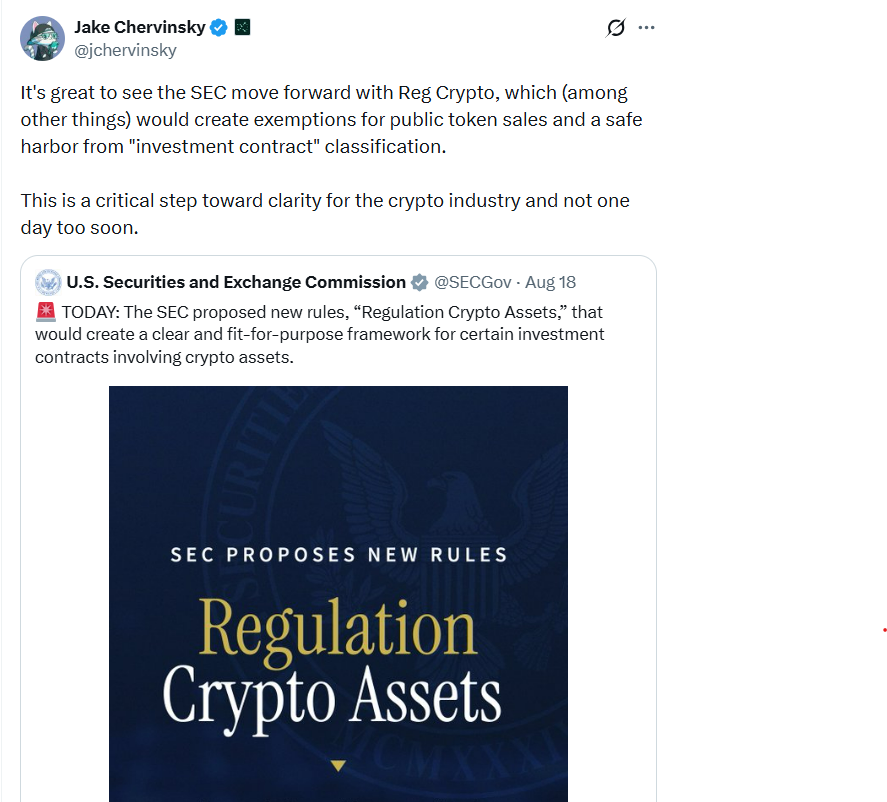
SEC moves forward with Reg Crypto. Source: Jake Chervinsky
The potential for tokens to fall into a no man land between security and non-security also worries Reiners. He says that projects could learn how to operate within the new framework without addressing the underlying investor protection concerns:
“A public offering exemption could become a vehicle for regulatory arbitrage […] A token issuer may satisfy the formal conditions for an exempt sale while continuing to market an asset whose value depends heavily on the issuer’s managerial efforts.”
That would leave retail investors in the same grey area as a decade prior, exposed to “opaque disclosures, concentrated insider holdings, and aggressive promotion.”
Magazine: Bitget CEO isn’t buying the Bitcoin rally — She’s waiting for $50K
Cointelegraph publishes long-form journalism, analysis and narrative reporting produced by Cointelegraph’s in-house editorial team with subject-matter expertise. All articles are edited and reviewed by Cointelegraph editors in line with our editorial standards. Some articles contain affiliate links, from which Cointelegraph may earn a commission. These relationships do not influence which products we review or our editorial conclusions. Content published in here does not constitute financial, legal or investment advice. Readers should conduct their own research and consult qualified professionals where appropriate. Cointelegraph maintains full editorial independence.

The trading infrastructure runs on LayerZero’s Zero blockchain, backed by Citadel Securities with DTCC and ICE exploring institutional market applications.
Bitmine owns 4.8% of the total ETH coin supply of 120.7 million
Bitmine is 97% of the way to the ‘Alchemy of 5%’ in just 14 months
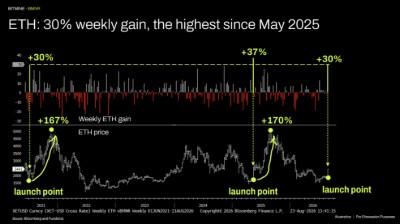
ETH gained 30% in the past week, the largest weekly gain since May 2025 and July 2021. Both precedent instances were followed by subsequent gains of +170% and +167%, respectively.
Bitmine was added to the Russell 1000 Large-cap index on June 26, 2026
Bitmine’s Series A Preferred Stock is trading on the NYSE under the symbol BMNP
Bitmine has 5,067,309 staked ETH, representing $12.4 billion at $2,440 per ETH. MAVAN (Made in America VAlidator Network) is a premier Ethereum staking destination for BMNR and institutional investors
Bitmine owns $89 million of Eightco (NASDAQ: ORBS), now one of the only publicly listed equities in the world to provide investors indirect exposure to OpenAI
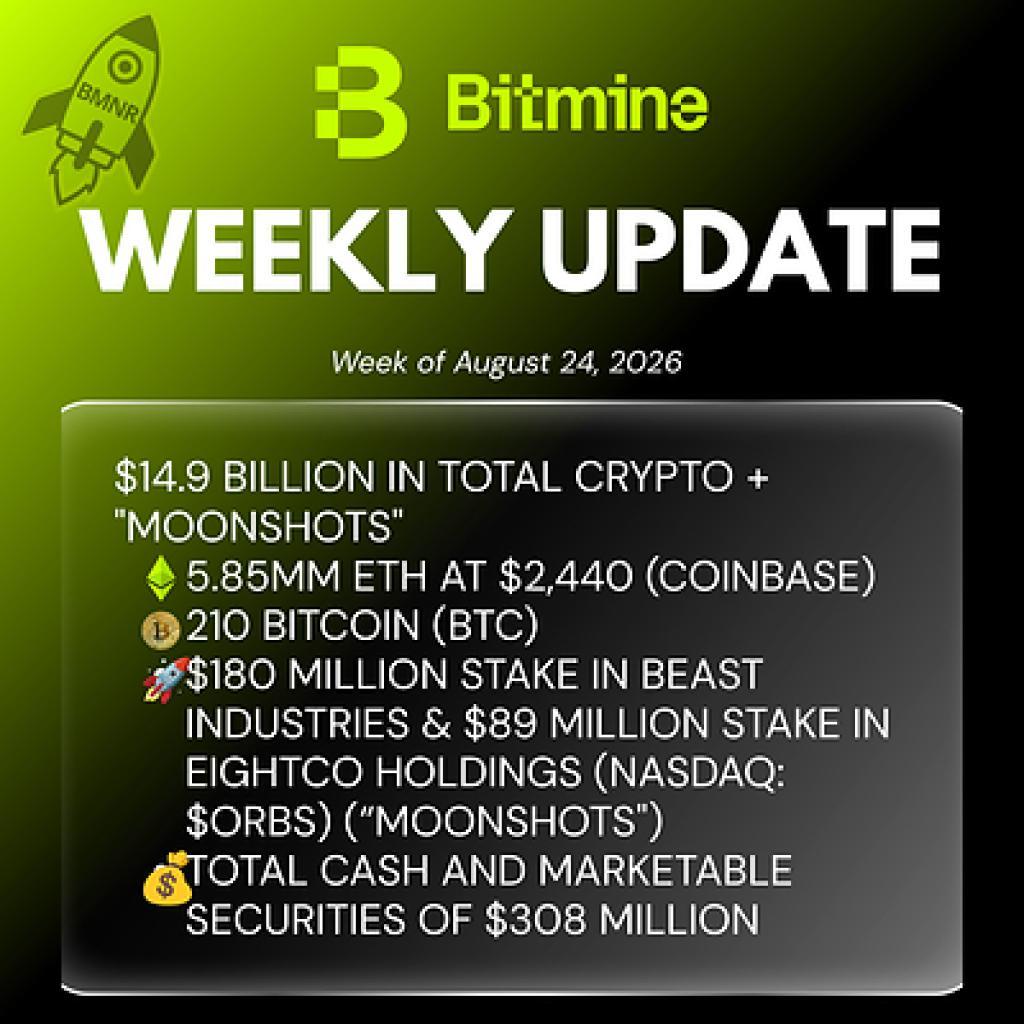
Bitmine Crypto + Total Cash Holdings & Marketable Securities + “Moonshots” total $14.9 billion, including 5.85 million ETH tokens, total cash & marketable securities of $308 million, and other crypto holdings
Bitmine remains supported by a premier group of institutional investors including ARK’s Cathie Wood, MOZAYYX, Founders Fund, Bill Miller III, Pantera, Kraken, DCG, Galaxy Digital and personal investor Thomas “Tom” Lee to support Bitmine’s goal of acquiring 5% of ETH
NORWALK, Conn., Aug. 24, 2026 /PRNewswire/ — (NYSE: BMNR) Bitmine Immersion Technologies, Inc. (“Bitmine” or the “Company”) a Bitcoin and Ethereum Network company with a focus on the accumulation of crypto for long term investment, today announced Bitmine crypto + total cash & marketable securities + “moonshots” holdings totaling $14.9 billion.
As of August 23, 2026 at 2:00pm ET, the Company’s crypto holdings are comprised of 5,847,611 ETH at $2,440 per ETH (per Coinbase NASDAQ: COIN), 210 Bitcoin (BTC), $180 million stake in Beast Industries, $89 million stake in Eightco Holdings (NASDAQ: ORBS) (“moonshots”) and total cash & marketable securities of $308 million. Bitmine’s ETH holdings are 4.8% of the ETH supply (of 120.7 million ETH).
“ETH gained 30% in the past week. This is the largest weekly gain since May 2025, prior to that it was July 2021. In those two precedent instances, this weekly gain of >30% signaled a launch point for a larger move in ETH. In July 2021, ETH subsequently gained +167% and after May 2025, ETH gained +170%,” stated Thomas “Tom” Lee, Chairman of Bitmine. “We expect easing financial conditions to be a tailwind for crypto.”
“We believe this upside move in ETH was overdue given the strengthening fundamentals in crypto, the multiple tailwinds of Wall Street tokenization, and agentic-AI. Moreover, the fact that the White House signaled support for crypto and the Treasury buying long-term bonds supported improved risk appetite,” stated Lee.
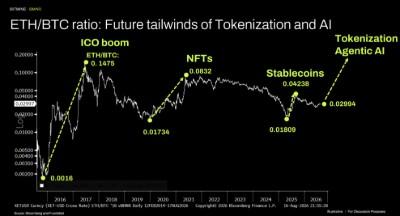
“This ETH/BTC ratio has moved up during crypto bull cycles, driven by increasing use of Ethereum relative to bitcoin. These prior cycles were fueled by ICOs (2017-2018), NFTs (2020-2021), and stablecoins (2025). In this upcoming crypto cycle, we see the ETH/BTC ratio rising, driven by Wall Street tokenizing on the blockchain and by agentic-AI using blockchains,” continued Lee.
“Over the past week, we acquired 32,447 ETH. Bitmine has bought ETH every week since the inception of the ETH Treasury Strategy on June 30, 2025 about 14 months ago,” stated Lee.
On July 16, 2026, Bitmine released the latest Chairman’s Message (link here) for July 2026. The title of the Message is “ETH is the cure for the Uncanny Valley of Wealth.”
Earlier in 2026, Bitmine launched MAVAN (the Made in America VAlidator Network), the institutional-grade staking platform. While MAVAN was originally developed to support Bitmine’s own Ethereum treasury, MAVAN intends to expand to serve institutional investors, custodians, and ecosystem partners seeking best-in-class staking infrastructure. A portion of Bitmine’s ETH is already staked on the MAVAN platform.
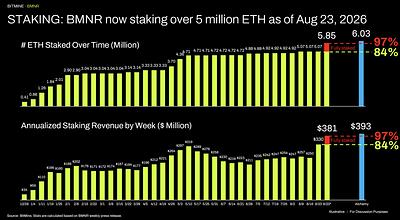
As of August 23, 2026, Bitmine total staked ETH stands at 5,067,309 ($12.4 billion at $2,440 per ETH). “Bitmine has staked more ETH than other entities in the world. At scale (when Bitmine’s ETH is fully staked by MAVAN and its staking partners), the projected ETH staking reward is $381 million on an annualized basis (using 2.67% 7-day BMNR yield),” stated Lee.
“Annualized staking revenues are now projected at $330 million. And this 5.1 million ETH is 87% of the 5.85 million ETH held by Bitmine. Bitmine’s own staking operations generated a 7-day yield of 2.67% (annualized),” continued Lee.
Bitmine’s crypto holdings reign as the #1 Ethereum treasury and #2 global treasury, behind Strategy Inc., which reportedly owns 840,447 BTC valued at approximately $70 billion. Bitmine remains the largest ETH treasury in the world.
Bitmine management believes the GENIUS Act and the Securities and Exchange Commission’s (SEC) Project Crypto are as transformational to financial services in 2026 as the US action on August 15, 1971, which ended the Bretton Woods system and took the U.S. dollar off the gold standard 55 years ago. This 1971 event was the catalyst for the modernization of Wall Street, creating the iconic Wall Street titans and financial and payment rails of today. These proved to be better investments than gold.
The Chairman’s message can be found here:
https://www.Bitminetech.io/chairmans-message
The Fiscal Full Year 2025 Earnings presentation and corporate presentation can be found here: https://Bitminetech.io/investor-relations/
To stay informed, please sign up at: https://Bitminetech.io/contact-us/
About Bitmine
Bitmine Immersion Technologies, Inc. (NYSE: BMNR), together with its subsidiaries (“Bitmine” or the “Company”), is a blockchain technology infrastructure company operating across institutional digital asset staking and validation services, bitcoin mining, and strategic digital asset management. As the world’s leading Ethereum Treasury company, it implements an innovative digital asset strategy for institutional investors and public market participants. The Company provides institutional-grade staking and validation infrastructure—through which it earns staking rewards and validation income—alongside bitcoin mining activities. Bitmine holds digital assets strategically, generating yield on those holdings to support liquidity and capital formation. Since 2025, the Company has expanded its blockchain infrastructure capabilities, including developing and deploying MAVAN, its institutional staking and validation platform. The Company’s activities further include investments in early-stage blockchain opportunities (“moonshot” investments) and ancillary mining, hosting, and consulting services.
For additional details, follow on X:
https://x.com/bitmnr
https://x.com/fundstrat
Forward Looking Statements
This press release contains statements that constitute “forward-looking statements” within the meaning of the Private Securities Litigation Reform Act of 1995, as amended. Forward-looking statements include all statements that are not purely historical and can generally be identified by terms such as “expects,” “projects,” “intends,” “plans,” “believes,” “anticipates,” “estimates,” “forecasts,” “targets,” “goals,” “may,” “will,” “would,” “could,” “should,” “view,” “see,” or similar expressions, or the negative of such terms, or other comparable terminology. This press release specifically contains forward-looking statements regarding, among other things: (i) the Company’s goal of acquiring 5% of the total ETH supply (the “Alchemy of 5%” initiative) and statements regarding its progress toward this goal; (ii) the Company’s digital asset accumulation and treasury strategy, including statements regarding continued weekly ETH acquisitions and the Company’s status as the largest ETH treasury in the world; (iii) the Company’s staking operations, including projected annualized ETH staking rewards of approximately $381 million at scale (assuming Bitmine’s ETH is fully staked by MAVAN and its staking partners), currently projected annualized staking revenues of approximately $330 million, and the 7-day yield of 2.67% (annualized); (iv) MAVAN’s intended expansion to serve institutional investors, custodians, and ecosystem partners seeking best-in-class staking infrastructure, and its intended position as a premier Ethereum staking destination for institutional investors; (v) expectations regarding future ETH price performance, including statements that ETH’s recent weekly gain of more than 30% signals “a launch point for a larger move in ETH” and references to subsequent gains of +167% and +170% following prior comparable weekly gains; (vi) management’s expectation that easing financial conditions will be “a tailwind for crypto” and that the recent upside move in ETH “was overdue given the strengthening fundamentals in crypto,” including the anticipated effects of Wall Street tokenization, agentic-AI, signals of White House support for crypto, and Treasury purchases of long-term bonds; (vii) statements and expectations regarding the ETH/BTC ratio, including that the ratio will rise in the upcoming crypto cycle driven by Wall Street tokenizing on the blockchain and by agentic-AI using blockchains; (viii) management’s belief that the GENIUS Act and SEC Project Crypto are “as transformational to financial services” as the end of the Bretton Woods system in 1971, and that the resulting investments will prove better than gold; (x) statements regarding the Company’s investment in Eightco Holdings (NASDAQ: ORBS) as providing indirect exposure to OpenAI, and its investment in Beast Industries; and (xi) the future growth, advancement, and strategic direction of the Company’s Ethereum treasury strategy, blockchain infrastructure capabilities, and MAVAN staking platform.
These forward-looking statements involve substantial risks and uncertainties that could cause actual results to differ materially from those expressed or implied. Factors that could cause or contribute to such differences include, but are not limited to: the extreme volatility and unpredictability of digital asset prices, including ETH and Bitcoin, and the speculative nature of digital asset investments; the risk that historical ETH price movements, including prior weekly gains and the price appreciation that followed them, will not recur or are not indicative of future performance; the Company’s reliance on third-party pricing sources and reported market values in calculating the value of its crypto, cash, marketable securities, and “moonshot” holdings, and the risk that such values fluctuate materially after the date and time referenced in this release; changes in market conditions affecting the trading price of the Company’s common stock and Series A Preferred Stock; the Company’s ability to successfully execute its digital asset acquisition strategy and achieve its ETH accumulation targets, including the “Alchemy of 5%” goal; the Company’s ability to finance its business operations, Ethereum treasury operations, and MAVAN expansion; operational, security, and technological risks associated with the Company’s staking and validation operations, including network failures, slashing events, cybersecurity breaches, and protocol changes; the risk that actual staking participation, yields, rewards, and revenues differ materially from the projected amounts described in this release, which are based on a 7-day yield and assume ETH is fully staked at scale; competition in the digital asset treasury, staking, and mining industries; the Company’s dependence on key personnel, including executive leadership; regulatory developments affecting digital assets, blockchain technology, and staking activities in the United States and globally, including the ultimate enactment, implementation, and interpretation of the GENIUS Act and other pending legislation and regulatory initiatives; actions by the SEC, CFTC, and other regulatory bodies affecting digital assets and related businesses; risks related to the Company’s investments in early-stage blockchain opportunities (“moonshot” investments), including the investments in Eightco Holdings and Beast Industries and any indirect exposure to OpenAI; macroeconomic factors, including inflation, interest rates, Federal Reserve monetary policy, labor market conditions, and general economic conditions affecting investor sentiment toward digital assets; the accuracy of management’s expectations regarding the ETH/BTC ratio and the impact of tokenization and agentic-AI applications on Ethereum; the unpredictability of cryptocurrency market cycles and the accuracy of expectations regarding future crypto cycles; changes to the Ethereum protocol, including staking mechanics, validator requirements, and reward structures; risks related to AI systems and their potential impact on cryptocurrency markets and blockchain technology; the performance of third-party service providers, exchanges, custodians, and staking partners; risks related to the concentration of the Company’s assets in digital currencies, particularly Ethereum; and the other risk factors described in the Company’s filings with the SEC.
The forward-looking statements contained in this press release are based on information available to management as of the date of this release and reflect management’s current expectations, estimates, forecasts, projections, views, and beliefs concerning future events and circumstances. Actual results may vary materially from those expressed or implied by forward-looking statements based on a number of factors, including those described above and in the Risk Factors section of the Company’s Annual Report on Form 10-K for the fiscal year ended September 30, 2025 filed with the SEC on November 21, 2025, the Company’s Quarterly Reports on Form 10-Q, and the Company’s other filings with the SEC, as amended or updated from time to time. Copies of these filings are available on the SEC’s website at www.sec.gov and on the Company’s website at https://Bitminetech.io/investor-relations/. The Company cautions readers not to place undue reliance on any forward-looking statements, which speak only as of the date on which they are made. Bitmine expressly disclaims any obligation or undertaking to update, revise, or supplement any forward-looking statements to reflect any change in its expectations or any change in events, conditions, or circumstances on which any such statements are based, except as required by applicable law or regulation.


A new Federal Reserve Bank of Cleveland working paper offers a provocative explanation for why cryptocurrency behaves so differently from traditional financial assets: Americans who buy crypto don’t simply have different demographics or risk appetites, they have radically different beliefs about digital assets’ future returns.
The finding could help explain both crypto’s persistent volatility and the way rallies can attract new buyers, potentially creating a feedback loop in which rising prices reinforce bullish expectations and pull more investors into the market.
Using repeated surveys of as many as 25,000 US households per wave, researchers Michael Weber, Bernardo Candia, Olivier Coibion and Yuriy Gorodnichenko found that expectations about crypto returns explain more of the variation in who owns cryptocurrency than a broad range of demographic characteristics.
The paper, titled “Do You Even Crypto, Bro? Cryptocurrencies in Household Finance,” also uses a randomized information experiment to show that simply giving people information about Bitcoin’s (BTC) recent performance can increase both their desired crypto allocation and their subsequent purchases.
Perceived risk of crypto by ownership. Source: Federal Reserve Bank of Cleveland
The researchers say the results point to a potential mechanism behind speculative bubbles: past gains can attract new investors, whose purchases push prices higher and potentially attract still more buyers.
“Positive returns attract new participants, which raises the price further,” the authors write
That dynamic is particularly striking because cryptocurrency remains poorly understood by a large share of the population. In the researchers’ 2021 survey, 87% of people who did not own crypto said they didn’t know what return to expect from it over the following year. Among crypto owners, the figure was still 54%.
Related: Canadian crypto ownership increases to 25%: Ontario survey
For those willing to make a forecast, however, the gap was enormous. Crypto owners expected an average 22% return over the following year, compared with just 7% among non-owners. Owners also tended to view crypto as less risky than non-owners did.
The researchers found that expected returns were unusually powerful in determining ownership. A one-percentage-point increase in an individual’s expected crypto return was associated with a 0.8-percentage-point increase in the probability of owning cryptocurrency. Expectations about returns and risk together explained considerably more variation in crypto ownership than observable characteristics such as age, income and gender.
That makes crypto an outlier compared with stocks, bonds and gold. For traditional assets, demographic and financial characteristics generally have much more explanatory power than differences in expected returns. Crypto reverses that relationship.
Source: Federal Reserve Bank of Cleveland
The demographic profile of crypto investors nevertheless remains distinctive. People under 40 were 13 percentage points more likely to own cryptocurrency than those over 60, even after controlling for other characteristics. Men were about 4 percentage points more likely than women to own crypto, while higher-income and wealthier households were also more likely to participate.
The experiment provides perhaps the paper’s most consequential finding for crypto markets.
In 2025, researchers randomly assigned households to receive information about BTC, stocks, GameStop or inflation. Participants who were shown Bitcoin’s previous 12-month return increased their desired crypto portfolio allocation by roughly 2 percentage points, or about a 47% increase relative to the 4.3% desired allocation among the control group. Actual subsequent crypto purchases also rose by about 2.5 percentage points.
The authors describe the result as “providing information about recent Bitcoin returns induces some households to start buying cryptocurrency.”
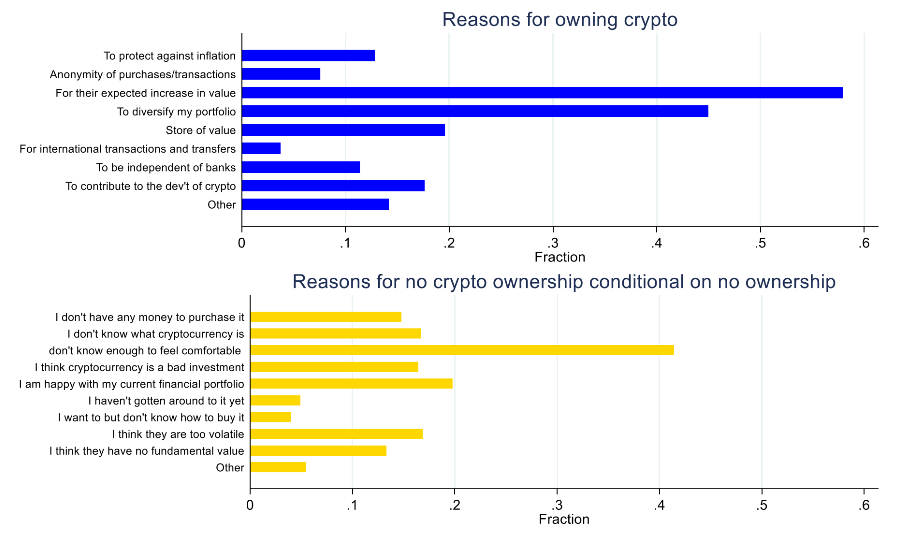
The effect was concentrated among people who said they didn’t own crypto because they lacked sufficient information. Those who already believed crypto was a bad investment generally did not respond to the information treatment.
The paper also finds that crypto wealth can spill into household consumption. A doubling in BTC’s price made a household whose entire financial portfolio was in crypto 1.4 percentage points more likely to buy a durable good, equivalent to roughly a 7% increase relative to the unconditional probability of such a purchase. But the effect did not persist into ordinary spending.
That led the researchers to a stark comparison: crypto gains appear to be treated more like “gambling income” or lottery winnings than a permanent increase in wealth.
The broader implication is that crypto’s volatility may be rooted partly in disagreement and learning rather than simply market fundamentals. The authors conclude that cryptocurrency stands out because it is poorly understood, investors form sharply different views about its prospects, and new information about past returns can change both expectations and behavior.
“The absence of common information and beliefs about crypto across investors,” they write, “suggests that price volatility will continue to be one of the most defining characteristics of this new asset for the foreseeable future.”
For crypto markets, that suggests a potentially uncomfortable conclusion: the next wave of retail demand may depend not only on Bitcoin’s price, but on what investors are told about the price that came before it.
Magazine: The 100x obsession: Fundamentals grow in importance as crypto matures

Willemstad, Curaçao, August 19th, 2026, PlayNewswire
1win, a crypto entertainment platform, has added Crypto Genesys, Pragmatic Play’s new crypto-themed slot, giving its players access to a title currently available across only a limited selection of gaming platforms.
As one of the few selected gaming platforms that offer Crypto Genesys, 1win is expanding its entertainment offerings beyond cryptocurrency transactions to include gaming experiences designed specifically for crypto-oriented audiences.
Set in the world of crypto, AI, and digital culture, Crypto Genesys takes players into a neon-lit cyberpunk metropolis where digital currencies meet futuristic gameplay. A cyborg character overlooks the reels, while crypto-inspired tokens, including a prominent Bitcoin symbol, drive the game’s visual identity.
Instead of traditional paylines, Crypto Genesys uses a scatter-pays system across a 6-reel, 5-row grid, allowing winning symbols to land anywhere on the reels. Tumbles clear winning symbols to make room for new ones, creating opportunities for consecutive wins within a single sequence.
The game also features multiplier symbols and Free Spins with accumulating multipliers. Players looking for more control over the gameplay can use the Ante Bet feature to increase their chances of triggering Free Spins or access the bonus round directly through the Buy Free Spins option.
With high volatility and a maximum win of up to 15,000x the stake, Crypto Genesys is designed for players looking for high-risk, high-reward gameplay wrapped in a distinctly crypto-inspired experience.
Crypto Genesys is now available to play on 1win.
About 1win
Founded in 2016, 1win is a crypto entertainment platform in the global gaming industry. Operating across Asia, Latin America, and Africa, 1win offers a wide range of entertainment products adapted to regional audiences. The brand has active collaborations with international public figures, including football legend Luis Suarez, martial artist Jon Jones, and Olympic champion and UFC fighter Gable Steveson. In 2026, 1win welcomed rapper Tyga, UFC legend Ilia Topuria, and reggaeton star Nicky Jam as members of the 1win VIP community.
Press Office
1win
press@1win.pro


