Bernstein sees Robinhood’s crypto business shifting toward infrastructure as new products like prediction markets and perps gain ground.

 Live Chat
Bernstein sees Robinhood’s crypto business shifting toward infrastructure as new products like prediction markets and perps gain ground.
News
Circle urged the SEC to align its proposed Regulation Crypto Assets with the GENIUS Act and clarify treatment for payment stablecoins.
Circle said it submitted comments to the U.S. Securities and Exchange Commission on October 20 on the agency’s proposed Regulation Crypto Assets, urging the commission to align the framework with the GENIUS Act and to clarify how payment stablecoins should be treated in onchain capital formation. The company said the proposal could support innovation while preserving market transparency, investor protection, liquidity and efficiency, but asked for clearer rules on permissionless networks, stablecoin use and post-launch technical services.
In its comment letter, Circle backed the SEC’s stated goal of creating a tailored framework for certain crypto-asset offerings and investment contracts, while arguing that blockchain networks can complement existing market strengths through faster settlement, programmable transactions, transparent records and improved auditability. The company also emphasized technology neutrality and said permissionless networks such as Arc can offer scale and network security, while asking the SEC to clarify the treatment of different permissionless network structures.
Circle said the proposal should operate consistently with the GENIUS Act. It asked the SEC to clarify how GENIUS-compliant payment stablecoins may be used as payment and settlement assets in onchain capital formation, and to specify that qualifying payment stablecoins count as “cash” for purposes of proposed Rule 302(b). The company also called for dollar-based valuation treatment, appropriate accounting and customer-reserve treatment, and a reduction of the current 2% broker-dealer haircut to zero for GENIUS-compliant payment stablecoins, subject to objective safeguards.
The letter further asked the commission to clarify that technical services performed after a network becomes functional, including maintaining a known validator set, do not amount to essential managerial efforts. Circle said a safe harbor for technical roadmaps would allow issuers to maintain and improve functioning networks without inadvertently restarting that analysis.
The filing comes against the backdrop of the SEC’s proposed Regulation Crypto Assets, which remains a proposal as of October 28, 2026. The rulemaking record shows the proposal was issued on August 18, published in the Federal Register on August 21, and had a comment deadline of October 20. Separately, the SEC on October 1 proposed a crypto-custody framework for investment advisers and regulated funds, including conditional self-custody and use of state trust companies.
Because the SEC proposal has not been finalized, the practical effect of Circle’s requested changes remains uncertain. The agency has said antifraud and antimanipulation provisions would continue to apply even if the framework is adopted, and the proposed safe harbor is conditional rather than a blanket exemption.

The OCC’s new GENIUS Act rules let exchanges like Coinbase and Robinhood keep paying interest-like stablecoin rewards, despite warnings from banks about deposit flight.
Crypto companies can keep paying interest-like rewards to customers, according to federal bank regulators. The ruling arrives despite warnings from banks that such programs could pull trillions of dollars out of the banking system.
The decision is part of the rollout of the GENIUS Act, which was signed into law last year to set rules for stablecoin issuers. The Office of the Comptroller of the Currency (OCC) published the new rules on Wednesday.
Under the OCC’s framework, stablecoin issuers like Circle remain barred from paying interest to people who hold their coins. Exchanges that trade and hold those stablecoins, including Coinbase and Robinhood, can pass earnings from the coins on to customers as interest-like rewards. Regulators said exchanges can do so on a case-by-case basis. Banks had wanted the practice banned outright.
Stablecoins are crypto tokens designed to hold a steady value, typically $1 per coin. They are backed by bank deposits and U.S. Treasuries, which earn interest, and that interest sits at the center of the fight between banks and crypto firms. The industry wants to turn the income from those reserves into a yield for customers.
Banking groups have pushed for tighter limits because crypto firms often offer higher yields than traditional savings accounts. Coinbase, for example, offers up to 3.5% on USDC balances. The FDIC’s latest figures put the average savings account yield at 0.38%.
If stablecoins and exchanges outcompete banks on yield, customers could shift their savings into crypto, a trend known as deposit flight. The banking industry argues this would reduce banks’ ability to lend and, in a worst-case scenario, cause some to fail. The same issue sparked intense debate when lawmakers drafted the CLARITY Act.
The American Bankers Association said the decision threatens the funds banks use to make loans that drive the U.S. economy. It argued the rule preserves the status quo for crypto platforms despite Congress’s clear intent to protect local lending.
Consumer advocates have joined banks on this issue, which is unusual. They worry that customers will see crypto rewards as equivalent to bank account interest, even though the crypto world has no equivalent of FDIC deposit insurance. Phillip Basil of Better Markets said the OCC has handed stablecoin issuers a free pass to do the work of banks without the protections that keep the banking system safe.

Editorial Process for bitcoinist is centered on delivering thoroughly researched, accurate, and unbiased content. We uphold strict sourcing standards, and each page undergoes diligent review by our team of top technology experts and seasoned editors. This process ensures the integrity, relevance, and value of our content for our readers.
Castries, Saint Lucia, October 27th, 2026, Chainwire
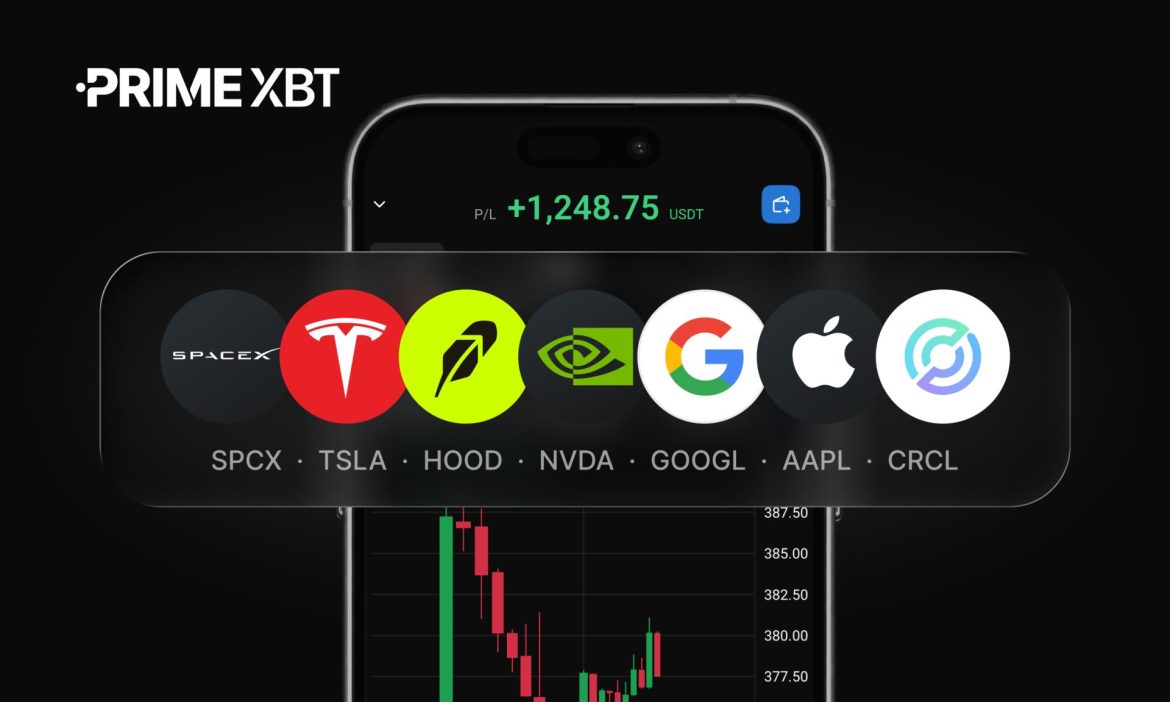
PrimeXBT, a global multi-asset broker and crypto asset service provider, has announced a major expansion of its offering, introducing Tokenised Stocks, a new category of Crypto Futures available on its native PXTrader 2.0 platform. The launch gives crypto traders access to price movements linked to some of the world’s most prominent companies, bringing opportunities from traditional equity markets into the crypto trading environment.
The new category includes seven USDT-denominated Crypto Futures linked to SpaceX (SPCX/USDT), NVIDIA (NVDA/USDT), Tesla (TSLA/USDT), Circle (CRCL/USDT), Apple (AAPL/USDT), Alphabet (GOOGL/USDT) and Robinhood (HOOD/USDT). Traders can take long or short positions and respond to market developments around the clock, including outside traditional stock exchange hours. The contracts provide exposure to company-linked price movements without ownership of the underlying shares.
“Big Tech remains at the centre of market attention, with AI investment, corporate earnings and growth expectations driving sentiment across global equities. Earnings season in particular can bring significant price movements, as investors reassess company performance and future prospects,” commented Jonatan Randin, Senior Market Analyst at PrimeXBT. “With tokenised stocks, we’re opening up new opportunities to crypto traders, allowing them to participate in major equity market trends through a familiar crypto trading environment.”
Alongside Tokenised Stocks, PrimeXBT has added Lighter (LIT/USDT), Monad (MON/USDT), Venice Token (VVV/USDT), Canton (CC/USDT), Stable (STABLE/USDT), JUST (JST/USDT) and Midnight (NIGHT/USDT) to its PXTrader 2.0 lineup of over 170 Crypto Futures, further strengthening the depth and diversity of its offering across DeFi, AI, Gaming, Payments, Layer 1 and 2 networks, blockchain infrastructure, NFTs, Meme coins and the Metaverse. The broker has also introduced new Crypto CFDs on Monero (XMR/USD), Hyperliquid (HYPE/USD) and Zcash (ZEC/USD) on PXTrader 2.0, with corresponding USDT-quoted instruments available on MetaTrader 5.
PrimeXBT has also expanded its blockchain network support with the addition of Arbitrum, Optimism and Base, joining existing networks including Bitcoin, Ethereum, Tron, BNB Smart Chain and Solana. Additionally, the broker has added Tether Gold (XAUT), a tokenized gold asset, to its internal Exchange, expanding its offering of over 50 cryptocurrencies and digital assets.
The expanded offering is supported by flexible crypto funding and crypto-denominated accounts in USDT, USDC, BTC and ETH, allowing clients to trade without converting their holdings into fiat. PrimeXBT offers competitive Crypto Futures fees of 0.01% for makers and 0.045% for takers, with further discounts through its volume-based VIP program. New clients automatically receive VIP 4 status for their first 14 days, reducing Crypto Futures taker fees by 33%, while high-volume traders can unlock fees as low as 0.015% and Bitcoin CFD spreads from $19 at the highest VIP tier.
The launch reflects the growing convergence of crypto and traditional financial markets, bringing a wider range of global market trends into the crypto trading environment. From artificial intelligence and electric vehicles to space technology and digital finance, PrimeXBT continues to broaden trading opportunities beyond digital assets, reinforcing its position as an innovative multi-asset broker connecting markets through one trading ecosystem.
To learn more about the Crypto Futures offering, users can visit PrimeXBT’s website.
About PrimeXBT
PrimeXBT is a global multi-asset broker and crypto asset service provider trusted by traders in more than 150 countries. The platform bridges traditional and digital markets within one integrated environment, redefining versatility and innovation in online trading. Clients can access Forex, CFDs on indices, commodities, shares, crypto, and Crypto Futures, as well as buy, store and exchange cryptocurrencies. This unified experience extends across both the native PXTrader 2.0 platform and MetaTrader 5, supported by advanced risk-management tools and a wide range of funding options in crypto, fiat and local payment methods. Since 2018, PrimeXBT has focused on empowering traders through broad multi-asset access, fair and transparent conditions, professional-grade technology and dedicated human support. By combining expertise, trust and a client-first approach, PrimeXBT sets a benchmark of excellence in the financial industry and provides traders with the tools they need to trade, grow and succeed with confidence.
Disclaimer: The content provided here is for informational purposes only and is not intended as personal investment advice and does not constitute a solicitation or invitation to engage in any financial transactions, investments, or related activities. Past performance is not a reliable indicator of future results. The financial products offered by the Company are complex and come with a high risk of losing money rapidly due to leverage. These products may not be suitable for all investors. Before engaging, you should consider whether you understand how these leveraged products work and whether you can afford the high risk of losing your money. The Company does not accept clients from the Restricted Jurisdictions as indicated on its website / T&Cs. Some products and services, including MT5, may not be available in your jurisdiction. The applicable legal entity and its respective products and services depend on the client’s country of residence and the entity with which the client has established a contractual relationship during registration.
PrimeXBT
pr@primexbt.com
Bitmine repurchased 2.04 million shares in the past week
Bitmine has repurchased a cumulative 22.9 million shares so far in 2026, the largest ever crypto treasury company equity buyback executed
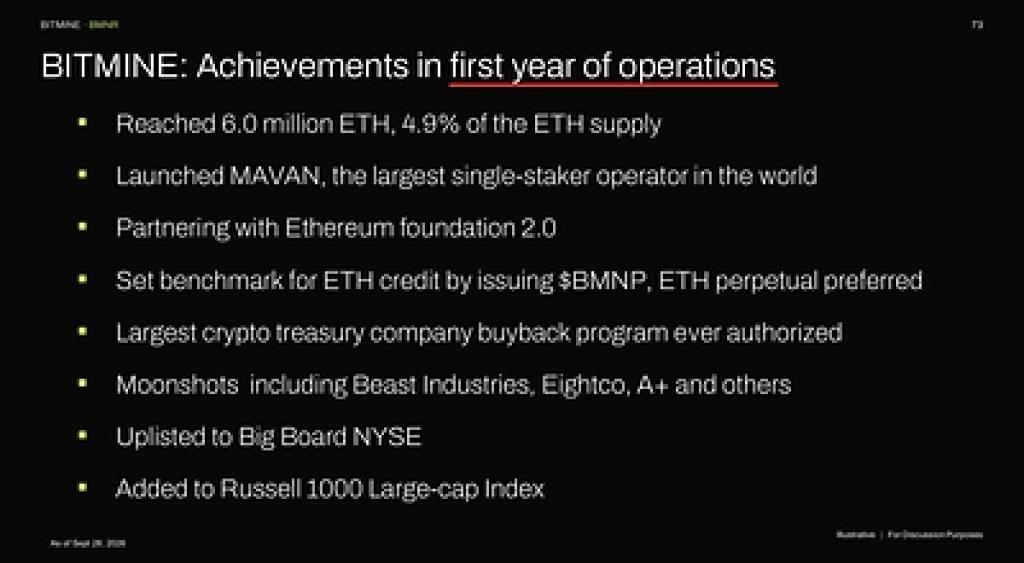
Bitmine owns 4.95% of the total ETH coin supply of 122.2 million
Bitmine is 99% of the way to the ‘Alchemy of 5%’ in just 15 months
Bitmine released Chairman’s Message on October 7 titled “Crypto Bull Underway — This Cycle Likely the Largest”
Bitmine was added to the Russell 1000 Large-cap index on June 26, 2026
Bitmine’s Series A Preferred Stock is trading on the NYSE under the symbol BMNP
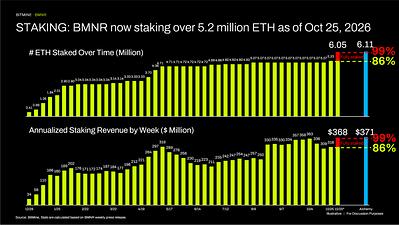
Bitmine has 5,227,037 staked ETH, representing $12.3 billion at $2,356 per ETH. MAVAN (Made in America VAlidator Network) is a premier Ethereum staking destination for BMNR and institutional investors
Bitmine owns $76 million of Eightco (NASDAQ: ORBS), now one of the only publicly listed equities in the world to provide investors indirect exposure to OpenAI
Bitmine Crypto + Total Cash Holdings & Marketable Securities + “Moonshots” total $15 billion, including 6.05 million ETH tokens, total cash & marketable securities of $514 million, and other crypto holdings
Bitmine remains supported by a premier group of institutional investors including ARK’s Cathie Wood, MOZAYYX, Founders Fund, Bill Miller III, Pantera, Kraken, DCG, Galaxy Digital and personal investor Thomas “Tom” Lee to support Bitmine’s goal of acquiring 5% of ETH
NORWALK, Conn., Oct. 26, 2026 /PRNewswire/ — (NYSE: BMNR) Bitmine Immersion Technologies, Inc. (“Bitmine” or the “Company”), a Bitcoin and Ethereum Network company with a focus on the accumulation of crypto for long term investment, today announced Bitmine crypto + total cash & marketable securities + “moonshots” holdings totaling $15 billion.
As of October 25, 2026 at 2:00pm ET, the Company’s crypto holdings are comprised of 6,051,933 ETH at $2,356 per ETH (per Coinbase NASDAQ: COIN), 215 Bitcoin (BTC), $180 million stake in Beast Industries, $76 million stake in Eightco Holdings (NASDAQ: ORBS) (“moonshots”) and total cash & marketable securities of $514 million. Bitmine’s ETH holdings are 4.95% of the ETH supply (of 122.2 million ETH).
“Crypto got pulled down by the same ‘risk off’ forces behind the AI sell-off. In contrast to late-2025 and early 2026, crypto pullbacks have been comparatively shallow. ETH has fallen 13% from its recent peak while US semiconductors ($SOXX) is down 20% in that same timeframe. We believe this is further evidence that a crypto bull market is underway,” stated Thomas “Tom” Lee, Chairman of Bitmine.
“Bitmine executed equity buybacks in the past week, acquiring 2.04 million shares, repurchased at an average price of $22.48. When management believes Bitmine shares are relatively undervalued, the Company intends to accretively repurchase shares, subject to market conditions and under the existing repurchase authorization. Optimizing shareholder value remains our top objective,” continued Lee.
In 2026, Bitmine has repurchased 22.9 million common shares, at an average price of $17.48 or an aggregate amount of $399.6 million. “This is the largest crypto treasury company common equity buyback ever executed, and reflects our commitment to shareholders,” stated Lee.
“We believe Bitmine is positioned to outperform the crypto bull market that we expect to be coming, as the Company has strengthened its competitive position over the past year in the midst of a crypto winter (bear market),” stated Lee.
“Over the past week, we acquired 10,452 ETH. Bitmine’s track record of consistent buying of crypto is unmatched by any public company in the world. Bitmine has bought ETH each and every week since the inception of the ETH Treasury Strategy on June 30, 2025,” stated Lee.
On October 7, Bitmine released its latest Chairman’s message titled “Crypto Bull Underway — This Cycle Likely the Largest.” The presentation is available at the Bitmine website (presentation link).
Earlier in 2026, Bitmine launched MAVAN (the Made in America VAlidator Network), the institutional-grade staking platform. While MAVAN was originally developed to support Bitmine’s own Ethereum treasury, MAVAN has expanded to serve institutional investors, custodians, and ecosystem partners seeking best-in-class staking infrastructure. A portion of Bitmine’s ETH is already staked on the MAVAN platform.
As of October 25, 2026, Bitmine total staked ETH stands at 5,227,037 ($12.3 billion at $2,356 per ETH). “Bitmine has staked more ETH than other entities in the world. At scale (assuming Bitmine’s ETH is fully staked by MAVAN and its staking partners), the projected ETH staking reward would be $368 million on an annualized basis (using 2.58% 7-day BMNR yield). This compares to annualized staking revenues at $318 million based upon 5.2 million staked ETH (86% of the 6.05 million ETH held by Bitmine),” continued Lee.
Bitmine’s crypto holdings reign as the #1 Ethereum treasury and #2 global treasury, behind Strategy Inc., which reportedly owns 848,517 BTC valued at approximately $74 billion. Bitmine remains the largest ETH treasury in the world.
Bitmine management believes the GENIUS Act and the Securities and Exchange Commission’s (SEC) Project Crypto are as transformational to financial services in 2026 as the U.S. action on August 15, 1971, which ended the Bretton Woods system and took the U.S. dollar off the gold standard 55 years ago. This 1971 event was the catalyst for the modernization of Wall Street, creating the iconic Wall Street titans and financial and payment rails of today.
The Chairman’s message can be found here:
https://www.Bitminetech.io/chairmans-message
The Fiscal Full Year 2025 Earnings presentation and corporate presentation can be found here: https://Bitminetech.io/investor-relations/
To stay informed, please sign up at: https://Bitminetech.io/contact-us/
About Bitmine
Bitmine Immersion Technologies, Inc. (NYSE: BMNR), together with its subsidiaries (“Bitmine” or the “Company”), is a blockchain technology infrastructure company operating across institutional digital asset staking and validation services, bitcoin mining, and strategic digital asset management. As the world’s leading Ethereum Treasury company, it implements an innovative digital asset strategy for institutional investors and public market participants. The Company provides institutional-grade staking and validation infrastructure—through which it earns staking rewards and validation income—alongside bitcoin mining activities. Bitmine holds digital assets strategically, generating yield on those holdings to support liquidity and capital formation. Since 2025, the Company has expanded its blockchain infrastructure capabilities, including developing and deploying MAVAN, its institutional staking and validation platform. The Company’s activities further include investments in early-stage blockchain opportunities (“moonshot” investments) and ancillary mining, hosting, and consulting services.
For additional details, follow on X:
Cautionary Note on Forward Looking Statements
This press release contains statements that constitute “forward-looking statements” within the meaning of the Private Securities Litigation Reform Act of 1995, as amended. Forward-looking statements include all statements that are not purely historical and can generally be identified by terms such as “expects,” “projects,” “intends,” “plans,” “believes,” “anticipates,” “estimates,” “may,” “will,” “would,” “could,” “should,” “view,” “likely,” “positioned,” or similar expressions. This press release specifically contains forward-looking statements regarding: (i) the Company’s goal of acquiring 5% of the total ETH supply (the “Alchemy of 5%” initiative) and its progress toward that goal; (ii) the Company’s digital asset accumulation and treasury strategy, including statements regarding continued weekly ETH acquisitions and the Company’s status as the largest ETH treasury in the world; (iii) the Company’s intention to repurchase shares of its common stock when management believes the shares are relatively undervalued, the timing, amount, and accretive effect of any such repurchases, and the Company’s objective of optimizing shareholder value; (iv) the Company’s staking operations, including projected annualized ETH staking rewards of approximately $368 million at scale (assuming the Company’s ETH is fully staked) and annualized staking revenues of approximately $318 million based on currently staked ETH; (v) MAVAN’s expansion to serve institutional investors, custodians, and ecosystem partners; (vi) management’s beliefs regarding crypto market conditions, including that a crypto bull market is underway, that the current cycle is likely the largest, and that the Company is positioned to outperform the crypto bull market; (vii) ETH’s relative performance versus U.S. semiconductor equities and other risk assets; (viii) management’s belief that the GENIUS Act and SEC Project Crypto are transformational to financial services; and (ix) statements regarding the value of the Company’s crypto, cash, marketable securities, and “moonshot” holdings.
These forward-looking statements involve substantial risks and uncertainties that could cause actual results to differ materially from those expressed or implied. Factors that could cause or contribute to such differences include, but are not limited to: the extreme volatility and unpredictability of digital asset prices, including ETH and Bitcoin; the Company’s reliance on third-party pricing sources and reported market values, which may fluctuate materially; changes in market conditions affecting the trading price and volume of the Company’s securities; the Company’s ability to successfully execute its digital asset acquisition strategy and achieve its ETH accumulation targets, including the “Alchemy of 5%” goal; the timing, amount, and manner of any share repurchases, which will depend on market conditions, the trading price of the Company’s common stock, available capital, and the terms of the Company’s existing repurchase authorization, and the fact that the Company is not obligated to repurchase any particular number of shares and may suspend or discontinue repurchases at any time; the Company’s ability to finance its business operations and MAVAN expansion; operational, security, and technological risks associated with the Company’s staking and validation operations, including network failures, slashing events, cybersecurity breaches, and protocol changes; the risk that actual staking yields, rewards, and revenues differ materially from projected amounts, including because staking yields fluctuate and the Company’s ETH may not be fully staked; competition in the digital asset treasury, staking, and mining industries; the Company’s dependence on key personnel; regulatory developments affecting digital assets, blockchain technology, and staking activities, including the implementation and interpretation of the GENIUS Act, SEC Project Crypto, and other pending legislation or regulatory initiatives; actions by the SEC, CFTC, and other regulatory bodies; risks related to the Company’s “moonshot” investments, including in Eightco Holdings and Beast Industries; macroeconomic factors, including inflation, interest rates, and general economic conditions; changes to the Ethereum protocol; the performance of third-party service providers, exchanges, custodians, and staking partners; and the other risk factors described in the Company’s filings with the SEC.
The forward-looking statements contained in this press release are based on information available to management as of the date of this release and reflect management’s current expectations, estimates, and beliefs concerning future events. Actual results may vary materially from those expressed or implied based on the factors described above and in the Risk Factors section of the Company’s Annual Report on Form 10-K for the fiscal year ended September 30, 2025 filed with the SEC on November 21, 2025, the Company’s Quarterly Reports on Form 10-Q, and the Company’s other filings with the SEC, as amended or updated from time to time. Copies of these filings are available at www.sec.gov and at https://Bitminetech.io/investor-relations/. The Company cautions readers not to place undue reliance on any forward-looking statements, which speak only as of the date on which they are made. Bitmine expressly disclaims any obligation to update or revise any forward-looking statements except as required by applicable law.

Russia’s central bank is rapidly widening the list of firms allowed to trade crypto, as the country’s two biggest lenders prepare to sell Bitcoin and other coins to ordinary customers before the end of the year.
The Bank of Russia added a 17th company, Prosto LLC, to its register of crypto exchange providers on Thursday, according to a notice on the regulator’s website. The register had four members when it opened on 6 October. The separate register of digital depositories, which record who owns which coins, now has eight.
The registrations put into practice a law “On Digital Currencies and Digital Rights”, which took effect on 1 September and brings crypto trading inside Russia’s regulated financial system for the first time.
Sberbank and VTB, Russia’s largest state-controlled banks, were among the first five digital depositories approved on 6 October, the central bank said. VTB was also listed as a crypto exchange provider that day. Sberbank joined the exchange register on 12 October, Interfax reported.
Holding both statuses lets a bank buy and sell crypto in its own name and keep the record of clients’ holdings. Exchange providers can trade digital currencies for their own account outside organised venues, while depositories record and transfer the assets and give clients access to the addresses where they are held, according to the central bank.
VTB’s broker carried out its first stablecoin deals for corporate clients on 6 October, settling them through accounts at its new digital depository, the bank said.
“We expect to open access to digital currency trading for a broad range of investors through VTB My Investments and directly through the bank’s exchange in November and December 2026 respectively,” Vitaly Sergeichuk, VTB’s deputy president and chairman of the management board, said, according to Interfax.
Sberbank plans to launch its first crypto products on 1 December through apps its customers already use, though the timing depends on the regulations being ready, Interfax reported. The bank is already testing Bitcoin, Ether and USDT trades in its app, CoinDesk reported.
The new rules draw a sharp line between retail and professional investors.
Non-qualified investors will be able to buy only the most liquid cryptocurrencies, up to 300,000 roubles, or about $3,800, a year through any one intermediary, and only after passing a test, the central bank said in July. Qualified investors must also pass the test but can buy and sell any cryptocurrency without a limit.
Using crypto to pay for goods and services inside Russia remains banned.
Exporters and importers, however, can use crypto for cross-border settlements without restrictions, either through intermediaries or directly from any type of wallet.
Sberbank moved first on that front. On 1 September it launched crypto payments for companies engaged in foreign trade, with wallet-to-wallet transfers taking a couple of minutes, no minimum payment and an average cost of 0.3%, first deputy chairman Alexander Vedyakhin said, according to Interfax.
The service followed a central bank pilot that had run under an experimental legal regime since September 2024, Vedyakhin said.
The two state banks are not alone. T-Technologies, the parent of T-Bank, has registered its units Atomyze as a depository and T-Invest Lab as an exchange provider.
A string of newly formed companies have since joined the exchange register, central bank records show. MTS Bank has said it plans to launch basic crypto services in the fourth quarter, Interfax reported.
Banks and other licensed institutions can join the registers through a simplified procedure that takes one working day, according to the central bank.
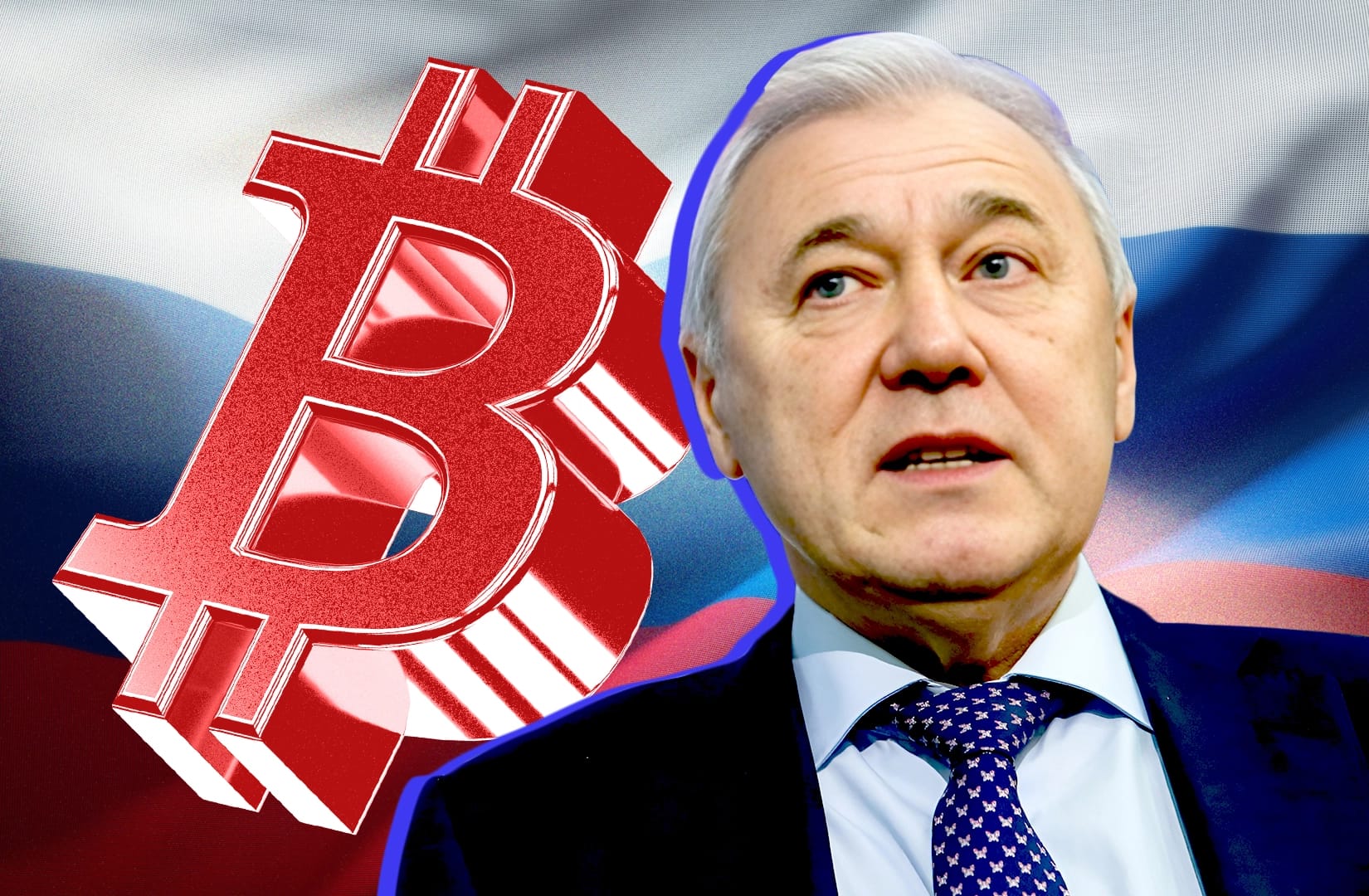
Firms already on the registers have until 1 September 2027 to bring their operations fully in line with the law, the central bank said.
From 1 July 2027, Russian residents will be allowed to trade crypto only through registered intermediaries, the regulator said, which would effectively end peer-to-peer trading settled through Russian bank accounts. Authorities plan to introduce penalties for unlicensed crypto intermediaries from the same date, mirroring those for illegal banking.
Kyle Pare is a reporter for DL News. Have a tip? Contact Kyle at kyle@dlnews.com.

The 3-month operation led to over 960 arrests, while authorities blocked thousands of bank accounts and closed hundreds of social accounts.
A UAE-led international operation involving Interpol and law enforcement agencies from 30 countries identified more than $39 billion in fraud-linked funds and digital assets while thwarting well over 123 million online fraud attempts between July and September 2026.
The results point to the scale of cross-border digital crime, with authorities now working to recover the identified assets and disrupt networks using online platforms, financial services and cryptocurrencies.
Led by the UAE’s Ministry of Interior, Operation Confrontation Ghost ran from July 1 to September 30 and went after AI-enabled fraud, financial scams run through digital platforms and online sextortion. WAM, the Emirates News Agency, stated that the operation stopped at least 123.71 million online fraud attempts worldwide.
Authorities arrested more than 960 suspects and raided 29 fraud centers. Investigators identified over 3,500 suspects and 15,500 victims, while 4,126 bank accounts were blocked and more than 570 social media accounts closed. Participants also exchanged over 9,000 pieces of intelligence.
Interpol and the Global Anti-Scam Alliance took part alongside 13 private companies, including Crypto.com, Meta, Mastercard and TikTok, WAM added. The operation also reported that tokenization technology helped secure more than four billion transactions each month, reducing fraud risks and strengthening data protection.
Results were presented at a UAE-organized side event during the 13th session of the Conference of the Parties to the UN Convention Against Transnational Organized Crime in Vienna.
Colonel Dana Al Marzouqi, director-general of the Interior Ministry’s International Affairs Bureau, explained that real-time intelligence sharing helps agencies spot suspicious activity faster and trace illicit money flows.
Dr. Monica Juma, executive director at the UN Office on Drugs and Crime, called the operation a model of international cooperation. She stressed that criminals’ use of AI, bank accounts and cryptocurrencies to move money and hide its origins demands better countermeasures and closer coordination.
As CryptoPotato reported previously, the US Justice Department’s Scam Center Strike Force seized Telegram-based scam marketplace Xinbi Guarantee in September and restrained about $52 million in crypto in a single day.
That lifted the total the Strike Force has restrained since its founding in November 2025 to roughly $938 million. Federal data reported crypto investment fraud losses at $8.65 billion in 2025, up 89% from 2023, although the FBI calls those figures “significantly underrepresented” because most fraud victims do not report.

A Circle shareholder sued President Donald Trump, alleging UAE-linked cryptocurrency payments enriched his family and diverted business from USDC.
The complaint, filed Oct. 22 in Washington federal court, challenges a $500 million investment in Trump’s World Liberty Financial and a separate $2 billion transaction settled using its USD1 stablecoin.
The lawsuit alleges that “No president in American history has profited from his office so brazenly,” arguing that the payments violated constitutional restrictions on benefits from foreign governments.
J. Benjamin Greenberg, a former Circle employee, brought the case on the company’s behalf. The complaint says he currently holds 10,000 Class A shares of the USDC stablecoin issuer.
The parties agreed to the first deal four days before Trump’s January 2025 inauguration. Aryam, an investment vehicle allegedly linked to Sheikh Tahnoon bin Zayed Al Nahyan, the UAE national security adviser, agreed to pay $500 million for 49% of World Liberty.
The complaint says $187 million of the $250 million initial installment went to Trump-linked entities. The remaining $250 million was due in July, after Trump returned to the White House.
The complaint cites $263 million in 2025 equity-sale proceeds to two related entities, about $76 million above their share of the initial payment.
The lawsuit treats that difference as evidence that UAE-linked proceeds reached the president’s businesses while he was in office, alleging that “millions of dollars from that deal” flowed to Trump after his inauguration.
Greenberg argues that the Constitution’s Foreign Emoluments Clause barred the president from accepting the alleged benefits without congressional approval. “Congress has not consented,” the filing states.
Aryam also obtained seats on World Liberty’s board, placing executives tied to Sheikh Tahnoon’s business network inside the company before it launched USD1.
That token became central to a second transaction. In March 2025, Abu Dhabi-backed MGX announced a $2 billion investment in Binance, saying settlement would occur in a stablecoin without naming one. USD1 did not launch until March 25, almost two weeks after the announcement.
On May 1, World Liberty disclosed that it would use USD1. According to the complaint, its circulating supply rose by about two billion tokens in the preceding eight days, which it attributes mostly to MGX’s purchase.
The suit says MGX purchased USD1 with $2 billion in cash before transferring the tokens to Binance. That created reserves backing USD1, generating potential interest income for World Liberty as long as the tokens remained outstanding.
The complaint argues that references to “tokens and stablecoins, holding companies and reserve yields” obscure what it calls “the oldest form of public corruption,” pointing to subsequent US decisions involving advanced AI chips for the UAE, a pardon for Binance founder Changpeng Zhao and regulatory approval for a World Liberty-linked bank.
Those connections form part of Greenberg’s allegations of improper foreign influence. A court has yet to determine whether the transactions or government decisions violated the law.
The complaint then turns to a commercial relationship that, it argues, put Circle in line for the MGX business.
Circle had agreed in November 2024 to pay Binance $60 million upfront plus monthly fees. The following month, Binance announced it would adopt USDC for its corporate treasury.
MGX’s original investment announcement did not specify a stablecoin, and USDC was already widely used. Greenberg alleges Binance asked MGX to settle in USD1 even though the token had yet to launch when the investment was unveiled.
The filing also records contrary accounts: Binance and World Liberty deny that Binance arranged the use of USD1. It cites World Liberty’s May 2025 letter to US senators saying the deal would otherwise have been settled in foreign currency, most likely UAE dirhams.
That decision created a substantial income opportunity for World Liberty. Stablecoin businesses earn revenue from cash and short-term securities backing their tokens while the coins remain in circulation.
“Circle’s losses can be measured,” the filing says. At Circle’s reserve returns of 4.1% in 2025 and 3.5% in the second quarter of 2026, $2 billion in additional reserves could have generated $70 million to $82 million annually.
Those numbers describe potential gross reserve income and not an established net loss. They depend on MGX having selected USDC and the tokens remaining outstanding. Circle also shares reserve revenue with distribution partners.
The shareholder alleges that competition continued after the original payment, citing USD1 trading incentives and Binance’s plans to shift collateral backing Binance-Peg BUSD into the token.
He argues that USD1 offered foreign states “the opportunity, by enriching the President, to obtain favorable treatment” that an ordinary rival could not match.
Greenberg must also establish why he may sue for Circle without seeking board approval. His complaint argues that directors could not independently assess a claim against the president given their regulatory exposure and Circle’s continuing business relationship with Binance.
He seeks an order blocking further prohibited foreign benefits, requiring Trump-linked companies to account for and surrender disputed proceeds, and awarding damages to Circle.
The requested injunction specifically targets reserve income from USD1 held for foreign-state entities, placing continuing payments associated with the MGX transaction within the court relief Greenberg is seeking.

On Monday, the Hyperliquid Policy Center (HPC) filed a comment letter supporting the U.S. Securities and Exchange Commission’s (SEC) proposed Regulation Crypto Assets, urging the regulator to adopt the rule with five refinements.
According to HPC, the proposal could give developers long-sought clarity on when US securities laws apply to tokens, but it also argued that gaps around the safe harbor, secondary trading, and state preemption could leave projects with little reason to build in the US.
The SEC proposed Regulation Crypto Assets in August, building on a March interpretation of how securities laws apply to token distributions. This also included airdrops, a marketing strategy that was widely used during DeFi summer in 2020 when prominent crypto companies would gift free tokens to users to incentivize liquidity, platform activity, and decentralize project governance.
Regulation Crypto Assets would create two exemptions for token offerings:
· A startup exemption of up to $5 million over four years
· A fundraising exemption of up to $75 million in any 12-month period.
Additionally, a new safe harbor would provide a clear legal off-ramp, officially confirming when a token has become independent enough to no longer be classified as an investment contract subject to strict SEC rules.
Joseph Hall, a partner at Davis Polk & Wardwell, wrote in a September op-ed for Bloomberg Law that the SEC’s proposal still leaves uncertainty because it builds on the Howey test, a legal standard used to determine whether a transaction qualifies as an investment contract.
HPC pointed to the same test as the root of the problem.
According to Hyperliquid, the current draft of the SEC’s Regulation Crypto Assets will not deliver the certainty the SEC intended. It has thus asked the SEC to consider five key changes:
· Write the SEC’s March airdrop analysis into the final rule text.
· Address resales and intermediary status directly.
· Allow projects to certify that their token was never tied to an investment contract.
· Fold the SEC staff’s buyback guidance into the final rule or adopting release.
· Make federal preemption of state registration requirements durable.
Speaking with DeFi Rate, Amir Forouzani, co-founder and CEO of Puffer Labs, noted that the stronger point in Hyperliquid’s letter is that the company focuses on “what comes next.”
“Institutions need clear rules for trading and confidence that those rules remain workable as networks evolve,” Forouzani said. “Builders need certainty while developing those networks, too.
“The SEC has an opportunity to connect these pieces and give onchain markets a predictable path from launch to adoption, with clear accountability and investor protections throughout.”
Hyperliquid has asked the SEC to treat an airdrop as not involving an “investment of money” when the network is already functional, eligibility depends on the recipient’s own contributions, and the distribution is not a capital raise, regardless of when it is announced. It said such airdrops may be recurring or programmatic.
The argument is that a user who earns tokens by using a network, running a validator, supplying liquidity, or voting in governance has not funded the project or put money at risk. HPC also wants steps such as connecting a wallet, signing a claim transaction, or completing sanctions screening confirmed as not counting as payment, and for the same analysis to apply to past airdrops.
“If projects are becoming more selective about airdrops, I see that as a reassessment of what incentives can realistically achieve,” Forouzani said.
He noted that an airdrop’s success can be measured months after distribution through protocol activity, contributions, and governance participation.
Bitmine owns 4.9% of the total ETH coin supply of 122.1 million
Bitmine is 99% of the way to the ‘Alchemy of 5%’ in just 15 months
Bitmine released Chairman’s Message on October 7 titled “Crypto Bull Underway — This Cycle Likely the Largest”
Bitmine was added to the Russell 1000 Large-cap index on June 26, 2026
Bitmine’s Series A Preferred Stock is trading on the NYSE under the symbol BMNP
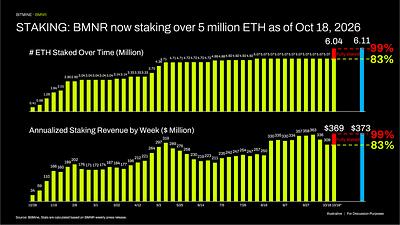
Bitmine has 5,067,309 staked ETH, representing $12 billion at $2,365 per ETH. MAVAN (Made in America VAlidator Network) is a premier Ethereum staking destination for BMNR and institutional investors
Bitmine owns $74 million of Eightco (NASDAQ: ORBS), now one of the only publicly listed equities in the world to provide investors indirect exposure to OpenAI
Bitmine Crypto + Total Cash Holdings & Marketable Securities + “Moonshots” total $15.1 billion, including 6.04 million ETH tokens, total cash & marketable securities of $582 million, and other crypto holdings
Bitmine remains supported by a premier group of institutional investors including ARK’s Cathie Wood, MOZAYYX, Founders Fund, Bill Miller III, Pantera, Kraken, DCG, Galaxy Digital and personal investor Thomas “Tom” Lee to support Bitmine’s goal of acquiring 5% of ETH
NORWALK, Conn., Oct. 19, 2026 /PRNewswire/ — (NYSE: BMNR) Bitmine Immersion Technologies, Inc. (“Bitmine” or the “Company”), a Bitcoin and Ethereum Network company with a focus on the accumulation of crypto for long term investment, today announced Bitmine crypto + total cash & marketable securities + “moonshots” holdings totaling $15.1 billion
“The risk appetite of investors contracted in the past few weeks fueled by the worrying combination of AI funding and AI model safety; escalating US-Iran war activity; anxiousness in front of US midterm elections and generally rising bond yields around the world. This has triggered a selloff in AI stocks including semis and memory stocks, and has further led to selloffs in the Korean and Taiwan markets, both of which are dominated by semis and memory stocks,” stated Thomas “Tom” Lee, Chairman of Bitmine.
“Crypto is widely held in the US, Korea and Taiwan. So naturally, when investors in those regions de-risk, this creates spillover pressures in crypto markets. In the past, whenever fundamentals remain resilient and strong, while price declines, these have historically been attractive risk/reward opportunities. And given crypto’s positive exposure to both modernizing global financial system rails and to agentic-AI, we believe this will again prove to be the case,” continued Lee.
As of October 18, 2026 at 3:00pm ET, the Company’s crypto holdings are comprised of 6,041,481 ETH at $2,365 per ETH (per Coinbase NASDAQ: COIN), 215 Bitcoin (BTC), $180 million stake in Beast Industries, $74 million stake in Eightco Holdings (NASDAQ: ORBS) (“moonshots”) and total cash & marketable securities of $582 million. Bitmine’s ETH holdings are 4.9% of the ETH supply (of 122.1 million ETH).
“We believe Bitmine is positioned to outperform the crypto bull market that we expect to be coming, as the company has strengthened its competitive position over the past year in the midst of a crypto winter (bear market),” continued Lee.
“Over the past week, we acquired 12,535 ETH. Bitmine’s track record of consistent buying of crypto is unmatched by any public company in the world. Bitmine has bought ETH each and every week since the inception of the ETH Treasury Strategy on June 30, 2025,” stated Lee.
On October 7, Bitmine released its latest Chairman’s message titled “Crypto Bull Underway — This Cycle Likely the Largest.” The presentation is available at the Bitmine website (presentation link).
Earlier in 2026, Bitmine launched MAVAN (the Made in America VAlidator Network), the institutional-grade staking platform. While MAVAN was originally developed to support Bitmine’s own Ethereum treasury, MAVAN has expanded to serve institutional investors, custodians, and ecosystem partners seeking best-in-class staking infrastructure. A portion of Bitmine’s ETH is already staked on the MAVAN platform.
As of October 18, 2026, Bitmine total staked ETH stands at 5,067,309 ($12 billion at $2,365 per ETH). “Bitmine has staked more ETH than other entities in the world. At scale (assuming Bitmine’s ETH is fully staked by MAVAN and its staking partners), the projected ETH staking reward would be $369 million on an annualized basis (using 2.58% 7-day BMNR yield). This compares to annualized staking revenues at $309 million based upon 5.1 million staked ETH (84% of the 6.04 million ETH held by Bitmine),” continued Lee.
Bitmine’s crypto holdings reign as the #1 Ethereum treasury and #2 global treasury, behind Strategy Inc., which reportedly owns 848,250 BTC valued at approximately $74 billion. Bitmine remains the largest ETH treasury in the world.
Bitmine management believes the GENIUS Act and the Securities and Exchange Commission’s (SEC) Project Crypto are as transformational to financial services in 2026 as the U.S. action on August 15, 1971, which ended the Bretton Woods system and took the U.S. dollar off the gold standard 55 years ago. This 1971 event was the catalyst for the modernization of Wall Street, creating the iconic Wall Street titans and financial and payment rails of today.
The Chairman’s message can be found here:
https://www.Bitminetech.io/chairmans-message
The Fiscal Full Year 2025 Earnings presentation and corporate presentation can be found here: https://Bitminetech.io/investor-relations/
To stay informed, please sign up at: https://Bitminetech.io/contact-us/
About Bitmine
Bitmine Immersion Technologies, Inc. (NYSE: BMNR), together with its subsidiaries (“Bitmine” or the “Company”), is a blockchain technology infrastructure company operating across institutional digital asset staking and validation services, bitcoin mining, and strategic digital asset management. As the world’s leading Ethereum Treasury company, it implements an innovative digital asset strategy for institutional investors and public market participants. The Company provides institutional-grade staking and validation infrastructure—through which it earns staking rewards and validation income—alongside bitcoin mining activities. Bitmine holds digital assets strategically, generating yield on those holdings to support liquidity and capital formation. Since 2025, the Company has expanded its blockchain infrastructure capabilities, including developing and deploying MAVAN, its institutional staking and validation platform. The Company’s activities further include investments in early-stage blockchain opportunities (“moonshot” investments) and ancillary mining, hosting, and consulting services.
For additional details, follow on X:
Cautionary Note on Forward Looking Statements
This press release contains statements that constitute “forward-looking statements” within the meaning of the Private Securities Litigation Reform Act of 1995, as amended. Forward-looking statements include all statements that are not purely historical and can generally be identified by terms such as “expects,” “projects,” “intends,” “plans,” “believes,” “anticipates,” “estimates,” “may,” “will,” “would,” “could,” “should,” “view,” “likely,” “positioned,” or similar expressions. This press release specifically contains forward-looking statements regarding: (i) the Company’s goal of acquiring 5% of the total ETH supply (the “Alchemy of 5%” initiative); (ii) the Company’s digital asset accumulation and treasury strategy, including statements regarding continued weekly ETH acquisitions and the Company’s status as the largest ETH treasury in the world; (iii) the Company’s staking operations, including projected annualized ETH staking rewards of approximately $369 million at scale, assuming the Company’s ETH is fully staked by MAVAN and its staking partners, and currently projected annualized staking revenues of approximately $309 million; (iv) MAVAN’s expansion to serve institutional investors, custodians, and ecosystem partners; (v) management’s beliefs regarding crypto market conditions, including expectations of a coming crypto bull market and that the current cycle is likely the largest, that recent price declines represent attractive risk/reward opportunities, and that the Company is positioned to outperform the crypto bull market; (vi) management’s beliefs regarding the impact of investor risk appetite, AI funding and AI model safety, geopolitical events, U.S. midterm elections, bond yields, and Korean and Taiwanese market conditions on crypto markets, and crypto’s exposure to modernizing global financial system rails and agentic-AI; (vii) management’s belief that the GENIUS Act and SEC Project Crypto are transformational to financial services; and (viii) statements regarding the value of the Company’s crypto, cash, marketable securities, and “moonshot” holdings, including the indirect exposure to OpenAI provided by the Company’s investment in Eightco Holdings.
These forward-looking statements involve substantial risks and uncertainties that could cause actual results to differ materially from those expressed or implied. Factors that could cause or contribute to such differences include, but are not limited to: the extreme volatility and unpredictability of digital asset prices, including ETH and Bitcoin; the Company’s reliance on third-party pricing sources and reported market values, which may fluctuate materially; changes in market conditions affecting the trading price and volume of the Company’s securities; the Company’s ability to successfully execute its digital asset acquisition strategy and achieve its ETH accumulation targets, including the “Alchemy of 5%” goal; the Company’s ability to finance its business operations and MAVAN expansion; operational, security, and technological risks associated with the Company’s staking and validation operations, including network failures, slashing events, cybersecurity breaches, and protocol changes; the risk that actual staking yields, rewards, and revenues differ materially from projected amounts, including if the Company’s ETH is not fully staked; competition in the digital asset treasury, staking, and mining industries; the Company’s dependence on key personnel; regulatory developments affecting digital assets, blockchain technology, and staking activities, including the ultimate enactment, implementation, and interpretation of the GENIUS Act and other pending legislation; actions by the SEC, CFTC, and other regulatory bodies; risks related to the Company’s “moonshot” investments, including in Eightco Holdings and Beast Industries; macroeconomic and geopolitical factors, including inflation, interest rates, bond yields, military conflicts, elections, and general economic conditions; volatility in AI-related and semiconductor equities and in foreign markets, including Korea and Taiwan; changes to the Ethereum protocol; the performance of third-party service providers, exchanges, custodians, and staking partners; and the other risk factors described in the Company’s filings with the SEC.
The forward-looking statements contained in this press release are based on information available to management as of the date of this release and reflect management’s current expectations, estimates, and beliefs concerning future events. Actual results may vary materially from those expressed or implied based on the factors described above and in the Risk Factors section of the Company’s Annual Report on Form 10-K for the fiscal year ended September 30, 2025 filed with the SEC on November 21, 2025, the Company’s Quarterly Reports on Form 10-Q, and the Company’s other filings with the SEC, as amended or updated from time to time. Copies of these filings are available at www.sec.gov and at https://Bitminetech.io/investor-relations/. The Company cautions readers not to place undue reliance on any forward-looking statements, which speak only as of the date on which they are made. Bitmine expressly disclaims any obligation to update or revise any forward-looking statements except as required by applicable law.