Applied Optoelectronics told the WSJ it objected because it was unsure how tokenization would affect its stock price, liquidity and volatility.


 Live Chat
Applied Optoelectronics told the WSJ it objected because it was unsure how tokenization would affect its stock price, liquidity and volatility.

In a post on Friday, Vlad Tenev said securities issuers should control shareholder rights, but not separate products that track their publicly traded shares.

The European Union’s cryptocurrency industry has entered a new enforcement phase as the transition period under the Markets in Crypto-Assets (MiCA) regulation came to an end.
The end of the transition means crypto companies without MiCA authorization can no longer legally serve EU clients and are expected to wind down operations or face multimillion-euro fines and other enforcement action.
Industry executives and lawyers told Cointelegraph the next challenge is ensuring national regulators apply the bloc’s single rulebook consistently, even as supervisory approaches are expected to vary across member states.
The transition marks MiCA’s first major enforcement test as regulators begin applying the EU’s crypto rulebook.
Although complying with MiCA can cost hundreds of thousands or, in some cases, millions of euros, experts say operating without authorization carries far greater financial and regulatory risks.
Nicola Massella, partner at Storm Partners, estimated MiCA implementation costs for many cryptocurrency companies at 350,000 euros ($400,000) to 600,000 euros ($690,000), while Brickken CEO Edwin Mata said costs can reach 2 million euros ($2.3 million) depending on a company’s size, services and compliance readiness.
On penalties, Eckehard Stolz, managing director of Amina EU, said MiCA penalties start at 5 million euros or 5% of annual turnover for some violations.
Source: EBA
Massella added that the European Banking Authority (EBA) proposed on June 26 increasing penalties under certain regulatory regimes, including as much as 12.5% of annual turnover for some stablecoin-related breaches.
While MiCA creates a single EU rulebook, day-to-day supervision is handled by national competent authorities (NCAs), which authorize, supervise and enforce the rules for crypto companies.
The European Securities and Markets Authority (ESMA) coordinates supervision across member states and maintains the public register of authorized crypto-asset service providers, and the EBA directly oversees significant stablecoin issuers.
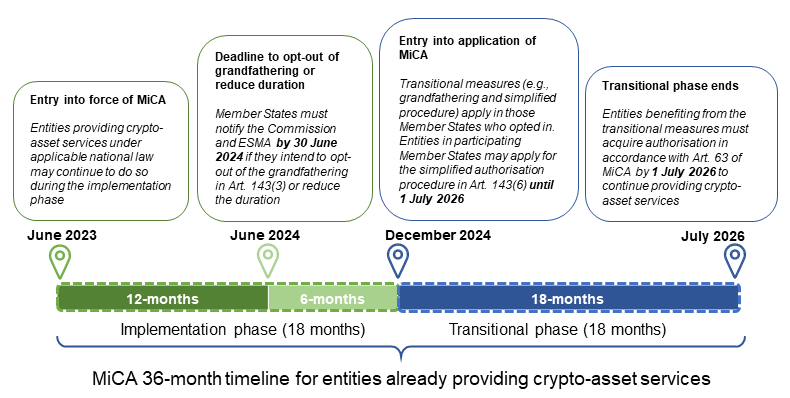
Source: ESMA
“At the EU level, ESMA plays an important coordination and supervisory-convergence role, especially to avoid regulatory arbitrage between member states,” Ivo Grlica, founder of GrlicaLaw and G Lab Advisors, told Cointelegraph.
“National regulators are only the first line of MiCA enforcement, but the legal consequences can spread into national courts and criminal-law systems if the underlying conduct causes harm,” he added.
MiCA enforcement is unlikely to be uniform in its early stages because NCAs differ in resources, experience and supervisory priorities.
“ESMA made clear it expects NCAs to act against unauthorized providers from July 1,” Stolz said, adding that how aggressively each regulator moves “will depend on local resourcing and priorities.”
Peter Bidewell, vice president of institutional product adoption at Parfin, said differing supervisory approaches could create opportunities for regulatory arbitrage despite MiCA’s goal of harmonizing crypto rules across the EU.
Related: StanChart joins ESMA’s first MiCA register update since deadline
Grlica said he expects enforcement to become more systematic over time as regulators identify unauthorized providers and share information across member states, making it increasingly difficult for companies with a history of non-compliance to obtain MiCA authorization later.
Several EU regulators, including authorities in the Czech Republic, Bulgaria, Luxembourg and Italy, have issued notices reminding crypto companies that the MiCA transition period has ended and urging providers without authorization to wind down their operations.
The Czech National Bank told Cointelegraph that the country’s Financial Market Digitization Act gives it the authority to impose sanctions for MiCA-related violations, including operating without authorization, unlawful token offerings and failing to cooperate with supervisors. The law allows the central bank to fine companies providing crypto services without authorization up to 118.5 million Czech koruna (about $5.6 million), 5% of annual turnover if higher, or twice the unlawful benefit obtained, whichever is greater.
Cointelegraph contacted France’s Autorité des marchés financiers (AMF), the Netherlands’ Authority for the Financial Markets (AFM) and Germany’s Federal Financial Supervisory Authority (BaFin) to ask how they plan to enforce MiCA following the transition deadline. None had responded by publication.
Magazine: How crypto laws changed in 2025 — and how they’ll change in 2026

Crypto companies raised just over $600 million from venture investors in April, DefiLlama data shows.
That’s despite the epidemic of “disingenuous innovation” that is plaguing the digital assets industry, Diego Martin, CEO of Yellow Capital, told DL News, referring to grand promises widely made by crypto startup teams that are rarely fulfilled.
“Institutional investors typically wait for retail demand before taking a punt on innovation,” Martin said.
To be sure, fundraising in April fell some 75% from March, which was a blockbuster month that saw massive raises in the prediction market sector amid a shifting focus in the crypto industry.
“Trust is the primary barrier — and opportunity — to tap into, due to the nature of the technology we work with,” Martin said.
Still, marquee investors including German banking giant Deutsche Börse Group, Andreessen Horowitz, Paradigm and Coinbase, all piled on capital into crypto companies including Kraken, OpenGradient, and Pixie Chess.
These are the top three raises in April.
Payward, the parent company of crypto exchange Kraken, raised $200 million through a secondary share sale to Deutsche Börse.
The deal gives the German banking group a minority stake as it moves deeper into digital assets.
The move values Kraken at about $13.3 billion, down from $20 billion in late 2025.
The company made five acquisition deals in 2025. Kraken’s co-CEO Arjun Sethi told DL News in September that the firm had more transactions lined up.
Neobanking platform Slash raised $100 million in a Series C round led by Ribbit Capital. Khosla Ventures and Goodwater Capital also backed the raise.
Slash provides banking tools for online businesses, including those using crypto.
The latest round pushes Slash into unicorn territory, valuing the company at over $1 billion and bringing total funding past $160 million.
New Enterprise Associates and Y Combinator also joined the round, marking their fourth investment in the company.
Pharos raised $44 million in a Series A round backed by SNZ Holding, Chainlink, and Flow Traders, Coindesk reported. The company is building a Layer 1 blockchain focused on handling large-scale financial activity.
Pharos supports Ethereum-compatible applications, making it easier for crypto-native developers to use.
You’re reading the latest instalment of The Weekly Raise, our column covering fundraising deals across the crypto and DeFi spaces, powered by DefiLlama.
Lance Datskoluo is DL News’ Europe-based markets correspondent. Got a tip? Email him at lance@dlnews.com.
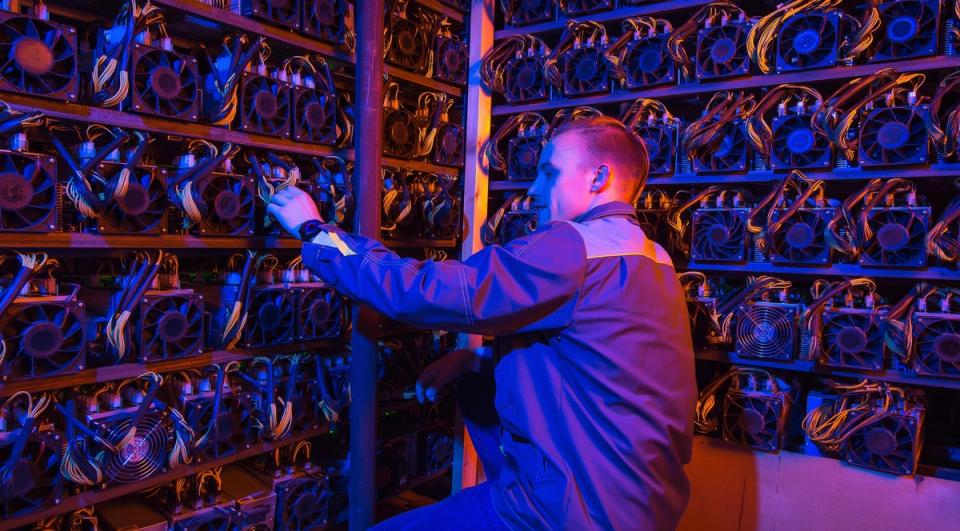
The bitcoin mining industry is undergoing the most fundamental transformation in its history, and the clearest sign isn’t the hashrate or the difficulty adjustments. It’s the balance sheets.
CoinShares’ Q1 2026 mining report, published this week, reveals that the weighted average cash cost to produce one bitcoin among publicly listed miners rose to approximately $79,995 in Q4 2025.
Bitcoin has traded in the $68,000 to $70,000 band, with a CoinDesk report last week estimating losses of $19,000 per BTC mined.
These numbers aren’t sustainable, and the industry knows it. The response has been a wholesale pivot toward artificial intelligence infrastructure that is reshaping what these companies actually are.
Over $70 billion in cumulative AI and high-performance computing contracts have now been announced across the public mining sector, according to the CoinShares report. CoreWeave’s expanded deal with Core Scientific alone is worth $10.2 billion over 12 years. TeraWulf has $12.8 billion in contracted HPC revenue. Hut 8 signed a $7 billion, 15-year lease for AI infrastructure at its River Bend campus. Cipher Digital has a multi-billion-dollar agreement with Google-backed Fluidstack.
Listed miners could derive as much as 70% of their revenue from AI by the end of 2026, up from roughly 30% today. Core Scientific’s AI colocation revenue already accounts for 39% of its total. TeraWulf is at 27%. IREN is at 9% and scaling rapidly with up to 200 megawatts of liquid-cooled GPU capacity under construction.
That means these mining companies are increasingly becoming data center operators that happen to still mine bitcoin on the side.
The economics explain why. According to CoinShares, the cost differential between bitcoin mining infrastructure at roughly $700,000 to $1 million per megawatt and AI infrastructure at $8 million to $15 million per megawatt is wide, but AI offers structurally higher and more stable returns.
Hash price, the metric that determines miner revenue per unit of computing power, hit an all-time post-halving low of roughly $28 to $30 per petahash per day in early March.
At those levels, miners running mid-generation hardware need access to electricity below $0.05 per kilowatt-hour to remain cash-profitable. Meanwhile, AI infrastructure contracts promise margins above 85% with multi-year revenue visibility.
The transition is being financed in two ways, and both are visible in the data, the report explained.
First, debt. The sector’s aggregate leverage has fundamentally changed. IREN now carries $3.7 billion in convertible notes across five series. TeraWulf has $5.7 billion in total debt, split between convertible notes and senior secured notes at its compute subsidiary.
Cipher Digital issued $1.7 billion in senior secured notes in November, causing its quarterly interest expense to surge from $3.2 million for the first nine months to $33.4 million in Q4 alone. These are not mining-scale debt loads. These are infrastructure-scale bets that the AI revenue will materialize fast enough to service the obligations.
Second, bitcoin sales. Publicly listed miners have collectively reduced their BTC treasuries by over 15,000 BTC from peak levels. Core Scientific sold roughly 1,900 BTC worth $175 million in January and is planning to liquidate substantially all remaining holdings in Q1 2026. Bitdeer reduced its treasury to zero in February. Riot Platforms sold 1,818 BTC worth $162 million in December.
Even Marathon, the largest public holder at 53,822 BTC, quietly expanded its policy in its March 10-K filing to authorize sales from its entire balance sheet reserve, partly driven by pressure on its $350 million bitcoin-backed credit facility where the loan-to-value ratio climbed to 87% as prices fell toward $68,000.

The miners that are selling bitcoin to fund AI buildouts are the same companies whose mining operations secure the bitcoin network. That creates a tension at the heart of the transition. When mining is unprofitable and AI is lucrative, the rational economic decision is to reallocate capital away from mining. But if enough miners do that, the network’s security budget shrinks.
The hashrate data already reflects this. The network peaked at approximately 1,160 exahashes per second in early October 2025 and has since declined to roughly 920 EH/s, with three consecutive negative difficulty adjustments, the first such streak since July 2022.
The valuation market has already priced the bifurcation. Miners with secured HPC contracts now trade at 12.3 times next-twelve-month sales. Pure-play miners trade at 5.9 times. The market is paying more than double for the AI exposure, which reinforces the incentive to pivot further.
The geographic picture is shifting alongside the economics, meanwhile. The United States, China, and Russia now control roughly 68% of global hashrate. The U.S. gained about 2 percentage points of market share in Q4 alone.
But emerging markets are entering the picture. Paraguay and Ethiopia have joined the global top 10 mining countries, driven by HIVE’s 300-megawatt operation in Paraguay and Bitdeer’s 40-megawatt facility in Ethiopia.
CoinShares forecasts the network hashrate will reach 1.8 zetahashes by the end of 2026 and 2 zetahashes by end of March 2027, one month later than previously predicted.
But that forecast depends on bitcoin recovering to $100,000 by year-end. If prices stay below $80,000, CoinShares expects hash price to continue falling and the hashrate to decline further as more miners exit.
A sustained move below $70,000 could trigger larger capitulation that, paradoxically, benefits survivors through lower difficulty.
Next-generation hardware offers a potential lifeline. Bitmain’s S23 series and Bitdeer’s proprietary SEALMINER A3, both operating below 10 joules per terahash, are expected at scale through the first half of 2026. These machines would roughly halve the energy cost per bitcoin compared to current mid-generation fleets. But deploying them requires capital that many miners are directing toward AI instead.
The bitcoin mining industry entered this cycle as a group of companies that secured the network and accumulated bitcoin. It is exiting as a group of companies that build AI data centers and sell bitcoin to fund them.
Whether that’s a temporary response to unfavorable economics or a permanent structural shift depends on one variable: the price of bitcoin. If it returns to $100,000, mining margins recover and the AI pivot slows. If it stays at $70,000 or below, the transition accelerates and the mining sector as it existed for the past decade continues to disappear into something else entirely.

In 2025, the United States continues to establish itself as one of the largest hubs for cryptocurrency mining. With stricter regulations and higher energy costs compared to some regions, legally registered and transparent Bitcoin mining companies are becoming essential for both beginners and serious investors.
This guide explores the leading trusted Bitcoin mining companies officially registered in the USA for 2025, highlighting their legal credentials, operations, and why they are worth considering for safe crypto earnings.
Mining in the US is tightly linked to regulations covering:
For US miners, choosing a registered mining company isn’t just about profits — it’s about long-term security and trustworthiness.
ETNCrypto is one of the most trusted names in cloud mining for 2025. While headquartered in Switzerland, it is fully compliant with US laws and offers transparent contracts to American users.
Its cloud mining centers run on high-performance ASIC clusters and clean energy, with advanced monitoring for uptime and security. More importantly, ETNCrypto offers a $100 signup bonus that allows beginners in the US to test mining without risk.
ETNCrypto Cloud Mining Rig
| Mining Rig | Contract Price | Contract Period | Daily Profit | Daily ROI |
| Antminer S19 XP【Free】 | $100 | 1 Day | $1.50 | 1.50% |
| Antminer T21 | $200 | 2 Days | $6.00 | 3.00% |
| Antminer Z15 Pro | $600 | 3 Days | $19.20 | 3.20% |
| Antminer S21 Pro | $1,300 | 5 Days | $45.50 | 3.50% |
| VolcMiner D1 Lite | $3,500 | 6 Days | $133.00 | 3.80% |
| Antminer S21+ Hyd | $8,000 | 3 Days | $336.00 | 4.20% |
| VolcMiner D1 | $17,800 | 5 Days | $854.40 | 4.80% |
| Antminer L9 | $36,000 | 6 Days | $2,088.00 | 5.80% |
| Antminer S21e XP Hyd 3U | $68,000 | 5 Days | $5,440.00 | 8.00% |
This diverse range of contracts—from free trials to enterprise-level packages—makes ETNCrypto a versatile option for investors of all kinds.
Why It’s Trusted: ETNCrypto’s legal structure, clear ROI, and commitment to compliance make it a ideal choice for US investors seeking safe daily payouts.
Location: Castle Rock, Colorado, USA
Highlight: Publicly traded company with full SEC compliance.
Riot Platforms is one of the largest Bitcoin mining companies in the US, operating massive facilities in Texas. Its status as a Nasdaq-listed company (RIOT) ensures complete transparency in financial reporting.
Why It’s Trusted: As a public company, Riot Platforms is one of the most regulated mining providers available.
Location: Rochester, New York, USA
Highlight: Trusted by institutions and operates under strict US regulations.
Foundry Digital has grown into one of the biggest US-based mining service providers, offering both mining pool services and equipment financing. Its US registration and ties with institutional clients give it strong credibility.
Why It’s Trusted: Foundry bridges professional mining operations with strict US compliance, making it a cornerstone of the domestic mining ecosystem.
Location: Nevada, USA
Highlight: Publicly traded mining company with sustainability focus.
CleanSpark is another US-registered and Nasdaq-listed mining company (CLSK). It specializes in using renewable energy resources to power mining farms, aligning with America’s push for greener Bitcoin mining.
Why It’s Trusted: US investors value CleanSpark’s regulatory compliance and eco-friendly strategy.
Location: Seattle, Washington, USA
Highlight: US-registered mining pool with strong transparency record.
Luxor Technologies operates one of the largest mining pools in North America. Its legal registration in the US provides additional reassurance to miners who want to participate in a trusted and transparent ecosystem.
Why It’s Trusted: Luxor is favored by US miners who want registered and compliant pool operations.
Location: Miami, Florida, USA
Highlight: Registered mining provider focusing on compliance and efficiency.
Arthur Mining is another registered US-based mining company, with operations tailored for institutional and retail investors. It has made a name by providing transparent energy-efficient mining services.
Why It’s Trusted: Arthur Mining appeals to US investors seeking a regulated alternative to offshore cloud mining platforms.
For US investors, the future of Bitcoin mining in 2025 lies with legally registered and transparent companies. While offshore providers exist, US users benefit most from companies accountable under American law.
In short, sticking with registered US or US-compliant mining companies ensures your crypto mining journey in 2025 is both profitable and secure.

Public companies now hold over 1 million Bitcoin worth $110 billion on their balance sheets, but only early adopters with disciplined strategies have seen major gains.

Weekly Raise
Twenty-seven crypto companies raised over $2.5 billion in October, according to DefiLlama data.
That brings the total funding for crypto companies to over $19 billion so far in 2025, outpacing 2024’s total by over $9 billion.
And analysts say investment in the space is just heating up.
PitchBook predicted that the industry will raise $18 billion this year.
Investors from Galaxy Ventures and Codebase expect it to go even higher and that investors will plough over $25 billion into the industry in 2025.
Here are the crypto companies that raised the most money in October.
Polymarket, $2 billion
Polymarket, the decentralised prediction market platform, secured a $2 billion strategic investment from Intercontinental Exchange (ICE), the parent company of the New York Stock Exchange.
The deal values Polymarket at $9 billion post-money and marks a landmark moment for the tokenisation of financial infrastructure.
Coplan also disclosed two previously unannounced rounds.
Founders Fund led a $150 million raise earlier this year at a $1.2 billion valuation, with participation from Point72, Coinbase, Dragonfly, and numerous high-profile angels. A $55 million round led by Blockchain Capital closed prior to the 2024 US election, valuing the firm at $350 million.
Founded in 2020, Polymarket emerged from obscurity during the pandemic.
Meanwhile, $82 million
Meanwhile, a life insurance firm licensed by the Bermuda Monetary Authority, has raised $82 million to offer up Bitcoin-based savings, annuities, and retirement products.
The Series B round was co-led by Bain Capital Crypto and Haun Ventures, with backing from Pantera Capital, Apollo, Northwestern Mutual Future Ventures and Stillmark. The raise brings Meanwhile’s total 2025 funding to $122 million.
CEO Zac Townsend said the firm is “bringing the long-term stability of traditional insurance to the Bitcoin economy,” enabling global users to “save and protect wealth in BTC.”
Amdax, $35 million
Dutch crypto company Amdax has raised $35 million to launch AMBTS, a Bitcoin-focused treasury firm. The raise marks the completion of AMBTS’s initial funding round and paves the way for the firm to begin accumulating Bitcoin for its reserves.
Lucas Wensing, CEO of Amdax and co-founder of AMBTS, said the firm is ready to “move forward with our bitcoin strategy, aiming to offer investors transparent access to this unique asset class.”
AMBTS joins a growing wave of firms turning to Bitcoin for treasury holdings, including the Winklevoss twins’ Dutch firm Treasury; Strive, which is linked to Vivek Ramaswamy; and Michael Saylor’s Strategy.
Amdax’s move signals growing European institutional appetite for Bitcoin-backed financial products and adds momentum to the broader trend of corporates treating Bitcoin as a long-term reserve asset.
You’re reading the latest instalment of The Weekly Raise, our column covering fundraising deals across the crypto and DeFi spaces, powered by DefiLlama.
Lance Datskoluo is DL News’ Europe-based markets correspondent. Got a tip? Email at lance@dlnews.com.

🧰 Public Companies Quietly Build A Serious Bitcoin Stack
In Corporate Treasuries / ETFs
In Memes
Start every day with the top news stories right now, plus original features, a podcast, videos and more.


