Coinbase plans to expand its Singapore office from 150 to about 200 employees by the end of 2026 as it grows its presence in the Lion City.
Coinbase CEO Brian Armstrong responded to criticism over the company’s promotion of high-risk products to young and financially vulnerable users. He called for responsible product design that does not restrict adult choice.
Zcash founder Zooko publicly criticized Coinbase for promoting sports betting and Bitcoin (BTC) price prediction to inexperienced users. Armstrong acknowledged the tension, noting that companies must balance user freedom against platform responsibility.
The CEO argued on X that companies should not aggressively promote high-risk products to unsophisticated users. A clear distinction exists between making products available and actively pushing them on people least equipped to handle the risks.
Three practical measures followed from that position. Platforms should offer clearer risk disclosures, built-in financial literacy tools, and user preference settings to control which products appear. Together, these options could create a more personalized experience without removing adult access.
Additionally, Zooko’s criticism targeted how Coinbase surfaces Bitcoin price prediction and sports betting to inexperienced users. That kind of aggressive in-app promotion crosses a line, Armstrong said, even if the products themselves remain available.
Interesting — and I appreciate the take.
I think there’s a balance here.
I’m pro-freedom. Consenting adults should be able to do what they want with their own money, as long as they’re not harming others. I don’t want companies patronizing users or dictating what they can do…— Brian Armstrong (@brian_armstrong) June 28, 2026
The Coinbase chief recently commented on Coinbase’s Bitcoin market view, noting AI cost reductions alongside broader product expansion. Responsible design, he suggested, needs to accompany that growth rather than trail it. However, those ambitions now face questions about whether user safety has kept pace.
Meanwhile, scrutiny of Coinbase’s 2026 product direction reflects the broader sentiment around the company’s trajectory. Critics have argued that feature expansion has outpaced user protections. That tension sharpened further with Zooko’s public call-out this week.
Beyond the exchange, Coinbase’s Base chain B20 push and Coinbase Luxembourg MiCA hub show a widening footprint. That scope makes it harder to enforce product design standards uniformly across user segments.
The CEO also addressed whether sports prediction markets should exist at all. Private companies should not decide that question on their own. Instead, democratic processes are better suited to establish those limits.
The position separates two types of responsibility. How a platform promotes products differs from whether those products should exist.
The Coinbase CEO supports tighter design standards, including opt-in controls and personalized risk settings. Nevertheless, the case for regulatory rather than corporate limits remains central to that position.
The post Coinbase CEO Armstrong Comments on Betting Promotion Concerns in the Base App appeared first on BeInCrypto.
JP Morgan CEO Jamie Dimon did not mince words about his stance on the Clarity Act and Coinbase CEO Brian Armstrong in an interview with Fox Business on Friday.
The banking executive said he is not happy with the current version of the Clarity Act, a bill that would regulate most crypto activity in America, and says banks will “not accept it that way.” Dimon further vowed that the banking industry will fight it, and if “we lose, we lose.”
“It will be fought,” said Dimon. “No one is going to bow down to this guy, or that company,” he added, without specifically naming Armstrong or Coinbase.
After Fox Business anchor Maria Baritromo asked specifically about Coinbase, Dimon had more to say: “He’s the only one… he’s spending hundreds of millions of dollars in Washington on this thing. He’s full of shit.”
Jamie Dimon, complaining about the Clarity Act and Coinbase CEO Brian Armstrong this AM: “He’s spending hundreds of millions of dollars in Washington in this thing.”
Maria: “He said he’s representing the whole —”
Dimon: “He’s full of shit.”
Maria: “…well.” pic.twitter.com/Qik9Hnue6U
— Brendan Pedersen (@BrendanPedersen) May 29, 2026
Dimon’s scrutiny of the Clarity Act largely stems from the issue of stablecoin yield—a major sticking point with the banking lobby that has stalled progress on the bill in recent months. At the moment, cryptocurrency platforms are able to offer yield, essentially a form of interest payments, on stablecoin holdings as permitted by the GENIUS Act—signed into law by President Donald Trump in July last year.
The GENIUS Act specifically prohibits stablecoin issuers, such as Tether or Circle, from offering yield to clients, but allows for third-parties, such as Coinbase or other exchanges, to do so instead.
Banks have fought to include language in the Clarity Act to close that loophole while crypto industry giants like Coinbase have sought to ensure platforms can continue offering yield tied to stablecoins.
The debate has helped draw out the Clarity Act’s potential passage by more than four months, with Coinbase at one point withdrawing its support for the bill prior to the inclusion of stablecoin reward compromise language.
Just two months ago, Dimon slammed the demands on stablecoin yields, noting that the “public will pay.” Once more on Friday, he added that “it would eventually blow up on its own.”
“If you want to be a bank, become a bank,” he said in March. “Then you can do whatever you want under bank law.”
The contentious bill has seen plenty of back and forth over the last few months, but passed a key Senate Banking Committee vote earlier this month. It will now move to the Senate floor for a potential final approval.
Despite the back and forth, President Trump has remained adamant getting the bill passed, posting earlier this week that he aims to “codify a future proof digital asset market structure.”
As it stands, predictors on Polymarket give the bill around a 59% chance of being signed into law by the end of 2026.
Start every day with the top news stories right now, plus original features, a podcast, videos and more.
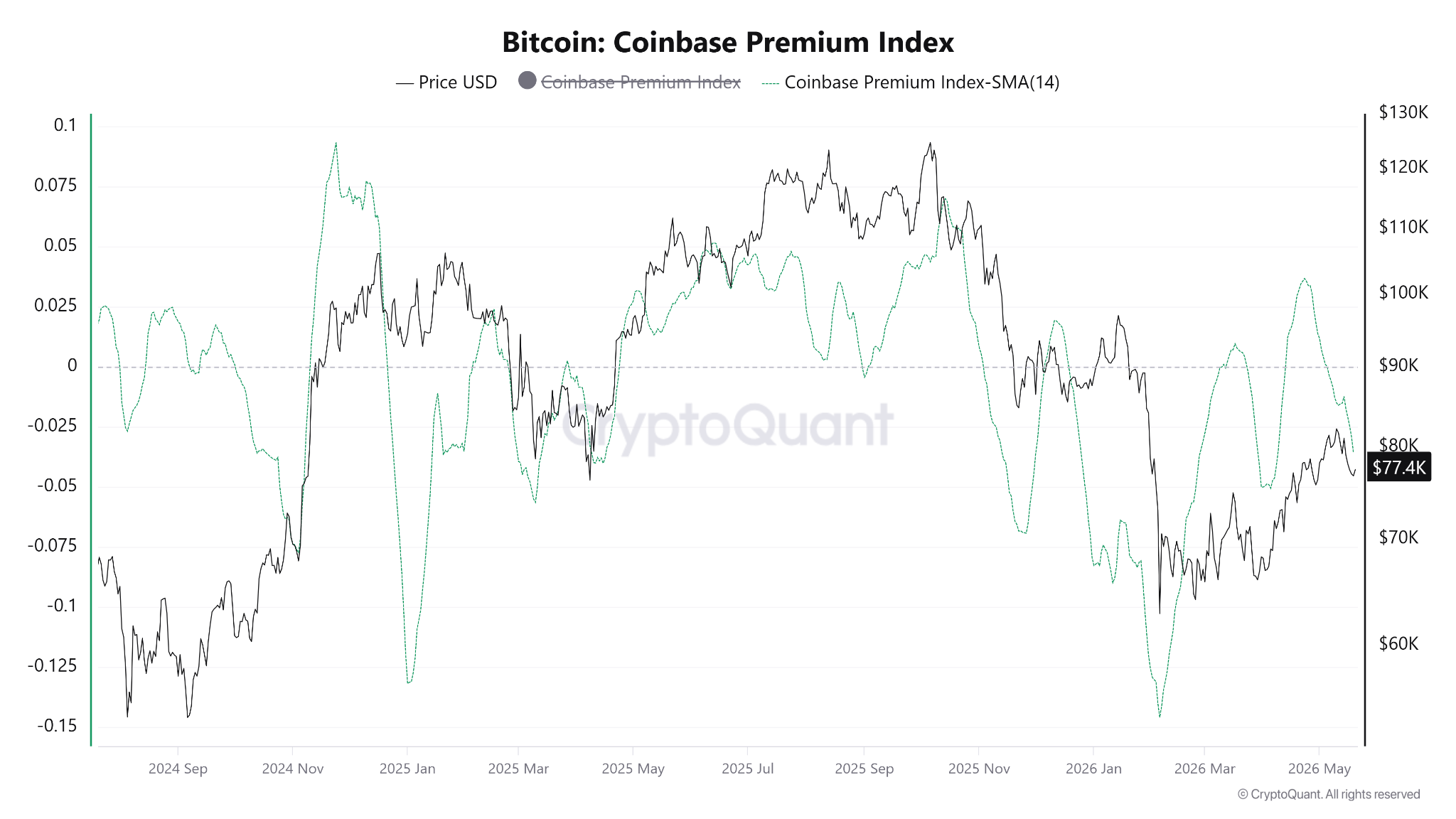
Bitcoin (BTC) demand on Coinbase points to early signs of market stabilization as BTC reclaimed the upper bounds of its range highs. The 14-day trend of the Coinbase Premium Index has remained in an uptrend, suggesting steady buyer interest despite traders taking $1.14 billion in profits, which pushed the daily Coinbase premium to a six-week low.
The Coinbase Premium Index dropped to -0.087 on May 19, its weakest reading since March 31. A negative premium means Bitcoin traded at a lower price on Coinbase than on Binance, signaling softer demand from US-based buyers.
BTC profit-taking accelerated as it rallied to $82,000 and holders realized 14,600 BTC ($1.14 billion) in daily profits on May 4. CryptoQuant noted unrealized profit margins climbed to 17.7% on May 5, the highest level since June 2025.
Bitcoin net realized profit and loss. Source: CryptoQuant
However, the longer-term trend for Coinbase paints a steadier picture. The 14-day simple moving average (SMA) of the premium index has remained above its February lows. Similar recoveries in the moving average preceded renewed spot demand on Coinbase during March 2025, shortly before Bitcoin pushed toward $110,000 in April-May 2025.
The daily premium readings still sit below zero, though the rising SMA points to easing sell-side pressure. Bitcoin also continues to hold above the $70,000–$75,000 range, a zone that previously attracted strong spot accumulation.

Bitcoin Coinbase Premium 14-day SMA. Source: CryptoQuant
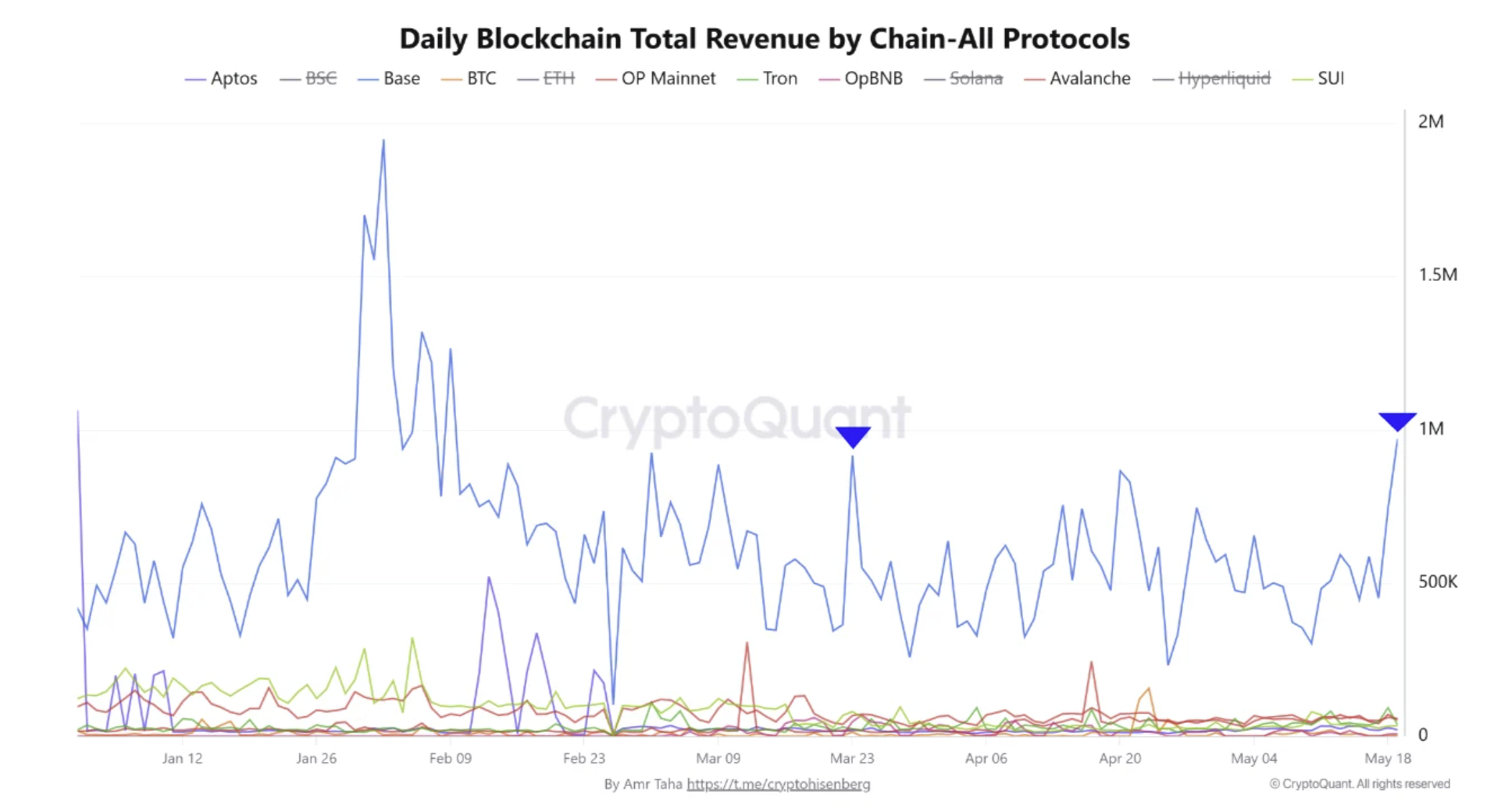
Crypto analyst Amr Taha noted that activity across the Coinbase-linked network stayed elevated during the latest pullback. The Base blockchain revenue climbed to nearly $972,000 on May 19, exceeding late-March levels even as the Coinbase Premium Gap remained negative.
The divergence highlights steady network participation inside the Coinbase ecosystem while spot demand gradually rebuilds.

Daily blockchain total revenue by different protocols. Source: CryptoQuant
Related: This Bitcoin price model targets ‘conservative’ $255K by year-end
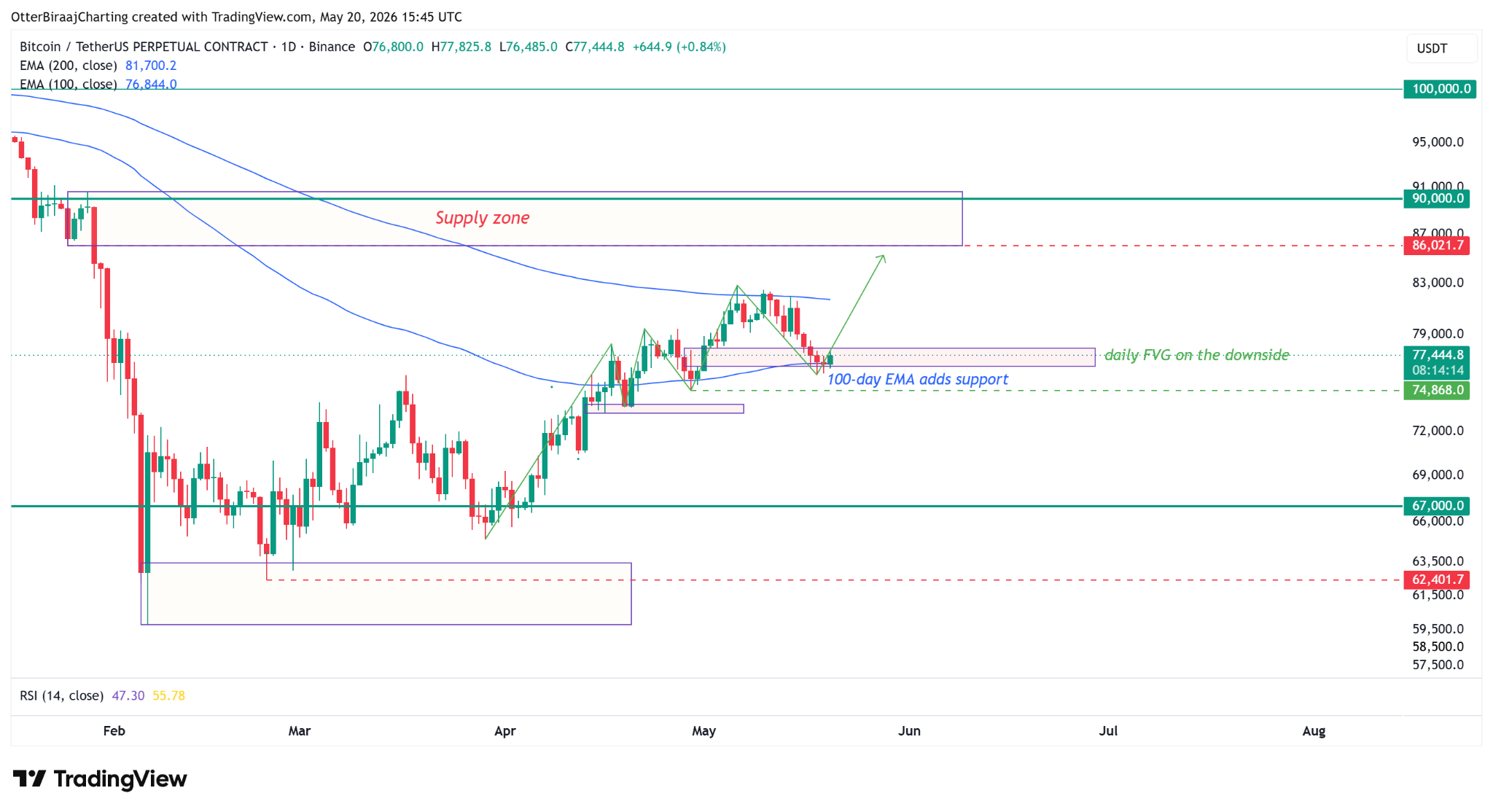
The daily chart of BTC still leans bullish after the rejection near $82,000. The price continues to trade above the 100-day exponential moving average (EMA) near $76,800, which is acting as key dynamic support.
The current retracement has held within the $76,000–$77,000 fair-value gap, keeping buyers active near recent accumulation levels. A recovery from this zone could reopen the path toward $80,000–$82,000, while the larger supply area near $86,000–$90,000 sits higher.

BTC/USDT, one-day chart. Source: Cointelegraph/TradingView
$74,800 remains a key level and a daily close below that price would mark the first bearish break in the current higher-low formation and shift focus to the $70,000 psychological support level.
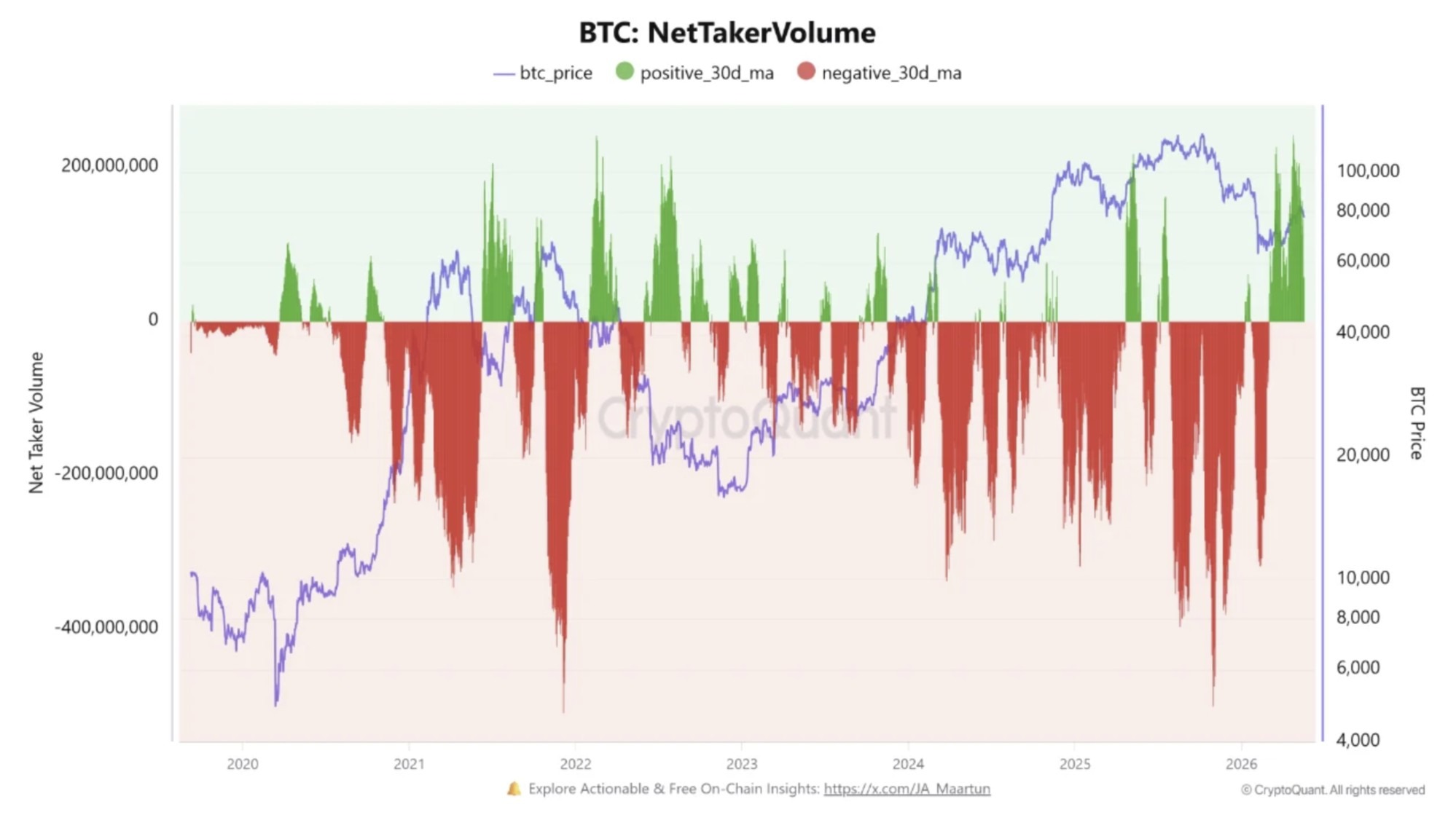
Futures data continues to support demand resilience. Market analyst CryptoOnChain reported that Bitcoin’s 30-day moving-average net taker volume dropped to $58 million on May 18 from $243 million in April. However, the metric remained positive during the recent correction, indicating that BTC futures buyers continued to absorb sell pressure near the current price.

BTC net taker volume. Source: CryptoQuant
Related: Bitcoin sees fresh US sell-off as markets await Nvidia ‘biggest earnings event’
New York AG Letitia James filed suit against Coinbase and Gemini, alleging their prediction market platforms constitute illegal gambling operations lacking state licenses.
New York Attorney General Letitia James sued Coinbase Financial Markets, Inc. and Gemini, Titan LLC on April 21, 2026, alleging both platforms illegally operated unlicensed gambling operations through prediction market offerings in New York.
The AG’s investigation found that Coinbase and Gemini’s prediction markets —which allow users to bet on sports, entertainment, and election outcomes —violate New York state gambling laws by operating without Gaming Commission licenses. The suit seeks court orders requiring both companies to pay fines, forfeit illegal profits, and provide restitution to customers.
The AG’s complaint highlights that both platforms allow New Yorkers ages 18 and older to access the prediction markets, despite New York law requiring participants in mobile sports betting to be at least 21 years old. The AG cited research showing early exposure to gambling increases risks of depression, anxiety, and financial stress, noting the platforms lack necessary consumer protections.
By operating unlicensed, Coinbase and Gemini bypass tax obligations that licensed casinos and mobile sports betting platforms must pay, which fund public schools, youth sports programs, and problem gambling treatment in New York.
Sources: New York State Attorney General
This article was generated automatically by The Defiant’s AI news system from publicly available sources.
Bitcoin flipped a small but notable technical switch this week when the Coinbase premium moved back above zero, ending a run of negative readings that began after heavy selling on February 6.
According to market data published on February 23, 2026, Bitcoin was trading around $66,150 on Binance futures at one point, showing a brief hourly uptick of 0.40%.
Yet other spot indexes told a different slice of the story: CoinMarketCap listed BTC near $65,070 and flagged a roughly 3% drop for the day.
Those gaps are normal: futures, spot feeds, and aggregate trackers can diverge. What matters here is the premium’s direction — it had been negative for much of February and then crossed into positive territory.
Coinbase Bitcoin Premium has flipped positive for the first time since the Feb 6th bottom.
It looks like institutions are done with selling for now. pic.twitter.com/rUYgxO2Fo8
— Ted (@TedPillows) February 23, 2026
Coinbase is widely used by big US buyers, so a positive premium is read by many traders as a hint that domestic spot demand is outpacing offshore pressure.
But a flip above zero is only a starting signal. The size of the spread, how long it holds, and whether exchange inflows back up the move are the things that turn a signal into a trend.
Small, short-lived flips can be caused by temporary liquidity differences or quick arbitrage trades. Larger, sustained spreads are the ones that tend to matter to portfolio managers.
Market watchers are also pointing to broader factors. Rising tensions between the US and Iran, along with talk about tariff adjustments linked to US President Donald Trump, have driven investors toward safer assets in recent sessions.
That mood has at times pushed BTC below important technical cushions near $65,000, and some sessions saw brief dips under $64,000 before a few calm windows allowed minor rebounds. When fear spikes, crypto often feels it first.
Futures activity on Binance and other platforms stayed busy, even if volume didn’t show the sort of surge that precedes big breakouts. Reports put daily trading volume near $45.71 billion while market cap sat close to $1.30 trillion.
Funding rates, open interest, and exchange inflows are being monitored closely; each can either confirm or undercut the message from the Coinbase premium. A rising open interest that aligns with a growing premium would be more persuasive than a lone spread tick.
A Coinbase premium turning positive offers a hopeful signal after weeks below zero, but it doesn’t confirm a sustained rally. Investors will be tracking how large the spread is, whether Coinbase sees significant inflows, and if funding rates and open interest support the move. Traders are likely to wait through the next sessions for clear signs before considering the market stabilized.
Featured image from Gemini, chart from TradingView
Jeffrey Epstein made a multimillion-dollar investment into crypto exchange Coinbase in 2014, and the company’s leadership appears to have been aware of the convicted sex offender’s involvement in the deal, newly surfaced emails indicate.
Epstein made a $3 million investment in the crypto exchange in December 2014, according to a new trove of emails released Friday by the U.S. Justice Department. The investment was arranged for Epstein by Tether co-founder Brock Pierce and Pierce’s venture firm, Blockchain Capital.
The emails indicate Fred Ehrsam, Coinbase’s co-founder, was personally aware the investment was being made on Epstein’s behalf. In a correspondence dated December 3, 2014, Ehrsam asked to meet with Epstein in New York to discuss the arrangement.
“I have a gap between noon and 3pm today, but again, not crucial for me, but would be nice to meet him if convenient,” Ehrsam wrote. “Is it important for him?”
Later that day, Blockchain Capital co-founder Brad Stephens emailed Ehrsam that they were good to move ahead with the investment. Coinbase’s wire transfer details were then immediately sent to Stephens, and forwarded to Epstein’s executive assistant, Darren Indyke.
The investment was made at a $400 million company valuation, the emails say. Today, Coinbase is worth some $51 billion.
Epstein’s apparent early investment in Coinbase also came more than six years after Epstein was convicted, in 2008, by a Florida state court for procuring a child for prostitution and soliciting a prostitute. From 2008 on, Epstein was a registered sex offender.
Ehrsam and Coinbase did not immediately respond to Decrypt’s requests for comment on this story. Brad Stephens, Brock Pierce, and Blockchain Capital also did not immediately respond to requests for comment.
When initially considering whether to invest in Coinbase in 2014, Epstein appears to have relied on the expertise of Pierce, and also on the advice of LinkedIn founder Reid Hoffman.
Pierce called the fundraising round Epstein ultimately participated in “the most platinum-plated deal in the space.”
When Epstein reached out to Hoffman asking “how hard” he should play in the Coinbase funding round, Hoffman replied that he didn’t know much about the company’s internals.
“I probably wouldn’t play,” Hoffman wrote to Epstein. “But I may not be up-to-date on interesting internal news.”
Additional emails released Friday revealed Epstein also invested in another early crypto giant, Blockstream. Blockstream co-founder Adam Back, an early Bitcoin contributor, acknowledged the 2014 investment in an X post on Sunday.
In 2018, Epstein sold half of his Coinbase equity back to Blockchain Capital, per further emails.
By that time, Coinbase’s valuation had climbed into the billions. Epstein cashed out half of his initial $3 million investment for nearly $15 million, and appears to have retained the other half of his equity. Less than two years later, the financier was found dead in a Manhattan jail cell while awaiting trial on sex trafficking charges.
Start every day with the top news stories right now, plus original features, a podcast, videos and more.
Massive Coinbase News! Bitcoin Rips to $96,750! Football.Fun TGE Interview with Founder!
Crypto majors are very green with Bitcoin making a new another 2-month high; BTC +2% at $96,7500; ETH +2% at $3,360, SOL even at $145; XRP -1% to $2.11. DCR (+30%), DASH (+10%), ICP (+10%) and ZEC (+7%) led top movers; XMR hit another new ATH at $800 before retracing to $725. Coinbase pulled support for the Senate’s crypto market structure bill ahead of a key vote, citing major concerns with the latest draft, leading to the Senate delaying the bill. Zcash avoided SEC action after the Zcash Foundation said the agency’s investigation has concluded. Ripple secured a Luxembourg license as its European expansion continued. Pakistan teamed with World Liberty Financial to explore stablecoin use cases for remittances and cross-border payments. The Human Rights Foundation awarded nearly $1.3M in Bitcoin grants to projects tied to human rights and freedom tech. Figure unveiled a new public equity network designed to enable on-chain issuance of stocks and related assets. FTX prepared another round of creditor payments and outlined timing details for the next distribution on March 31. Sui came back online after a nearly six-hour network stall, marking another reliability test for the chain.
Seeking truth has never been so profitable.
Prediction markets, futures markets for retail users to forecast everyday outcomes, peaked in December at over $4 billion in weekly trading volume.
Despite record volumes plummeting after the 2024 US elections, popular platforms like Kalshi and Polymarket blew past those highs again and again throughout 2025, according to data collated by the Dune user dashboard.
Along the way, they raised hundreds of millions of dollars in fresh capital at multi-billion valuations.
Now, insiders suggest that 2026 will be even bigger.
“Prediction markets should be a multiple of their current size,” Dustin Gouker, founder of gambling consultancy Closing Line Consulting, told DL News.
That growth won’t just come from homegrown crypto entities — gambling platforms and more traditional financial firms are lining up too for a slice of the pie.
However, regulatory challenges risk grinding the $4 billion freight train to a halt, or at least slow it down as it steams into 2026.
Polymarket and Kalshi enter the new year as competition heats up.
Crypto companies like Coinbase and Crypto.com, as well as more traditional sports-betting firms, are butting in.
“There is so much opportunity for continued growth that I believe there is room for many players because prediction markets, in some ways, will be limitless,” Travis McGhee, the global head of predictions at Crypto.com, told DL News.
In November, the CME Group, which runs the Chicago Mercantile Exchange, said it would launch a prediction market product in December together with one of the world’s largest gambling companies, FanDuel.
The CEO of Flutter, the Irish-American sports betting company that owns FanDuel, said the offering would unlock “an immediate growth opportunity” for the $17 billion company.
Elsewhere, trading platform Robinhood muscled into the competition.
Having partnered with Kalshi, the fintech generated roughly $300 million in revenue across nine billion event contracts and one million prediction market traders.
In November, Robinhood announced that it would launch its own proprietary prediction market in early 2026 — potentially leaving Kalshi out of the new product.
“When you build something as successful as Kalshi has, it’s no surprise that everyone and their mum wants a piece of it,” Jack Such, a growth executive at Kalshi, told DL News in November.
“It’s the ultimate compliment that companies like CME and Robinhood are validating the industry we created.”
Meanwhile, prediction markets have come under fire from authorities worldwide.
Gaming commissions across the US, for instance, have been a central sticking point. Some allege that prediction markets operate as unlicensed sportsbooks rather than federally regulated derivatives platforms.
And with sports markets on both Kalshi and Polymarket emerging as extremely lucrative opportunities, overcoming these legal issues is crucial for all companies entering the niche in 2026.
“Trading volume should meaningfully increase several times over current, as long as sports betting continues to be legal,” Gouker.
After a drawn-out legal battle with the Commodity Futures and Exchange Commission, which concluded in 2025, Kalshi looked bound for greener pastures for the rest of the year.
That soon changed when state gaming commissions in the US began to issue cease-and-desist letters as sports markets boomed on various prediction market platforms.
‘It’s important for people to understand that prediction markets are not wagering or betting.’
— Travis McGhee, the global head of predictions at Crypto.com
In October, Kalshi sued the New York State Gaming Commission over the agency’s order, putting its enforcement — and the company’s exit from the Empire State — on hold.
Several states followed suit, just as Kalshi countersued.
Many of the cease-and-desist letters revolve around the same legal argument: Prediction market platforms are operating as betting platforms that have failed to register with local state authorities.
As such, their continued operation is illegal, as the New York gaming commission alleged.
“By operating unlicensed sports betting, Kalshi has violated gambling laws, engaged in illegal deceptive activity, and unjustly enriched itself at the expense of tens of thousands of consumers,” the November complaint read.
Kalshi responded that the CFTC regulates it and thus does not fall under the purview of state gambling authorities.
And as more and more providers cropped up over the year, similar arguments have played out among the competition, too.
Amid pushback from several state regulators, Crypto.com pulled its prediction market product from several states.
On December 12, the gaming outlet Sports Betting Dime reported that the Arizona Department of Gaming intended to revoke Underdog’s gaming license due to its partnership with Crypto.com to launch prediction markets.
Crypto.com’s McGhee said the company regularly works with regulators and other key stakeholders to ensure compliance with its product.
Elsewhere, even before facing any legal action, Coinbase preemptively sued authorities in Michigan, Illinois, and Connecticut.
“Because the spectre of Illinois enforcement is imminent and existential to Coinbase’s event-contract operations in Illinois, Coinbase respectfully seeks expedited consideration of its request for a preliminary injunction,” the December 18 filing from December 18.
Many prediction markets argue, including Kalshi, that so-called event contracts, the markets these platforms spring up to let users put money down on future outcomes, are essentially commodities.
Certainly, it isn’t gambling, Crypto.com’s McGhee told DL News.
“It’s important for people to understand that prediction markets are not wagering or betting,” he said.
Users can buy “yes” or “no” tokens for any number of geopolitical, sports, or political questions.
A market with over $60 million in trading volume asks users how much the US Federal Reserve will cut rates, if at all, in January.
The “yes” token for the response “no change” currently has the highest odds at 83%, making the token worth 83 cents. If the Fed decides not to change rates at the January meeting, then the token’s value will jump to one dollar, and all other outcomes will plummet to zero.
It’s this monetary incentive, proponents say, that gives prediction markets their enhanced truth-finding ability.
Besides truth-seeking, CEOs posit that prediction markets give users a way to protect their financial positions, like a hedge.
Robinhood CEO Vlad Tenev said prediction markets can serve as a variety of insurance against catastrophe, such as fires or floods.
If 2025 was the year prediction markets hit the mainstream, 2026 will reveal their staying power.
Negative decisions in federal and state courts remain major blockers for the niche, Gouker said.
Likewise, the upcoming midterm elections next year will mark another turning point for prediction markets and the crypto industry more broadly.
“If Democrats take back the House, you could see this manifest more seriously after 2026,” Gouker told DL News.
Liam Kelly is DL News’ Berlin-based DeFi correspondent. Have a tip? Get in touch at liam@dlnews.com.
This year was a record for hacks in the crypto sector, with over $2.72 billion stolen, according to data from TRM Labs.
Yes, with depressed crypto prices getting investors down, 2025 was a particularly bad year for exploits—even after 2024 broke records.
The year got off to a terrible start with a $1.5 billion loss in February after North Korean hackers targeted centralized exchange Bybit in the most significant crypto exploit in history.
That set the tone for the rest of the year, with “even more organized and professionalized” crimes, TRM Labs told Decrypt.
“Attacks are faster, better coordinated, and far easier to scale than they were in previous cycles,” TRM’s Global Head of Policy Ari Redbord said. “In 2025, we also saw the continued expansion of North Korea’s IT worker schemes, which further added to the operational sophistication behind many campaigns.”
Let’s dive in and take a look at the biggest hacks and breaches of 2025.
The year got off to the worst possible start when hackers—believed to be from North Korea—targeted crypto exchange Bybit and made off with between $1.4 and $1.5 billion in Ethereum and related tokens.
The exploit shocked the industry not only because of its size, but also because the funds were supposedly held in cold, multi-signature wallets—the safest way to store digital assets securely.
Multi-signature wallet provider Safe said the heist stemmed from a compromised developer laptop. An investigation later found that a high-level Safe developer’s workstation was compromised on February 4 when it interacted with a malicious application.
Coinbase, America’s biggest crypto exchange and one of the most well-known and trusted brands in the space, dropped a bomb in May when it revealed a data breach.
Criminals had sent the company a letter demanding $20 million in Bitcoin in exchange for stolen customer details. Coinbase co-founder and CEO Brian Armstrong then offered the same bounty to help catch the criminals.
The exchange assured people that no funds, passwords, or private keys were compromised in the hack. And although customer funds weren’t stolen, Coinbase’s overseas subcontractors were bribed into handing over sensitive information. Coinbase said that the incident could cost the firm as much as $400 million to remedy.
Despite crooks eying centralized protocols this year, decentralized finance protocols remained a favorite for hackers, with Sui’s leading decentralized exchange, Cetus Protocol, receiving the biggest gut punch.
In May, attackers exploited vulnerabilities in Cetus Protocol’s smart contracts, using spoof tokens to manipulate price calculations and drain liquidity pools on the largest decentralized exchange in the Sui ecosystem.
In a rare outcome for the DeFi space, Cetus recovered around $162 million in funds frozen by the attack, and the protocol went back online 17 days after the exploit.
Pro-Israeli hacker group Gonjeshke Darande hit Iran’s biggest crypto exchange Nobitex in June, draining $90 million in crypto from the centralized platform.
The group alleged that Nobitex had links to the Islamic Revolutionary Guard Corps.
But the attack was controversial as compliance firm Crystal Intelligence told Decrypt at the time that many innocent retail investors were likely affected, despite the Israeli group’s claims.
Another DeFi protocol was hurt this year after cybercrooks drained $70 million from the open-source platform UPCX in April.
Hackers exploited a compromised private key to steal funds in the form of the protocol’s native UPC token, an exploit that barely made headlines despite the large amount of funds pinched.
The price of the protocol’s token has since struggled to recover, according to CoinGecko, after plunging hard following the exploit, from $4 in April to just over $1.20, as of December 5.
Hackers again targeted Turkish exchange BtcTurk in August, walking away with $48 million at the time. The attack came after cybercriminals made away with $54 million in 2024.
The exchange told users it had suspended withdrawals after blockchain analysts flagged suspicious transactions—mostly in Ethereum.
BtcTurk has said very little since the incident, but two major hacks in such a short period have done little to shore up confidence among retail investors.
North Korean actors were the main suspects again after South Korean exchange Upbit announced in November that it had lost around $36 million from its Solana hot wallet.
Meme coins were among the assets stolen, and the exchange was quick to reassure users that funds were quickly moved to cold wallets following the exploit. The speed of the attack led South Korean authorities to point the finger at the state-sponsored hacking organization, Lazarus.
Start every day with the top news stories right now, plus original features, a podcast, videos and more.