On Wednesday, Senate Republicans released the proposed text for the CLARITY Act, which has been met with pushback from Democrats regarding ethics provisions.
The White House is pushing Senate Democrats to accept a conflict-of-interest agreement that President Donald Trump worked out with Republicans, a move that negotiators hope will settle the last major dispute in the Digital Asset Market Clarity Act.
A White House official, who spoke on the condition of anonymity, told CoinDesk that Trump “has agreed to the most comprehensive and wide-ranging ethics provision in history.”
No details have emerged on what crypto restrictions Trump has consented to, and Democrats have been kept out of the loop on the provision.
The ethics section would restrict senior government officials from personal business ties to the crypto industry, including Trump, whose family holdings have generated more than $2 billion in new wealth since he returned to office, according to Reuters. Release of the final draft has stalled for several days as negotiators work through the language.
Democratic lawmakers have not received a briefing on the concession, though Republicans and the crypto industry have begun a sales campaign that casts Democrats as the obstacle.
“If Senate Democrats block this historic legislation after the administration has bent over backward to accommodate their concerns, stakeholders should make no mistake: It is the Democrats who are blocking this legislation because they were never serious about a legislative outcome,” the White House official said.
Treasury Secretary Scott Bessent has added his voice to the push, saying that lawmakers stood at the “1-yard line” on the Clarity Act and urging Congress to pass the bill before the recess.
Democratic negotiators such as Senators Kirsten Gillibrand, Ruben Gallego and Angela Alsobrooks have not seen details of the agreement with Trump, who met with Republican senators at the White House last week.
Many of the Democrats have drawn a line that the ethics provision needs to be strong. Trump has pressed the Senate to pass the Clarity Act, and his disclosure that he made more than $1 billion from crypto in 2025 has given critics fresh ammunition.
The Clarity Act’s text cleared the Senate Banking Committee in a 15-9 vote, with Gallego and Alsobrooks joining Republicans to advance it.
Both said in May they would not back the final passage without an ethics provision. During the committee markup, an amendment from Senator Chris Van Hollen to bar the president, vice president and members of Congress from crypto business ties failed 11-13.
The industry expects full circulation of the legislative text this week, according to CoinDesk.
The Senate has fewer than three weeks to finish the bill and clear a floor vote before Majority Leader John Thune’s August 7 deadline, when lawmakers break for their reelection campaigns and enter a narrow stretch to finish the bill.
Galaxy Research puts the odds of passage at 50-50.
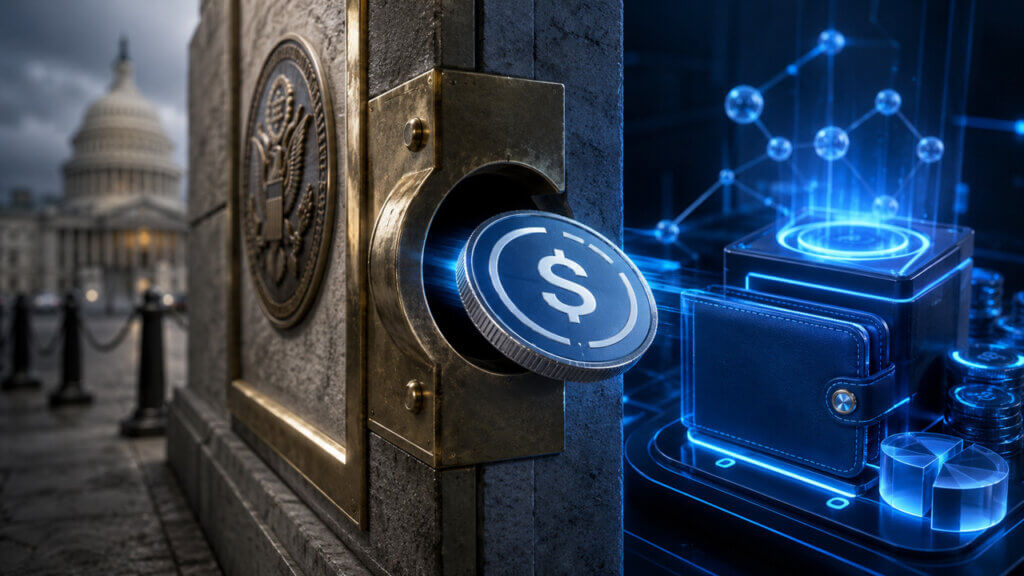
Open Standard’s Open USD is trying to make the stablecoin yield fight about distribution before the token is live.
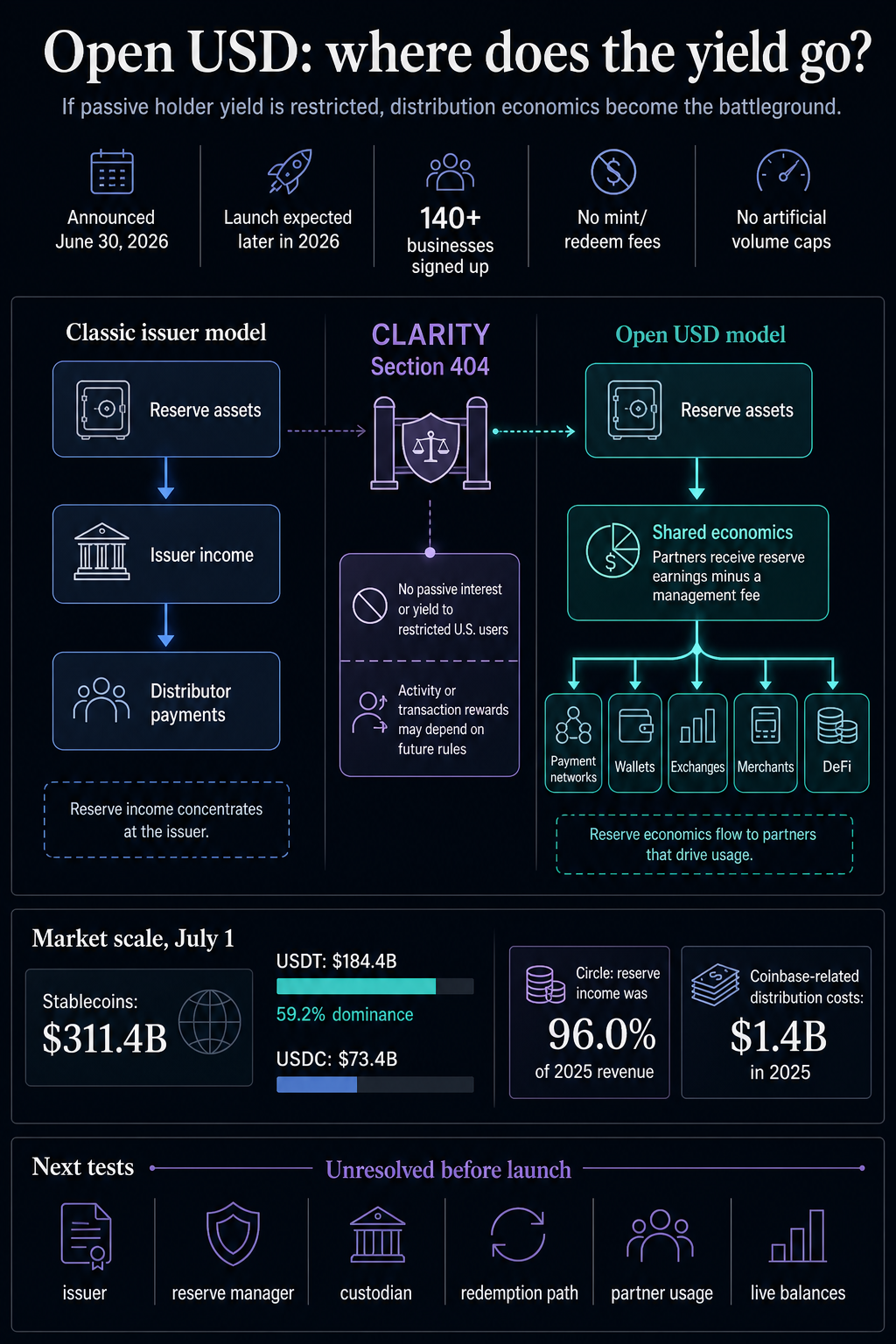
The company announced Open USD on June 30 as a stablecoin for global money movement. Its headline feature is a reserve-sharing model: businesses can mint and redeem at no cost, without artificial volume caps, while partners receive reserve earnings minus a small management fee.
Open Standard also says Open USD will be operated by an independent company with partner-led governance. Founding CEO Zach Abrams framed the product as a stablecoin built by and for the businesses that will use it.
Open USD has yet to show live supply, redemption history, reserve attestations, or a visible place in stablecoin market tables. It is expected to launch later in 2026.
Even so, its stated design points directly at the most contested part of the stablecoin business: reserve economics.
If U.S. rules limit passive yield to stablecoin holders, Open USD‘s bet is that the fight moves elsewhere. Instead of paying users to sit on tokens, the economic value can flow to merchants, payment processors, wallets, exchanges, marketplaces, DeFi venues, and other companies that drive transaction volume.

Open USD may turn stablecoin competition into a DeFi incentive war, with Plasma and other partners using shared economics to fight for user liquidity.
Jul 1, 2026 · Gino Matos


Open Standard’s pitch is simple in public but aggressive in market structure. It describes Open USD as shared infrastructure and says participants can earn revenue based on usage.
Its announcement lists more than 140 businesses across payments, finance, technology, commerce, and crypto, including Visa, Stripe, Mastercard, BlackRock, BNY, Google, Coinbase, Solana, Base, Aave, Ripple, Fireblocks, Shopify, and DoorDash.
The partner list maps where the economics could flow. Payment networks control merchant access. Exchanges and wallets control where balances sit. Marketplaces control payout flows.
DeFi protocols control liquidity venues, while banks and asset managers control the plumbing for trust, custody, and reserves. If those firms can share in reserve economics, a stablecoin issuer’s traditional advantage becomes a distribution negotiation.
That is why Open USD reads as an attempt to turn stablecoin float into partner compensation. In the classic model, reserve income is the issuer’s economic engine.
In Open Standard’s stated model, most of that value is supposed to return to the companies that adopt and distribute the stablecoin.
The caveat is large. Open Standard’s public materials say reserves are maintained at major financial institutions in compliance with U.S. regulatory requirements, but they have yet to fully identify the legal issuer, reserve manager, custodian, redemption counterparties, or reserve composition.
Those details determine whether the model can satisfy both compliance and marketing teams.
The strongest economic comparison is Circle. Circle’s 2025 Form 10-K says reserve income represented 96.0% of 2025 revenue and that reserve income depends on stablecoins in circulation and the reserve return rate.
The filing also shows that distribution is already expensive. Circle reported $1.4 billion of Coinbase-related distribution costs in 2025 and described allocations to Coinbase tied to USDC held on Coinbase’s platform and broader ecosystem growth.
Coinbase’s 2024 Form 10-K tells the other side of the same arrangement. Coinbase says its stablecoin revenue from Circle is determined by daily income generated from USDC reserves.
That revenue has exposure to USDC market capitalization, platform balances, approved ecosystem participants, deducted expenses, and interest rates.
Those filings make Open USD’s market signal sharper. Reserve economics are already moving between issuer and distributor in USDC’s ecosystem.
Open USD proposes to make that bargain more explicit and more widely available to the companies that can drive usage.


USDC scaled to $75.3B, but gatekeepers captured 63% of the yield, turning growth into a pay to play bargain.
Feb 26, 2026 · Gino Matos
Tether sits in a different category. DeFiLlama stablecoin data showed a total stablecoin market capitalization of near $311.4 billion on July 1, with USDT at around $184.4 billion and 59.2% dominance, while USDC was at around $73.4 billion.
CryptoSlate’s market pages showed a similar gap, with USDT having a far higher 24-hour trading volume than USDC, at $67 billion in exchange volume and $1.5 billion in DEX volume. USDC recorded a sizeable yet smaller $10.8 billion in exchange volume and $1.9 billion in DEX volume.
Tether’s moat extends beyond reserve yield. It is offshore dollar liquidity, exchange integration, settlement habit, and deep trading-pair usage.
Open USD can pressure that over time only if it becomes liquid across venues and geographies. Its earlier challenge is to Circle’s institutional claim that USDC is the default regulated stablecoin rail for businesses that need compliance, transparency, and distribution.


The policy backdrop gives Open USD its opportunity.
Section 404 of the Senate Banking Committee’s Digital Asset Market Clarity Act draft would prohibit covered parties from paying direct or indirect interest or yield tied to payment stablecoin balances to restricted U.S. customers or users.
Market-moving headlines and context delivered every morning in one tight read.
5-minute digest 100k+ readers
Free. No spam. Unsubscribe any time.
Whoops, looks like there was a problem. Please try again.
You’re subscribed. Welcome aboard.
The same section preserves room for bona fide activity-based or transaction-based rewards under future rules.
That distinction is where Open USD fits the current debate. If law and regulators draw a hard line around passive, deposit-like yields to holders, the market still has to decide whether businesses can be rewarded for actual distribution, transactional activity, or commercial use.
Open USD’s shared-economics model sits in that zone.


Coinbase and Ethena could turn idle USDC balances into activity-based yield, challenging banks as lawmakers move to limit passive stablecoin rewards.
Jun 3, 2026 · Oluwapelumi Adejumo
Open USD functions as a policy stress test. Its public materials describe partner economics and distribution incentives, while the final treatment of merchant rewards, exchange incentives, wallet rebates, and partner revenue shares depends on law, rulemaking, and program design.
The White House Council of Economic Advisers has argued that a prohibition on yield-bearing stablecoins would do little to protect bank lending while sacrificing consumer benefits.
The Bank Policy Institute has argued the opposite: that yield-bearing stablecoins can reduce deposits and lending after households and businesses adjust their balance sheets.


The report’s own projections show the ban barely nudges bank lending while putting stablecoin innovation and consumer yields on the line.
Apr 15, 2026 · Liam ‘Akiba’ Wright
Open USD leaves that fight open. It changes the underlying business question.
If the law makes passive user yield harder, the next fight may be over whether reserve economics can be paid to the companies that enable stablecoin transactions.
That creates the tension Open USD is built around. A holder reward looks like a consumer finance product; a partner revenue share looks like a commercial distribution arrangement.
The final rules will determine how much distance must exist between those categories, which parties can receive economic benefits, and what disclosures or controls companies need before reserve value can flow back to platforms that originate usage, rather than directly to end users.
That makes rule-writing important for each link in the distribution chain. A payment network, wallet, exchange, or marketplace can all help generate usage, but their incentives may be reviewed differently depending on who receives the payment and whether it reaches restricted U.S. users.
Open Standard’s partner list is unusually strong; reported balances remain the adoption test.
The launch test is practical. The market needs to see who issues Open USD, where the reserves sit, what backs them, how redemptions work, which chains launch first, which partners actually route money through it, and whether balances appear in market data after launch.
Until then, Open USD remains a serious proposal with credible distribution names and the incumbent test still ahead.
The implication is practical. Open USD can pressure Circle by turning USDC’s existing reserve-income bargaining problem into a product feature.
It can pressure stablecoin regulation by showing that yield debates extend beyond the holder’s wallet. It can pressure payment and merchant platforms by giving them a reason to treat the choice of stablecoin as an economic decision, alongside infrastructure and compliance.
The model still has to prove that the partner board, reserve structure, compliance model, redemption path, and actual usage can survive launch.
If that evidence never appears, the announcement remains a warning shot. If it does, the stablecoin war shifts from a fight over which issuer keeps the float to a fight over which network can share it without breaking the rules.
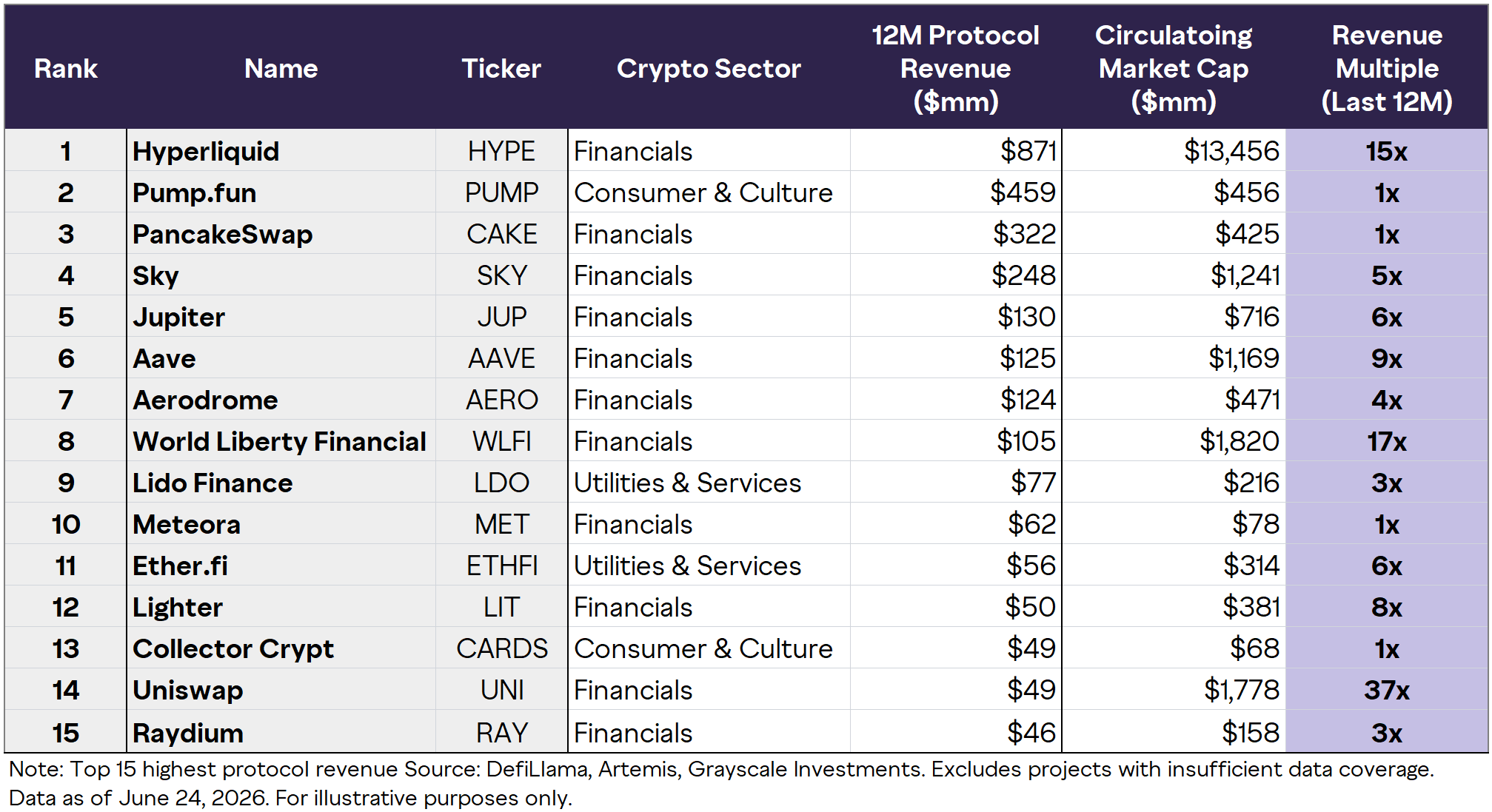
A group of crypto tokens tied to some of the industry’s largest revenue-generating applications could be positioned for a revaluation as Congress moves closer to establishing a federal rulebook for digital-asset markets.
The Digital Asset Market Clarity Act, known as the CLARITY Act, would define regulatory responsibilities for crypto assets and the companies that trade them. Supporters say the legislation could give banks, asset managers, and other traditional financial firms greater confidence to conduct business on public blockchains.
Asset management firm Grayscale expects that shift to favor applications already processing transactions and collecting fees, particularly those built around trading, lending, and other financial services.

The potential catalyst comes after a prolonged market downturn left many of their tokens valued at relatively low multiples of the revenue their protocols generated over the past year.
The Senate Banking Committee advanced the legislation in May after the House approved an earlier version in 2025. Grayscale said the bill could progress as soon as next month, though its timing and final provisions remain subject to negotiations in Congress.
Hyperliquid sits at the front of the group because of the scale of its derivatives business.
The decentralized trading platform generated $871 million in protocol revenue over the 12 months through June 24, more than any other application in a ranking compiled by Grayscale.
HYPE, its native token, carried a circulating market capitalization of approximately $13.46 billion, giving it a trailing revenue multiple of about 15. That valuation is higher than that of most tokens on the list, but Hyperliquid also generated almost twice as much revenue as its closest competitor.
Clearer US market-structure rules could expand the pool of assets and participants entering blockchain-based trading venues. Greater certainty over whether digital assets fall under securities or commodities regulation could also make it easier for regulated institutions to connect with on-chain markets.
The opportunity extends across decentralized exchanges and trading aggregators.
PancakeSwap generated $322 million over the trailing 12 months, while its CAKE token had a circulating value of $425 million. That placed it near 1 times protocol revenue, among the lowest multiples in the ranking.
Jupiter, a Solana-based trading aggregator, recorded $130 million of revenue and a $716 million circulating market capitalization, equivalent to about 6 times revenue. Aerodrome generated $124 million in revenue and traded at nearly 4 times revenue, while Meteora generated $62 million in revenue and carried a valuation of only $78 million.
Raydium’s $46 million in revenue compared with a $158 million circulating market value, leaving the Solana exchange token at roughly 3 times revenue.
Those platforms could benefit if the legislation encourages issuers to bring more regulated assets onto blockchains. Each new tokenized security, commodity, or fund would need markets where investors can buy, sell, and provide liquidity.
Uniswap offers a different valuation profile. The decentralized exchange generated $49 million in protocol revenue, but its UNI token carried a circulating market value of about $1.78 billion, equal to 37 times revenue and the highest multiple among the 15 protocols.
That premium suggests investors already assign substantial value to Uniswap’s brand, market position, and prospects for future fee generation.
It also means the token may have less room for a valuation-driven rebound than competitors trading at lower multiples, unless regulatory clarity produces a significant increase in activity or strengthens the connection between protocol fees and UNI holders.
Pump.fun, the Solana-based memcoin launchpad, ranked second overall with $459 million in annual protocol revenue and a circulating market capitalization of $456 million.
While the Solana-based platform is less directly tied to institutional finance, clearer rules around digital-asset issuance and trading could still affect its business.
Its approximately 1-times revenue multiple reflects both the scale of its fee generation and investor doubts about whether activity associated with speculative token launches can remain durable through changing market cycles.
Lending protocols may benefit from the next stage of on-chain adoption as tokenized assets move beyond trading and become collateral for loans.
Aave generated $125 million in trailing protocol revenue. Its AAVE token had a circulating market capitalization of approximately $1.17 billion, placing its multiple near 9.
The protocol allows users to borrow and lend digital assets through automated markets. An increase in regulated stablecoins, tokenized funds, and blockchain-based securities could broaden the pool of assets available as collateral and attract more borrowers and lenders to its markets.
Institutional participation could be particularly significant. Banks and asset managers entering public blockchains would require credit markets, collateral-management systems, and sources of liquidity alongside trading venues.
Aave already operates much of that infrastructure, though the extent of its benefits would depend on whether institutions use open protocols directly or favor permissioned systems and regulated intermediaries.
Sky, the project previously known as Maker, could also gain from the expansion of tokenized credit and stablecoins.
The protocol generated $248 million over the past year, the fourth-highest total in the ranking. Its SKY token had a circulating market capitalization of about $1.24 billion, equivalent to 5 times the protocol’s revenue.
Sky’s exposure to stablecoins and tokenized real-world assets gives it a direct link to the type of financial activity that Grayscale expects the legislation to encourage. Greater use of blockchain-based Treasury products, credit instruments, and cash-like tokens could increase demand for the infrastructure used to issue, borrow, and settle those assets.
Market-moving headlines and context delivered every morning in one tight read.
5-minute digest 100k+ readers
Free. No spam. Unsubscribe any time.
Whoops, looks like there was a problem. Please try again.
You’re subscribed. Welcome aboard.
President Donald Trump-backed World Liberty Financial also appears among the largest revenue producers, with $105 million over 12 months. Its WLFI token was valued at approximately $1.82 billion, or 17 times revenue.
That relatively high multiple indicates that investors are assigning value beyond the protocol’s current fee generation. Its political connections and evolving product strategy may also make direct comparisons with more established lending and exchange protocols difficult.
An increase in on-chain financial activity would also create demand for the systems that secure blockchain networks and allow investors to earn returns from their assets.
Lido Finance generated $77 million in trailing protocol revenue, while its LDO token had a circulating value of $216 million. Its 3-times revenue multiple places it among the cheapest assets in the group on that measure.
Lido provides liquid staking services, allowing users to commit assets to help secure blockchain networks while receiving tokens that can continue to circulate through decentralized finance applications.
Ether.fi operates in a related part of the market. The protocol generated $56 million over the period and carried a circulating market value of $314 million, giving its ETHFI token a multiple of about 6.
If the CLARITY Act encourages more assets and transactions to move onto public networks, staking providers could benefit from higher demand for blockchain security and yield-bearing products. Growth in tokenized finance could also create more uses for liquid staking tokens as collateral across trading and lending applications.
The effect would probably arrive less directly than it would for exchanges or lending markets. Staking remains subject to separate legal questions, while the final legislation may not resolve every issue surrounding the treatment of staking services or rewards.
Still, the inclusion of Lido and Ether.fi among the industry’s largest revenue generators shows that the economic activity behind crypto extends beyond trading. Financial applications depend on underlying networks, validators, and liquidity systems that may also expand as transaction volumes rise.
The broader investment case rests on how little the market currently pays for the revenue generated by many of these applications.
Twelve of the 15 protocols in Grayscale’s ranking traded at single-digit multiples of trailing revenue. Pump.fun, PancakeSwap, Meteora, and Collector Crypt were each valued at approximately 1 times revenue. Lido and Raydium traded at nearly 3x, while Aerodrome was valued at 4x.
Sky, Jupiter, and Ether.fi carried multiples between 5 and 6. Lighter, an on-chain trading platform that generated $50 million in revenue, traded at around 8x, while Aave stood at 9x.
Grayscale argues that the valuations look even lower when viewed against potential earnings or cash flow because many blockchain applications operate without the large staffing, property, and administrative expenses associated with traditional companies.
The comparison has limits. Protocol revenue does not always belong to token holders in the same way corporate revenue belongs to a company and ultimately supports its shareholders.
Fees can flow to validators, liquidity providers, developers, protocol treasuries, or users. Some applications also distribute tokens to attract activity, creating an economic cost that may not appear in headline revenue figures.
Circulating market capitalization can further understate a project’s eventual valuation when a large portion of its token supply remains locked and scheduled for future release.
For investors, the strongest potential winners will therefore be protocols that combine revenue growth with a clear mechanism for directing economic value toward their tokens. Those links can include fee distributions, token repurchases, staking demand, or governance rights over protocol income.
The CLARITY Act would not guarantee higher prices for any of the assets. It could, however, reduce a regulatory discount that has limited institutional participation and complicated how investors value US-facing crypto projects.
JP Morgan CEO Jamie Dimon did not mince words about his stance on the Clarity Act and Coinbase CEO Brian Armstrong in an interview with Fox Business on Friday.
The banking executive said he is not happy with the current version of the Clarity Act, a bill that would regulate most crypto activity in America, and says banks will “not accept it that way.” Dimon further vowed that the banking industry will fight it, and if “we lose, we lose.”
“It will be fought,” said Dimon. “No one is going to bow down to this guy, or that company,” he added, without specifically naming Armstrong or Coinbase.
After Fox Business anchor Maria Baritromo asked specifically about Coinbase, Dimon had more to say: “He’s the only one… he’s spending hundreds of millions of dollars in Washington on this thing. He’s full of shit.”
Jamie Dimon, complaining about the Clarity Act and Coinbase CEO Brian Armstrong this AM: “He’s spending hundreds of millions of dollars in Washington in this thing.”
Maria: “He said he’s representing the whole —”
Dimon: “He’s full of shit.”
Maria: “…well.” pic.twitter.com/Qik9Hnue6U
— Brendan Pedersen (@BrendanPedersen) May 29, 2026
Dimon’s scrutiny of the Clarity Act largely stems from the issue of stablecoin yield—a major sticking point with the banking lobby that has stalled progress on the bill in recent months. At the moment, cryptocurrency platforms are able to offer yield, essentially a form of interest payments, on stablecoin holdings as permitted by the GENIUS Act—signed into law by President Donald Trump in July last year.
The GENIUS Act specifically prohibits stablecoin issuers, such as Tether or Circle, from offering yield to clients, but allows for third-parties, such as Coinbase or other exchanges, to do so instead.
Banks have fought to include language in the Clarity Act to close that loophole while crypto industry giants like Coinbase have sought to ensure platforms can continue offering yield tied to stablecoins.
The debate has helped draw out the Clarity Act’s potential passage by more than four months, with Coinbase at one point withdrawing its support for the bill prior to the inclusion of stablecoin reward compromise language.
Just two months ago, Dimon slammed the demands on stablecoin yields, noting that the “public will pay.” Once more on Friday, he added that “it would eventually blow up on its own.”
“If you want to be a bank, become a bank,” he said in March. “Then you can do whatever you want under bank law.”
The contentious bill has seen plenty of back and forth over the last few months, but passed a key Senate Banking Committee vote earlier this month. It will now move to the Senate floor for a potential final approval.
Despite the back and forth, President Trump has remained adamant getting the bill passed, posting earlier this week that he aims to “codify a future proof digital asset market structure.”
As it stands, predictors on Polymarket give the bill around a 59% chance of being signed into law by the end of 2026.
Start every day with the top news stories right now, plus original features, a podcast, videos and more.
The US CLARITY Act, which aims to provide the US crypto industry with more regulatory clarity, could have a positive ripple effect beyond the crypto sector itself, according to venture capital firm a16z crypto.
“If the US provides builders with regulatory clarity, it will be a boon for domestic innovation,” a16z crypto said in an X post on Friday.
A16z pointed to the passage of the GENIUS Act in July 2025, which created a regulatory framework for stablecoins, as a possible indication of what may happen following the CLARITY Act.
“Its passage led to unprecedented growth and adoption, which is not only good for the U.S. economy, but is also good for long-term dominance of the US dollar,” a16z crypto said. The US dollar index, which tracks the dollar’s strength against a basket of major currencies, is 99.27 at the time of publication, up 1.28% over the past 30 days, according to TradingView. A16z said:
“When our legal frameworks are designed to both foster innovation and protect consumers, America leads and the world benefits.”
Source: Cynthia Lummis
Since the US CLARITY Act was introduced in July 2025, the crypto industry has been widely speculating about its potential impact on global markets.
Sharplink Gaming CEO Joseph Chalom recently said that while many view the legislation as “a US phenomenon,” it is also being seen as a major signal for other jurisdictions around the world.

Source: Kalshi Crypto
US asset management firm Grayscale said in a report published on Friday that the odds of the legislation passing are high in the firm’s view, but “the bill will require bipartisan support to clear the full Senate and become law.”
“There are still a few hurdles to clear before CLARITY can become law,” Grayscale said.
Related: US CLARITY Act brings ‘major spike of euphoria’ to Bitcoin: Santiment
The comments came after a Thursday session of the US Senate Banking Committee, in which all 13 Republican members and two Democrats voted to advance the bill, with nine Democrats also voting no on the bill.
Grayscale pointed out that Republicans currently hold 53 seats, meaning at least seven Democrats would need to support the bill. “We believe that’s possible: the GENIUS Act cleared the Senate with 66 votes including 18 Democrats,” Grayscale said.
Magazine: ETH stalls at $2.4K five times, SOL to rally to $120: Market Moves
Crypto firms can offer stablecoin rewards now. But they can’t make those rewards look like bank deposits.
The Clarity Act dropped Friday with a pretty clear message: stablecoin incentives are fine as long as companies stick to what regulators call “bona fide” transactions. The law draws a line between legitimate crypto products and offerings that basically mimic what banks do. Banks didn’t want competition for deposit yields, and they got protection here. The crypto industry got a green light to keep building reward programs, just not the kind that blur into traditional finance territory.
Companies in the space can roll out stablecoin rewards tied to real transactions. That’s the core of what Friday’s announcement allows. The catch is those rewards can’t resemble the deposit products banks offer to customers. Regulators want a clear boundary between what crypto does and what banks do, and the Clarity Act tries to establish that boundary with some force.
For crypto firms, the rules mean they can still incentivize users. Stablecoin returns are on the table. But the structure matters a lot. If a product starts looking too much like a savings account or a certificate of deposit, it probably crosses the line the Clarity Act draws. The legislation protects bank deposit structures by keeping crypto firms out of that specific business model.
The distinction seems designed to prevent a scenario where crypto companies siphon deposits away from traditional banks by offering higher yields on products that function identically to bank accounts. Banks have regulatory burdens and insurance requirements that crypto firms don’t carry. Letting crypto firms compete directly on deposit-like products would create an uneven playing field, and the Clarity Act shuts that door.
What counts as a genuine transaction? The Clarity Act doesn’t spell that out in detail. The phrase “bona fide” leaves room for interpretation, and that’s going to matter when companies start testing the boundaries. Some firms will probably push right up to the edge of what regulators consider acceptable. Others will play it safe.
No crypto companies issued statements Friday about how they’ll adapt. That silence is telling. Companies are likely working through what the new rules mean for their existing products and future plans. Some stablecoin reward programs might need restructuring. Others might be fine as-is. It’s not clear yet.
See also: GENIUS Act Blocks Stablecoin Yield Payments as FDIC Tightens Reserve Rules
The ambiguity around what qualifies as a permissible transaction could lead to enforcement actions down the road. Regulators will have to clarify through guidance or through legal challenges when companies get it wrong. That process takes time and creates uncertainty for firms trying to innovate within the new framework.
Crypto firms that offered high yields on stablecoin deposits were already operating in a regulatory gray zone. Some companies attracted billions in customer funds by offering returns that beat what banks paid on savings accounts. Those products looked a lot like bank deposits to consumers, even if the legal structure differed. The Clarity Act basically says that model is off limits going forward.
The legislation reflects broader regulatory anxiety about crypto’s growth. As digital assets gained traction, regulators worried about systemic risks and consumer protection gaps. Stablecoin products that functioned like bank accounts raised specific concerns because they combined crypto’s light regulatory touch with banking’s consumer appeal. That combination made traditional financial institutions nervous and caught regulators’ attention.
Banks have deposit insurance through the FDIC. Crypto firms don’t. When consumers can’t easily tell the difference between a bank deposit and a crypto yield product, that creates risk. The Clarity Act tries to eliminate that confusion by forcing crypto firms to offer something clearly different from what banks provide.
For users, the practical impact depends on how companies respond. Some stablecoin reward programs will continue without changes. Others might disappear or get redesigned. The highest-yield products that most closely resembled bank deposits are probably at risk. Companies will need to show their offerings involve genuine transactions rather than simple deposit-and-earn structures.
See also: Brazil Shuts Crypto Out of Official Cross-Border Payment Rails
The crypto industry has been asking for regulatory clarity for years. The Clarity Act delivers some of that, though not necessarily in the way companies hoped. Clear rules are better than uncertainty, but restrictions still limit what firms can build. The trade-off is that companies now know where the boundaries are, even if those boundaries feel constraining.
Traditional banks probably see the Clarity Act as a win. It protects their deposit base from crypto competition while still allowing the digital asset industry to operate. That balance seems intentional—regulators want innovation in crypto without destabilizing traditional finance. Whether that balance holds depends on how firms adapt and how regulators enforce the new rules.
The coming months will show how crypto companies restructure their products. Some firms might exit the stablecoin rewards business entirely. Others will find creative ways to offer returns within the Clarity Act’s framework. The definition of “bona fide” transactions will get tested repeatedly as companies experiment with different models.
Post Views: 1
Yes, crypto firms can offer stablecoin rewards as long as they’re tied to genuine transactions and don’t resemble traditional bank deposits.
The Clarity Act doesn’t define this precisely, leaving room for interpretation and likely future regulatory guidance or legal challenges.
The ongoing war between Iran and the US has stifled market movements, particularly in the crypto market. Following the Easter holidays, the XRP price has shot up to its monthly starting price of around $1.37.
The reports from Yahoo Finance were derived from ChatGPT’s predictions of Ripple’s likely outcomes this year. Its predictions are based on the Straits of Hormuz opening and the war ending. In that case, the AI predicted that XRP could hit three different levels, depending on how the circumstances turn out.

XRP currently holds a tight support band between $1.29 and $1.31, with the first meaningful resistance clustering around $1.35 to $1.38.
Momentum indicators lean mixed rather than strongly bullish. RSI readings in the low-to-mid 40s suggest XRP is not overbought, but it also is not showing a strong rebound signal yet, while several oscillators remain neutral or slightly bearish.
The moving-average setup is more cautious. XRP is trading below its 50-day and 200-day averages, which usually points to a weaker medium-term trend. A clean hold above $1.35 would keep the short-term structure intact, but if XRP drops through $1.29, it could expose the next support around $1.27.
On the upside, clearing $1.35 would open room toward $1.37 and $1.38, and a stronger breakout would be needed before the chart starts to look decisively bullish. Longer-term, some technical dashboards note a broader resistance zone much higher, around $2.65, which aligns with prior swing highs and would matter only if XRP first reclaims its near-term resistance cluster.
Read next: The best crypto exchanges to buy XRP and other cryptocurrencies in 2026.
For a move to $1.47, XRP first needs to break above $1.37, stay above the 20-day SMA, and show stronger buying momentum with RSI pushing back above 50. Hitting $1.60 starts to look more realistic if the broader market improves, especially with better regulatory clarity, like progress around the CLARITY Act.
From there, a climb to $2.80 could happen into late 2026 if XRP regains solid momentum. The $3.30 to $3.84 range is a big milestone and a major resistance zone, so breaking through it would signal a much stronger trend shift. And for XRP to trade at $5.00 and above, it will need serious catalysts like strong institutional interest and a clearly sustained bull run.
On the bearish side, XRP’s outlook is tied to how well it holds key support levels. The $1.30 to $1.28 range is the immediate area to watch, considering XRP has been testing it, and a break below signals short-term weakness. If that happens, the next likely floor sits around $1.25, marking a stronger support level.
Further downside to $1.15 could come into play in a tougher macro environment, especially with factors like high oil prices and persistent Fed rates weighing on the market. If conditions turn more risk-off and the $1.28 support fails under continued external pressure, XRP could even drop below $1.00. In an extreme bear case, a deeper structural breakdown could push prices as low as $0.53, based on extended technical projections.
Patience is key for now, as the US, Israel, and Iran are approaching the end of their ceasefire talks. Any success there will move the XRP price predictions toward bullish outcomes, with sights set on even more optimistic results. The converse situation, where the war is sustained, could see the token price fall even lower to levels last seen in 2024.
If you decide to invest in XRP, here is a complete guide on how to buy XRP in 2026 from major exchanges and third-party platforms.


XRP trades at $1.35, posting a 2.3% gain over the past 7 days, with a 24-hour range between $1.32 and $1.36. Price continues to sit below the 50-day moving average of $1.388 and well beneath the 200-day moving average of $1.97, keeping the broader trend cautious. Trading volume reaches $2.59 billion in the last 24 hours, with a market cap of $82.5 billion and a circulating supply of 61.4 billion XRP.
All things considered, the XRP price prediction is bullish, at least for 2026. We are banking on the war ending, even if not in April, and the rest of the year could go to recovery and a brief rally in the $2 to $4 range. If the ideal circumstances hold, Ripple could very well become the best investment this year.
Hyperliquid launched a policy center in Washington on Feb. 18, seeded with 1 million HYPE tokens worth roughly $28 million, led by Jake Chervinsky, the crypto lawyer who spent years building the industry’s Capitol Hill playbook.
The Hyperliquid Policy Center operates as a 501(c)(4) focused on decentralized finance and perpetual derivatives. This isn’t just another crypto company hiring lobbyists. It’s a protocol that funds a sustained DC presence with its native token, making policy infrastructure part of the product itself.
The move signals something broader: DeFi’s “code routes around regulation” era is coming to an end. Policy is now part of the moat. And the battleground is derivatives, because perpetual futures are the largest real on-chain use case that US regulators still don’t know how to handle.
Hyperliquid processed $256 billion in perpetual futures volume over the past 30 days, with open interest exceeding $5 billion.
When a venue becomes meaningful market infrastructure for leveraged trading, it attracts scrutiny. The UK maintains its ban on retail crypto-derivatives even as it loosens other access.
The CFTC brought enforcement actions against bZeroX and Ooki DAO for offering illegal off-exchange digital-asset trading. Perps dominate crypto derivatives markets, accounting for roughly 75% of total activity, largely because onshore rules remain ambiguous.
Perpetuals don’t expire and use continuous funding rates instead of settlement mechanics. That simplicity creates regulatory friction: perps don’t fit cleanly into existing commodity futures statutes.
Chervinsky told Fortune that perps offer “more direct exposure to the underlying asset” than traditional derivatives, but that same design makes them harder to regulate.
The Hyperliquid Policy Center exists to make perps legible to lawmakers before lawmakers make them illegal by default.
Treasury Secretary Scott Bessent told Congress it needs to pass a major crypto market-structure bill by spring 2026, warning the coalition could fracture if delayed.
The SEC and CFTC held a joint harmonization event on Jan. 27. These aren’t abstract conversations, they’re drafting sessions for the map.
The CLARITY Act passed the House in July 2025 and sits in the Senate Banking Committee. It establishes a federal market structure for digital commodities, including frameworks for exchange and broker registration, and defines terms such as “mature blockchains.”
However, the Congressional Research Service’s analysis explicitly states that CLARITY’s framework excludes derivatives. Even if market structure legislation passes, leveraged perpetuals remain unresolved.
Meanwhile, stablecoin regulation is becoming law. The GENIUS Act was passed in July 2025, establishing a federal framework for a stablecoin. Standard Chartered forecasts that stablecoin supply will grow to $2 trillion by 2028.
The contrast is stark: payment rails are gaining clarity, while trading rails remain ambiguous. This split defines crypto’s next DC battle.
Digital asset sector lobbying spending rose 66% to $40.6 million in 2025, according to OpenSecrets data. Big banks spent $86.8 million.
Crypto is learning DC the TradFi way: sustained institutional presence, technical research, relationship cultivation. Hyperliquid’s $28 million seed round exceeds what most crypto advocacy groups spend in a year. The Digital Chamber spent $5.6 million in 2024, and the Blockchain Association spent $8.3 million.
The Hyperliquid Policy Center isn’t alone.
The DeFi Education Fund has operated since 2021. Ethereum ecosystem protocols formed the Ethereum Protocol Advocacy Alliance in November 2025. The Solana Policy Institute exists.
These aren’t ad hoc legal defense funds. They’re institutionalized policy layers operating as 501(c)(4) nonprofits with full-time staff and Hill briefing schedules.


DeFi venues now compete on three dimensions: market design (user experience, liquidity, fees), compliance design (what can be compelled, who controls interfaces), and narrative design (how “decentralized” gets defined in statute).
CLARITY creates registration concepts for digital commodity exchanges and brokers, but explicitly excludes derivatives, leaving perps in regulatory limbo.
The practical implication: even if Hyperliquid’s protocol remains globally accessible, US-facing front ends will face pressure to adopt registration-like standards, such as surveillance, disclosure, segregation, and KYC gating.
The question is whether the US uses routes through compliant intermediaries or targets control points, such as operators and governance participants, for enforcement.
The CFTC’s enforcement history suggests regulators will pursue the latter if the former doesn’t materialize.
Market-moving headlines and context delivered every morning in one tight read.
5-minute digest 100k+ readers
Free. No spam. Unsubscribe any time.
Whoops, looks like there was a problem. Please try again.
You’re subscribed. Welcome aboard.
The next six to eighteen months will determine how the US treats rules on decentralized derivatives.
The first scenario consists of regulated access paths emerging. Spring 2026 legislation passes, with follow-on guidance on derivatives. US-facing front ends adopt registration-like standards while base protocols remain globally accessible.
Volume consolidates into venues that can afford compliance, creating policy moats.
The second scenario is if front-end chokepoint crackdowns intensify. Enforcement focuses on control points, such as operators and governance actors. Geofencing proliferates, US-facing interfaces degrade, and retail users get pushed offshore. Trading continues but fragments between jurisdictions.
The third scenario becomes concrete if legislative breakdown leaves perps offshore.
The coalition Bessent warned about fractures. CLARITY stalls or passes without derivatives provisions. The US gets clarity on spot and stablecoins, but leaves perps in a gray zone. Offshore dominance persists.
All three scenarios involve policy work. The difference is timing and leverage. Early engagement when rules are being drafted carries more weight than reactive defense when enforcement actions land.
| Scenario | Trigger / policy catalyst | Regulatory posture | What happens to US access | Market outcome |
|---|---|---|---|---|
| Regulated access paths emerge | Spring 2026 market-structure momentum holds; SEC/CFTC harmonization continues; follow-on work clarifies how onchain perps can fit into a compliant framework | “Yes, but” regime: permissioned rails + registration-like expectations for interfaces | US-facing front ends adopt KYC gating, disclosures, surveillance, segregation, and tighter controls; base protocols remain globally accessible but US UX becomes “regulated mode” | Volume consolidates into a few venues that can afford compliance; policy moats form; perps become more institutionally legible (but less permissionless) |
| Front-end chokepoint crackdown | Enforcement prioritizes control points (operators, key contributors, UI hosts, governance actors) after limited legislative progress | “Enforcement-first” posture: focus on intermediaries and “effective control” rather than protocol ideology | More geofencing, front-end shutdown risk, and degraded access; US users pushed to offshore routes/APIs and fragmented liquidity | Trading persists but routes around the US; liquidity fragments; compliance becomes a competitive weapon; higher legal risk premium for token-linked venues |
| Legislative breakdown → offshore dominance | Coalition fractures; CLARITY stalls or advances without derivatives; stablecoins get clarity while perps remain unaddressed | “No clear pathway” regime: derivatives remain in limbo; policy uncertainty persists | US access stays gray/limited; compliant onshore perps don’t materialize at scale; offshore remains the default | Offshore venues keep dominance; onchain perps grow globally but US participation is structurally constrained; DC becomes a recurring headline risk rather than a solved moat |
For years, crypto has positioned decentralization as regulatory arbitrage: build systems that can’t be shut down and route around legacy rules.
That narrative is colliding with reality. When your protocol processes billions in daily volume, generates revenue flowing to token holders, and offers leverage to retail users in a 24/7 global market, you’re not routing around regulation.
Instead, you’re building parallel infrastructure that regulators will eventually force into their framework or shut out of their jurisdiction.
Hyperliquid’s move to Washington openly acknowledges this.
DeFi is entering its K Street era not because protocols have lost their ideological moorings, but because waiting for enforcement-driven precedent is riskier and less likely to produce workable rules.
While DC debates, Hong Kong plans to issue its first stablecoin licenses in March 2026.
The EU’s MiCA provides a live token framework. The UK loosens access to some crypto products while maintaining strict perimeter controls for derivatives. Chervinsky’s warning that “other nations seize the opportunity” isn’t hypothetical.
The next moat won’t just be technical superiority or liquidity depth. It will be compliance architecture that works, narrative frameworks that resonate with lawmakers, and relationships that let you shape rulemaking before rulemaking shapes you.
The market will test whether this works. If the Hyperliquid Policy Center helps secure a regulatory path for on-chain perps in the US, other protocols will follow suit.
If it doesn’t, the $28 million becomes a case study in expensive signaling. Either way, the experiment is live. DeFi went to Washington. Now, the market finds out whether Washington was waiting.
While supporters say the CLARITY Act could bring long-awaited regulatory certainty to crypto markets, not everyone is on board.
Critics argue the bill doesn’t need to “ban DeFi” to reshape it. Their claim is that CLARITY can leave base-layer software intact while shifting the real battleground to regulated access points: the brokers, dealers, custodians, exchanges, and interfaces most users rely on to reach on-chain markets.
In that reading, the “hidden compliance choke point” is not protocol code. The perimeter is expanding as access providers are drawn deeper into Bank Secrecy Act obligations and registration requirements, raising fixed costs and liability for anyone serving customers at scale.
That dynamic is why critics frame CLARITY less as a straightforward market-structure upgrade and more as a pathway to concentration: permissionless rails may still exist, but most users could be funneled toward a smaller set of compliant venues that determine which tokens, pools, and routes remain practically reachable.
Vandell Aljarrah of Black Swan Capital called the Digital Asset Market Clarity Act of 2025 “the nationalization of crypto” and “the final handover of decentralized finance.”
His comments circulated as Senate consideration of the House-passed bill has moved slowly, even as the measure advanced through the Agriculture Committee.
Financial freedom advocate, Aaron Day, also offered a “decoder ring” framing that maps “consumer protection” to “surveillance” and “market structure” to “rigged” outcomes.
The Senate Banking Committee’s executive session to consider the bill remained listed as “POSTPONED” for Jan. 15, 2026, but the bill has since logged its first concrete Senate win after the Senate Agriculture Committee advanced the CLARITY Act on Jan. 29.
For broader context on how the Banking committee delay and the Agriculture committee advance fit into the current U.S. policy calendar, see CryptoSlate’s coverage of developer-protection debates and committee timelines and the latest update on the CLARITY Act’s Senate movement.


John Boozman’s updated draft quietly pulls ‘meme coins’ into CFTC turf… unless regulators carve them out later.
Jan 22, 2026 · Liam ‘Akiba’ Wright
The bill passed the House on July 17, 2025, by a 294–134 vote.
The Senate received the bill on Sept. 18, 2025, read it twice, and referred it to the Senate Committee on Banking, Housing, and Urban Affairs, where it remains pending.
CLARITY’s core design choice, as summarized by the Congressional Research Service, is a market structure framework that would give the Commodity Futures Trading Commission a “central role.”
The CRS summary says it would preserve certain Securities and Exchange Commission authority, including through a “new limited exemption.”
The CRS summary also defines a “mature blockchain” as one “not controlled by any person or group of persons under common control.”
That threshold matters for how tokens and networks would be treated as they develop past initial distribution and governance stages.
Those mechanics help explain why critics focus less on whether on-chain software can exist and more on where lawful distribution and liquidity may concentrate if CLARITY becomes the default compliance path.


Bitcoin is being quietly hijacked by “broken” financial systems, creating a surveillance trap disguised as a massive market rally.
Jan 18, 2026 · Liam ‘Akiba’ Wright
The bill text contains two provisions that complicate simple claims that it “bans DeFi,” because it explicitly excludes enumerated decentralized finance activities on both the SEC side and the CFTC side of the framework.
Section 309, titled “Exclusion for decentralized finance activities,” lists activities that are “not subject to this Act,” including categories such as participating in network validation, operating nodes and oracles, and publishing and maintaining protocols, among other technical functions enumerated in the text.
Section 409 contains a parallel “Exclusion for decentralized finance activities” on the CFTC side.
At the same time, the exclusions are not framed as immunity from enforcement.
Both the SEC-side and CFTC-side exclusions include carve-backs that preserve anti-fraud and anti-manipulation authority, and the CFTC-side language also preserves authority tied to false reporting as specified in the text.
That structure creates a forward-looking implementation question for protocol teams, interface builders, and liquidity venues.
It centers on how regulators interpret “control,” affiliation, and customer access points when anti-fraud authority is preserved even where the act’s registration perimeter does not apply to certain listed DeFi activities.
Day’s “surveillance” framing maps more directly onto another part of the text: CLARITY’s amendments to the Bank Secrecy Act.
In the House-passed version, the bill expands the BSA definition of “financial institution” to include digital commodity intermediaries, including “digital commodity broker” and “digital commodity dealer.”
It also extends coverage to “any digital commodity exchange” that permits “direct customer access,” according to the bill text.
In the official House-passed Congressional Record text, the developer protection language appears as Section 109, titled “Treatment of certain non-controlling blockchain developers.”
The BSA language appears as Section 110, titled “Application of the Bank Secrecy Act,” a numbering detail that matters when market participants cite “developer safe harbor” and “BSA expansion” in the same debate.
The Section 109 language states that certain non-controlling blockchain developers “shall not be treated as a money transmitter” solely on the basis of specified activities, according to the official record.
That safe-harbor approach, paired with BSA expansion for intermediaries that provide direct customer access, creates a scenario in which core protocol work and self-custody tooling may sit in one lane.
Compliant distribution could consolidate in another lane where registration, reporting, and BSA programs become table stakes for fiat-connected access.

For critics, that is where “market structure” turns into a centralization risk: if the law and subsequent rulemaking make customer-facing access costly and legally exposed, the market can converge on a small set of venues that can afford compliance and absorb enforcement risk.
Critics argue the centralization risk is less about whether smart contracts can technically run and more about which choke points end up controlling reachability for everyday users.
One choke point is the user interface layer. Even if publishing a protocol is excluded, most users rely on frontends, hosted web apps, and aggregators to discover pools and execute trades.
Even with the bill’s enumerated DeFi exclusions (which include some UI/data-access functions), critics argue the customer-facing execution layer, meaning the venues and products that effectively provide “direct customer access” to trading, could still become the compliance bottleneck in practice
Another choke point is infrastructure. Many wallets and apps depend on centralized RPC providers, hosted indexers, relayers, and transaction-routing services. If compliance expectations migrate toward the services that “make DeFi usable,” the practical permission set can shift from “anyone can interact with a contract” to “anyone can interact if their access provider allows it.”
A third choke point is regulated liquidity. Stablecoin issuers, centralized exchanges, and large custodians sit at the junction of issuance, redemption, and market-making. If CLARITY’s BSA perimeter makes these entities the default distribution lane for regulated dollars onchain, they can indirectly shape which routes remain liquid and economical, even if the underlying contracts remain available.
Market-moving headlines and context delivered every morning in one tight read.
5-minute digest 100k+ readers
Free. No spam. Unsubscribe any time.
Whoops, looks like there was a problem. Please try again.
You’re subscribed. Welcome aboard.
Stablecoins provide a measurable context for why the distribution lane matters, because they already sit at a scale where compliance choke points can influence onchain liquidity without changing base-layer code.
DefiLlama’s stablecoins dashboard put total stablecoin market capitalization at $307.081 billion, with Ethereum’s chain share at 52.52% at the time of the snapshot included in this reporting pack.
Related: CryptoSlate’s stablecoin regulation coverage and stablecoin market structure reporting.


The bill is now moving to the full Senate for a vote. If enacted, the legislation would provide long-awaited clarity for stablecoin issuers and users.
Mar 13, 2025 · Gino Matos
A forward-looking reading of the “incumbent protection” critique is that the bill’s practical impact may be determined less by whether protocol publishing is excluded.
Instead, it may depend on whether BSA-covered access points become the default venue for stablecoin issuance, redemption, and routing, because those functions touch “direct customer access” channels enumerated in the amendments.
If that perimeter expands as written, compliance costs may function as fixed costs that favor larger brokers, dealers, custodians, and exchanges over smaller venues.
That is one pathway by which “market structure” can translate into concentration even when decentralized protocols remain available, because liquidity and distribution tend to follow the lowest-friction compliant rail.


President Donald Trump’s World Liberty Financial USD1 stablecoin breaks into top 10 by market cap.
May 1, 2025 · Liam ‘Akiba’ Wright
The macro-policy backdrop also aligns with a regulated-rails trajectory that critics associate with “handover” narratives, even when the legal mechanism is not nationalization.
The Bank for International Settlements has argued that a next-generation financial system is forming around a tokenized “unified ledger” that integrates tokenized central bank reserves, commercial bank money, and government bonds.
The BIS also said stablecoins “fall short,” adding that without regulation they pose risks to financial stability and monetary sovereignty, and it expanded on the concept in its Annual Economic Report chapter.
Those BIS positions do not address H.R. 3633 directly, yet they frame a global policy direction in which tokenization is paired with regulated money and compliance tooling.
That direction would interact with any U.S. market structure bill that expands BSA coverage for digital commodity intermediaries.
After the Senate Agriculture Committee advanced the CLARITY Act on Jan. 29, the legislative path now points to a two-track Senate fight: Agriculture has moved its market-structure package forward, while the Banking Committee process remains stalled amid an escalating dispute over stablecoin “interest” and rewards.
One path is the bill gaining Senate floor time after clearing the committee reporting process, setting up a full-chamber battle over the CFTC-centered architecture described by CRS and how “digital commodity” intermediaries should register and be supervised.
It would still set a clearer registration and compliance baseline for intermediaries while keeping enumerated DeFi exclusions with anti-fraud carve-backs, but the practical impact would turn on how definitions around access, control, and covered intermediaries are finalized across the Senate process.
Another path is a longer, politically driven rewrite as Senate leaders and committees try to assemble the votes needed to proceed, including potential changes tied to stablecoin rewards language that has already contributed to Banking committee gridlock.
The bill already preserves anti-fraud and anti-manipulation authority and expands BSA coverage categories in the text, which could shape how those hooks are applied as lawmakers attempt to unify the Senate’s approach across committees.
A third path is continued procedural delay, in which Agriculture’s advance does not translate into floor consideration because Banking’s unresolved stablecoin-rewards fight blocks a broader deal and Senate leaders do not prioritize floor time.
The House’s 294–134 vote shows prior momentum, while the split committee dynamics in the Senate show timing and coalition risk, particularly if the bill ultimately requires a bipartisan vote threshold to move through the chamber.
For traders and builders tracking whether the “nationalization” critique turns into measurable concentration, the bill’s text points to observable signposts rather than slogans.
Those include how many intermediaries register in the new categories, whether liquidity and listings concentrate among venues that can run BSA programs, and whether stablecoin circulation becomes more dependent on compliant issuance and redemption channels.
Vandell’s post frames that set of outcomes as a political choice, while Day’s post frames it as a surveillance story.
The bill text frames it as a compliance perimeter and market-structure architecture, but the Senate’s next steps will likely be shaped by how lawmakers resolve the stablecoin rewards dispute and align Agriculture and Banking into a single, passable package.