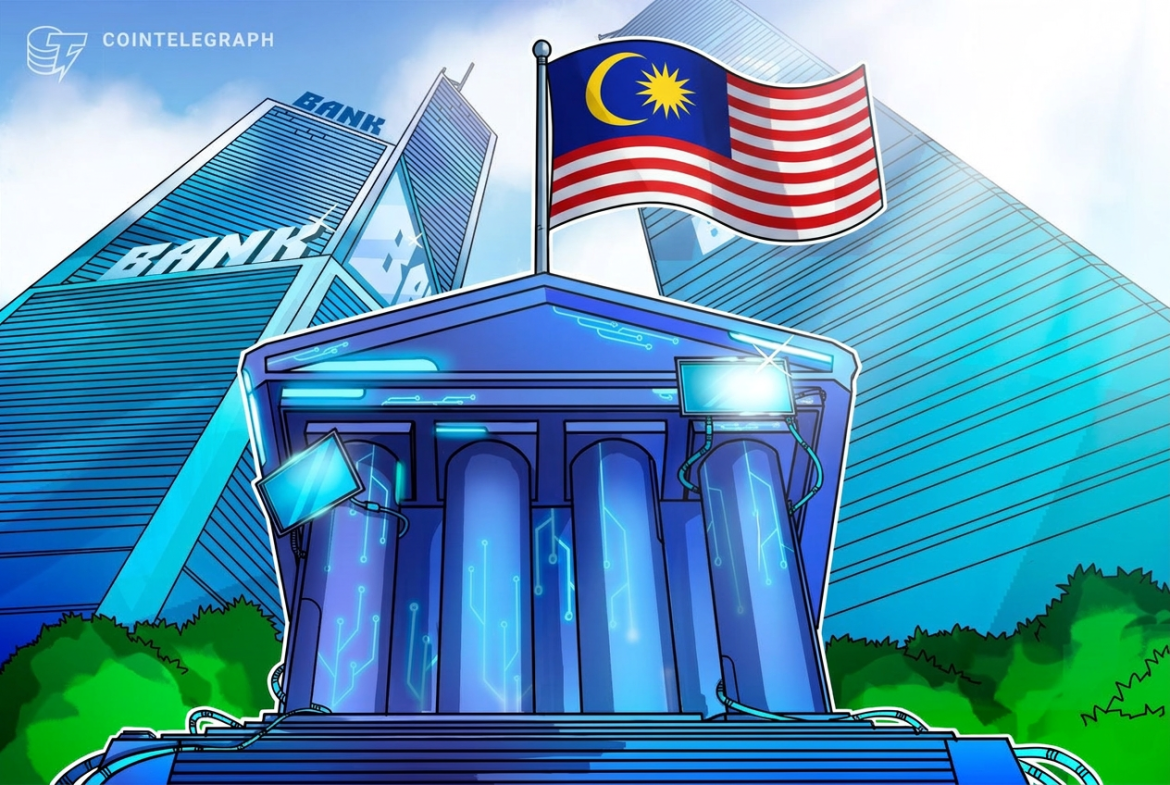
The platform tracks tokenized securities ownership and transfers, linking to Malaysia’s RENTAS+ system to settle corresponding payments in central bank money.

 Live Chat
The platform tracks tokenized securities ownership and transfers, linking to Malaysia’s RENTAS+ system to settle corresponding payments in central bank money.
Russia’s central bank has added Sberbank to its register of organizations authorized to exchange digital currencies, according to reports.
Sberbank was added to the list of digital depositories, which will keep a record of cryptocurrencies and digital rights, earlier this month.
Now, it joins eight other organizations on the exchange register, including state-controlled VTB, Russia’s second-largest bank, and T-Invest Lab, part of T-Technologies, which also owns online lender T-Bank, according to a Monday report from Interfax.
The announcement comes as Russia fast moves forward with Bitcoin-related regulation. Sberbank last month announced that it was the first in the country to have been approved to custody bitcoin.
The Bank of Russia gave it the green light for “digital currency record-keeping” and to facilitate the transfer of such assets, covering bitcoin and other, smaller cryptocurrencies.
“This status will allow the bank to provide services related to organizing the circulation of digital currency on interfaces which clients already use,” Sberbank was quoted saying in the news report.
A law on digital currencies and digital rights came into effect in Russia on September 1, creating a comprehensive legal framework for cryptocurrency circulation. Transactions involving cryptocurrencies can be conducted via the existing infrastructure of exchanges, brokers and trustees, and now also via crypto exchanges and digital depositories.
Cryptocurrency can be bought and sold via crypto exchanges, while the rights to these assets are recorded in digital depositories.
Banks and other organizations have been able to apply to the CBR for the corresponding licenses since October 5. Some existing players have simplified access to the market and can obtain licenses on a notification basis within just one day.
Under the new rules, unqualified investors will be able to buy bitcoin and other cryptocurrencies including stablecoins, within a limit of 300,000 rubles ($3,556) per year through one intermediary.
Qualified investors will have access to all cryptocurrencies traded on the exchange and over-the-counter markets.
Sberbank will debut its crypto wallet in December — the same month the Moscow Exchange will debut crypto trading.
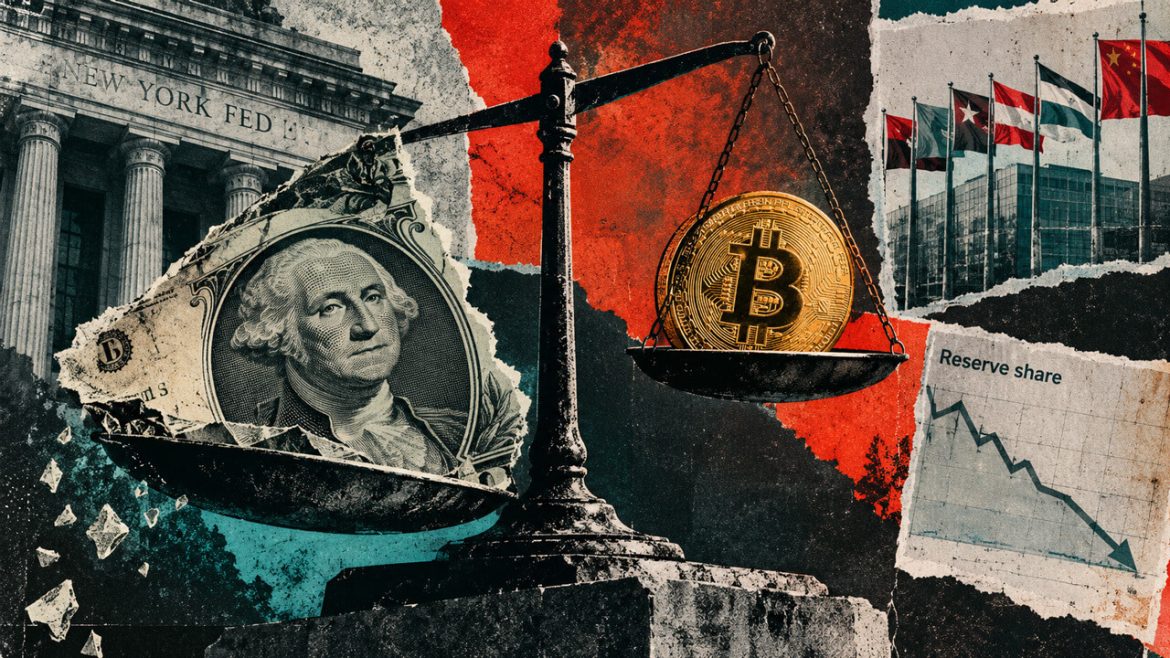
A Sept. 2, 2026 analysis by New York Fed researchers shows how a few large reserve portfolios can lower the global dollar share without a broad retreat from dollars. For investors assessing future sovereign demand for Bitcoin, the distinction is between a changing average and an investment decision.
Linda S. Goldberg, Oliver Hannaoui and Sneha Parthasarathy report that the dollar share of global official foreign-exchange reserves fell from 64% at year-end 2015 to 56% at year-end 2025, using IMF COFER data.
Their country-level evidence points to concentrated decisions and changes in reserve sizes.
Countries can change the currency mix of their portfolios, the “preferences” channel. Alternatively, their total reserves can grow or shrink, changing their weight in the global average.
When a country with a below-average dollar allocation accumulates reserves, it can pull down the worldwide dollar share without cutting its own allocation. Switzerland did that between 2015 and 2019: its reserve growth pushed the aggregate share down even as its own dollar allocation rose.
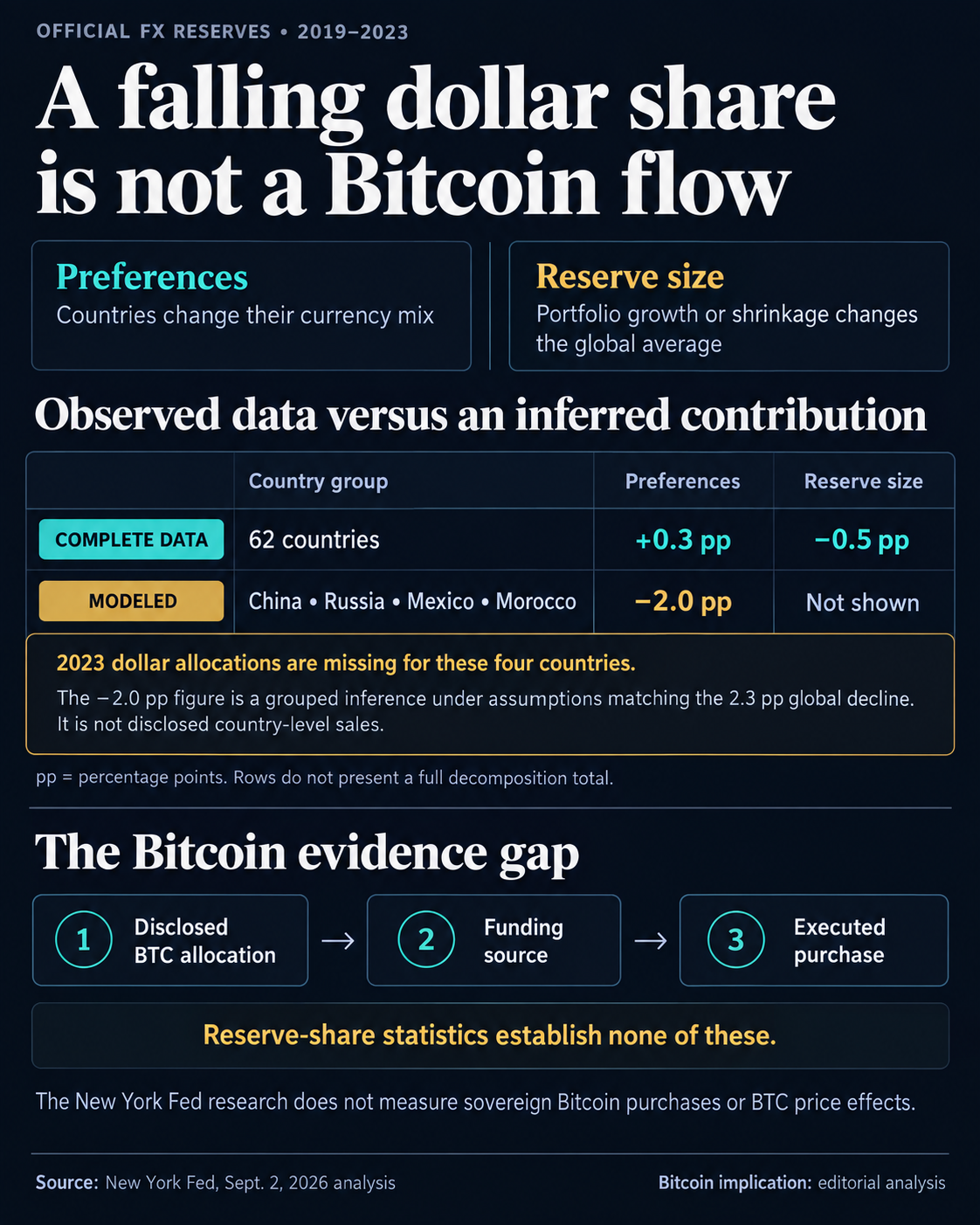
For that period, 76 countries had complete endpoint data within a 79-country exercise. Their preferences and reserve-size contributions declined by 1.2 and 1.5 percentage points, respectively.
For 2019-2023, the 62 countries with complete data contributed a positive 0.3 percentage point through preferences and a negative 0.5 percentage point through reserve-size changes.
China, Russia, Mexico and Morocco lacked 2023 dollar-allocation data. Under assumptions matching the observed 2.3-percentage-point global decline, the researchers inferred a combined negative 2.0-percentage-point preferences contribution for that group.
The underlying Staff Report 1087, issued in March 2024 and revised in February 2026, separates reserves needed for liquidity from an investment portion above those needs. Trade payments, foreign-currency debt, and currency stabilization sustain the need for liquid reserves.
The paper models that investment portion using short-term external debt or three months of imports as alternative measures of liquidity needs.
Diversification is more prevalent when reserves can satisfy those needs. Its earlier decomposition covers 2015-2020, while its broader country panel spans 1999–2023.
The distinction also applies when a central bank actually buys Bitcoin. On Nov. 13, 2025, the Czech National Bank announced a $1 million digital-asset test portfolio including Bitcoin, with a dollar stablecoin and tokenized deposit also part of the project.
The amount covered the whole portfolio, and the purchase was explicitly outside international reserves.
Applied to Bitcoin, the reserve research supports a limited inference: diversification beyond liquidity needs does not identify the money’s destination. Neither New York Fed source measures sovereign Bitcoin purchases or estimates a Bitcoin price effect.
A sovereign Bitcoin demand case needs separate evidence: a disclosed allocation, its funding source, and executed purchases, with official reserves distinguished from holdings outside them. A shrinking dollar share supplies none of those details.

Czech National Bank Governor Aleš Michl used a Bitcoin industry stage in Las Vegas to defend a reserve strategy that mixes strict inflation control with measured exposure to digital assets.
He described the bank’s move to add a small Bitcoin allocation as a way to raise expected returns without increasing overall portfolio risk.
Michl said that when he became governor in mid‑2022, inflation in the Czech Republic was near 20%. He told the audience that the central bank pledged to bring inflation back to 2% within two years and met that goal through discipline, not “magic.”
He said money had been too cheap for too long, the currency had weakened, and there was too much easy money in the system. The bank responded by supporting saving and strengthening the Koruna, and its rule now is “to stay hawkish forever.”
Alongside that stance, Michl highlighted the scale of the Czech National Bank’s balance sheet. He said the institution manages about 180 billion dollars in foreign exchange reserves, equal to roughly 44% of Czech GDP, and described those reserves as among the largest in the world relative to the size of the economy.
The task, he said, is to “build for the future,” think ahead, and invest in a way that protects the country. That has meant shifting away from low‑return bonds and increasing exposure to assets such as stocks and gold through low‑risk portfolios.
Michl said the next question for the bank was whether it could do more to build a stronger portfolio for the long run. That led to an internal debate over Bitcoin. He recalled first using Bitcoin to buy coffee in Prague and acknowledged that its price swings make it look risky, since its value can be higher one day and lower the next. He argued that other assets also move up and down and that the key issue for a central bank is how each asset behaves inside a broader portfolio.
According to Michl, Czech National Bank research found that Bitcoin has low long‑term correlation with many traditional reserve assets and does not move in the same way as them. Over longer horizons, he said, Bitcoin can provide returns that are not closely linked to other holdings. On that basis, the bank introduced a 1% Bitcoin position in its reserves.
In the bank’s analysis, he said, a 1% allocation lifts expected returns in Czech Koruna terms while leaving overall portfolio risk unchanged. “When you add Bitcoin to your portfolio it works better, returns go up and risk stays the same – that is diversification,” he told the audience.
Michl framed the move as part of a broader philosophy for central banking in an era of digital assets. His message to the crowd was to remain “conservative but innovative” in how institutions work and invest.
For the Czech National Bank, that has meant a strict anti‑inflation stance and a strong domestic currency, paired with a controlled experiment in using Bitcoin and other non‑traditional assets to strengthen reserves over time.

South Korea’s incoming central bank chief is a crypto-sceptic who could derail industry leaders’ and lawmakers’ hopes of launching won-pegged stablecoins.
So say media outlets in the East Asian nation, after President Lee Jae-myung nominated the Bank for International Settlements’ Monetary Economy Bureau chief Shin Hung-song for the governorship of the Bank of Korea on March 22.
“Won-denominated stablecoins are a shortcut to effectively neutralising existing foreign exchange regulations,” Shin said in August, South Korean news agency Yonhap reported. “By exchanging stablecoins for dollar-denominated cryptocurrencies on blockchain protocols, [South Korea] could open a channel for capital outflow.”
Some of South Korea’s biggest, stablecoin-keen firms have been left in the lurch for months as government officials talk up imminent stablecoin legislative developments.
Shin “will step back from his duties with immediate effect” following his selection as BOK nominee, the BIS wrote in a statement.
Observers are waiting to see if Shin will change his tune on stablecoins after taking the helm at the BOK, Yonhap wrote.
Lee made won-pegged stablecoin issuance a key manifesto issue ahead of his election last year. But so far, the BOK has resolutely stood in the way of his governing party’s attempts to launch legislation.
Unnamed industry insiders said it was “a matter of great interest” to see what stance he would take on stablecoins.
A BIS report, published last year, warned that “stablecoins do not fulfil the role of stable currency.”
“Due to a lack of regulation, they could pose risks to financial stability and monetary sovereignty,” the report’s authors wrote.
South Korea’s top tech firms want to issue won-denominated coins to help them boost cross-border trade.
But the BOK says that allowing them to do so could undermine its efforts to control fiscal policy.
Tim Alper is a News Correspondent at DL News. Got a tip? Email him at tdalper@dlnews.com.

Where bitcoin trades from here: Expect patience before the next leg higher.
Why precious metals matter: Gold’s rally reinforces bitcoin’s long-term case.
Central banks are circling, slowly: Interest is rising, but adoption is years away.
The $6.5 million bitcoin call: A long-term bet on monetary reality.
Zooming out: Volatility compression is key for institutions.
Final take: Short-term chop, long-term conviction.
Watch the full interview.

What is Bitcoin’s role in the global monetary system?
That question sparked a tense exchange between Coinbase CEO Brian Armstrong and French central bank governor François Villeroy de Galhau at the World Economic Forum in Davos, Switzerland this week.
“Bitcoin is the greatest accountability mechanism on deficit spending,” said Armstrong.
“If we lose public control over money, you lose a key function of democracy,” returned Villeroy.
The rapid-fire exchange between Armstrong and Villeroy de Galhau at Davos exposed a fundamental rift between Bitcoin hardliners and proponents of the existing system: who should control money in the 21st century?
At the core of the debate was the question of whether Bitcoin can coexist with — or directly replace — traditional fiat currencies controlled by central banks. A fiat currency is government-issued money, like the dollar or the euro, that derives its value from state decree.
The skirmish reflects a growing global tension over who should control money in an era of persistent inflation, rising debt, debasement fear, and the US’ increasingly frequent weaponisation of its financial dominance.
While policymakers in advanced economies continue to frame inflation as a temporary deviation from their stated target, hundreds of millions of people live under double-digit inflation, capital controls, or unstable currencies — conditions that make Bitcoin’s fixed supply and censorship resistance less ideological and more practical.
Defenders of the existing financial system, meanwhile, counter that government-issued money is designed to be flexible. Central banks exist to manage crises, stabilise economies, and act as lenders of last resort, all of which are roles that a rules-based protocol cannot perform.
For Armstrong, Bitcoin has plenty of good to serve people who struggle financially around the world.
“Bitcoin is good as a check and balance on deficit spending because when there is a lack of trust or people are worried about inflation — maybe in places like Argentina or Turkey or Nigeria — they are going to flee to the thing that they believe is going to store value more,” Armstrong said.
In Argentina, the country recorded a 31% inflation rate in 2025. Still high, it’s a considerable drop from the nation’s hyperinflationary experience before President Javier Milei took office in 2024.
Turkey’s inflation rate came in at around 30% in 2025, while Nigeria had a 15% inflation rate.
With their ability to issue money as they please, those figures are likely to remain high — and damaging to citizens, Armstrong argued.
“Bitcoin doesn’t have a money printer. The supply is fixed and people will go to it in times of uncertainty kind of like they did with gold,” Armstrong said.
Villeroy rejected the premise entirely.
“I am a bit sceptical about this idea of the Bitcoin standard,” Villeroy said. “We left the gold standard. But the gold was only a technical mean. What is important is that monetary policy and money is part of society and we live in democracies and I think the public role is key.”
He warned that losing public control over money threatens democratic governance.
“Sorry to say that I trust more independent central banks with a democratic mandate than private issuers,” Villeroy said.
Villeroy failed to point out one minor detail: around the world, governments are attempting to put pressure on central banks, weakening that independence he referred to.
Take the US. President Donald Trump has repeatedly tried to goad Federal Reserve chair Jerome Powell into resigning in order to install someone who will push to lower interest rates more aggressively.
But Armstrong quickly corrected him: “Bitcoin is a decentralised protocol. There’s actually no issuer of it. There’s no country or company or individual who controls it in the world.”
He then turned Villeroy’s independence argument against him.
“In the sense that central banks have independence, Bitcoin is even more independent,” Armstrong said.
Pedro Solimano is aDL News’markets correspondent based in Buenos Aires.Got a tip? Email them atpsolimano@dlnews.com.
The US Department of Justice has charged a man for allegedly laundering $1 billion in criminal funds, using USDT on the Tron blockchain to help him do so.
Feds said in a statement that Venezuelan national Jorge Figueira, 59, allegedly made the transactions in “a scale of criminal conduct that poses a profound threat to financial systems and public safety.”
Court documents unsealed this month allege that Figueira’s cryptocurrency of choice was Tether’s USDT stablecoin, which he used to receive huge payments in digital tokens before converting them via liquidity providers into US dollars.
“Let me be clear with you, [USDT] is used a lot for laundering money,” Feds quoted Figueira saying in a phone call.
“It is used for what we are doing,” he continued. “It is used to transfer money in a quick way, even to make it get to jurisdictions that have some type of issues, etcetera,” he added, using China as an example.
Feds allege in court documents that blockchain analysts found the illicit money movements were made using the Tron blockchain — the crypto network founded by entrepreneur Justin Sun.
USDT, the most-traded digital asset, runs on a number of blockchains but transactions on Tron are faster and cheaper than other networks.
Figueira allegedly made many transactions to a number of crypto wallets before using liquidity providers to then convert the crypto to cash for American bank accounts.
But using USDT or other cryptocurrencies to launder money is nothing new, FBI Special Agent Stephen A. Walker said in the affidavit.
“The cryptocurrency ecosystem is often used by money launderers to receive money, and to launder it quickly, anonymously, and at scale,” Walker testified.
Walker added that “a series of convoluted transactions and quick swaps between financial accounts, whether traditional bank accounts or cryptocurrency wallets” often shows that money movements are being obfuscated.
Figueira allegedly received huge transfers for crooks, with feds quoting him boasting that he and his associates would manage sometimes up to $700 million per month, sending funds all over the world — from Colombia to China.
Court documents added Figueira allegedly said he could receive $100 million in a single transaction with his digital wallet.
The Justice Department said it had identified approximately $1 billion that moved through digital wallets used by Figueira and his operation to individuals and businesses throughout the world.
Figueira now faces up to 20 years in prison if convicted of conspiracy to launder money, the Justice Department said.
The Justice Department did not immediately respond to further questions from DL News.
DL News reached out to Tron’s press department for comment.
Mathew Di Salvo is a news correspondent with DL News. Got a tip? Email at mdisalvo@dlnews.com.


