On Wednesday, Senate Republicans released the proposed text for the CLARITY Act, which has been met with pushback from Democrats regarding ethics provisions.

 Live Chat

On Wednesday, Senate Republicans released the proposed text for the CLARITY Act, which has been met with pushback from Democrats regarding ethics provisions.

Phong Le, President and CEO of Strategy, the world’s first and largest Bitcoin treasury firm, said Morgan Stanley’s proposed bitcoin ETF could unlock as much as $160 billion in demand under a modest portfolio allocation scenario.
“Morgan Stanley Wealth Management oversees about $8 trillion in AUM and recommends 0–4% bitcoin allocation,” Le wrote on X. “A 2% allocation would represent $160 billion, about three times the size of IBIT. MSBT: Monster Bitcoin.”
In other words, Le is saying that even a modest 2% bitcoin allocation across Morgan Stanley’s $8 trillion wealth platform could drive about $160 billion into bitcoin, far exceeding the size of existing ETFs like BlackRock’s iShares Bitcoin Trust.
The comment landed as Morgan Stanley advanced plans for its own spot BTC ETF, revealing new details in a filing with the U.S. Securities and Exchange Commission. The fund would trade under the ticker MSBT, a symbol that Le cast as shorthand for the potential scale of institutional demand.
Morgan Stanley’s amended S-1 outlines a structure familiar to the growing class of spot BTC ETFs. The trust is set to list on NYSE Arca with a 10,000-share creation unit and an initial seed basket of 50,000 shares, expected to raise about $1 million. The bank also disclosed it purchased two shares earlier this month for audit purposes.
Key service providers mirror those used across the ETF ecosystem. BNY Mellon will act as cash custodian, administrator, and transfer agent, while Coinbase is set to serve as prime broker and custodian for the fund’s bitcoin.
The product would hold BTC directly, aligning with the structure that has defined the current wave of the U.S.-listed spot ETFs.
Le’s framing points to a larger question that sits beyond the mechanics of the filing: how much capital wealth managers may allocate if BTC becomes a standard portfolio component. Morgan Stanley Wealth Management, with trillions in client assets, has signaled that bitcoin exposure can range from zero to four percent depending on client profile.
Even a midpoint allocation, as Le noted, would imply flows that exceed the size of existing flagship products such as iShares Bitcoin Trust.
So far, adoption has moved in stages. Since spot BTC ETFs launched in 2024, the category has attracted more than $50 billion in inflows, driven in large part by self-directed investors. Within advisory channels, uptake remains uneven, shaped by internal policies, risk models, and client demand.
Morgan Stanley has already taken steps in that direction, allowing brokerage clients to access spot BTC ETFs and widening availability over time. The MSBT filing suggests a shift from distribution toward ownership of the product itself, a move that could deepen the bank’s role in the market if approval is granted.
The SEC has not provided a timeline for a decision, and approval is not assured. Still, the application marks a notable development: a major U.S. bank seeking to issue its own spot bitcoin ETF in a market it once approached with caution.

Start every day with the top news stories right now, plus original features, a podcast, videos and more.

As stablecoins continue to gain worldwide momentum, the International Monetary Fund (IMF) has called for global cooperation to avert potential macro financial stability risks related to the rapidly growing sector and to turn the industry “into a force for good.”
On Thursday, the IMF released a 56-page report discussing the growing influence of stablecoins, their potential use cases in mainstream financial markets, and the risks associated with the sector’s varying oversight.
Amid the sector’s rapid growth, the organization highlighted that the two largest stablecoins, USDT and USDC, have tripled their market capitalization since 2023, reaching a combined $260 billion. Meanwhile, their trading volume has increased by around 90% to $23 trillion in 2024, with Asia surpassing North America in stablecoin activity volume.
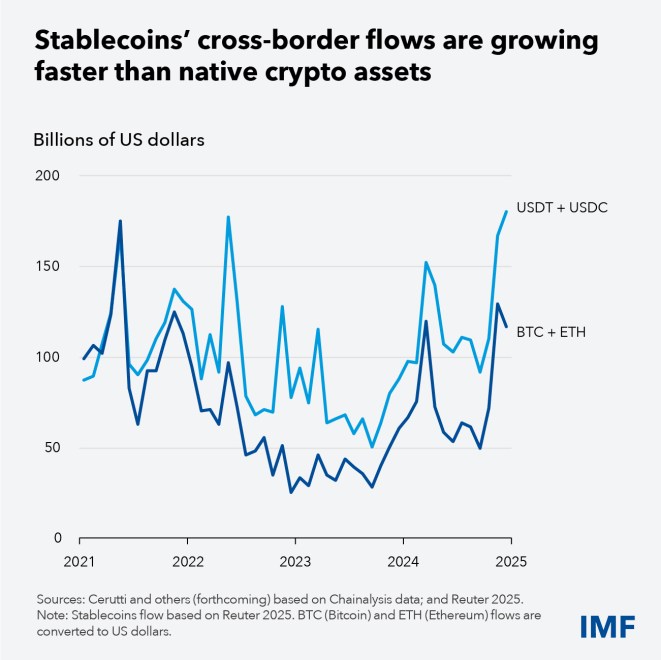
USDT and USDT cross-border flows over the years. Source: IMF
The IMF noted two major potential benefits from stablecoins. First, they could enable faster and cheaper cross-border payments, especially for remittances, which can cost 20% of the amount being sent and face some delays.
However, “being a single source of information, blockchains can greatly simplify the processes linked with cross-border payments and reduce costs,” the Fund’s economists explained in a blog post.
Second, stablecoins could expand financial access, driving innovation by increasing competition with established payment service providers, therefore, making retail digital payments more accessible to underserved customers.
They could facilitate digital payments in areas where it is costly or not profitable for banks to serve customers. Many developing countries are already leapfrogging traditional banking with the expansion of mobile phones and different forms of digital and tokenized money.
Notably, competition with already established providers could lower costs and lead to enhanced product diversity, “leveraging synergies between digital payments and other digital services.”
Despite their potential benefits, stablecoins also carry significant risks, the IMF explained, including de-pegging and collapsing if the underlying assets lose value or if users lose confidence in the ability to cash out. Per the report, this could also trigger fire sales of the reserve assets and disrupt financial markets.
Stablecoins could also accelerate a “currency substitution” dynamic, where individuals and companies abandon their national currency in favor of a foreign one, like US dollars or euros, due to instability or high inflation.
The organization noted that the dynamic decreases a country’s central bank’s ability to control its monetary policy and serve as the lender of last resort, damaging the financial sovereignty of affected nations.
In addition, the potential to reduce cross-border frictions and make faster and cheaper transactions could be undermined by a lack of interoperability if various networks are unable to connect or are restricted by different regulations and other hurdles.
“Stablecoin regulation is in its infancy, so the ability to mitigate these risks remains uneven across countries,” the organization affirmed, noting that “the IMF and the Financial Stability Board have issued recommendations to safeguard against currency substitution, maintain capital flow controls, address fiscal risks, ensure clear legal treatment and robust regulation, implement financial integrity standards, and strengthen global cooperation.”
As reported by Bitcoinist, the FSB vowed in October to address the evolving threats from private finance and the growing use of stablecoins, promising to increase the global watchdog’s policy response and overhaul its surveillance system to make it more flexible and quicker.
Nonetheless, major jurisdictions have taken different stances in key areas, as the IMF detailed, which could result in the exploitation of gaps between jurisdictions and issuers to locate where oversight is weaker.
All this underscores the need for strong international cooperation to mitigate macrofinancial and spillover risks (…). Tokenization and stablecoins are here to stay. But their future adoption and the outlook for this technology are still mostly unknown.
The organization concluded that “improving the existing global financial infrastructure might be easier than replacing it. Achieving the best possible balance will require close cooperation among policymakers, regulators, and the private sector.”
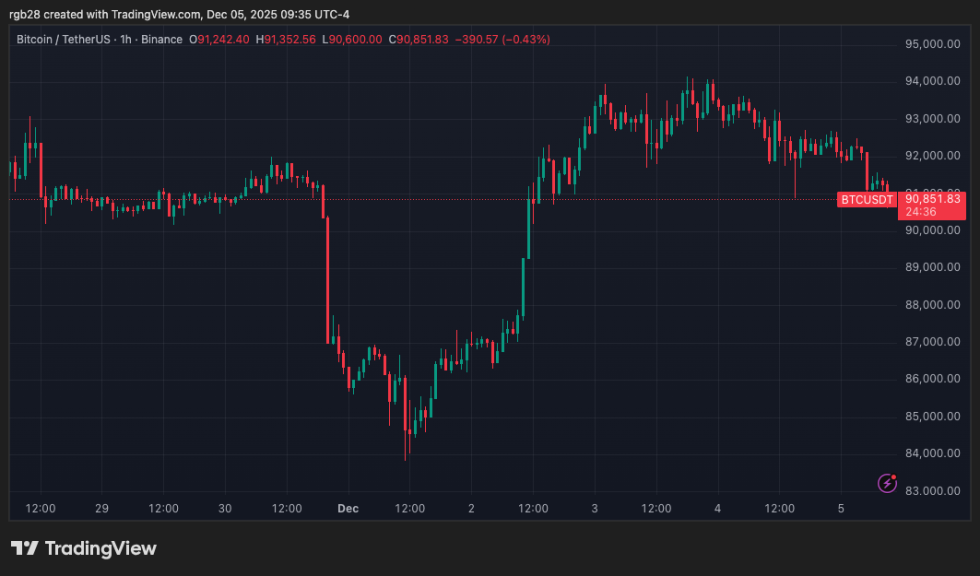
Bitcoin (BTC) trades at $90,851 in the one-week chart. Source: BTCUSDT on TradingView
Featured Image from Unsplash.com, Chart from TradingView.com

Editorial Process for bitcoinist is centered on delivering thoroughly researched, accurate, and unbiased content. We uphold strict sourcing standards, and each page undergoes diligent review by our team of top technology experts and seasoned editors. This process ensures the integrity, relevance, and value of our content for our readers.

UFC star Conor McGregor criticized former rival Khabib Nurmagomedov for his non-fungible token (NFT) drop on Telegram, which featured digital “papakhas” — a traditional hat worn in Nurmagomedov’s native country of Dagestan.
“There is just no way good guy Khabib used his late father’s name, as well as Dagestan’s culture, to scam his fans and fire sell a bunch of digital NFTs online,” McGregor wrote in a now-deleted X post.
Onchain sleuth ZachXBT responded to McGregor, pointing out that McGregor attempted to launch his own celebrity memecoin in April called REAL. ZachXBT said:
“There is just no way good guy McGregor used his reputation, as well as Irish culture, to scam his fans and fire sell a bunch of digital tokens online and then delete all of the posts after they were sold, leaving his fans robbed of their money?”
McGregor’s REAL token was offered to prospective buyers in a sealed-bid auction to prevent snipers and automated trading bots from manipulating prices at launch. It featured staking rewards for holders, but it only managed to raise 39% of its target launch goal.
The funds that were raised were refunded to participants following the failed launch, according to McGregor. The failure of the token was due to multiple factors, including a broad downturn in the crypto market at the time and a memecoin bear market.
Related: NFT and memecoin markets recover after month-long crypto slump
Memecoins were one of the hottest narratives and best-performing sectors in the crypto market in 2024. However, the parabolic run enjoyed by memecoins came to a screeching halt in 2025.
The decline of memecoins followed several high-profile launches that plummeted in value almost immediately after launch or were characterized as a rug pull, including projects endorsed by US President Donald Trump and Argentina’s President Javier Milei.

Memecoins fell to a market cap of $39.4 billion on Friday, reaching the lowest level on record in 2025 and shedding up to $5 billion in one day, according to CoinMarketCap.
Magazine: Memecoins: Betrayal of crypto’s ideals… or its true purpose?


