The first reserve-yield payment awaits transfer to the Assistance Fund, adding buyback funding tied to USDC balances rather than trading volume…. Read the full story at The Defiant

 Live Chat
The first reserve-yield payment awaits transfer to the Assistance Fund, adding buyback funding tied to USDC balances rather than trading volume…. Read the full story at The Defiant
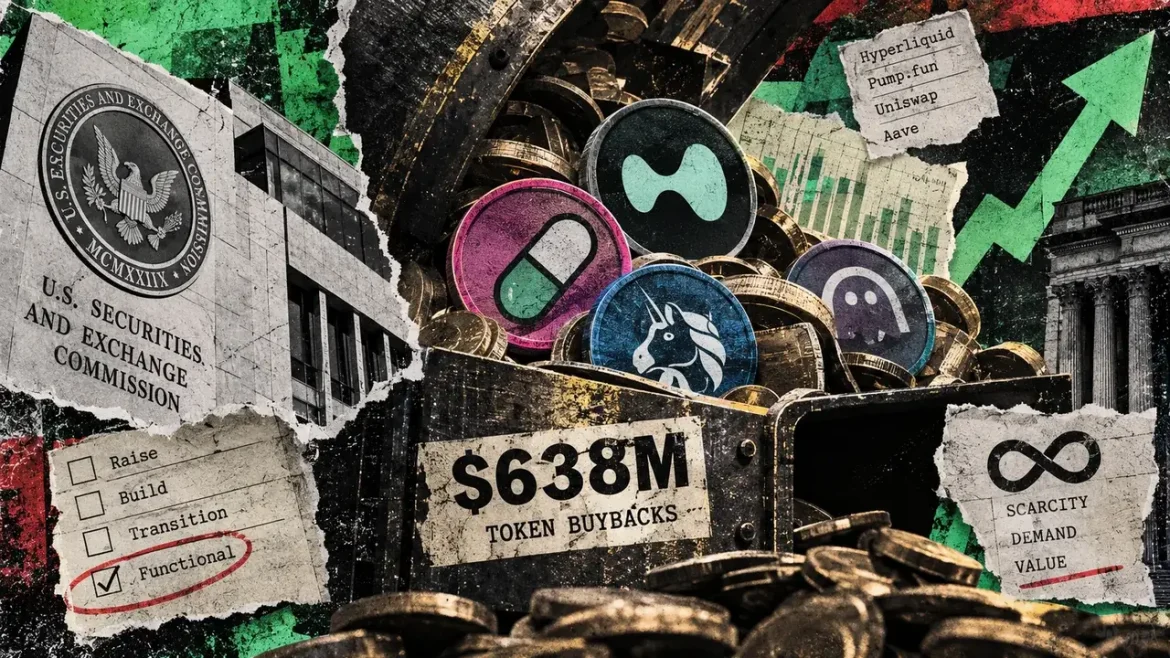
Crypto projects spent about $638 million with token buybacks through late August 2026, according to Allium Labs data.
That is already a record, up from $545 million over the same stretch of 2025. Hyperliquid accounted for roughly $370 million and Pump.fun for about $200 million, together close to 90% of the total.
On Sept. 25, staff at the Securities and Exchange Commission (SEC) addressed the legal tension that has shadowed those programs since they began. The more openly a project ties its token to business returns, the easier it becomes to argue that holders are investing in a security.
The SEC’s Division of Corporation Finance addressed buybacks in a new set of crypto FAQs covering networks that are already functional.
Staff said an issuer’s buyback announcement for a non-security crypto asset on such a network falls outside the promises of “essential managerial efforts” at the center of the Howey test for investment contracts.
The same answer warns younger projects that on a network yet to reach functionality, pitching a buyback as a source of yield or returns can feed into an investment-contract analysis.
The answer rests on two built-in assumptions, a functional system and a token that already sits outside securities law, and it carries the weight of staff views, which the SEC describes as lacking legal force.
Under the agency’s March interpretation, a network counts as functional when its native token can be used according to its programmed utility.
The SEC’s March interpretation says a token can be sold as part of an investment contract while a team raises money against promises of managerial work. That contract can end once buyers stop expecting profits from those promised efforts.
The pending Regulation Crypto Assets proposal would let projects raise up to $5 million over four years under a startup exemption. A larger fundraising exemption would allow up to $75 million every 12 months, with disclosure requirements attached to both.
Proposed Rule 400 adds a transition filing, the Form TR, in which an issuer certifies on EDGAR that it has completed or permanently ceased its promised managerial efforts and stopped making new ones.
The issuer files it directly, and the agency could later contest whether the conditions were met. In its paperwork estimates, the SEC assumes about 475 issuers a year could rely on that safe harbor, based on 15% of the roughly 3,165 projects launched in 2024. Comments on the proposal close Oct. 20.
Put together, the pieces sketch a path from securities-regulated fundraising to a mature network that can spend real revenue on its own token. The Form TR covers projects that abandoned their roadmaps as well as those that finished them, while the buyback FAQ applies only once a network is functional.
That structure rewards teams that define their build as a finite list of milestones they can eventually complete, and it discourages marketing that frames buybacks as returns before the product works.
| Stage | Regulatory position | What the project can do | Key constraint |
|---|---|---|---|
| Raise | Token sold as part of an investment contract | Raise capital against promised managerial work | Securities-law obligations attach to the fundraising arrangement |
| Build | Promised essential managerial efforts continue | Develop network and deliver disclosed milestones | Marketing returns or buybacks can contribute to Howey analysis |
| Transition | Promised efforts completed or permanently ceased | Proposed Form TR documents the transition | SEC can later challenge whether conditions were actually satisfied |
| Functional network | Token can perform its programmed utility | Operate without the original investment contract necessarily continuing | Token’s status still depends on facts and circumstances |
| Mature buybacks | SEC FAQ assumes a functional network and non-security token | Announce revenue-funded token repurchases | Buyback announcement alone is not an essential-managerial-efforts promise |
Pump.fun says half its revenue goes to buying and permanently burning PUMP. Its dashboard shows roughly $500 million in annualized revenue, about $462.5 million in cumulative purchases, and 167.7 billion tokens destroyed, equal to 16.8% of the original supply.
At the current run rate and allocation, that implies around $250 million in annual purchases,
about 6.4% of Pump.fun’s displayed $3.91 billion fully diluted valuation. The figure measures purchasing power against valuation, with the cash going into open-market token purchases.
Hyperliquid has bought and burned roughly $1.3 billion of HYPE since launch, and its documentation says more than $1 billion in annualized fees now flows into programmatic HYPE purchases.
Uniswap switched on protocol fees on Ethereum mainnet in December 2025 and has since extended them to other chains, with outside searchers collecting accumulated fees only by burning UNI in exchange.
Hyperliquid funds staking rewards from a reserve of future emissions even as trading fees burn HYPE. A protocol that burns 5% of supply while issuing 8% through emissions and unlocks ends up diluting holders despite a large headline buyback.
A more useful measure for these tokens is net burns against new issuance before comparing the result to valuation.
Aave’s program shows how quickly treasury needs can override a buyback. It acquired more than 205,000 AAVE, about 1.28% of supply, for roughly $42 million in its first ten months.
Governance then debated cutting the annual budget from $50 million to $30 million as revenue softened. The DAO paused purchases on April 19, after the rsETH bridge incident, to preserve balance-sheet flexibility.
Crypto’s record remains small next to Wall Street, where S&P 500 companies spent $1.02 trillion on repurchases in the 12 months through September 2025. The growth pace sets crypto apart, rising from about $366,000 in 2024 to $638 million in under eight months of 2026, with mechanisms that automatically convert revenue into market purchases.
| Protocol | Buyback / burn mechanism | Scale cited in article | What can offset or interrupt it |
|---|---|---|---|
| Pump.fun | 50% of revenue allocated to open-market PUMP purchases and permanent burns | ~$500M annualized revenue; ~$462.5M cumulative purchases; 167.7B PUMP destroyed | Revenue declines; future token issuance/unlocks |
| Hyperliquid | Trading fees fund programmatic HYPE purchases and burns | ~$1.3B bought and burned since launch; >$1B annualized fees flowing toward purchases | Staking rewards and future emissions can offset supply reduction |
| Uniswap | Protocol fees accumulate; searchers obtain assets by burning UNI | Fee mechanism active since Dec. 2025 and expanded across chains | Governance controls fee deployment and future mechanism |
| Aave | Treasury-funded open-market AAVE purchases | >205,000 AAVE / ~$42M in first ten months | Treasury needs; program paused after rsETH incident |
The rights attached to these tokens remain thin. Uniswap’s documentation says value reaches UNI holders through the burn mechanism and whatever future mechanisms governance approves, with protocol revenue staying under the protocol’s control.
The SEC’s March interpretation describes digital commodities as assets whose holders lack any inherent right to passive yield, future income, or profits. A buyback can reduce supply and create steady demand, and governance can redirect or pause it at any point.
The same distance from securities law that makes a mature token easier to trade also keeps it apart from the cash flows investors use to value it.
Bitcoin, which the SEC lists as a digital commodity, runs without an issuer or protocol revenue to recycle, so revenue multiples and buyback ratios apply to tokens like HYPE, PUMP and UNI.
If the SEC finalizes Regulation Crypto Assets close to its current form, teams can raise money under the exemptions, write finite roadmaps, file transition reports, and steer revenue into token purchases once their networks work.
Hyperliquid’s fee flows and Pump.fun’s allocation alone point to industry buybacks above $1 billion a year at current run rates. Revenue and dilution-adjusted buyback yield would become standard tools for valuing protocol tokens.
| Feature | Public-company shareholder | Mature protocol token holder |
|---|---|---|
| Ownership claim | Equity ownership in corporation | Generally no ownership of protocol/company merely from holding token |
| Right to profits | May receive distributions if declared; residual corporate rights defined by securities/corporate law | No inherent right to future protocol income or profits |
| Buyback effect | Company purchases outstanding shares | Protocol/DAO purchases or burns tokens, potentially reducing supply or adding market demand |
| Guaranteed buybacks? | No | No |
| Who can change the program? | Board/company subject to corporate and securities-law constraints | Governance, protocol rules or other authorized actors depending on design |
| New issuance can offset purchases? | Yes, through new share issuance/compensation | Yes — emissions, incentives and unlocks can overwhelm burns |
| Claim on underlying revenue | Share represents equity rights in the company | Buyback-linked token may have no contractual claim on the revenue funding purchases |
| Useful valuation metric | Earnings, free cash flow, buyback yield, dilution | Protocol revenue, gross buybacks and net issuance/dilution |
If the proposal stalls or emerges in weaker form, the nonbinding staff FAQ becomes the main source of comfort, and projects would keep return language out of their marketing while treating buybacks as discretionary.
Revenue-linked programs shrink mechanically when revenue falls, and a major exploit or bad-debt event could push other treasuries to conserve funds the way Aave did. Holders would then find that a buyback resembles a shareholder return in its market effect while remaining revocable, governance-dependent, and free of any contractual claim.
The SEC is building a route for crypto networks to spend their revenue on their tokens. Holders at the end of that route own an asset tied to a business’s success through scarcity and demand, while the business’s revenue stays with the protocol.
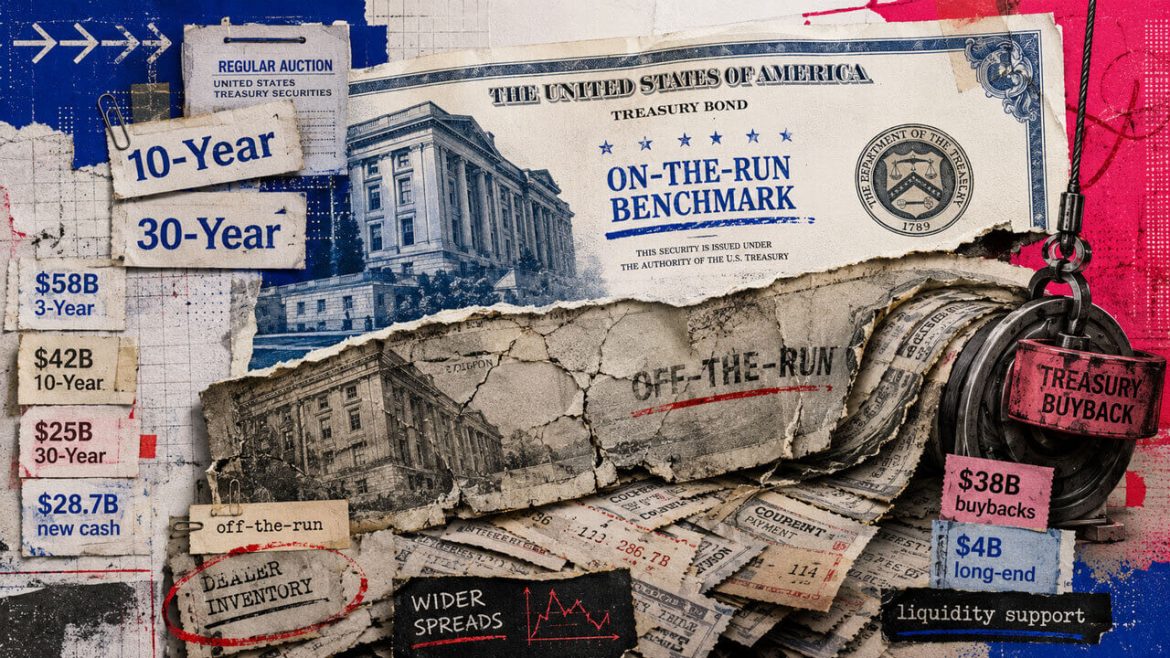
The US Treasury expects to borrow $739 billion from July through September while paying investors to hand back some of its older bonds. The pairing looks self-defeating because both transactions involve the same issuer. However, they are on separate ledgers and solve separate problems: auctions finance the government and create liquid benchmarks, while buybacks retire selected old issues or help Treasury manage its cash balance.
Treasury’s Aug. 3 borrowing estimate assumes a $950 billion cash balance at the end of September, then projects another $628 billion of borrowing from October through December. Its August refunding statement authorized as much as $38 billion of liquidity-support purchases and $25 billion of short-dated cash-management purchases during the current quarter.
Treasury widened the program on Aug. 19, lifting the maximum size of each buyback in the 10-to-20-year and 20-to-30-year sectors from $2 billion to at least $4 billion for operations from Sept. 9 through Nov. 4.
The announcement kept the regular auction schedule intact and confirmed that purchased debt will generally be replaced through new issuance, giving the government room to sell and buy bonds during the same financing cycle. Because the expansion came later, the earlier $38 billion quarterly figure isn’t a final ceiling for long-end purchases.
Treasury sells bills, notes, bonds, floating-rate notes, and inflation-protected securities to fund the gap between federal receipts and spending, refinance maturing debt, and maintain its cash balance. Bills mature within a year and are generally sold at a discount, while notes and bonds usually pay interest every six months across maturities from two to 30 years. “Coupon” is the old name for that periodic interest payment, inherited from the paper certificates whose interest slips investors once clipped by hand.
An auction can introduce a new security or reopen an existing one, with competitive bids establishing the market-clearing yield and price. A new 10-year note receives a fresh CUSIP and becomes the current benchmark, while a reopening adds supply to that same security at a later auction. The August refunding, for example, comprised a $58 billion three-year note, a $42 billion 10-year note and a $25 billion 30-year bond, producing $28.7 billion of new cash once maturing securities were accounted for.
The newest security in a maturity bucket becomes the on-the-run issue, usually trading more frequently and at tighter bid-ask spreads than comparable older bonds. Traders and institutions use it for hedging and price discovery, giving Treasury a reason to keep benchmark auctions large and predictable even when its cash balance can support buybacks.
Once a new security replaces it, the previous benchmark becomes off-the-run while retaining the same federal guarantee and scheduled payments. Trading migrates toward the fresh issue and the pool of natural buyers narrows, leaving dealers to use more balance-sheet capacity when they warehouse the older bond. Investors can then face a wider selling spread, and small price gaps can open between securities with nearly identical interest-rate exposure.
Across a debt market measured in tens of trillions of dollars, small trading frictions become expensive when volatility consumes dealer capacity, and investors crowd into the newest issues. An old Treasury can retain the same credit quality and cash flows while becoming inconvenient to sell, which is why a liquidity-support buyback gives dealers and other holders a regular outlet for selected off-the-run supply.
Treasury announces an eligible maturity bucket and a maximum purchase amount before each operation, then approved counterparties submit competitive offers through FedTrade, with the New York Fed acting as Treasury’s fiscal agent. Sellers specify the security and price, and Treasury evaluates those offers using market prices and relative value across eligible issues, according to its buyback guidance.
It can accept less than the published maximum when prices look unattractive, preserving the discipline of an auction rather than guaranteeing every seller an exit.
Liquidity-support operations focus on older coupons whose trading can benefit from a regular buyer, with Treasury retiring accepted securities as scheduled auctions keep building the current benchmarks. Josh Frost, then Treasury’s assistant secretary for financial markets, described the program as a tool for ordinary market functioning that can reduce fragmented supply and free dealer capacity between operations.
Cash-management buybacks address a different problem because tax receipts, spending, maturities, and auction settlements arrive in uneven waves.
Treasury can buy securities that are close to maturity when its cash balance would otherwise run higher than desired, smoothing upcoming redemptions and giving debt managers more control over near-term cash needs. That flexibility also reduces the need for abrupt bill-auction adjustments around large payment dates.
Treasury’s own borrowing estimates exclude a large net effect from the program because every repurchased dollar has to be financed somewhere else, all else equal. If Treasury sells $100 billion of new securities to private investors and buys back $4 billion held by private investors, privately held debt has increased by $96 billion. Reaching a $100 billion net borrowing target alongside that purchase would require roughly $104 billion of gross issuance.
That also lets sales and purchases expand together because the Treasury can deepen a current benchmark, remove a slice of older supply and still raise the net cash in its financing plan. The federal deficit determines the net financing need, while buybacks alter the age, composition, and maturity profile of debt held by the public.
Auction proceeds and buyback payments pass through the Treasury General Account, the federal government’s operating account at the Fed. When private buyers settle a Treasury auction, money moves toward the TGA and reserve balances in the banking system generally decline, all else equal. Federal spending and Treasury buybacks send funds back toward private accounts, generally adding reserves along the way.
The Fed’s Aug. 27 H.4.1 release showed the TGA averaging $950.7 billion during the week ended Aug. 26 and standing at $959.4 billion on Wednesday, while reserve balances averaged $2.92 trillion. Treasury expects the account to finish September near $950 billion, reach roughly $1.05 trillion, plus or minus $50 billion, in late October and settle near $850 billion at year-end.
A $4 billion buyback can therefore put cash into sellers’ hands on settlement day, and a larger auction can pull cash toward the TGA on another day. Taxes and federal outlays add more movements, so the reserve path depends on the full calendar rather than the headline maximum attached to one operation. Timing can loosen or tighten dollar availability for several days even when the quarter’s net borrowing estimate barely moves.
The source of the money separates Treasury buybacks from quantitative easing because the Fed creates reserve balances when it purchases securities for its own portfolio, adding reserves to its liabilities and bonds to its assets. Treasury spends an existing TGA balance and replenishes that balance through taxes or debt sales, while repurchased securities are retired instead of joining a monetary-policy portfolio.
Those balance sheets give the two programs different effects because removing off-the-run duration can free dealer capacity, narrow relative-value gaps, and make long bonds easier to transact, while surrounding Treasury issuance can absorb cash and add duration elsewhere. Accepted offers, auction demand, settlement dates and maturity buckets determine the combined result.
Treasury preserves that two-sided structure because shrinking benchmark auctions whenever cash-management needs fluctuate would make issuance less predictable, fragment current securities, and risk higher financing costs over time. Regular auctions give investors dependable supply, while selective purchases let debt managers address older pockets of inventory without rebuilding the entire calendar around temporary cash swings.
Long-dated bonds are the most price-sensitive securities in the regular auction schedule, and warehousing them consumes more dealer risk capacity when yields move sharply. Older 20- and 30-year issues can linger once demand concentrates in a fresh benchmark, so doubling the per-operation ceiling gives Treasury more room to buy attractive offers while retaining the option to stop below the cap.
Treasury’s formal objective is ordinary market functioning, and the agency hasn’t announced a target for long-term yields. Purchases can still affect relative prices at the margin because they remove duration from selected issues and give dealers another buyer, which makes intent and market effect separate parts of the analysis. A $4 billion operation can ease a local pocket of illiquidity, while its scale stays small beside a Treasury market measured in tens of trillions of dollars.
For Bitcoin, the connection runs through reserve availability, long-term yields, collateral markets, and dealer capacity, all of which influence the cost of carrying risk across asset classes. CryptoSlate has tracked how Treasury yields can transmit stress into Bitcoin, and buybacks enter that channel by easing selected bond inventories while auctions move cash toward the TGA.
A well-received long-bond buyback could ease a local dislocation and lower one source of cross-market strain, while a heavy auction week or a rapid TGA build could absorb cash at the same time. Bitcoin can benefit when yields settle and dollar availability improves, though the size and timing of those effects have to be measured across the whole financing schedule. Treating every purchase ceiling as an equal injection assigns the program a power its funding mechanics don’t provide.
The larger long-end operations begin Sept. 9, and the next quarterly refunding announcement arrives Nov. 4. Accepted purchase amounts, offered prices, demand for the new benchmarks, and the TGA path around settlement will show how much Treasury has improved trading in old bonds while continuing to finance the government through new ones.

Ethereum-focused digital asset treasury firm ETHZilla (ETHZ) on Froday sold about $40 million ether from its treasury, so far using some of the cash to repurchase shares of its own stock, the company said on Monday.
Since the sale on October 24, the firm bought back around 600,000 shares for roughly $12 million. The repurchases are part of a broader $250 million buyback plan approved by its board.
The firm said it plans to continue with repurchases with the remaining cash raised. Furthermore, it intends to continue selling ETH to fund more buybacks “until the discount to NAV is normalized.”
For now, the firm still holds around $400 million in ETH.
Interestingly, the ETH sales made Friday likely were made in the $3,900 area — ETH subsequently rose throughout the weekend, trading as high as $4,250 overnight before pulling back to the current $4,150. So while the timing of the ETH sales may not have been ideal, the repurchase effort will surely send a warning to sellers of the stock to be careful getting short at any substantial discount to NAV.
ETHZ shares rallied 14.5% Monday alongside a major rally in the beaten-down digital asset treasury sector. The stock’s higher by another 12% in after hours trade following the buyback announcement.
The maneuver underscores the ongoing pressure digital asset treasuries face. Many stocks are now trading below the net asset value (NAV) of their underlying holdings as their stock prices plunged over the past months, limiting their ability to raise funds to expand their crypto holdings. ETHZ cratered as much as 90% from its August peak, and traded at a 30% discount to its NAV, Blockworks data shows.
“By opportunistically repurchasing shares while our stock is trading below NAV, we plan to reduce the number of shares that are available for stock loan/borrow activity, while increasing the NAV per share of the company,” chairman and CEO McAndrew Rudisill said in a statement.


The move reflects ASTER’s strategy to balance growth, community incentives, and long-term token value while maintaining operational flexibility amid an unpredictable market.
Token buybacks are a common method projects use to support their token’s value by reducing the circulating supply. For ASTER, committing a significant portion of S3 fees to buybacks signals confidence in the project and its community. The final allocation will adapt to market conditions, ensuring that the initiative aligns with broader goals such as liquidity management, network security, and incentivizing participation.
Recent trends show that dynamic buyback programs can create positive momentum. For instance, Solana-based project Raydium has periodically used protocol fees for token repurchases, helping maintain liquidity and foster community engagement even during volatile market periods. By taking a flexible approach, ASTER aims to protect its ecosystem from sudden swings while rewarding holders and participants in S3.
Buyback Announcement:
ASTER is currently targeting 70-80% of S3 fees for $ASTER buybacks, exact allocation will depend on market conditions and final results will be released following conclusion of S3.
As a growing project, and in these uncertain market conditions, it’s…
— Aster (@Aster_DEX) October 24, 2025
ASTER also emphasized that subsequent airdrops and buybacks will be announced as details are finalized. This phased approach allows the project to respond to evolving market conditions and community needs while sustaining healthy operational practices. In practice, this means users and investors can expect updates that balance immediate incentives with long-term stability, giving both retail and institutional participants clear visibility into project governance and tokenomics.
ASTER has announced that its first Rocket Launch campaign featuring $APRO is now live. Participants can trade $AT spot from now until 23:59 UTC on November 6 to compete for a total reward pool of $200,000 in $ASTER, along with bonuses in $AT and 1.2 times trading points.
The first Rocket Launch campaign featuring @APRO_Oracle is now live!
Trade $AT spot from now until 23:59 UTC 6 Nov to earn $200,000 in $ASTER + Bonus in $AT + 1.2x trading points! 💰
🚀 https://t.co/s4bGHLnpmZ
Please note that to be qualified for this campaign, make sure you… https://t.co/vUsfZ8N7Hl
— Aster (@Aster_DEX) October 24, 2025
This campaign is designed to incentivize trading activity, reward the community, and increase engagement with ASTER’s growing ecosystem.


The information provided by Altcoin Buzz is not financial advice. It is intended solely for educational, entertainment, and informational purposes. Any opinions or strategies shared are those of the writer/reviewers, and their risk tolerance may differ from yours. We are not liable for any losses you may incur from investments related to the information given. Bitcoin and other cryptocurrencies are high-risk assets; therefore, conduct thorough due diligence. Copyright Altcoin Buzz Pte Ltd.

Hyperliquid spent $644 million repurchasing HYPE, which accounted for 46% of all 2025 buybacks.
Hyperliquid is leading the token buyback in 2025, according to CoinGecko. The platform has allocated over $644.64 million in revenue to repurchase its HYPE tokens through its Assistance Fund, which represents 46% of all token buyback spending this year.
In fact, Hyperliquid’s buyback efforts are equivalent to the combined spending of the next nine largest buybacks.
To date, at least 21.36 million HYPE tokens have been repurchased. This figure accounted for roughly 2.1% of the total supply. Monthly buybacks have averaged $65.50 million, fluctuating from $39.14 million in March to a peak of $110.62 million in August, with an average repurchase price of $30.18 per HYPE.
To put this into perspective, LayerZero ranks as the second largest token buyback, having spent $150 million in September to repurchase 5% of its ZRO supply, with an average price of $3.00. However, this was a one-off discretionary buyback, and CoinGecko expects Hyperliquid’s ongoing program to maintain its dominance.
Meanwhile, Pump.fun occupied the third spot as it spent $138.17 million on repurchases since July, averaging $40.47 million per month, and capturing 3% of its total supply. While Pump.fun’s average buyback price of $0.0046 places its repurchased tokens at a paper loss following the October 10 crypto crash, the program demonstrates a strategic approach to supply management.
Raydium, the Solana-based DEX, leads in token buyback-and-burn activity after spending $100.35 million since 2022. Other notable projects include Rollbit ($27.93 million), Bonk via Bonk.fun ($27.30 million), Tron’s Sun platform ($3.03 million), and exchange WOO ($1.68 million).
Overall, CoinGecko identified 28 projects implementing meaningful buybacks in 2025, amidst a growing trend in the industry as projects explore buybacks as a mechanism to return value to holders and incentivize long-term engagement.
Zooming out, token buybacks have surged to over $1.40 billion so far in 2025. The trend was largely fueled by Hyperliquid. On average, crypto projects have spent roughly $146 million per month repurchasing their tokens this year. A significant spike in September’s figures was linked to LayerZero’s one-off $150 million repurchase, though CoinGecko clarified that this announcement likely distorted month-to-month comparisons.
Excluding that, September’s total buyback spending stood at $168.45 million. Interestingly, the pace of buybacks has accelerated in the second half of 2025 as spending saw a jump of 85% month-on-month in July. As of mid-October, projects have already spent almost $89 million, putting the month on course to log a fourth straight period above the first-half average of over $99 million.
LIMITED OFFER for CryptoPotato readers at Bybit: Use this link to register and open a $500 FREE position on any coin!

Cryptocurrency projects have poured over $1.4 billion toward token buybacks in 2025, with just 10 projects capturing 92% of the total expenditure.
Hyperliquid, a decentralized perp exchange protocol, led the market with roughly $645 million committed. That represented nearly half of all token buyback activity recorded across the crypto market this year.
Sponsored
According to the latest report by CoinGecko, 28 cryptocurrency projects devoted substantial resources to token buybacks this year. The pace picked up in the second half of 2025, with buyback spending surging by 85% month over month in July.
“Although a jump in token buyback spending was attributed to September, this was due to the one-off LayerZero repurchase announcement, which did not specify when it was carried out. Excluding the ZRO buyback, September only saw $168.45 million in token buyback spending,” CoinGecko’s research analyst Yuqian Lim noted.
By mid-October, buyback spending had already reached $88.81 million. This suggests the market is on track for a fourth straight month exceeding the first-half monthly average of $99.32 million.
On average, around $145.93 million has been spent each month, signaling growing enthusiasm for the mechanism across the sector.
Sponsored
Hyperliquid stands out as the undisputed leader in token repurchases this year. The project has spent more than $644.64 million in revenue through its Assistance Fund. This amount equals the combined total of the next nine largest projects.
Furthermore, the protocol accounted for 46% of all token buyback activity in 2025. So far, the network has bought back 21.36 million HYPE tokens, representing 2.1% of the total supply.
According to earlier OAK Research estimates, Hyperliquid’s model has the potential to repurchase up to 13% of its total supply each year.
LayerZero followed Hyperliquid with a $150 million one-off buyback of ZRO tokens, acquiring 5% of its supply. Pump.fun invested $138 million in PUMP repurchases since July, covering 3% of supply.
“While this puts PUMP buyback spending on the lower end compared to HYPE so far, it is worth noting that Pump.fun has already bought back a higher 3.0% share of total supply,” Lim highlighted
Sponsored
Meanwhile, Raydium directed $100 million toward buybacks and burns of RAY tokens. Lastly, rounding out the top 10 list were Sky Protocol (SKY), Jupiter (JUP), Ethena (ENA), Rollbit (RLB), Bonk (BONK), and Aave (AAVE).
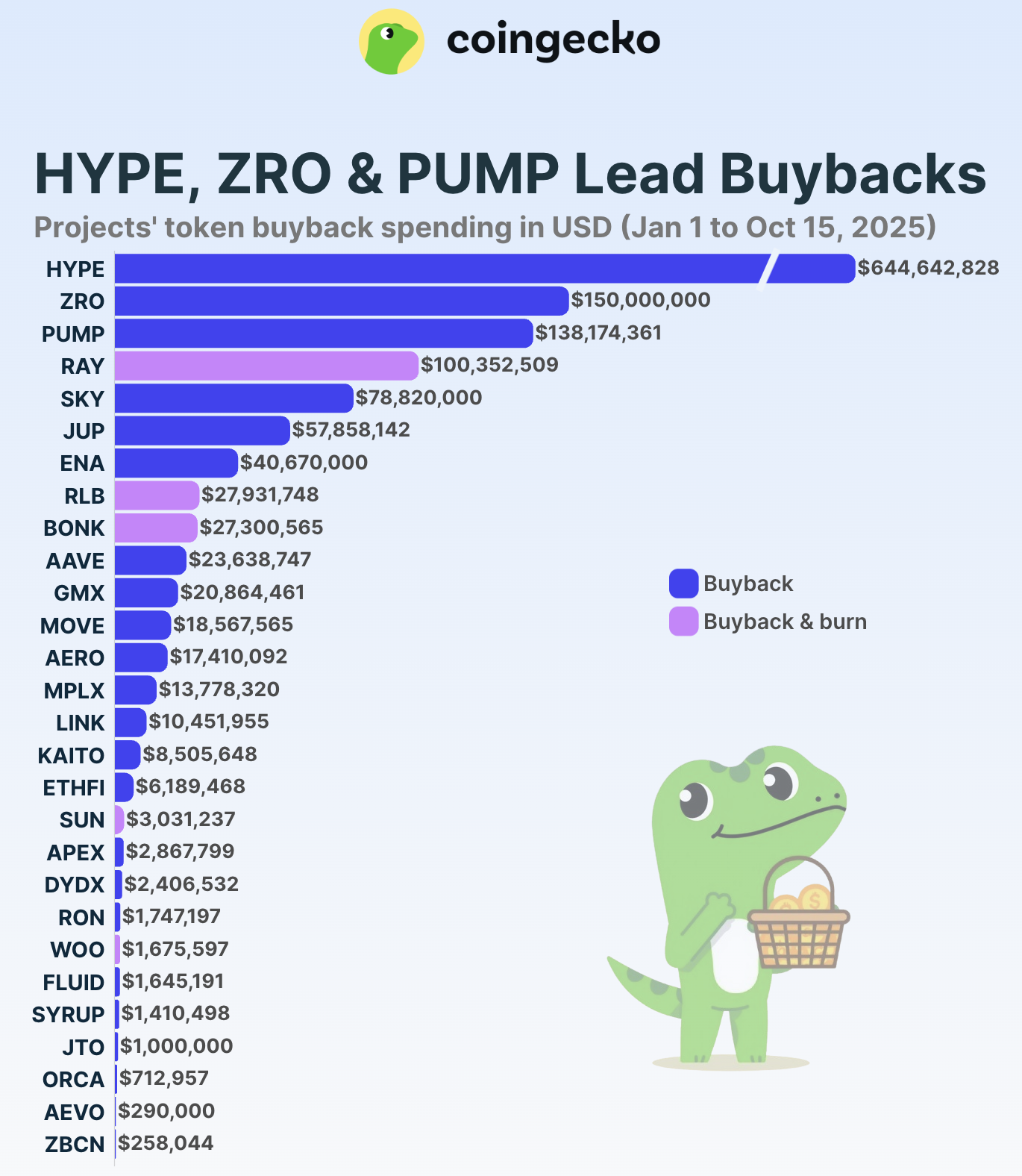
In terms of the share of supply retired, GMX outperformed with repurchases equating to 12.9% of its supply for $20.86 million, highlighting efficiency in smaller-scale efforts.
“Excluding buyback-and-burn programs, the 23 token buybacks examined here have repurchased on average 1.9% of their respective total supply. So far, 14 out of the 23 projects have only bought back less than 1.0% of total supply,” the report added.
Sponsored
Several forces fueled the 2025 buyback boom. According to DWF Labs, the surge stemmed from a convergence of profitability, governance maturity, and market psychology across the Web3 space.
“With an increasing number of projects achieving profitability, buybacks have become an essential strategy to reward long-term users, reduce circulating supply, and generate positive feedback loops that benefit both users and projects,” the report read.
As more decentralized protocols achieved sustainable revenue, they began channeling earnings into token repurchases to reinforce long-term value and community trust. DWF pointed out that mature DAO governance and disciplined treasury management—such as Aave’s structured “Aavenomics” buybacks—helped institutionalize these practices.
At the same time, investors gravitated toward scarcity-based token models following a volatile 2024. Meanwhile, automated on-chain systems from projects like Hyperliquid and Raydium turned buybacks into transparent, continuous mechanisms.
Together, these dynamics transformed buybacks into a hallmark of disciplined tokenomics and a defining trend in 2025’s decentralized economy.


