Bernstein sees Robinhood’s crypto business shifting toward infrastructure as new products like prediction markets and perps gain ground.


 Live Chat
Bernstein sees Robinhood’s crypto business shifting toward infrastructure as new products like prediction markets and perps gain ground.

Bitcoin just closed a weekly candle above its 50-week simple moving average for the first time this cycle, and Sean Hagan puts roughly 80% confidence on this being a genuine regime change. In this Chart of the Day, he and Grace Remington break down why this indicator has historically marked the line between bull and bear regimes, what one additional weekly close would confirm, and the only two times in Bitcoin’s history the signal didn’t hold. With Bitcoin up nearly 10% on the week and pushing through $86K, the timing lines up almost exactly with the one-year window from all-time high to cycle bottom.
DISCLAIMER: The views and opinions expressed in this show are those of the participants and do not necessarily reflect the official policy or position of BTC Inc., Bitcoin Magazine, or any affiliated entities. This content is provided for informational and educational purposes only and should not be construed as investment, legal, tax, or accounting advice. Nothing contained in this show constitutes a solicitation, recommendation, endorsement, or offer to buy or sell any securities or financial instruments. Viewers should consult their own advisors before making financial or business decisions.

The Bitcoin bottom may be in — but don’t get your hopes up: It might struggle to go up anytime soon, according to one investment firm.
A Friday report from European asset management firm CoinShares said that investors last week threw fresh cash at Bitcoin — and other crypto — exchange-traded products, indicating a change in sentiment.
But other factors may hold digital asset markets from going higher, James Butterfill, head of research at CoinShares, wrote.
“We have said for some time that Bitcoin has probably reached, or is close to, its floor,” the report read. “But we see no significant upside potential from here.”
The report added that current macroeconomic headwinds, such as the US bombing Iran and rising oil prices, could see inflation go up again.
Bitcoin’s price was up earlier this week, hitting a seven-day high of $65,501 on news that inflation in the US was softer than expected. It has since erased those gains and was recently trading for $64,010.
The price of Bitcoin has typically done well on news that inflation is coming down because investors expect interest rates to come down. But Butterfill said that “a rate cut does not look probable at this stage.”
CoinShares’ data showed that investors pulled a total of $8 billion out of funds giving crypto exposure — “the worst run on record.”
Last week, though, things reversed when $287 million hit crypto funds, CoinShares said, with the data so far showing that this week looks likely to be another positive streak.
The price of Bitcoin has typically done well when US investors — previously excluded from crypto investing — have bought shares in exchange-traded funds approved in 2024.
The products — handled by the likes of BlackRock, Fidelity, and Grayscale — allow more traditional investors or Wall Street institutions to buy positions in Bitcoin via shares that trade on stock exchanges.
Since BTC’s October all-time high of $126,080, crypto markets have faced a battering as those investors have fast cashed out of the funds. Bitcoin has struggled to make gains, especially after the US and Israel started bombing Iran, leading to a surge in the price of oil.
The leading cryptocurrency is now nearly 50% below its record.
“The dominant picture is that the current setup is prompting interest in adding positions, but caution prevails while sentiment remains broadly negative,” CoinShares added.

Michael Saylor’s Strategy sold 3,588 Bitcoin (BTC) to fund preferred stock dividend payments and replenish its cash reserves.
Strategy sold the Bitcoin for $216 million, reducing its total holdings to 843,775 Bitcoin, according to a Monday 8-K filing with the US Securities and Exchange Commission.
This included 1,363 Bitcoin sold at an average price of $59,256 between last Monday and Tuesday, and 2,225 Bitcoin sold at an average price of $60,773 between Wednesday and Sunday.
Strategy disclosed the sale of 32 Bitcoin in early June, as its first reported Bitcoin sale since the 2022 tax-loss transaction.
Before Strategy disclosed its latest Bitcoin sale, Bernstein said the company was unlikely to be forced to sell its holdings, citing its liquidity position and cash reserve coverage.
Bernstein’s report said Strategy had 17 months of cash to cover dividend obligations and interest payments. It added that the company remained a net buyer of Bitcoin and served as a strong “balancing force” in a market where leading US Bitcoin miners are net sellers due to their pivot to AI.
US President Donald Trump has responded to criticism of his 2025 financial disclosures, showing that he earned $1.4 billion in income from crypto-related ventures while in office.
In a Thursday interview with CNBC’s Joe Kernen, Trump said that there was “nothing illegal” and “nothing wrong” with profiting from his crypto investments as president. He claimed that other people were responsible for his investments and he didn’t “even know who they are,” not directly answering questions about perceived conflicts of interest as president.
Trump’s comments followed the release of his 2025 financial disclosure report by the US Office of Government Ethics, showing that he took in more than $2 billion from his businesses and investments, about $1.4 billion of which was connected to crypto projects like his memecoin and family’s platform World Liberty Financial. Many advocacy organizations have characterized the investments as a “grift” allowing the president to influence related legislation like the Digital Asset Market Clarity (CLARITY) Act.
Trump disclosed that his memecoin generated about $636 million, World Liberty sales about $588 million and $197 million from equity in a stablecoin venture.
Senator Kirsten Gillibrand, one of the US lawmakers behind negotiations for a digital asset market structure bill in Congress, has proposed barring elected officials and the president from issuing or sponsoring their own tokens, citing President Donald Trump’s and First Lady Melania Trump’s memecoins.
In a Friday notice, Gillibrand said that Congress should support measures barring elected officials and their spouses from “issuing or sponsoring their own digital assets.” The New York lawmaker said that the proposed restriction would include any US president and their spouse, but did not specifically mention extending the provision to the office of the vice president or other members of their families.
“This is a commonsense requirement that should get broad bipartisan support – public officials and their spouses should not be issuing memecoins,” said Gillibrand. “We cannot let self-dealing destroy an opportunity to strengthen consumer protections, crack down on illicit finance, and expand economic opportunity for the millions of Americans our financial system has left behind.”

Ethereum co-founder Vitalik Buterin has named quantum resistance, scalability and privacy as three of Ethereum’s top priorities under a new “Lean Ethereum” strawmap, which lays out the network’s technical direction for the remainder of the decade.
In a post to X on Saturday, Buterin said the collection of upgrades will roll out over the next three to four years, touching nearly every layer of Ethereum in a transformation he compared in scale to the September 2022 Merge, which shifted the network away from energy-intensive mining.
“Quantum safety has shifted up a LOT in priority,” he said, adding that finalizing a quantum-safe solution for blobs has “become urgent.” Enhancing privacy is another priority, Buterin said, stating that it has become a “first class goal.”
Dankrad Feist, a former Ethereum Foundation researcher behind the payments-focused layer-1 Tempo blockchain, praised the new plan but argued the 3-4 year timeline is too slow, stating that AI could help developers ship the upgrades within a year.
More than 140 companies have reportedly signed onto a US dollar-pegged stablecoin project that allows them to “receive all of the earnings” from its reserves.
In a Tuesday notice, Open Standard said it was launching the Open USD (OUSD) stablecoin, a US dollar-pegged coin supported by financial companies including Visa and Mastercard, as well as crypto companies Coinbase, Ripple, OKX and Bybit. The project will allow businesses to mint OUSD “at no cost and with no artificial limits on volume,” and keep earnings from the coin’s reserves.
“When Visa, Stripe, Mastercard, Coinbase and Google coordinate on a new stablecoin, the signal is unmistakable,” said Rhino.fi co-founder and CEO Will Harborne. “Open USD is the first launch with a real chance to win share from USDT and USDC, because reserve revenue flows back to everyone who holds it. But that same incentive is what drives fragmentation at scale.”
As the week continued, some of the signatories denied making any firm commitments to the consortium.

At the end of the week, Bitcoin (BTC) is at $64,039, Ether (ETH) at $1798, and XRP (XRP) is at $1.14. The total market cap is at $2.12 trillion, according to CoinMarketCap.
Among the biggest 100 cryptocurrencies, the top three altcoin winners of the week are MemeCore (M) at 105%, Lighter (LIT) at 39%, and ether.fi (ETHFI) at 29%.
The top three altcoin losers of the week are Venice Token (VVV) at -13%, Stable (STABLE) at -10% and Audiera (BEAT) at -5%.
John Bollinger, creator of the Bollinger Bands volatility indicator, believes he has spied a “W”-shaped double bottom on BTC/USD on the charts.
“$BTC has seen a series of bullish patterns broken, evidence of the power of the downtrend,” he commented in X posts on Friday.
“Will this ‘W’ be the one that breaks the trend?”
“W”-shaped reversals involve two swing lows with a rejected rebound in between, with price ultimately breaking through that rejection level to form a new uptrend.
Bollinger has been bullish on BTC for some time. In early May, he revealed a new long position via his Bitcoin investment vehicle.
As Cointelegraph reported, an increasing number of price indicators are flashing signals not seen since the last bear market in 2022. Despite this, market participants broadly believe that the next macro bottom is still to come and is due in Q3 or later.
Billionaire investor and longtime Bitcoin bull Tim Draper said blockchain analytics company Arkham incorrectly linked him to a wallet involved in a large Bitcoin transfer to Coinbase Prime.
“It just wasn’t me. I haven’t touched it. Arkham has it wrong,” Draper told Cointelegraph, adding that he still expects Bitcoin to reach $250,000 within one year.
The statement came after blockchain analytics platform Lookonchain reported Friday that a wallet “possibly linked” to Draper had transferred 1,000 Bitcoin worth about $62 million to Coinbase Prime, citing data from Arkham.
Draper is best known in the crypto community as one of Bitcoin’s earliest high-profile investors, having won a US Marshals Service auction for nearly 30,000 Bitcoin seized by US authorities from Silk Road-related holdings in 2014. The holdings are now worth $1.9 billion, meaning Draper selling could have a big impact on Bitcoin’s.
Bitcoin’s realized profit and loss ratio has fallen to a 43-month low of -0.35, a figure that signals extreme market-wide loss conditions but has historically coincided with market bottoms, blockchain analytics platform CryptoQuant said.
The Bitcoin realized P&L ratio — which measures the net percentage of Bitcoin (BTC) in profit or loss relative to total supply — hasn’t fallen this low since December 2022, shortly after FTX shockingly collapsed and sent Bitcoin below $16,000.
“Historically the indicator has marked BTC bottoms with extreme precision,” CryptoQuant said on Thursday. In 2015 and 2019, the Bitcoin realized P&L ratio also fell below -0.35 before price rallies followed.
The data could lift market sentiment, which has repeatedly fallen to near-record lows during the course of Bitcoin’s latest 50% drawdown from $126,080, set in October. Market sentiment has risen cautiously over the last 10 days, with Bitcoin up more than 7% since tanking to a near two-year low of $58,190 on June 25.
South Korean crypto exchange Upbit said it is not participating in the issuance of Open USD, after its operator Dunamu was named among more than 140 businesses involved in the new stablecoin initiative.
“Upbit has only indicated our potential willingness to consider taking part in the future expansion of the OpenStandard ecosystem,” an Upbit spokesperson told Cointelegraph.
The clarification follows similar pushback from Samsung Electronics and other South Korean companies listed by Open Standard.
According to a Friday report by ChosunBiz, Samsung said it had not held formal discussions with the project and did not know what role it was expected to perform. Meanwhile, Shinhan Financial Group and KBank reportedly said they had only indicated that they would consider the initiative.
Cointelegraph reached out to Open Standard for comments but did not receive a response before publication.
From Ethereum’s Glamsterdam and Solana’s Alpenglow, to proposed post quantum security changes for Bitcoin, 2026’s key crypto upgrades are some of the most significant in years.
Has Strategy’s new capital overhaul defused the fears swirling around STRC, or has it simply bought more time before the next bout of stress?
From crypto hater Nouriel Roubini launching the Technodollar to Bitcoin critic Peter Schiff putting out tokenized gold, meet the skeptics who are now cashing in on crypto.

Jane Street sharply reduced its Bitcoin ETF exposure in the first quarter of 2026, cutting holdings in BlackRock’s IBIT and Fidelity’s FBTC while increasing positions in Ether ETFs and several crypto-linked equities. The move has revived speculation that one of the market’s largest trading firms may have been a major force in Bitcoin’s recent price dynamics — and that a lighter reported position could remove a key overhang for BTC.
According to the latest 13F filings, Jane Street cut its IBIT position by roughly 71% and its FBTC position by about 60% in Q1. Parker White, the Chief Operating Officer (COO) and Chief Investment Officer (CIO) of DeFi Development Corp (DFDV), renewed his thesis from February and argued via X that the filing may help answer questions that have circulated since a major IBIT trading dislocation on February 5 when BTC price saw a massive -18% drawdown.
“It is now apparent that Jane Street cut their IBIT and FBTC holdings by roughly 70% in Q1 based on 13F filings,” Parker wrote on X. “Did they just outright sell or more likely, did they make a HUGE profit on their short derivatives, which they don’t have to report? We are still waiting for the final shoe to drop with one of the likely culprits of the blowup.”
It is now apparent that Jane Street cut their IBIT and FBTC holdings by roughly 70% in Q1 based on 13F filings. Did they just outright sell or more likely, did they make a HUGE profit on their short derivatives (which they don’t have to report)?
We are still waiting for the… https://t.co/67XxlwZEGm
— Parker (@TheOtherParker_) May 13, 2026
The filing does not show Jane Street’s derivatives exposure, nor does it establish whether the firm was directionally bearish, hedged, or engaged in ETF arbitrage and market-making activity. That limitation is central to the debate. A 13F captures certain long holdings at quarter-end, but it does not give a complete view of options, swaps, futures, or short exposure that could materially change the economic interpretation of the reported cuts.
Still, the reduction has become a focal point because of earlier claims that Bitcoin’s price discovery may have been distorted by the mechanics of spot ETF trading. Bitwise advisor Jeff Park wrote that Jane Street had “slashed its Bitcoin ETF exposure in Q1 2026,” cutting IBIT by approximately 71% and FBTC by approximately 60%, before adding: “Price discovery is back on the menu.”
Park’s broader argument is not that one firm explicitly suppressed Bitcoin’s price, but that the ETF structure creates a complex market-making environment in which authorized participants can use creation and redemption mechanics, derivatives, and futures hedges in ways that may weaken the link between ETF demand and spot Bitcoin buying. In a prior post, he framed the issue as structural rather than conspiratorial.
JANE STREET SLASHED ITS BITCOIN ETF EXPOSURE IN Q1 2026, CUTTING IBIT BY ~71% AND FBTC BY ~60%, ACCORDING TO ITS LATEST 13F FILING
Price discovery is back on the menu https://t.co/ed41KhlQC4
— Jeff Park (@dgt10011) May 13, 2026
“The short answer is that no AP explicitly suppresses Bitcoin price,” Park wrote. “What the AP structure can suppress is the integrity of the price discovery mechanism itself. Those are not the same thing—but the second is arguably more consequential than the first.”
That distinction matters for the bullish interpretation. If Jane Street’s reported Bitcoin ETF exposure has already been reduced substantially, some traders may read the filing as evidence that a large source of ETF-related pressure has been partially cleared. Parker went further, suggesting Jane Street “likely doesn’t want to be short BTC forever” and that observers should “look for them to begin re-accumulating in Q2.”
The thesis is speculative, but it is not without a clear market logic. If a large trading firm had been involved in strategies that created persistent ETF or derivatives pressure, a reduction in reported Bitcoin ETF holdings, combined with any eventual unwind of related positions, could shift the market’s balance back toward cleaner spot-led price discovery. That is the bullish setup implied by the posts: not simply that Jane Street sold, but that the trade may already have played out.
At the same time, Jane Street did not exit crypto exposure broadly. The firm increased holdings in BlackRock and Fidelity Ether ETFs and added to positions in Riot Platforms, Coinbase, and Galaxy Digital, while trimming Strategy and several Bitcoin mining names.
At press time, BTC traded at $79,783.
Featured image created with DALL.E, chart from TradingView.com

Bitcoin is no longer being discussed only by crypto traders and retail bulls. Some of the world’s biggest banks are now attaching six-figure targets to the leading cryptocurrency, and this is a major change in how Wall Street is looking at Bitcoin’s next cycle. Major banks including Citi, JPMorgan, Goldman Sachs, Standard Chartered, and TD Cowen are all pointing to a future where the BTC price trades well above current levels, with several projections clustered between $140,000 and $200,000.
Not long ago, the words “fraud” and “ponzi scheme” were the most popular way Wall Street described Bitcoin. The very institutions now projecting six-figure price targets spent years trying to talk investors out of the asset entirely. The most interesting BTC price projection is from Citi. Citi projected a base case of $143,000 for BTC, with its bull case reaching as high as $189,000. The forecast is tied to stronger institutional demand and the idea that Bitcoin can continue absorbing capital through ETFs.
JPMorgan’s outlook is similarly bullish, with analysts at the bank pointing to a $170,000 scenario based on Bitcoin’s valuation relative to gold. The bank’s model suggests BTC still has room to close the gap with gold as a store-of-value asset, especially if there’s continued ETF demand.
Goldman Sachs has highlighted its view as a scenario, and the number is also worth noting. Goldman’s digital assets team sees potential for Bitcoin to approach $200,000 in 2026.
Standard Chartered has taken the longest view of the group. The bank revised its 2026 year-end target to approximately $100,000, citing reduced buying from digital asset treasury companies and slowing ETF inflows. However, Standard Chartered still maintains a long-term projection of $500,000 by 2030. TD Cowen rounds out the group with a target of $140,000, which is the lowest prediction from the bunch.
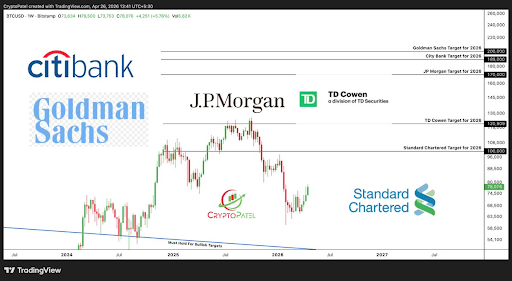
Bitcoin Price Predictions From Banks. Source: @CryptoPatel On X
The contrast between Wall Street’s past posture and its current research output is interesting, mostly with JPMorgan. Back in September 2017, when Bitcoin was trading around $4,200, JPMorgan CEO Jamie Dimon called the cryptocurrency a fraud at an investor conference, compared it to tulip bulbs, and said he would fire in a second any trader caught dealing in it.
However, things have changed now, and reports indicate that JPMorgan Chase & Co. is in the process of offering cryptocurrency trading services to institutional clients. Goldman Sachs also disclosed in a regulatory filing that it owns around $1 billion worth of Bitcoin, with CEO David Solomon also confirming that he personally owns a small amount of the asset.
Citi, Morgan Stanley, JPMorgan, and Goldman Sachs have all announced new Bitcoin-related products over the past three months, spanning custody, trading, ETF filings, and direct purchases. The banks that once called BTC a fraud are now modeling its path to $200,000. According to crypto analyst Crypto Patel, that’s not adoption. That’s capitulation.
Featured image created with Dall.E, chart from Tradingview.com

Editorial Process for bitcoinist is centered on delivering thoroughly researched, accurate, and unbiased content. We uphold strict sourcing standards, and each page undergoes diligent review by our team of top technology experts and seasoned editors. This process ensures the integrity, relevance, and value of our content for our readers.

The crypto industry is likely to see more projects snapped up by larger companies, which may lead to a much less fragmented sector in the months ahead, says Bullish CEO Tom Farley.
“I was in the exchange sector during continual massive consolidation…the same thing is going to happen starting right now in crypto,” Farley said during an interview on CNBC on Friday.
Farley, who served as president of the New York Stock Exchange (NYSE) until 2018, said the recent drop in the crypto market will be a key catalyst, with Bitcoin (BTC) down nearly 45% from its October all-time high of $126,100 and trading at $69,405 at the time of publication, according to CoinMarketCap
However, he said that the industry’s consolidation should have happened earlier, but inflated valuations kept false optimism going. “It should have happened a year or two ago,” he said.
“People were still holding onto this hope that they’d get 2020 valuations, and so we’d have conversations with companies that would say, hey, we have $10 million in revenue, it’s not growing, we want $200 million to buy the company,” he said.
“That dream is going to be over,” Farley said, adding that “people are going to realize they don’t have businesses, they have products, and they need to merge up, and they need to scale, and that is going to happen.”
Consolidation in the crypto industry can cut both ways. Underperforming projects may be absorbed by larger companies, but this process can lead to redundancies, layoffs, and internal disruption in the industry as companies merge or wind down.
Related: Crypto retail investors are trying to ‘meta-analyze’ crypto crash: Santiment
Eva Oberholzer, the chief investment officer at venture capital firm Ajna Capital, told Cointelegraph in September 2025 that VC firms have become much more selective with the crypto projects they invest in, due to market maturation.
“It’s harder because we have reached a different stage in crypto, similar to every cycle we have seen for other technologies in the past,” Oberholzer told Cointelegraph.
Magazine: Bitcoin’s ‘biggest bull catalyst’ would be Saylor’s liquidation: Santiment founder

ARK Invest closed out the week with a fresh round of accumulation across several of its flagship funds, picking up positions in Circle, Bullish, BitMine, Robinhood and Bitcoin ETFs as crypto-related equities rebounded.
The largest set of purchases targeted Bullish, with ARK Innovation ETF (ARKK), ARK Fintech Innovation ETF (ARKF) and ARK Next Generation Internet ETF (ARKW) expanding their exposure, according to trade notifications for Friday. Combined, these buys amounted to about $2 million, following Bullish’s 5.75% gain on the day.
ARK also continued accumulating BitMine, with purchases across ARKF, ARKK and ARKW totaling approximately $830,000. BitMine closed slightly lower on the day but remained within its recent trading range near $26.
Furthermore, the firm added small amounts of Circle and Robinhood. It acquired 3,529 Circle shares, worth $250,000, as the stablecoin issuer’s stock climbed more than 6%. ARK also added about $200,000 in new Robinhood shares.
Related: Cathie Wood’s ARK loads up on Circle, BitMine, Bullish as crypto stocks slide
On Friday, ARK increased its Bitcoin (BTC) ETF exposure by nearly $600,000, led by fresh purchases of the ARK 21Shares Bitcoin ETF (ARKB). The ARKF and ARKW funds together added more than 20,000 shares.
The purchase comes as the US spot Bitcoin ETF market is facing one of its sharpest downturns since its launch. The 12 funds collectively recorded nearly $1 billion in net outflows on Friday, marking the second-largest daily withdrawal to date and placing the group on pace for its weakest week since February.
Outflows have accelerated throughout the past month, with around $4 billion leaving the products as Bitcoin’s price has slipped roughly 30% from recent highs.
Related: ARK Invest scoops $10M in Bullish as it hits record low amid crypto stock rout
On Thursday, ARK made its largest daily acquisition of the week. The firm snapped up $10.1 million in Coinbase, $9.9 million in BitMine, $9 million in Circle and $9.65 million in Bullish, alongside additional purchases of $16.8 million in Nvidia and $6.8 million in Robinhood.
Prior to that, the firm also purchased $16.8 million worth of Bullish shares, roughly $15 million in Circle and about $7.6 million in BitMine across its ARKF, ARKW and ARKK ETFs on Wednesday.
Magazine: 2026 is the year of pragmatic privacy in crypto — Canton, Zcash and more

Exciting data from an on-chain analysis has recently surfaced, revealing accumulation patterns in Bitcoin and Ethereum on the Binance exchange that have historically preceded renewed bullish momentum.
In a QuickTake post on November 14, pseudonymous market analyst CryptoOnchain shares insights into the crypto market direction, based on Binance activity. This post revolves around the Binance 7-Day Asset Netflow By Network metric, which shows if more volumes of an asset on specific networks are being deposited into Binance (net inflow), or being withdrawn (net outflow) over the past seven days, revealing the underlying activity across different asset types.
According to CryptoOnchain, a net outflow of $1.77 billion in Bitcoin and Ethereum assets has been recorded from the Binance network. Specifically, the analyst reports outflows of $1.1 billion in Bitcoin (BTC_Native) and $670 million in Ethereum (ETH_Native) occurring over the past week.
Typically, a large movement of assets out of exchanges such as of this magnitude reflects a growing ‘HODL’ sentiment among investors, as these coins are usually transferred into private wallets for holding. As an extension, an increasing hoarding appetite among holders signals a reduction in sell-side pressure, as there is less liquidity on standby, betting against price.
Simultaneously, Binance records an almost similar amount, $1.58 billion, in stablecoin inflows. About $900 million of these came in as USDT, while $680 million was in USDC. Usually, a large inflow of stablecoins indicates an active increment by ‘smart money’ of their buying power. As short-term holders or retailers sell, thereby adding to sell pressure, the long-term holders in this scenario stand ready to absorb sell pressure with their liquidity.
Historically, this divergence in on-chain activity (a significant amount in BTC/ETH outflows vs a large amount in stablecoin inflows) has preceded price recoveries to the upside. As such, it qualifies as one of the strongest indicators to show that the market is in an accumulation phase.
Despite the predominant market sentiment being one that depicts fear, CryptoOnchain posits that major market participants are currently “buying the dip,” thus putting in what may come to be a strong price bottom in the near future. In the grand scheme, the market still appears to hold a bullish outlook.
As of this writing, Bitcoin is worth around $96,133, losing more than 1.33% of its value since the last day. Ethereum, on the other hand, holds a valuation of $3,153, reflecting a 24-hour loss of 1.53% per CoinMarketCap data.

Key takeaways:
Institutional demand and ETF inflows have thus far absorbed the redistributed BTC from Mt. Gox.
Rate cuts, trade optimism, and rising global liquidity strengthen Bitcoin’s path toward $150,000–$500,000.
Mt. Gox, a defunct crypto exchange, has postponed repayments to its creditors by a year and remains in control of around $4 billion in Bitcoin (BTC) as of Wednesday.
Is this latest delay in repayments bearish or bullish for the Bitcoin price moving forward?
The Mt. Gox trust has redistributed approximately 75% of its Bitcoin reserves to creditors since mid-2024, reducing its BTC holdings to 34,690 from 142,000, according to data resource Arkham Intelligence.
That means over $12 billion worth of Bitcoin in today’s value has already been dispatched, but it has not helped the bears keep prices down.
Since the repayments began, BTC has gained 85%, and, according to multiple analysts, may climb toward $150,000 by year’s end.

That suggests buyers easily absorbed any selling pressure from the Mt. Gox repayments, a sign of strong market depth amid relentless demand from US spot Bitcoin ETFs and public companies steadily adding BTC to their balance sheets.
For instance, Nasdaq-listed Strategy (MSTR) has single-handedly accumulated 414,477 BTC (~$47 billion) since mid-July, according to data resource Bitbo.IO. That is roughly 3.9 times more Bitcoin than what Mt. Gox redistributed to date.

Therefore, today’s Bitcoin market, supported by ETFs, sovereign interest, and corporate treasuries, can absorb several billion dollars of BTC more easily than during the 2017 or 2021 cycles.
Pushing Mt. Gox repayments to October 2026 means that roughly $4 billion in Bitcoin will be kept off the market, reducing the chance of a sudden market dump.
Bitcoin bulls have projected the price to grow in the long term, citing macroeconomic catalysts that may mitigate any downside impact stemming from Mt. Gox’s BTC distribution.
First, markets are almost fully pricing multiple Federal Reserve rate cuts, signaling the start of an easing cycle. Lower borrowing costs reduce pressure on speculative assets, giving Bitcoin room to expand toward $150,000 in the coming months.
Progress toward a US–China trade deal has further improved global risk sentiment, removing one of the biggest overhangs on equities and crypto alike.
Global M2 money supply is accelerating at its fastest pace since 2020.

Analysts note that if Bitcoin follows the same liquidity-driven path as during the post-COVID expansion, it could climb toward $500,000 by 2026, potentially echoing its strongest historical uptrend.
This article does not contain investment advice or recommendations. Every investment and trading move involves risk, and readers should conduct their own research when making a decision.


