Dormant BTC activity fell to its lowest level since Q3 2022, suggesting long-term holders have slowed distribution after heavy profit-taking.
Adding Bitcoin to a cashier does not automatically turn an online casino into a crypto-first platform. Crypto users are accustomed to choosing their own wallets, moving value across different networks and controlling how their funds are stored. They increasingly expect the same flexibility when they play online, alongside clearly structured promotions such as the Luckiest welcome offer: 200% up to $2,000 plus 100 no-wagering free spins.
A useful example is the Luckiest crypto casino, which combines Bitcoin and altcoin payments, no-KYC withdrawals for eligible players, more than 3,000 games, no-wagering free spins and a 28-level rewards programme. Its structure helps illustrate the features that separate a crypto-native experience from a conventional casino that has simply added a cryptocurrency deposit option.
Ready to see the difference? Explore Luckiest.
Many online casinos now accept at least one cryptocurrency, but crypto-native users often need broader flexibility. They may hold different assets for different purposes, prefer stablecoins when they want to limit short-term volatility, or choose a particular blockchain because of its transaction costs and confirmation speed.
Luckiest supports Bitcoin (BTC), Ethereum (ETH), Tether (USDT), USD Coin (USDC), Solana (SOL) and TRON (TRX), alongside selected fiat options where available. Bitcoin provides a familiar route for long-standing crypto users, while USDT and USDC allow players to transact using assets designed to track the US dollar. SOL and TRX add further network choice for users who prioritise speed or lower transfer costs.
Players should always confirm both the wallet address and blockchain network before sending funds. Cryptocurrency transfers are generally irreversible, and availability, fees and processing times can vary by asset, network conditions, location and payment provider.
Want to get started? Create a Luckiest account and review the available payment options.
Privacy remains one of the strongest reasons people choose crypto products. Traditional casino withdrawals can involve repeated document uploads and long approval processes, creating friction for users accustomed to direct wallet transactions. Luckiest addresses this through no-KYC withdrawals for eligible players, allowing many routine cash-outs to proceed without an automatic, lengthy verification journey.
No-KYC should not be confused with guaranteed anonymity in every circumstance. Security, anti-fraud, source-of-funds or compliance reviews may still be required under the platform’s terms. This distinction matters because sustainable crypto services need to balance a low-friction user experience with controls designed to protect accounts and prevent abuse.
Prefer a lower-friction crypto casino journey? Discover Luckiest.
Bonuses can attract attention, but withdrawals are where a casino relationship is tested. Crypto rails can remove some of the delays associated with card networks and bank transfers by sending funds directly to a user-controlled wallet. Luckiest places fast crypto payouts at the centre of its product positioning.
For experienced cryptocurrency users, convenience often matters just as much as game selection. Having the ability to move funds directly between a personal wallet and a casino account without relying on traditional banking systems creates a smoother overall experience. This approach also aligns with the principles that attracted many users to blockchain technology in the first place: speed, transparency and greater financial control.
Explore the platform and its crypto-first experience at Luckiest.
Payment speed alone cannot sustain engagement. Luckiest therefore combines its crypto infrastructure with a casino library of more than 3,000 games, covering online slots, live dealer tables, blackjack, roulette, baccarat, instant-win titles and exclusive Luckiest Originals.
The platform features games from providers including Pragmatic Play, Hacksaw Gaming, Evolution, Play’n GO, Nolimit City, BGaming, Relax Gaming and Thunderkick. Players looking for shorter rounds can explore Crash, Mines, Dice and Limbo-style titles, while the live casino category delivers real-time blackjack, roulette, baccarat and game-show formats with professional dealers.
Luckiest Originals, including Cross the Road, Crash, Dice and Limbo, give the brand a distinct product layer beyond third-party content. A diverse game portfolio also means players can easily switch between different styles of gameplay without creating multiple accounts on different platforms. Whether someone prefers fast-paced instant games, traditional table games or immersive live dealer sessions, having everything available within a single ecosystem contributes to a more consistent user experience. The full game catalogue is available through a browser-based interface optimised for compatible desktop and mobile devices.
From live casino to instant games, explore more than 3,000 titles on Luckiest.
Casino promotions are often promoted through headline percentages while the practical value is hidden in the terms. Luckiest aims to make selected offers easier to understand through no-wagering free spins. Eligible winnings from these spins do not need to be turned over multiple times before becoming withdrawable, although expiry periods, eligible games and maximum-win limits may still apply.
Beyond the Luckiest welcome offer of 200% up to $2,000 and 100 Free Spins, players can also benefit from daily rakeback, weekly cashback, free spins, missions and limited-time campaigns.
Rather than rewarding players only on their first deposit, the platform continues offering incentives through recurring campaigns. This approach can be particularly attractive for long-term players who value ongoing rewards instead of one-time promotional offers.
As with any casino offer, players should review minimum deposits, wagering rules, expiry periods, game restrictions and withdrawal caps before claiming a promotion. Clear terms are more valuable than a large headline number that is difficult to convert into a usable benefit.
See the full promotion details and claim the Luckiest welcome offer.
A crypto-first casino builds the full journey around digital assets, including wallet-based deposits, multiple networks, crypto withdrawals and mobile access not merely a single Bitcoin payment option.
No. Eligible routine withdrawals may avoid lengthy automatic checks, but security, anti-fraud, source-of-funds or compliance reviews can still require additional information.
Supported assets include Bitcoin, Ethereum, USDT, USDC, Solana and TRON. Availability and usable blockchain networks can vary by country and payment provider.
Eligible winnings do not need to be wagered multiple times before withdrawal. Expiry periods, game restrictions and maximum-win limits may still apply.
Yes. Players can access supported games, promotions, rewards and payment methods through a compatible mobile browser without installing a separate casino app.
Yes. Depending on availability in their region, players can choose between supported cryptocurrencies and selected fiat payment methods.
Viewed as a complete product, Luckiest demonstrates how crypto payments, eligible no-KYC withdrawals, browser-based mobile access, games and rewards can operate within the same user journey. It offers slots, live casino, table games, instant-win titles and exclusive Originals alongside Bitcoin, multiple altcoins, selected fiat payments and 24/7 support. Availability, payment methods and promotional terms may vary by country. For players researching the next generation of crypto casinos, evaluating factors such as payment flexibility, withdrawal speed, promotion transparency and game variety often provides a better long-term comparison than simply looking at the size of a welcome bonus. Luckiest brings these elements together in a single platform designed around cryptocurrency users.
Ready to explore it for yourself? Join Luckiest and check the latest games and offers.
Eligible adult players can create a Luckiest account to explore the available games, supported payment methods and current offer terms.
Casino games are for adults aged 18 and over and should be treated as entertainment. Players should set personal limits, avoid chasing losses and review the platform’s responsible gambling information before playing.
Disclaimer: This article is for informational purposes only and does not constitute financial or legal advice. Readers should check local laws and the applicable platform terms. Gambling involves risk.
Toronto, Canada, July 23rd, 2026, Chainwire
CoinRabbit and GoMining have published a report on Bitcoin mining profitability, showing why managing mined Bitcoin is becoming as important as producing it.
The report highlights how the post-halving environment is redefining success in mining, with operators relying on stronger treasury management, capital discipline, and long-term asset strategies to navigate tighter margins. With the block reward reduced to 3.125 BTC and network difficulty near record levels, operational efficiency alone is no longer enough. The next phase of mining will be shaped by smarter capital allocation and long-term conviction in Bitcoin.
The Four Pillars of the Bitcoin Mining Efficiency Mindset
The report presents a clear framework built around four key pillars:
1) Operational Cost Efficiency
Low-cost power procurement, high uptime, efficient cooling, and disciplined maintenance remain the foundation of any viable mining operation. These factors determine the baseline production cost and are essential for competitiveness.
2) Collateralization Over Liquidation
Instead of selling freshly mined Bitcoin to cover expenses, effective operators are using it as collateral. This approach allows them to meet short-term cash needs while retaining full ownership and long-term exposure to the asset’s value.
3) Operational Liquidity and Tax Optimization
Bitcoin-backed lending provides flexibility to cover recurring operating costs, including power, hosting, and payroll, while avoiding taxable sales. At the same time, it preserves the deductibility of operational expenses.
4) Long-Term Vision and Capital Discipline
Sustainable operators treat mining as a disciplined, capital-intensive business. They maintain the flexibility to hold Bitcoin through market cycles and reinvest in hardware upgrades when opportunities arise, avoiding forced sales during downturns.
The full report can be downloaded here.
Walter Barrett, Chief Strategy & Growth Officer at CoinRabbit, commented: “Long-term success is built on conviction in the assets you hold and the discipline to manage them through different market cycles. At CoinRabbit, we are proud to work with clients who share this long-term vision and recognize the value of staying focused through periods of uncertainty. We appreciate the collaboration with GoMining experts and their contribution to sharing deeper industry insights with the mining community.”
Jeremy Dreier, Chief Business Development Officer at GoMining and Managing Director of GoMining Institutional, added: “In the post-halving environment, discipline is critical. The miners that are winning are those with efficient operations and cash put aside for this exact time. This is the best possible moment to deploy capital into expanding your fleet, because it’s cheap to add hash rate when Bitcoin’s price is down. There’s a lot of opportunity in the market. At GoMining, this is our third bear market, and we’ve seen that the operators who are prepared look at these conditions as an opportunity. Those who aren’t prepared are the ones who panic.”
About CoinRabbit
CoinRabbit is a crypto asset management platform built for long-term capital preservation. It enables users to manage liquidity seamlessly across instant payments, lending, trading products, and the Private Program — all within a single ecosystem. Since 2020, CoinRabbit ensures 100% capital reserve, keeping clients’ funds safe and never reused.
For more information, users can visit coinrabbit.io
About GoMining
GoMining is an all-in-one Bitcoin ecosystem that makes it simple and secure to mine, earn, and use Bitcoin every day. GoMining serves 5 million users and ranks among the top-10 Bitcoin miners by hashrate globally, with data centers in the U.S. and internationally. The company makes Bitcoin accessible through tokenized hashrate, daily BTC rewards, and an expanding suite of payment and earning products.
For more information, users can visit gomining.com
CMO
Irene Afanaseva
CoinRabbit
marketing@coinrabbit.io
The Bitcoin bottom may be in — but don’t get your hopes up: It might struggle to go up anytime soon, according to one investment firm.
A Friday report from European asset management firm CoinShares said that investors last week threw fresh cash at Bitcoin — and other crypto — exchange-traded products, indicating a change in sentiment.
But other factors may hold digital asset markets from going higher, James Butterfill, head of research at CoinShares, wrote.
“We have said for some time that Bitcoin has probably reached, or is close to, its floor,” the report read. “But we see no significant upside potential from here.”
The report added that current macroeconomic headwinds, such as the US bombing Iran and rising oil prices, could see inflation go up again.
Bitcoin’s price was up earlier this week, hitting a seven-day high of $65,501 on news that inflation in the US was softer than expected. It has since erased those gains and was recently trading for $64,010.
The price of Bitcoin has typically done well on news that inflation is coming down because investors expect interest rates to come down. But Butterfill said that “a rate cut does not look probable at this stage.”
CoinShares’ data showed that investors pulled a total of $8 billion out of funds giving crypto exposure — “the worst run on record.”
Last week, though, things reversed when $287 million hit crypto funds, CoinShares said, with the data so far showing that this week looks likely to be another positive streak.
The price of Bitcoin has typically done well when US investors — previously excluded from crypto investing — have bought shares in exchange-traded funds approved in 2024.
The products — handled by the likes of BlackRock, Fidelity, and Grayscale — allow more traditional investors or Wall Street institutions to buy positions in Bitcoin via shares that trade on stock exchanges.
Since BTC’s October all-time high of $126,080, crypto markets have faced a battering as those investors have fast cashed out of the funds. Bitcoin has struggled to make gains, especially after the US and Israel started bombing Iran, leading to a surge in the price of oil.
The leading cryptocurrency is now nearly 50% below its record.
“The dominant picture is that the current setup is prompting interest in adding positions, but caution prevails while sentiment remains broadly negative,” CoinShares added.
The moves priced a single fear, that a wider war keeps oil elevated and forces the Federal Reserve to hold rates higher for longer. Minutes of the Fed’s June meeting show a few policymakers saw a case for raising rates before backing a hold. Gold fell because a higher-for-longer path lifts real yields and dulls the appeal of metal that pays nothing, and bonds fell for the same reason.
But bitcoin sat all of it out. Ether was little changed at about $1,800, up 2% on the week, and the rest of the majors barely moved on the day, with Solana the weakest at $76, down 5% over seven days. XRP held $1.09 and dogecoin sat near $0.07.
The one crypto-relevant thread runs through Korean stocks. SK Hynix shares plunged 12% in Seoul after the chipmaker’s U.S.-listed shares surged 13% on their Friday debut, a reversal that helped drag the Kospi down 7%. That chip trade drove the rally that lifted bitcoin on Friday, and its sharp reversal on Monday still left crypto flat, in either direction.
Bitcoin has now held a tight range through a weekend of strikes, a Monday selloff in every asset that usually reacts to war, and a hawkish repricing of the Fed. That is a marked change for a market that once sold off fast on a single Hormuz headline. It is no longer trading the war at all, taking its direction from dollar liquidity and the chip cycle while oil, gold and rates do the reacting.
Strategy founder and chairman Michael Saylor again took to social media on Sunday to offer his latest signal to investors as one analyst sees Saylor’s messaging as needing more clarity to help Bitcoin regain its momentum.
“Orange dots tell only part of the story,” was Saylor’s message on Sunday in a post that accompanied a chart from Saylortracker.com, similar to previous social media messages that have preceded news of Strategy’s Bitcoin (BTC) purchases, typically announced the day after his posts.
In recent weeks, the largest digital asset treasury company and a major BTC holder, has moved away from its long-time “never sell Bitcoin” approach to a willingness to sell the biggest crypto as needed to fund dividends for holders of its STRC preferred stock and to replenish its cash reserves. Earlier this month, Strategy sold $216 million worth of Bitcoin, reducing its total holdings to 843,775 tokens, according to a July 6 filing with the US Securities and Exchange Commission.
“Orange dots tell only part of the story.” Source: Michael Saylor
Days earlier, Strategy unveiled a capital framework allowing Bitcoin sales to fund dividends, increased the annual dividend rate on its STRC preferred stock to 12%, and disclosed that its US dollar reserve had grown to $2.55 billion.
Standard Charter’s global head of digital assets research, Geoff Kendrick, believes recent Strategy’s actions — and Saylor’s manner of communicating them — “are muddying the waters for BTC near-term.”
“We think effective communication of MSTR’s new strategy (using BTC to back STRC) is key to reassuring markets that wholesale selling is unlikely; this should in turn support BTC prices,” Kendrick wrote in a note to clients on Friday. “Indeed, if this signalling proves effective, it should remove the need for MSTR to actually sell any BTC by supporting STRC’s price,” he said.
Related: Crypto Biz: Did Michael Saylor buy the Bitcoin bottom for once?
Kendrick said that Strategy’s long-held “never sell” approach limited what the company could with its industry-biggest digital asset treasury.
“The problem with the ‘never sell’ approach is that it limits what MSTR’s BTC holdings can do — or, perhaps more importantly, what they are perceived to be doing,” the StanChart analyst said. “MSTR has started to shift its communication strategy on this in recent months. It has sold BTC twice and recently announced a BTC monetization program.”

Source: Standard Chartered Bank
Still, he sees Strategy’s “market signaling” will improve soon. He expects that to bring clarity to the outlook for Bitcoin, on which StanChart maintains its $100,000 year-end forecast.
Investors who bought into the Strategy narrative have not had an easy time in the past 12 months. The STRC preferred shares were formulated to hold a price of $100 apiece. Shareholders saw that par value fall to the wayside last month, to the lowest value since the preferred stock was introduced a year ago.
The common shares, trading under the MSTR ticker, have lost more than 70% of their value since July 2025, closing at $94.64 per share on Friday, down from a 52-week high of $457.22.
The company is slated to report second-quarter earnings on July 30, with analysts consensus of $4.28 per share, according to Yahoo Finance data. Earnings have fallen short of analyst forecasts in six of the last eight quarters, according to Fintel.io data, including a 33.76% negative surprise in the first quarter of 2026.
Magazine: Will the crypto lobby’s $189M campaign get CLARITY over the line?
Zug, Switzerland, July 7th, 2026, Chainwire
Premium virtual assets pioneer BTCS (Middle East) Ltd. is now fully authorized by the Financial Services Regulatory Authority (FSRA) of ADGM, enabling regulated institutional services across the UAE.
Building on its position as Switzerland’s leading crypto financial services provider, Bitcoin Suisse is further accelerating its international expansion. Bitcoin Suisse Group’s subsidiary, BTCS (Middle East) Ltd. (“BTCS ME”) has received Financial Services Permission (FSP) from the Financial Services Regulatory Authority (FSRA) of ADGM, the international financial centre of Abu Dhabi, marking another significant step toward the Group’s international growth strategy becoming a leading global wealth management partner.
The FSP marks the completion of a thorough, multi-stage licensing process and enables BTCS ME to deliver a comprehensive suite of regulated digital asset financial services to institutional and professional clients in the United Arab Emirates. Bitcoin Suisse brings more than a decade of experience across multiple digital asset market cycles to the UAE. The Group currently safeguards USD 3.7 billion in crypto assets and ranks as the fourth-largest staking operator globally.
With the FSP, clients benefit from the same foundations that have made Bitcoin Suisse a trusted partner to investors, institutions, and blockchain innovators for more than a decade. Across multiple market cycles, Bitcoin Suisse has built a reputation for resilience, combining a robust, proprietary infrastructure with a service philosophy centered on long-term client relationships.
Institutional and professional clients can access a regulated digital asset financial infrastructure designed for sophisticated needs, including managing and hedging digital asset exposure, in a fully compliant environment, institutional-grade custody, and trading approved virtual assets. All supported by a dedicated relationship manager, ensuring access not only to institutional-grade technology and regulatory clarity, but also to personal attention, continuity, and deep expertise. As the market evolves, BTCS ME is also positioned to support clients in accessing tokenized real-world assets in the future.
By combining regulatory strength, operational depth, and a highly personalized approach to client service, BTCS ME is designed to support clients through the next phase of institutional adoption.
Ceyda Majcen, Chief Executive Officer and SEO of BTCS ME, leads Bitcoin Suisse Group’s expansion in the Middle East and brings extensive, long-standing senior leadership experience across the Group.
Receiving the FSP from the FSRA is a major milestone in our international growth strategy. The authorization reflects more than a decade of experience building resilient infrastructure, risk frameworks, and trusted client relationships. We are excited to bring our unique combination of institutional-grade capabilities and highly personalized service to the UAE, one of the world’s most dynamic hubs for digital assets.”
Arvind Ramamurthy, Chief Market Development Officer at ADGM, said “We congratulate Bitcoin Suisse on receiving its FSP from the FSRA. Its expansion into ADGM reinforces the strength and maturity of our digital assets’ ecosystem, which continues to attract leading global institutions seeking regulatory clarity, market access and long-term growth opportunities. As Abu Dhabi further strengthens its position as a leading financial hub in the region, ADGM remains committed to enabling innovation within a robust, internationally recognized regulatory environment.”
About Bitcoin Suisse
Bitcoin Suisse is a leading premium digital assets financial services provider. Founded in 2013 by digital asset experts, it provides a cohesive suite of trading, custody, staking and lending services for institutional clients, digital asset foundations, family offices, asset managers and high-net-worth individuals. Bitcoin Suisse is headquartered in Zug with over 200 employees in Switzerland, Liechtenstein, the United Arab Emirates, and Bermuda. www.bitcoinsuisse.com
Lukas Mettler
Bitcoin Suisse
l.mettler@bitcoinsuisse.com
American Bitcoin Corp (Nasdaq: ABTC) has moved its treasury past 8,000 bitcoin, the company said. The total marks a climb from about 5,401 BTC at the end of 2025, a gain of close to 50% across six months.
The company, a majority-owned subsidiary of Hut 8 Corp and backed by the Trump family, said its bitcoin reserve and its bitcoin-per-share have grown close to threefold since its Nasdaq debut. Co-founder Eric Trump has framed the growth as disciplined and large in scale.
American Bitcoin builds its stack through two channels: mining production and treasury purchases. In the first quarter of 2026, the firm mined 817 BTC and added 1,620 BTC to its reserve, a rise of about 30 percent in three months. That pace has carried into the summer.
Mining capacity has grown to match the treasury ambitions. In March, the company deployed 11,298 ASIC miners at its site in Drumheller, Alberta, a move that lifted capacity by about 12 percent and added 3.05 EH/s. The cost to mine a single bitcoin fell to about $36,200 in the first quarter, a drop of 23 percent from $46,900 in the prior quarter.
The financial picture remains mixed. American Bitcoin reported a net loss of $81.8 million for the first quarter on revenue of $62.1 million, a result that reflects a wider crypto market decline and the heavy spending behind its expansion.
JUST IN: 🇺🇸 Eric Trump’s ‘American Bitcoin’ increases their Bitcoin holdings by 500 BTC 👀
They now own over 8000 BTC! 🚀 pic.twitter.com/KEn8AlOSuq
— Bitcoin Magazine (@BitcoinMagazine) July 6, 2026
The company also reshaped its share structure. A 1-for-15 reverse stock split took effect at 5:00 p.m. on July 2, with shares trading on a split-adjusted basis from July 6. Shareholders approved the measure at the annual meeting on June 22.
The strategy sets American Bitcoin apart from a segment of the mining industry that has shifted resources toward artificial-intelligence data centers. Rather than pivot, the firm has doubled down on bitcoin mining and treasury accumulation, a bet that ties its fortunes to the price of the asset it collects.
At more than 8,000 BTC, American Bitcoin ranks among the larger corporate holders of the asset, and its stack has, at points, surpassed that of Galaxy Digital.
The company positions itself as a pure-play bitcoin accumulation platform, a structure that gives public investors exposure to both mining output and a growing reserve.
Whether the model rewards shareholders depends on the path of bitcoin and the discipline of the company’s spending. For the moment, the treasury keeps its climb.
Shares of ABTC were up 7% at time of writing.
Michael Saylor’s Strategy sold 3,588 Bitcoin (BTC) to fund preferred stock dividend payments and replenish its cash reserves.
Strategy sold the Bitcoin for $216 million, reducing its total holdings to 843,775 Bitcoin, according to a Monday 8-K filing with the US Securities and Exchange Commission.
This included 1,363 Bitcoin sold at an average price of $59,256 between last Monday and Tuesday, and 2,225 Bitcoin sold at an average price of $60,773 between Wednesday and Sunday.
Strategy disclosed the sale of 32 Bitcoin in early June, as its first reported Bitcoin sale since the 2022 tax-loss transaction.
Before Strategy disclosed its latest Bitcoin sale, Bernstein said the company was unlikely to be forced to sell its holdings, citing its liquidity position and cash reserve coverage.
Bernstein’s report said Strategy had 17 months of cash to cover dividend obligations and interest payments. It added that the company remained a net buyer of Bitcoin and served as a strong “balancing force” in a market where leading US Bitcoin miners are net sellers due to their pivot to AI.
US President Donald Trump has responded to criticism of his 2025 financial disclosures, showing that he earned $1.4 billion in income from crypto-related ventures while in office.
In a Thursday interview with CNBC’s Joe Kernen, Trump said that there was “nothing illegal” and “nothing wrong” with profiting from his crypto investments as president. He claimed that other people were responsible for his investments and he didn’t “even know who they are,” not directly answering questions about perceived conflicts of interest as president.
Trump’s comments followed the release of his 2025 financial disclosure report by the US Office of Government Ethics, showing that he took in more than $2 billion from his businesses and investments, about $1.4 billion of which was connected to crypto projects like his memecoin and family’s platform World Liberty Financial. Many advocacy organizations have characterized the investments as a “grift” allowing the president to influence related legislation like the Digital Asset Market Clarity (CLARITY) Act.
Trump disclosed that his memecoin generated about $636 million, World Liberty sales about $588 million and $197 million from equity in a stablecoin venture.
Senator Kirsten Gillibrand, one of the US lawmakers behind negotiations for a digital asset market structure bill in Congress, has proposed barring elected officials and the president from issuing or sponsoring their own tokens, citing President Donald Trump’s and First Lady Melania Trump’s memecoins.
In a Friday notice, Gillibrand said that Congress should support measures barring elected officials and their spouses from “issuing or sponsoring their own digital assets.” The New York lawmaker said that the proposed restriction would include any US president and their spouse, but did not specifically mention extending the provision to the office of the vice president or other members of their families.
“This is a commonsense requirement that should get broad bipartisan support – public officials and their spouses should not be issuing memecoins,” said Gillibrand. “We cannot let self-dealing destroy an opportunity to strengthen consumer protections, crack down on illicit finance, and expand economic opportunity for the millions of Americans our financial system has left behind.”

Ethereum co-founder Vitalik Buterin has named quantum resistance, scalability and privacy as three of Ethereum’s top priorities under a new “Lean Ethereum” strawmap, which lays out the network’s technical direction for the remainder of the decade.
In a post to X on Saturday, Buterin said the collection of upgrades will roll out over the next three to four years, touching nearly every layer of Ethereum in a transformation he compared in scale to the September 2022 Merge, which shifted the network away from energy-intensive mining.
“Quantum safety has shifted up a LOT in priority,” he said, adding that finalizing a quantum-safe solution for blobs has “become urgent.” Enhancing privacy is another priority, Buterin said, stating that it has become a “first class goal.”
Dankrad Feist, a former Ethereum Foundation researcher behind the payments-focused layer-1 Tempo blockchain, praised the new plan but argued the 3-4 year timeline is too slow, stating that AI could help developers ship the upgrades within a year.
More than 140 companies have reportedly signed onto a US dollar-pegged stablecoin project that allows them to “receive all of the earnings” from its reserves.
In a Tuesday notice, Open Standard said it was launching the Open USD (OUSD) stablecoin, a US dollar-pegged coin supported by financial companies including Visa and Mastercard, as well as crypto companies Coinbase, Ripple, OKX and Bybit. The project will allow businesses to mint OUSD “at no cost and with no artificial limits on volume,” and keep earnings from the coin’s reserves.
“When Visa, Stripe, Mastercard, Coinbase and Google coordinate on a new stablecoin, the signal is unmistakable,” said Rhino.fi co-founder and CEO Will Harborne. “Open USD is the first launch with a real chance to win share from USDT and USDC, because reserve revenue flows back to everyone who holds it. But that same incentive is what drives fragmentation at scale.”
As the week continued, some of the signatories denied making any firm commitments to the consortium.

At the end of the week, Bitcoin (BTC) is at $64,039, Ether (ETH) at $1798, and XRP (XRP) is at $1.14. The total market cap is at $2.12 trillion, according to CoinMarketCap.
Among the biggest 100 cryptocurrencies, the top three altcoin winners of the week are MemeCore (M) at 105%, Lighter (LIT) at 39%, and ether.fi (ETHFI) at 29%.
The top three altcoin losers of the week are Venice Token (VVV) at -13%, Stable (STABLE) at -10% and Audiera (BEAT) at -5%.
John Bollinger, creator of the Bollinger Bands volatility indicator, believes he has spied a “W”-shaped double bottom on BTC/USD on the charts.
“$BTC has seen a series of bullish patterns broken, evidence of the power of the downtrend,” he commented in X posts on Friday.
“Will this ‘W’ be the one that breaks the trend?”
“W”-shaped reversals involve two swing lows with a rejected rebound in between, with price ultimately breaking through that rejection level to form a new uptrend.
Bollinger has been bullish on BTC for some time. In early May, he revealed a new long position via his Bitcoin investment vehicle.
As Cointelegraph reported, an increasing number of price indicators are flashing signals not seen since the last bear market in 2022. Despite this, market participants broadly believe that the next macro bottom is still to come and is due in Q3 or later.
Billionaire investor and longtime Bitcoin bull Tim Draper said blockchain analytics company Arkham incorrectly linked him to a wallet involved in a large Bitcoin transfer to Coinbase Prime.
“It just wasn’t me. I haven’t touched it. Arkham has it wrong,” Draper told Cointelegraph, adding that he still expects Bitcoin to reach $250,000 within one year.
The statement came after blockchain analytics platform Lookonchain reported Friday that a wallet “possibly linked” to Draper had transferred 1,000 Bitcoin worth about $62 million to Coinbase Prime, citing data from Arkham.
Draper is best known in the crypto community as one of Bitcoin’s earliest high-profile investors, having won a US Marshals Service auction for nearly 30,000 Bitcoin seized by US authorities from Silk Road-related holdings in 2014. The holdings are now worth $1.9 billion, meaning Draper selling could have a big impact on Bitcoin’s.
Bitcoin’s realized profit and loss ratio has fallen to a 43-month low of -0.35, a figure that signals extreme market-wide loss conditions but has historically coincided with market bottoms, blockchain analytics platform CryptoQuant said.
The Bitcoin realized P&L ratio — which measures the net percentage of Bitcoin (BTC) in profit or loss relative to total supply — hasn’t fallen this low since December 2022, shortly after FTX shockingly collapsed and sent Bitcoin below $16,000.
“Historically the indicator has marked BTC bottoms with extreme precision,” CryptoQuant said on Thursday. In 2015 and 2019, the Bitcoin realized P&L ratio also fell below -0.35 before price rallies followed.
The data could lift market sentiment, which has repeatedly fallen to near-record lows during the course of Bitcoin’s latest 50% drawdown from $126,080, set in October. Market sentiment has risen cautiously over the last 10 days, with Bitcoin up more than 7% since tanking to a near two-year low of $58,190 on June 25.
South Korean crypto exchange Upbit said it is not participating in the issuance of Open USD, after its operator Dunamu was named among more than 140 businesses involved in the new stablecoin initiative.
“Upbit has only indicated our potential willingness to consider taking part in the future expansion of the OpenStandard ecosystem,” an Upbit spokesperson told Cointelegraph.
The clarification follows similar pushback from Samsung Electronics and other South Korean companies listed by Open Standard.
According to a Friday report by ChosunBiz, Samsung said it had not held formal discussions with the project and did not know what role it was expected to perform. Meanwhile, Shinhan Financial Group and KBank reportedly said they had only indicated that they would consider the initiative.
Cointelegraph reached out to Open Standard for comments but did not receive a response before publication.
From Ethereum’s Glamsterdam and Solana’s Alpenglow, to proposed post quantum security changes for Bitcoin, 2026’s key crypto upgrades are some of the most significant in years.
Has Strategy’s new capital overhaul defused the fears swirling around STRC, or has it simply bought more time before the next bout of stress?
From crypto hater Nouriel Roubini launching the Technodollar to Bitcoin critic Peter Schiff putting out tokenized gold, meet the skeptics who are now cashing in on crypto.
U.S. spot Bitcoin exchange-traded funds (ETFs) ended a 10-day streak of net outflows on Thursday, attracting $221.7 million in fresh capital as weaker-than-expected U.S. economic data boosted expectations that the Federal Reserve could ease its monetary stance. The renewed institutional demand helped Bitcoin rebound above $61,000 after falling below $58,000 earlier in the week, offering investors a rare positive signal following one of the sector’s weakest months on record.
According to SoSoValue, Thursday’s inflows were the largest daily total for U.S. spot Bitcoin ETFs in nearly two months, reversing a period that saw investors withdraw approximately $2.73 billion from the funds over the previous 10 trading sessions. The recovery follows a difficult June, during which U.S.-listed Bitcoin ETFs recorded roughly $4.5 billion in net outflows, making it the industry’s worst month since the products launched in January 2024.
Fidelity’s Wise Origin Bitcoin Fund (FBTC) accounted for the majority of Thursday’s inflows, attracting $165.96 million. The ARK 21Shares Bitcoin ETF (ARKB) followed with $91.84 million, while VanEck’s HODL added $4.35 million.
The only major fund to post losses was BlackRock’s iShares Bitcoin Trust (IBIT), which recorded $40.43 million in net outflows. The world’s largest spot Bitcoin ETF has now experienced several consecutive sessions of investor withdrawals dating back to mid-June, although it remains the dominant fund by assets under management.
While one day of positive flows does little to offset recent selling, it marked the first time since early May that U.S. Bitcoin ETFs collectively attracted more than $200 million in new investments, suggesting institutional sentiment may be stabilizing.

U.S. Spot Bitcoin ETF Flows (Source: SosoValue)
The improvement in ETF demand coincided with a recovery in Bitcoin’s market price.
Bitcoin had fallen to its lowest level in roughly 21 months earlier this week amid broad macroeconomic uncertainty and continued ETF outflows. However, following Thursday’s economic data, the cryptocurrency climbed back above $61,000, trading around $61,800 at the time of writing, according to CoinGecko.
The rebound also lifted broader digital asset markets after weeks of pressure driven by concerns that elevated U.S. interest rates would continue weighing on speculative investments.


Bitcoin (BTC) Price Performance on July 03, 2026 (Source: CoinMarketCap)
The primary catalyst behind Thursday’s recovery was a softer-than-expected U.S. labor market report.
The June employment report showed the U.S. economy added just 57,000 nonfarm payrolls, well below economists’ consensus estimate of around 110,000. The weaker hiring figures strengthened market expectations that the Federal Reserve could adopt a more accommodative policy path if economic growth continues to slow.
Federal Reserve Chair Kevin Warsh also indicated that inflation risks have eased, helping reinforce expectations that policymakers may not need to tighten monetary policy further.
The shift pushed Treasury yields and the U.S. dollar lower, creating a more supportive environment for non-yielding assets such as Bitcoin. Historically, cryptocurrencies have benefited when expectations for higher interest rates begin to fade.
Analysts largely attributed Thursday’s ETF inflows to improving macroeconomic conditions rather than crypto-specific developments.
Andri Fauzan Adziima, research lead at Bitrue Research Institute, said easing inflation concerns and the Federal Reserve’s softer tone helped improve overall market sentiment, encouraging investors to return to digital assets. He added that the same trend is beginning to benefit spot Ethereum ETFs, which attracted $14.9 million in inflows on Wednesday and another $29.1 million on Thursday, according to SoSoValue.
Tim Sun, senior researcher at HashKey, likewise argued that previous ETF outflows reflected market pricing in the possibility of additional interest-rate hikes. As expectations for tighter monetary policy have weakened following the latest jobs report, investors have become more willing to allocate capital back into Bitcoin.


U.S. Spot ETH ETF Flows (Source: SosoValue)
Despite Thursday’s encouraging figures, market observers caution that a single day of inflows is not enough to confirm a sustained recovery.
The previous 10-day outflow streak erased more than $2.7 billion from U.S. spot Bitcoin ETFs, while cumulative net flows for 2026 remain deeply negative. Thursday’s $221.7 million inflow therefore represents only a small fraction of the capital that left the market during June.
Historically, Bitcoin bull markets have been supported by consistent institutional buying through ETFs rather than isolated daily inflows. Investors will be watching closely to see whether Thursday’s rebound develops into a broader trend over the coming weeks.
Stephen Wundke, strategy and revenue director at Algoz Technologies, believes recent buyers are taking advantage of oversold conditions after investors rotated heavily into defensive assets such as U.S. Treasury bills during the recent selloff. He noted that declining Treasury yields and easing oil prices point to moderating inflation, potentially improving the outlook for risk assets.
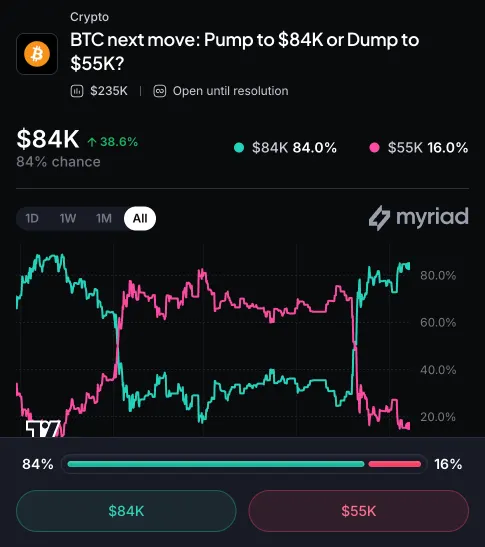
Still, he expects Bitcoin to remain range-bound before establishing a clearer direction. That cautious outlook is reflected in prediction markets, where traders continue assigning a significantly higher probability that Bitcoin’s next major move will be toward $55,000 rather than $84,000.
For now, the return of more than $221 million in ETF inflows provides a welcome boost after weeks of persistent selling. Whether it marks the beginning of renewed institutional accumulation or merely a short-term rebound will depend largely on upcoming U.S. economic data, Federal Reserve policy decisions, and whether ETF demand remains positive in the weeks ahead.