Three bets totaling about $173 were placed before news outlets reported Zacharia’s pick and are expected to pay out roughly $9,600 combined.


 Live Chat
Three bets totaling about $173 were placed before news outlets reported Zacharia’s pick and are expected to pay out roughly $9,600 combined.

Nexo has launched its crypto debit-and-credit card in Argentina, marking a deeper push into one of Latin America’s most active digital-asset markets and placing Buenos Aires at the centre of its regional expansion strategy.
The launch comes alongside a leadership change, with Andres Ondarra appointed General Manager of Nexo Argentina.
The company said the two developments mark the next stage of its growth in the country, where digital assets have become a mainstream part of wealth management for many users.
Nexo described Argentina as a market where crypto adoption runs deeper than almost anywhere else, citing the highest share of digital-asset adoption among markets surveyed.
The company also said Argentina processed approximately $93.9 billion in digital-asset transactions over three years, ranking second in Latin America behind Brazil.
The Nexo Card allows clients in Argentina to use digital assets in two ways. In debit mode, users can spend their holdings directly. In credit mode, they can borrow against those assets as collateral without selling them.
The company said clients can switch between both modes through a single interface, giving users more flexibility in how they manage and use their crypto wealth.
New clients are being offered 10% back on their first swipe.
They can also receive additional cashback and milestone rewards worth up to USD 450 in total during their first three months. Nexo said users can earn up to 13% annual interest on idle in-app balances, paid daily.
The card has previously been recognised by the Digital Banker Awards, the FinTech Breakthrough Awards, and the PAY360 Awards.
“Argentine clients have spent a decade making digital assets part of how they manage wealth. The Nexo Card is built precisely for that — letting them spend in debit mode, borrow against their holdings in credit mode, and earn from every transaction, all without having to sell. It’s the freedom to live on that wealth, not just hold it,” said Andres Ondarra, incoming General Manager, Nexo Argentina.
For Nexo, the product launch is aimed at the next phase of crypto usage in Argentina.
With capital already moved into digital assets, the company is focusing on everyday utility: spending, borrowing and earning from holdings without requiring clients to sell them.
Eligible clients in Argentina can apply for the Nexo Card through the Nexo app and website.
Ondarra will formally lead Nexo Argentina’s operations from August 1.
He brings more than 25 years of experience across traditional finance, fintech and crypto in Latin America, including a background in Wall Street investment banking.
His appointment comes as Nexo positions Buenos Aires as its regional hub for Latin America.
The company said it is investing in local infrastructure, sports partnerships, including the AFA, and a local team to support clients across the region.
Ondarra succeeds Federico Ogue, who led Nexo’s expansion in Argentina and is now moving to a new entrepreneurial venture.
“Argentina has one of the most sophisticated crypto and fintech ecosystems in the region, and the work Nexo has done here is something to be proud of. I look forward to passing the baton to Andres, who brings exactly the experience and vision to lead Nexo’s next stage of growth in Argentina,” said Ogue.

Andrew Tate, founder of the Real World, a company that sells online education courses on trading, lost nearly $100,000 while betting on Bitcoin (BTC) between Wednesday and Thursday.
Key takeaways:
A Hyperliquid wallet reportedly linked to Andrew Tate opened a 57.36 BTC long position on Wednesday, with an entry price near $66,000, according to data resource HyperDash.
The trade was worth about $3.79 million, backed by roughly $100,000 in USDC, implying leverage of around 40x.
Andrew Tate’s filled order history. Source: HyperDash
The position began unwinding on Thursday as Bitcoin fell toward the mid-$64,000 area. Ultimately, the long trade recorded about $68,600 in cumulative realized losses.
The wallet then switched direction, opening a 14.33 BTC short position worth about $1 million at $64,817. That trade was also hit as Bitcoin rebounded, with five short liquidation fills.
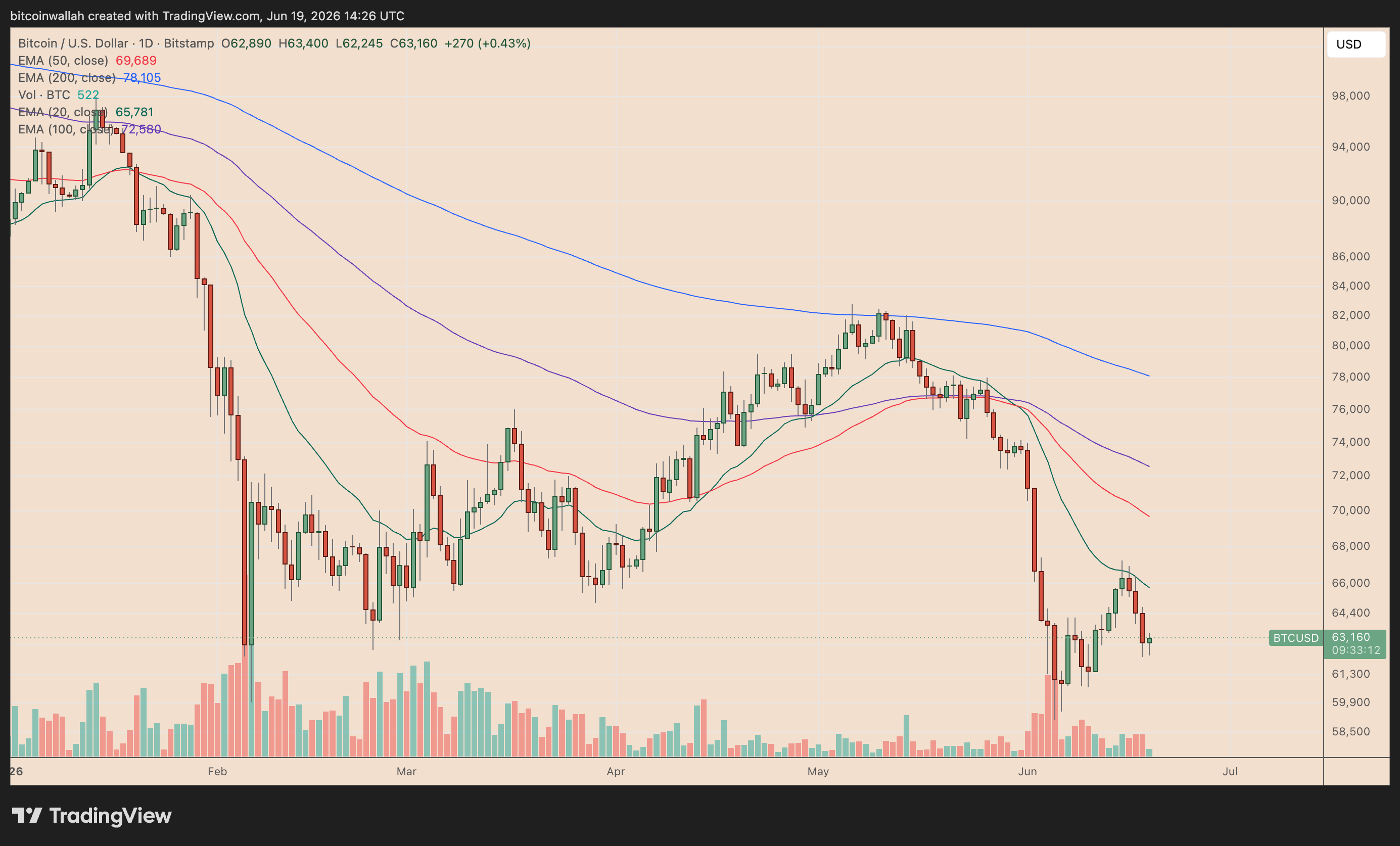
BTC/USD daily chart. Source: TradingView
By June 18, the account balance had fallen to around $14,000, thus losing almost the entire deposit.
Andrew Tate’s crypto trading issues on Hyperliquid began well before 2026.
For instance, in November 2025, his 40x BTC long position was liquidated for $235,000 on Nov. 14. By Nov. 18, multiple longs near $90,000–$95,000 were wiped out, leaving the account near zero.
Related: Bitcoin to $145K by October? Why this ‘crazy accurate’ 4chan prediction is sketchy
In another instance, Tate lost around $67,500 on World Liberty Financial (WLFI) positions ahead of a token unlock that triggered a sharp drop in September 2025. He re-entered the same trade almost immediately and lost again.
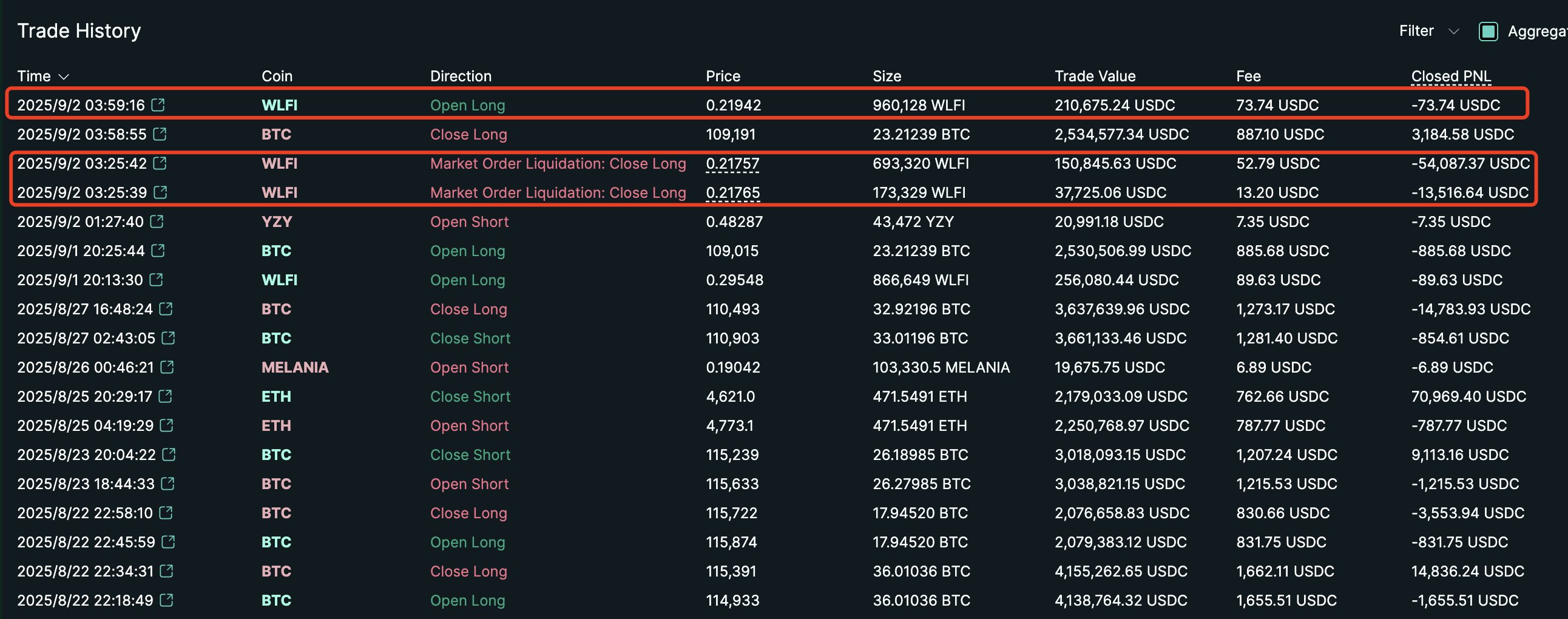
Screenshot of Tate’s WLFI positions from 2025. Source: HyperDash/Lookonchain
As of Friday, Tate’s all-time performance tab showed perpetual futures losses of $803,800, extending a drawdown that began in early 2025 and deepened again after the latest June liquidation streak.
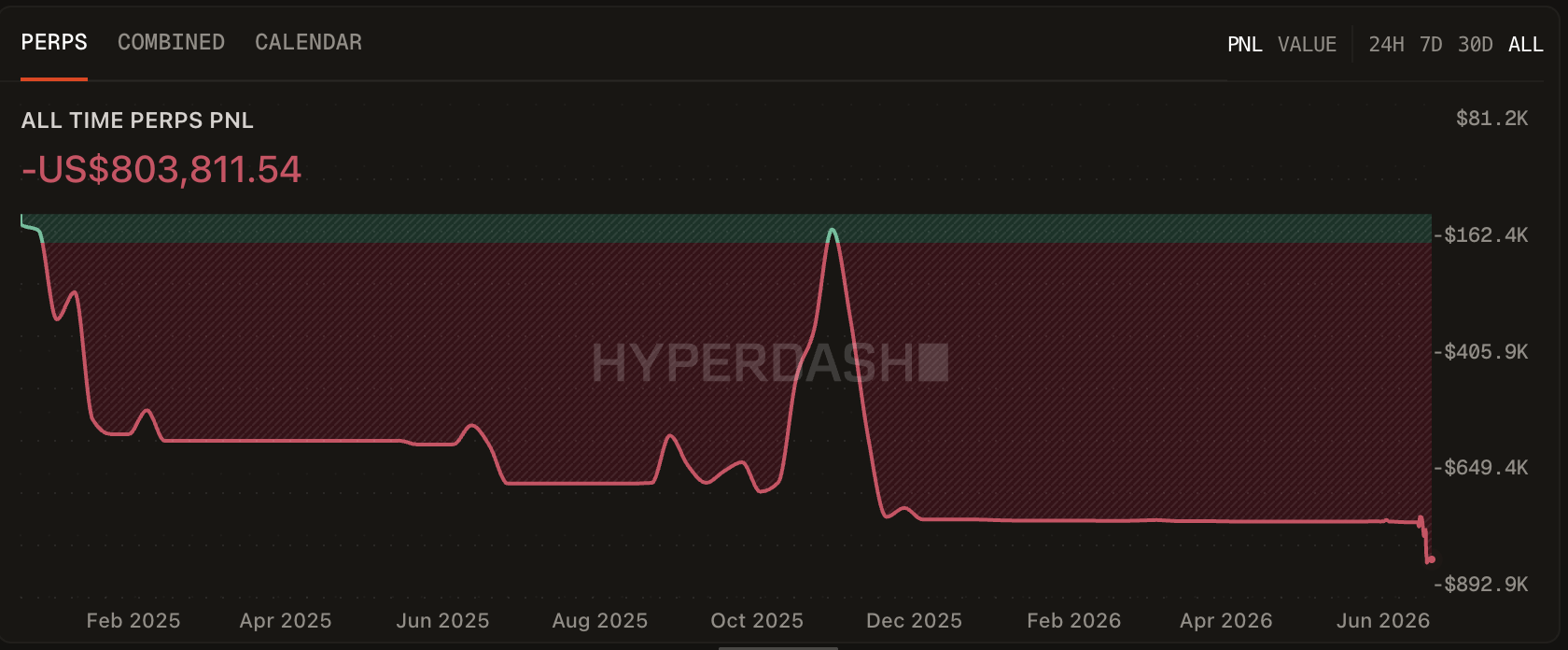
Tate’s profit-and-loss from all perp trades. Source: HyperDash
The trades show how quickly a leveraged account can lose capital in volatile market conditions, even when the underlying asset moves only a few percentage points.

Options traders are building bearish positions around Strategy’s (formerly MicroStrategy) flagship preferred STRC stock after the security fell to a record low, adding a new layer of pressure to one of Michael Saylor’s main funding tools for buying Bitcoin.
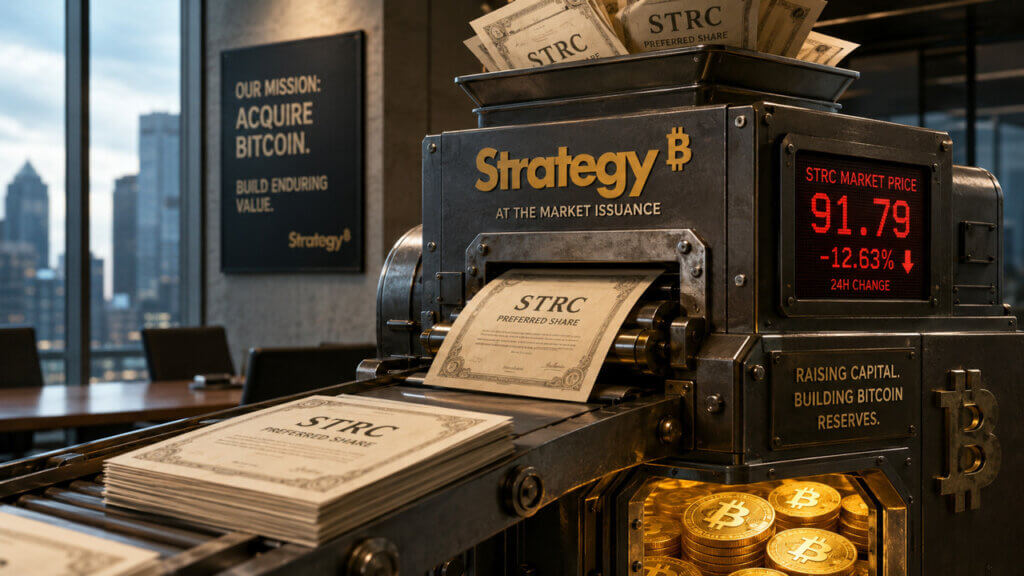
Strategy’s Variable Rate Series A Perpetual Stretch Preferred Stock, known by the ticker STRC, closed Wednesday at $89 after touching an intraday low of $88.51.
The close left the security about 11% below its stated $100 level and extended its year-to-date decline to roughly 10.7%.
The move is drawing added attention because STRC was designed to trade near $100 through monthly dividend adjustments.
Instead, the preferred stock is now trading near levels that imply investors want a higher payout for holding it, while options activity shows traders leaning toward further downside.
OptionsCharts data for STRC contracts expiring June 18 showed total put open interest of 8,951 contracts, compared with 7,906 call contracts.
That put-call open interest ratio of 1.13 is modestly bearish, but the concentration of activity is more telling. The open interest in puts stood at 1,912 contracts at the $60 strike, 1,230 at the $80 strike, and 916 at the $85 strike.
The same data showed a max-pain level of $95, above STRC’s close, while net gamma exposure stood at-$1.1 million per 1% move. Negative gamma can lead dealers to hedge in ways that amplify price swings when an asset moves lower, though the effect depends on trading flows and market depth.
This option setup indicates that traders are monitoring whether the discount to par becomes persistent enough to force a change in Strategy’s dividend policy or to slow its use of STRC as a BTC funding vehicle.
Andre Dragosch, head of research at Bitwise Europe, said STRC’s weakness suggests that Saylor may need to raise the dividend or the broader rate environment may need to ease before the preferred stock can return to $100.
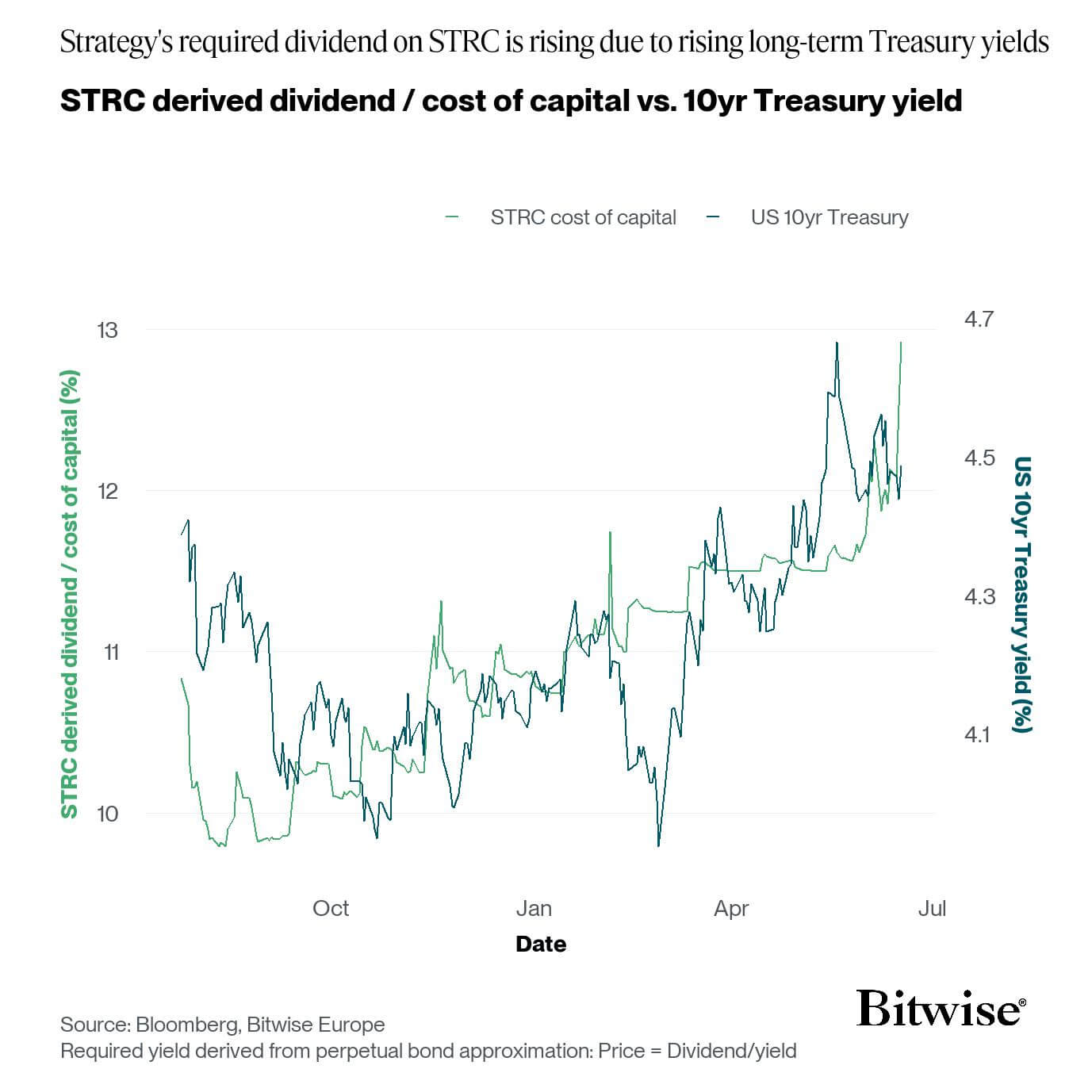
He estimated that a dividend closer to about $13 annually, or roughly 13% of the stated amount, would be needed to restore the stock to par under current conditions.
That creates a difficult trade-off. Raising the dividend could support STRC’s current price action and reopen the issuance channel, but it would also increase Strategy’s cash obligations.
On the other hand, leaving the dividend unchanged could preserve near-term cash costs, but it risks letting the discount widen further.
Strategy has sought to ease concerns over STRC by pointing to the size of its Bitcoin holdings, saying its reserves provide 32 years of dividend coverage. The company holds 846,842 BTC, worth about $54.2 billion at recent prices, making it the largest public holder of the cryptocurrency.
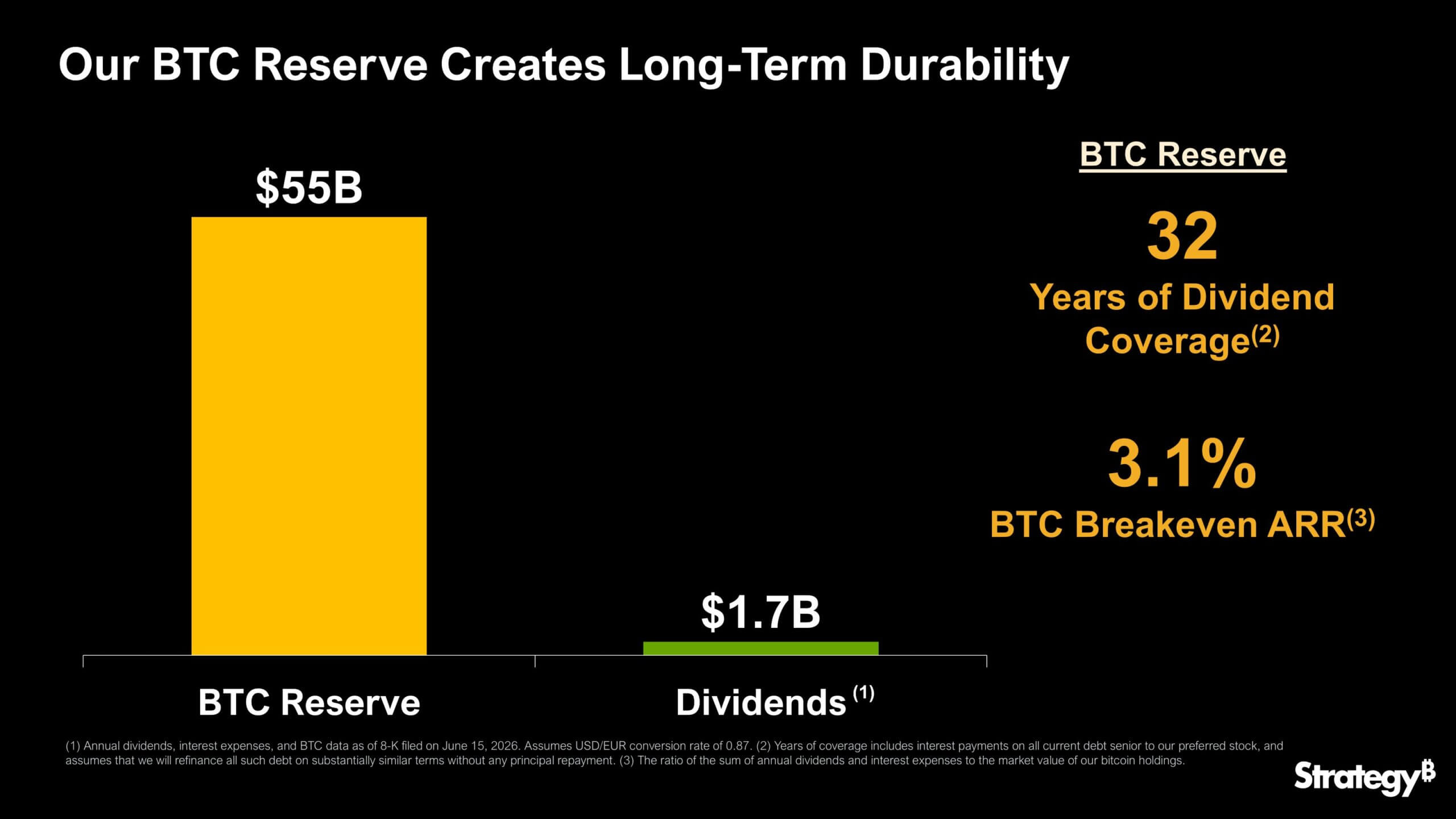
On paper, the coverage claim remains intact. Strategy’s Bitcoin treasury is worth just under $55 billion, compared with about $1.7 billion of annual preferred-dividend obligations. However, that calculation depends heavily on Bitcoin’s market price and does not answer the cash-flow question now facing investors.
CryptoQuant analyst JA Maartunn said:
“If Strategy had to sell BTC to cover those dividends, it would create selling pressure that could push BTC prices lower. That, in turn, would reduce the value of its BTC reserves and shorten the very dividend coverage it’s highlighting. In other words, if sustained, it risks becoming a downward spiral.”
Indeed, the sensitivity of that claim has already become clear. Last November, Strategy claimed it had 71 years of dividend coverage, assuming Bitcoin’s price stayed flat. But since then, Bitcoin’s price has halved, and the estimated coverage period has since fallen sharply.
That does not mean Strategy is close to exhausting its assets. The company still holds a large Bitcoin position and has raised cash by selling common stock.
However, the market’s concern has shifted from asset value to liquidity. Preferred dividends must be paid in cash when declared, while Strategy’s Bitcoin holdings fluctuate with the market and are not pledged as direct collateral to STRC investors.
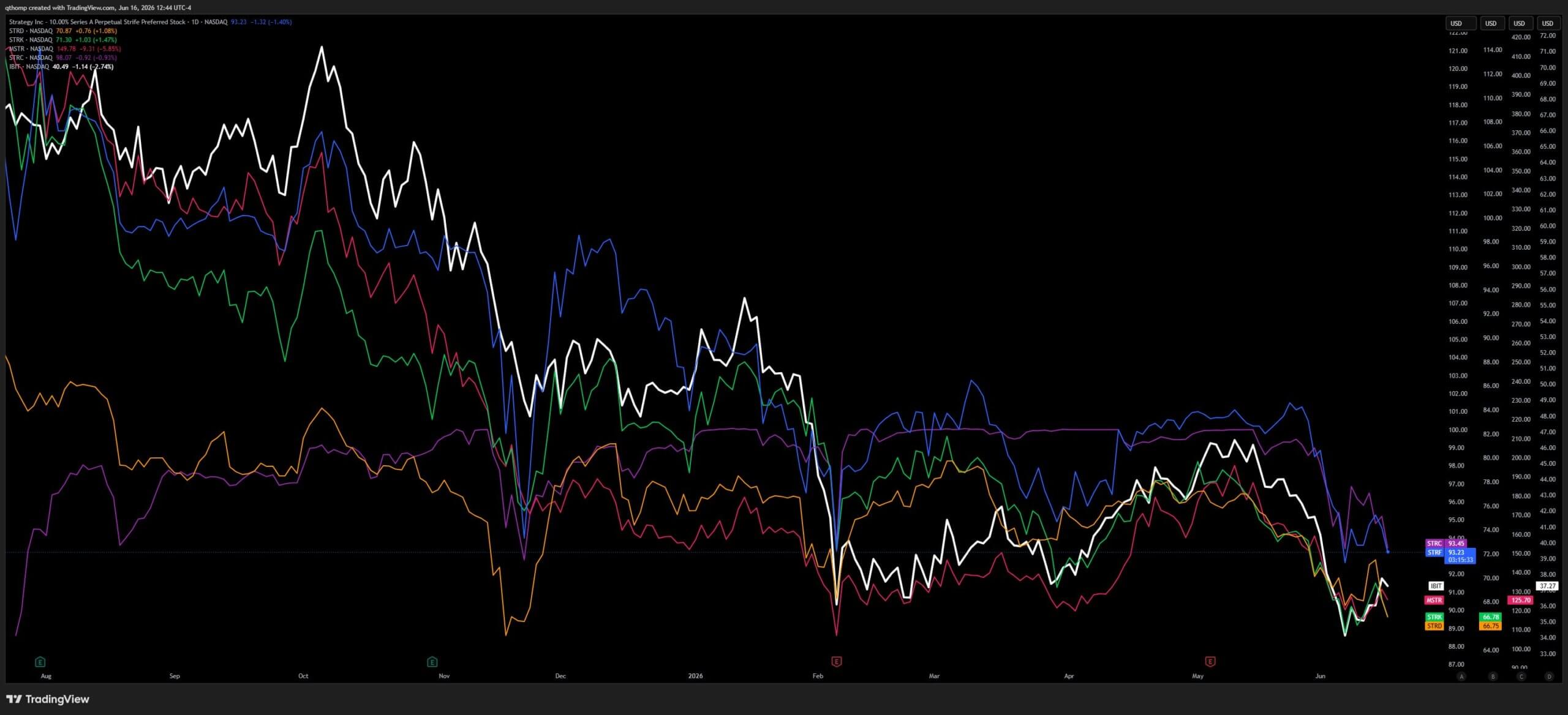
Quinn Thompson, chief investment officer of Lekker Capital, said pressure across Strategy’s capital structure is likely to persist until the company strengthens its balance sheet and improves liquidity.
According to him, the weakness has extended beyond STRC, suggesting investors are reassessing the company’s broader financing model rather than a single preferred security.
Singapore-based crypto trading firm QCP said Bitcoin’s recent underperformance partly reflects those concerns. Bitcoin has remained below $65,000 even as broader risk assets have traded higher, with traders watching whether Strategy may need to sell more Bitcoin or issue additional MSTR shares to support its preferred-stock obligations.
QCP said Strategy’s repurchase of $1.5 billion of 2029 convertible senior notes, followed by fresh common-stock sales, has added to the overhang.
The company has raised about $200 million through MSTR sales and continued to buy Bitcoin with the proceeds, but investors remain focused on how long its cash runway can support dividend payments without adding pressure to its capital structure.

On stage, co-founder and CEO JP Richardson opened by talking about the company’s derailment at the New York Stock Exchange in May 2024, when Exodus flew 130 employees, friends, and family to Manhattan only to learn the night before that regulators had pulled its listing.
He described the reversal as a rule change at “the 11th hour” that left a room of supporters stunned and forced the company back into private status despite having, in his telling, followed the playbook.
That episode ended months later after the U.S. election, when Exodus finally listed on NYSE American in January with the same team, ticker, and business, but under a new administration more open to digital asset companies.
Richardson framed that saga as proof that Exodus can absorb political and regulatory shock while holding to a single principle: money belongs under user control.
Exodus, founded in 2015 in Omaha, built a self-custodial wallet that stores keys on user devices and routes swaps across multiple liquidity providers, offering access to Bitcoin and other assets without ever holding customer funds in company accounts.
The CEO argued that crypto still fails normal users on basic usability. He recounted an early experience helping a friend download four different wallets and write a 12-word seed phrase on a cocktail napkin, a ritual he said still defines too many products a decade later. Richardson called this the “pub test”: if a friend in a bar cannot safely set up a wallet without resorting to napkins, the industry has missed the mark.
He extended that critique to chain tribalism, insisting that consumers do not care whether payments settle on Solana, Ethereum, Arbitrum, or Base as long as the experience works.
To make the point concrete, he asked the audience to pull out their phones and count how many apps they use for money. The typical screen, he said, shows a bank app, person-to-person payment apps, a brokerage account, and often a separate crypto wallet.
He cast this fragmentation as a structural problem that leaves consumers juggling providers who do not share their interests.
Exodus wants to replace that cluster with “one app” that holds digital assets, connects to card networks, and routes payments while keeping users in self-custody.
A central reveal at the summit was the closing of the Monavate and Baanx UK acquisitions, a move that shifts Exodus from “renting the rails to owning them,” in Richardson’s phrase.
Monavate and Baanx supply regulated card issuing, acquiring, and processing infrastructure in the UK and EU, including BIN sponsorship, Visa and MasterCard membership, and fraud systems that already support crypto brands such as Ledger and MetaMask.
Exodus previously agreed to acquire their parent, W3C Corp, in a roughly $175 million deal aimed at building an on-chain payments stack; the company later enforced a $70 million secured loan against that group in UK receivership to protect its position.
With those assets, Exodus gains the ability to issue and process cards directly rather than acting as a program that rides on third-party rails.
CFO James Gernetzke said the combined platform now supports six layers of activity, from the core wallet and swap engine to stablecoin issuance, card programs, and banking rails, giving Exodus “owner economics” on each step of a transaction.
On stage, he walked through a £100 purchase example, explaining that where Exodus once retained a fraction of the economics as a client of Monavate and Baanx, it now captures a larger share through interchange, processing fees, and interest on float.
Richardson and Gernetzke both made it clear that Exodus is trying to grow past a trading‑centric model after a peak year in 2025, when it generated $121.6 million in revenue and $11 million in adjusted EBITDA on a base of roughly 1.5 to 1.6 million monthly active users.
In early 2026, the limits of that dependence on crypto cycles came into sharper focus: preliminary first‑quarter results show revenue falling to $22.7 million from $36.0 million a year earlier, a $36.4 million net loss on digital assets, and a 22% quarter‑over‑quarter drop in exchange volume to $1.18 billion, even as monthly active users held at 1.5 million and funded users slipped to 1.4 million.
Gernetzke described the tight correlation between trading revenue and Bitcoin’s price as a ceiling the company needs to break.
Exodus Pay, now live in all 50 states, is the clearest expression of that strategy. Embedded in the core wallet, it lets users spend USD‑backed stablecoins, Bitcoin, and other assets anywhere Visa or Apple Pay works, while keeping keys in self‑custody and turning every checkout into interchange, processing, and float income.
Later in the Summit at a fireside chat, Richardson cast that stack as infrastructure not only for today’s users but for AI agents that will execute autonomous payments across the same rails.

Stablecoins and tokenisation will be at the forefront of how Brits make payments as the UK government overhauls regulation, a top official said this week.
The British government in a Tuesday statement announced a new range of measures to “help the UK remain at the cutting edge” with fintech — including by regulating stablecoins.
The measures would modernise payment services regulation by creating a single framework covering both traditional and tokenised payments, the Treasury said. The measures would also explore how regulation should adapt to AI agents making payments on behalf of consumers and businesses.
Stablecoins are not widely used in the UK currently, but the country’s Financial Conduct Authority is drawing up a regulatory framework for cryptoassets — including stablecoins — that will come into force in October 2027.
“Fintech is a true British success story, and we are backing the industry to maintain its competitive edge and go even further and faster in driving growth,” Lucy Rigby, economic secretary to the Treasury, said.
The Treasury also said it had appointed Chris Woolard CBE as the government’s new wholesale digital markets champion to lead the government’s work to deliver “a more efficient and competitive financial sector by building a tokenised wholesale financial markets system.”
Woolard, currently a partner at Big Four accounting firm Ernst & Young, was previously a board member and interim chief executive at the FCA. He also worked as a civil servant and served briefly as a regulator at the Bank of England, according to his LinkedIn profile and a BoE profile page.
The Treasury added that it was also bringing forward legislation to slash “administrative burdens” for companies wanting to issue stablecoins in a bid to cement the UK as “a world-leading destination for digital assets while maintaining safeguards” but did not provide additional details when contacted by DL News.
Stablecoins are largely issued by US companies, and dollar-backed tokens reign supreme. Pound sterling-backed stablecoins are a tiny market — worth just $30 million, according to DefiLlama data. Tether, the biggest stablecoin issuer, debuted a pound-backed token, but it never gained traction.

The Bank of England has called for international standards for the assets.
Dante Disparte, chief strategy officer and head of global policy and operations at stablecoin issuer Circle, warned in an op-ed this month that the UK was falling behind the US and EU with regulating the tokens.
US lawmakers now are rushing to regulate the space. The Clarity Act, which would classify most tokens as securities or digital commodities, could see a vote in May, according to Punchbowl News.
The EU also has an extensive regulatory framework for crypto and tokenised assets, the Markets in Crypto-Assets regulation, or MiCA, which analysts have said will help drive adoption of the tokens.
The UK says it’s following suit. Woolard’s appointment will help “drive tokenisation in our markets” in order to help the “next digital big bang” for the UK, Rigby said.
Mathew Di Salvo is a news correspondent with DL News. Got a tip? Email at mdisalvo@dlnews.com.

Ripple is trying to reshape the institutional case for the XRP Ledger (XRPL) around two issues that have long limited the use of public blockchains in mainstream finance: privacy and software risk.
The company’s argument is that banks, payment firms, and asset managers may be more willing to use a public ledger for tokenized cash, treasury operations, and other regulated financial activity if they can keep sensitive transaction data from a broad public view and if the network can show stronger security controls as it grows more complex.
That marks a broader repositioning for XRPL, which for years was tied mainly to cross-border payments.

Ripple now wants the ledger to be seen as part of a larger institutional stack spanning stablecoins, custody, treasury infrastructure, and tokenized asset flows, with compliance tooling and permissioned market structure layered into the network.
The timing reflects how far Ripple’s business has moved beyond a single payments narrative.
The company says Ripple Payments has processed more than $100 billion globally, while its product set now includes RLUSD, custody services, treasury software, and institutional trading infrastructure.
XRPL sits at the center of that effort as Ripple tries to present the ledger as financial plumbing rather than a retail crypto venue.
One of the clearest obstacles for institutions on public blockchains is transparency itself. Open ledgers can make settlement and audit trails easier, but they also expose balances, transaction amounts, and activity patterns in ways that many firms do not accept for trading, treasury management, or fund operations.
Ripple’s response is a proposal known as Confidential Transfers for Multi-Purpose Tokens (Confidential MPTs). The MPTs are an extension of the XLS-33 token standard.
The design would allow balances and transfer amounts to be encrypted while preserving issuer controls, such as freeze and clawback, and while still allowing validators to verify transfer correctness and supply integrity through zero-knowledge proofs.
That approach is aimed directly at regulated use cases. Ripple’s researchers describe the challenge as separating actor privacy from market integrity.
According to them, positions and transaction amounts can remain hidden, while the ledger can still verify that transfers are valid and that issuance rules are being followed.
Here, the sender and receiver identities would remain visible, preserving XRPL’s account-based structure, but the system is intended to prevent sensitive balance information from becoming publicly available.
The commercial logic is straightforward. Institutions may be more willing to use a public blockchain for tokenized funds, collateral management, or corporate treasury activity if they do not have to reveal every balance movement to competitors and other market participants.
That still leaves Ripple with an execution problem as confidential MPTs remain a research and design effort rather than a feature already operating at scale in production.

Ripple is therefore asking institutions to buy into a roadmap while competing against networks that already have a deeper foothold in tokenized finance.
The current activity mix on XRPL shows why Ripple is pushing now. The network appears to be gaining more traction in stablecoins and payment-related flows than in the active movement of tokenized securities and other real-world assets.
That split suggests Ripple has made more progress in tokenized cash and settlement than in broader capital markets use cases, making privacy one of the next major hurdles if it wants institutions to move higher-value activity onto the ledger.
Ripple’s AI push is also framed less as a product theme than as a security discipline.
The company has outlined a plan to use AI across the XRPL development cycle, including code scanning on pull requests, automated adversarial testing guided by threat models, and a dedicated AI-assisted red team focused on how features interact under real-world conditions.
Ripple says the red team has already identified more than 10 bugs and that the next XRPL release will be devoted entirely to fixes and improvements rather than new features.
That message is designed for institutional audiences that care less about AI branding than about operational reliability. A ledger designed to support stablecoins, treasury systems, and tokenized assets must demonstrate that security processes can keep pace with a growing codebase and a broader set of use cases.
Ripple has made that point explicitly. XRPL has been running since 2012, processing billions of transactions and more than 100 million ledgers.
Systems with that kind of longevity tend to accumulate older assumptions, legacy design choices, and more complicated feature interactions over time. Ripple’s position is that periodic audits and reactive patching are no longer sufficient for infrastructure that serves regulated finance.
Essentially, Ripple plans to use AI to argue that software hardening can become more continuous, systematic, and scalable than traditional review processes alone.
For institutions, that is a practical question. Public blockchains can offer 24-hour settlement, lower reconciliation costs, and programmable asset flows. They still have to prove release discipline, security oversight, and resilience under stress.
Ripple is trying to show that XRPL can meet those standards as it moves further into compliance-heavy financial applications.

This strategy also fits with Ripple’s wider push into enterprise finance.
The company has more closely tied XRPL to RLUSD, its dollar-backed stablecoin, while broadening its institutional footprint through treasury tools, custody, and prime brokerage capabilities.
It has described its acquisition of GTreasury as a way to deepen its role in corporate finance, while Ripple Prime, built from its Hidden Road acquisition, is meant to offer institutional clients clearing, financing, and access to digital-asset markets.
XRPL itself is being repositioned for that environment. Permissioned domains and a permissioned decentralized exchange are intended to support more controlled venues where access can be managed through credentials and compliance checks.
That gives Ripple a way to pitch public blockchain infrastructure in terms that are more familiar to regulated institutions.
Seen together, the effort suggests Ripple as a broader operating system for tokenized money movement, treasury activity, and selected forms of institutional DeFi.
The harder question is whether that broader infrastructure buildout creates meaningful demand for XRP itself.

That is where the market case becomes more complicated.
Bitrue Research argued in a March 27 report that the XRP ecosystem is expanding beyond payments into a wider stack that includes stablecoins, decentralized finance, sidechains, and cross-chain settlement.
The report said that growth could help deepen XRP’s role in liquidity and on-chain activity, especially if RLUSD expands, XRPFi grows, and institutional usage increases across the network.
At the same time, Bitrue highlighted a tension that sits at the center of Ripple’s strategy. Stronger infrastructure does not automatically translate into stronger value capture for XRP.
However, more economic value could accrue to RLUSD, liquidity pools, sidechain activity, or surrounding services, even as the ecosystem around XRPL becomes more active and more institutional.

That tension runs through Bitrue’s price outlook. The firm laid out a base case for XRP rising from around $1.40 in March to $1.80 to $2.00 by September, and a stronger scenario of $2.25 to $2.50 if RLUSD grows faster, the XRPFi market expands, and regulation becomes more supportive.
But the report described the central issue for 2026 as the gap between infrastructure growth and token value capture.
So, Ripple’s push into privacy and AI could help narrow that gap if it leads to more settlement activity, greater liquidity demand, and deeper institutional adoption of XRPL-based systems.

Bitcoin (BTC) bottomed after CME futures speculators turned net bullish in April 2025. A similar positioning shift is resurfacing in 2026, raising the odds of a BTC price recovery in the coming weeks.
Key takeaways:
Non-commercial Bitcoin futures traders cut their net position to about -1,600 contracts from roughly +1,000 a month earlier, according to the CFTC Commitment of Traders (COT) report published last week.
In practice, this means that large speculators, including hedge funds and similar financial institutions, have shifted from net short to long, with bulls outnumbering bears on the CME.
The rapid net-short unwind implies that “smart money” added longs “with some urgency,” said analyst Tom McClellan, while pointing to two similar past swings that preceded Bitcoin price bottoms.
For instance, BTC’s price gained around 70% after a sharp dip in CME Bitcoin futures net shorts in April 2025. In 2023, BTC price rose by over 190% under similar futures market conditions.

As of February, the smart money swing is flashing once again, just as Bitcoin defends its 200-week exponential moving average (200-week EMA, the blue line), which has acted as a bear-market floor in most major drawdowns of the last decade.
On Sunday, BTC’s 200-week EMA was hovering around near $68,350.

The last time Bitcoin traded around this moving average during deep sell-offs (in 2015, 2018 and 2020), it eventually marked the end of the downtrend and the start of a new recovery phase.
Related: Bitcoin historical price metric sees $122K ‘average return’ over 10 months
Bitcoin’s weekly relative strength index (RSI) remains in oversold territory, a sign that selling pressure is nearing exhaustion.
That further raises Bitcoin’s odds of recovering in the coming weeks. A decisive rebound from the 200-week EMA could trigger a run-up toward the 100-week EMA (the purple wave) at roughly $85,000 by April.
McClellan cautioned that the smart money shift is “a condition, not a signal,” meaning Bitcoin could still slide from its current price levels before a durable low forms.
That may trigger the 2022 scenario, wherein BTC plunged by over 40% after breaking below its 200-week EMA despite similar oversold conditions.

A repeat of that 40% plunge in 2026 could result in BTC prices falling toward $40,000, or 60% from its record high of around $126,270.
Some analysts, including Kaiko, also see BTC potentially bottoming around $40,000–$50,000 based on its “four-year cycle” framework.
This article does not contain investment advice or recommendations. Every investment and trading move involves risk, and readers should conduct their own research when making a decision. While we strive to provide accurate and timely information, Cointelegraph does not guarantee the accuracy, completeness, or reliability of any information in this article. This article may contain forward-looking statements that are subject to risks and uncertainties. Cointelegraph will not be liable for any loss or damage arising from your reliance on this information.

No votes yet – Be the first to vote
Bitcoin climbs close to $66,500. Traders pile into short positions at levels not seen since 2024, creating a weird contradiction that’s got the crypto world buzzing.
The numbers don’t lie – short positions against Bitcoin jumped to extreme levels over the past week. Data from multiple exchanges shows bearish bets spiking as the price pushes higher. It’s the kind of setup that makes veteran traders scratch their heads. When everyone’s betting one way, markets have a funny habit of doing the opposite. And Bitcoin? Well, it’s never been one to follow the crowd.
Markets love extremes.
Binance reported a massive surge in Bitcoin futures trading on February 12. Volume spiked 40% compared to the previous week, with most of that action coming from short positions. The exchange’s data shows traders aren’t just dipping their toes – they’re going all-in on bearish bets. But here’s the thing: extreme sentiment often marks turning points, not continuation patterns.
JPMorgan analysts weighed in recently, pointing to broader economic uncertainty as the driver behind the short squeeze. “The increase in short positions reflects institutional caution amid potential monetary policy shifts,” one analyst said. They’re probably right about the macro picture, but Bitcoin has this annoying habit of ignoring traditional financial logic.
Retail investors tell a different story entirely. Glassnode’s February 10 report caught something interesting – new Bitcoin addresses jumped 15% over the past two weeks. So while the big money bets against Bitcoin, regular folks keep buying. That disconnect? It’s happened before, and it usually ends with someone getting burned.
Coinbase stayed quiet on the whole mess. No comment, no statement, nothing. Sometimes silence speaks louder than words in this business. See also: Bitcoin Metrics Turn Red as Bears.
The pattern looks familiar to anyone who lived through 2024’s wild ride. Short positions peaked in March that year, right before Bitcoin ripped higher for six straight weeks. History doesn’t repeat, but it sure likes to rhyme. And right now, the rhyme scheme looks pretty clear.
Kraken saw its own surge in activity on February 11. Spot trading volume jumped 30% as users repositioned ahead of what many expect will be serious volatility. The exchange’s data shows both buying and selling pressure building, creating the kind of coiled spring that can explode in either direction. But with shorts this heavy, the path of least resistance might surprise people.
MicroStrategy’s Michael Saylor doubled down on his Bitcoin bet this week, announcing the company won’t change course despite the bearish noise. “We’re accumulating regardless of short-term sentiment,” he said during a recent interview. That’s either brilliant contrarian thinking or stubborn denial. Time will tell which one it is.
The institutional money tells two stories. CoinShares reported $50 million in Bitcoin fund inflows last week, even as short positions climbed. So some big players are buying while others are selling. That kind of split usually means something big is coming – the question is which direction.
CME futures activity exploded higher too. Open interest jumped 25% by February 12, with most of that coming from new short positions. The Chicago exchange hasn’t seen this kind of bearish positioning since Bitcoin hit its 2024 lows. Back then, all those shorts got squeezed when the market reversed. Could be different this time. Could be exactly the same. For more details, see Bitcoin plummets 40% since october, returns.
The macro picture isn’t helping Bitcoin’s case much. Interest rate uncertainty and regulatory pressure from multiple governments have crypto traders on edge. But Bitcoin’s survived worse storms than this one. The question isn’t whether it can handle the pressure – it’s whether the shorts can handle what comes next.
Technical indicators show Bitcoin sitting at a critical level near $66,500. Break higher and those shorts are in serious trouble. Break lower and the bears get their payday. With positioning this extreme, the move will probably be violent either way.
Market makers are watching every tick. Any shift in sentiment could trigger massive covering or more aggressive shorting. The next few trading sessions will likely determine whether Bitcoin breaks out or breaks down from this tense standoff.
The options market is painting an even more dramatic picture. Put-call ratios for Bitcoin options hit their highest levels since March 2024, according to Deribit data from February 13. Traders are paying premium prices for downside protection, with 30-day implied volatility spiking to 85%. That’s fear talking, not logic. When options traders get this nervous, big moves usually follow within days, not weeks.
Meanwhile, whale activity suggests the smart money might be positioning for a different outcome entirely. Blockchain analytics firm Santiment tracked 47 large Bitcoin transactions exceeding $10 million each over the past 72 hours. Most were accumulation moves, not distribution. These aren’t retail investors panic-buying – these are sophisticated players with serious capital making calculated bets against the crowd.
Post Views: 12

Aliens more probable than a $200K Bitcoin? Polymarket bettors seem to think so.
Investor sentiment flipped sharply bearish as Bitcoin (BTC) and major crypto assets succumbed to macroeconomic pressures. Polymarket’s latest tweet has injected a fresh dose of skepticism into the Bitcoin narrative.
The decentralized prediction market humorously noted that the odds of aliens being confirmed this year (6%) slightly surpass Bitcoin hitting $200,000 (5%). Yet beneath the levity, Polymarket’s data highlighted a more serious near-term risk.
Polymarket is seeing a 52% chance that Bitcoin could crash below $100,000 this month. This is in line with the broader market unease, as crypto analyst Ted Pillow recently stated that Bitcoin has already lost its critical $108,000 support level, which has left a minimal buffer until $101,000-$102,000. Pillow stated that a reclaim of $110,000 could trigger a short-term bounce, but otherwise, traders should brace for more pain before relief arrives.
Adding to the cautionary sentiment, Doctor Profit, another popular market analyst, called the current environment the “early phase of the bear market,” which is seeing intense deceptive mini-rallies and sharp downside moves. He predicted the macro bottom would eventually settle between $60,000-$70,000.
According to Doctor Profit, traders should expect increasing selling pressure, with the Fear & Greed Index likely reaching extreme fear levels in the coming days, further backed by the red numbers across the charts. As such, these factors paint a picture of a market navigating a precarious balance.
“Remember, dead cat bounces are the biggest enemy for us shorts. Play them or ignore them, but don’t fight them.”
Macro uncertainty continues to weigh heavily on Bitcoin, and Glassnode revealed a major change in sentiment across markets and derivatives. Over the past week, gold has outperformed Bitcoin by more than 20%, reclaiming part of its “store-of-value” appeal. This was indicative of investors’ growing caution toward crypto.
This caution has spilled over into the options market. Short-dated BTC volatility spiked sharply overnight, while front-end options traded around 50 vol as traders paid up for immediate downside protection. BTC skew still behaves like a macro asset, favoring puts – downside protection remains pricier than upside exposure amidst defensive positioning. The market is balanced, as seen with some accounts rolling protection lower, others selling volatility on the dip, and a few selectively buying cheap calls. Overall, the tone is cautious but not one-sided.
Broader volatility metrics confirm this defensiveness. Put-heavy skew, bid wing vols, and strong demand for tail hedges indicate traders remain focused on downside risk. Year-end upside exposure has cooled as downside vol continues to dominate. For those willing to take risks, selling puts or put spreads to finance November topside remains a viable strategy.
LIMITED OFFER for CryptoPotato readers at Bybit: Use this link to register and open a $500 FREE position on any coin!


