A judge stayed the CFTC’s civil case against a soldier who allegedly used nonpublic information for a Polymarket bet, but the regulator is trying to weigh in on the criminal case.

 Live Chat

A judge stayed the CFTC’s civil case against a soldier who allegedly used nonpublic information for a Polymarket bet, but the regulator is trying to weigh in on the criminal case.

Willemstad, Curaçao, August 14th, 2026, PlayNewswire
A high-stakes crypto player connected to 1win’s Global Crypto Ambassador network received a 1.749 million USDC payout following a seven-figure wager on Paris Saint-Germain against Aston Villa in the 2026 tUEFA Super Cup.
The payout was received in USDC via the Ethereum network. Both the original deposit and subsequent withdrawal are publicly traceable on-chain, providing independent confirmation of the movement of funds.
The player joined 1win through the network of one of the brand’s Global Crypto Ambassadors, following the recent launch of the 1win Global Crypto Ambassador program. The initiative was designed to build a worldwide network of crypto-native creators, community leaders and active Web3 participants, as well as to connect 1win with established crypto communities.
The latest result also follows another seven-figure bet placed on 1win earlier this summer. In July, Mia Khalifa received a total payout of $1.65 million after placing a $1 million bet on Spain to defeat Argentina in the 2026 FIFA World Cup final.
The two million-dollar wagers within weeks of each other highlight the growing presence of high-stakes players on the platform. The latest case also demonstrates the role of stablecoins in high-value iGaming transactions, with the full cycle from deposit to payout conducted in USDC and recorded on Ethereum.
The win comes as 1win continues expanding its presence among crypto-native audiences, combining its Global Crypto Ambassador program with an increasing focus on digital assets and Web3 communities.
About 1win
Founded in 2016, 1win is a crypto entertainment platform in the global gaming industry. Operating across Asia, Latin America, and Africa, 1win offers a wide range of entertainment products adapted to regional audiences. The brand has active collaborations with international public figures, including football legend Luis Suarez, martial artist Jon Jones, and Olympic champion and UFC fighter Gable Steveson. In 2026, 1win welcomed rapper Tyga, UFC legend Ilia Topuria, and reggaeton star Nicky Jam as members of the 1win VIP community.
Press Office
1win
press@1win.pro
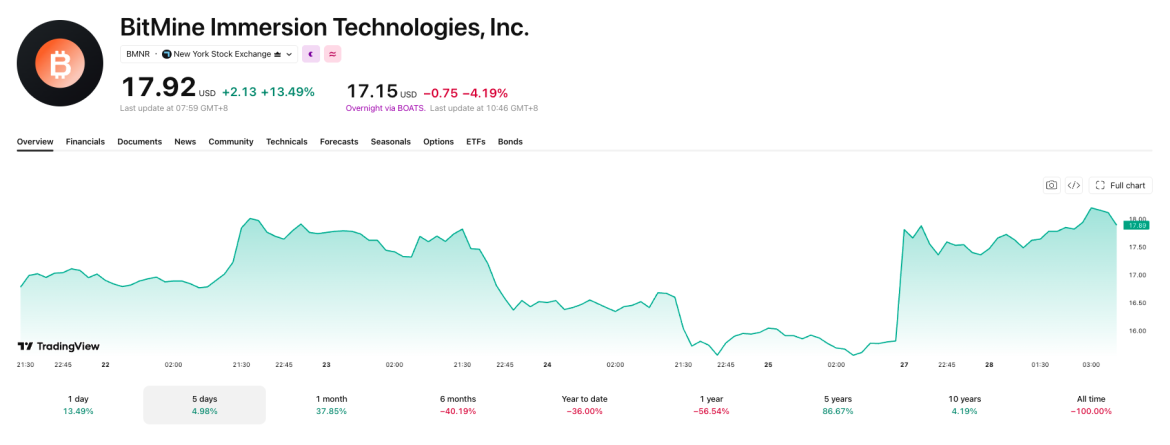
Bitmine Immersion Technologies (BMNR) shares popped 13% Monday after a fresh treasury update. It was the best-performing stock of the day on Wall Street. The Ethereum (ETH) firm’s $11.8 billion in crypto, cash, and equity stakes reassured Wall Street investors.
The company now holds 5.79 million ETH tokens, equal to 4.8% of Ethereum’s 120.7 million circulating supply. That puts Bitmine very close to its 5% accumulation target it set 13 months ago.
Bitmine repurchased 6.1 million shares last week, up from 5.5 million the week before. That brought total repurchases to 11.6 million shares since July 1, under a $4 billion buyback program. Bitmine unveiled that program at its April NYSE main-board debut.
Chairman Tom Lee framed the accumulation as a long-term commitment rather than opportunistic trading.
“Bitmine has bought ETH every week since the inception of the ETH Treasury Strategy on June 30, 2025.”
— Lee
The firm also runs MAVAN, its own Ethereum staking network, which now holds 4.9 million staked ETH. Bitmine currently projects $254 million in annualized staking revenue. That could reach $299 million once its entire ETH position is staked.
Backers including Cathie Wood’s ARK Invest, Pantera Capital, and Galaxy Digital have supported Bitmine’s strategy. That reflects institutional appetite for Ethereum treasury companies well beyond retail traders.
BMNR now ranks among the most actively traded US stocks by dollar volume, Fundstrat data show.
The rally comes as other Ethereum treasury firms, including SharpLink, keep building ETH positions despite a choppy year. Whether Bitmine’s buyback pace and staking revenue hold up may determine if Wall Street’s patience with crypto treasuries continues.
The post Bitmine Stock Pops 13% as ETH Treasury Bet Pays Off on Wall Street appeared first on BeInCrypto.

Base creator Jesse Pollak says he is stepping back from leading the Base App after admitting he made a “wrong bet” on social, leaving the chain to fall behind on prediction markets and perpetual futures.
In a post to X on Wednesday, Pollak said he had bet that creator, content and messaging apps would drive adoption, but instead the market “disintegrated completely.”
“We realized how our focus on social had meant that base had fallen behind in key areas that were now increasingly critical — we had perps (shoutout avantis!) and prediction markets (shoutout limitless!), but both were well behind scaled competitors.”
Dune Analytics data shows Base-native prediction market Limitless accounted for just 0.5% of total monthly notional volume across prediction markets in July. Perpetual decentralized exchange (DEX) Avantis ranked 18th by reported 30-day notional trading volume, according to DefiLlama.
Pollak’s comments give further insight into the reversal of Base’s growth strategy earlier this year. While Base initially focused on social products such as Farcaster, Zora and miniapps to bring crypto to “a billion people,” Pollak said financial applications are the way forward for the network, with a focus on trading, payments and AI agents.
Limitless Exchange’s monthly notional volume is only a fraction of its larger competitors. Source: Dune Analytics
Pollak added he will be returning leadership of the Base App to Coinbase, under Jordan Fish, known on X as “Cobie,” while he focuses on the Base blockchain.
Pollak’s post came just days after Coinbase CEO Brian Armstrong acknowledged content coins “didn’t work,” prompting the company to pivot earlier this year.
“We messed up, time to turn the page,” Armstrong said on Monday.
In February, Base sunset its Creator Rewards program and Farcaster-powered social feed as part of a strategic shift to tradable assets.
Related: Moonbeam to pivot from Polkadot to Base, unveils AI agent framework
The Creator Rewards program launched in July 2025 and was intended to make the Ethereum layer-2 Base a more social ecosystem, where activity and engagement translate into earnings. Meanwhile, Pollak admitted the Base App was an “imperfect Farcaster client.”
Last week, Base activated its B20 token standard on the mainnet, introducing a native framework for stablecoins, tokenized real-world assets (RWAs) and other fungible tokens.
In May, Base launched Base MCP (Model Context Protocol), a tool that lets users manage their crypto directly from an AI model’s chat interface and interact with crypto protocols such as Morpho, Moonwell, Uniswap, Aerodrome, Avantis, Bankr and Virtuals.
In April, Base said it was upgrading key systems in preparation for an AI agent economy as part of its 2026 roadmap. It highlighted real-world asset (RWA) tokenization, stablecoins, and prediction markets as being key growth areas in 2026.
“We’re going to build base into the blockchain for global finance and do everything we can to be the place that the world’s money settles over the next century,” Pollak said on Wednesday.
Magazine: Is Robinhood Chain’s success bullish or bearish for ETH the asset?

DeFi has long promised open and self-custodial finance. But for most users, actually using it still means juggling through wallets, dApps, bridges, pools, approvals, and risks that are very hard to understand in real time, especially for someone who’s relatively new to the industry.
CoinFello believes that the experience is ready for a major shift. With Fello 1, the company is building a self-sovereign AI agent designed to help users interact with DeFi through plain language while keeping complete control over their wallets and keys.
In the following interview with the founder, we go through why agents could become the primary interface for onchain finance, how controlled delegation can make automation a lot safer, and why liquidity provision is one of the first major frontiers for agent-powered decentralized finance.
CoinFello is positioning itself as a self-sovereign AI agent for DeFi. In simple terms, what problem are you trying to solve that wallets and dapps have not solved yet?
CoinFello is a completely new way to understand, use, and automate smart contracts.
The previous paradigm required users to create a wallet, navigate many disjointed websites, connect that wallet to a website, and then almost blindly trust that the smart contracts on that website do what the website promises they do. This made DeFi inaccessible, extremely complicated, and dangerous, and was one of the primary barriers to broader DeFi adoption.
CoinFello’s approach is to give users an agent that can interface directly with the smart contracts through a Claude-like user experience that people are familiar with. The agent isn’t just easier to use, it also opens up new frontiers of automation, where agents can act on behalf of users to accomplish virtually anything in DeFi: batch swap multiple tokens and bridge them across networks, discover advanced yield strategies, optimize existing deposits, take out a loan and automate payments, and a whole lot more. CoinFello makes doing these things super simple.
Fello 1 is described as a general-purpose DeFi agent rather than a narrowly integrated assistant. Why is general-purpose execution important, and what does it unlock for users that protocol-specific interfaces cannot?
DeFi is not one app or use case.
DeFi is an ecosystem of contracts, protocols, pools, vaults, bridges, and networks that constantly change.
Unfortunately, most of the crypto AI agent products on the market are just trading bots connected to some centralized API. If an agent only works through narrow integrations, it will always be limited to a few narrow use cases. That’s not how people use the internet (web browsers), their phones (extensible smartphones), AI agents, or even Ethereum itself. All of the great innovations were fundamentally extensible.
General-purpose execution means Fello 1 can reason about and interact with EVM-compatible smart contracts more broadly, instead of being locked into a small set of pre-built workflows. That unlocks all kinds of use cases that we ourselves never anticipate or integrate with. New pools, new protocols, and new opportunities can become accessible faster, without waiting for a dedicated front end or a code release for every specific action.
For the user, the benefit is simple: they do not need to jump between ten different interfaces to complete one DeFi strategy. They can describe what they want, review the steps, and execute across protocols from one agentic interface.
One of CoinFello’s core promises is that users can interact with DeFi through plain language while keeping custody of their wallets and private keys. How do you balance ease of use with the security expectations of self-custody?
We’ve tried to bring self-custody principles to the agentic era. This means that funds must remain in a self-custodied wallet, and agents should have guardrails enforced on them that define what funds they can access, in what ways those funds can be used, and for how long that agent has access to those funds.
With Fello 1, users keep their wallets and private keys. The agent operates through limited permissions that the user chooses to grant, and users review and approve transactions before execution. Plain language is the interface layer, not a replacement for consent. We fundamentally disagree with the approach of transferring funds to a centralized trading bot and hoping for the best.
The goal is to reduce cognitive overload without reducing user sovereignty. Fello can do the math, explain the route, surface the risks, prepare the transaction, and monitor positions, but the user remains in control of what permissions exist and what actually gets executed.
The Fello 1 launch puts a lot of emphasis on liquidity provision, including Uniswap V2, V3, and V4 positions, fee tiers, impermanent loss, and live position monitoring. Why did you choose LP management as such an important use case for the product?
Liquidity provision is one of the best examples of DeFi’s promise and its complexity. Concentrated liquidity can be a powerful yield opportunity, but it asks a lot from the user. You need to understand price ranges, ticks, fee tiers, pool selection, position sizing, impermanent loss, and when your liquidity is in or out of range.
That is exactly the kind of experience where an AI agent can create real value. Fello 1 can handle the mechanical and analytical parts: identifying LP strategies, doing the math, monitoring the position, explaining whether it is in range, showing the real return, and helping the user understand the trade-offs.
We chose LP management because it is not just a button-clicking problem. It is a decision-support problem. If we can make LPing understandable and manageable for more users while keeping them self-custodial, that is a major step toward making DeFi more mainstream.
AI agents in crypto are often associated with automation, but CoinFello says Fello 1 is not designed as an autonomous trading bot and that users still review and approve transactions. Where do you draw the line between helpful automation and too much delegation?
To be clear, we are building for automation, and we deeply believe users should be able to delegate approval for tightly defined automations to their agent. These are very complex problems to solve, so we’ve been working to expand the agent’s capabilities and the kinds of automation the user can create through the permissions and delegations we’ve been championing.
You previously led operations at MetaMask, one of the most important wallet products in crypto. What did that experience teach you about user behavior, wallet UX, and self-custody that directly shaped CoinFello?
MetaMask had a very radical vision in the early days of Ethereum. Most people at the time were building “use case wallets” with a handful of brittle integrations. MetaMask sought to do something else: create a permissionless and extensible wallet that could be used with any smart contract protocol.
We’ve brought the same radical values and vision to CoinFello that we previously used to build MetaMask. While most in the agent space are building narrow “use case bots,” our goal is different: to bring users onchain, and give them access to the entire decentralized web.
We also learned about the limitations of trying to solve the safety and user experience problems at the wallet layer. Wallets are forced to maintain endless integrations with third party protocols, and these integrations make their products slow to innovate, highly prone to bugs, and generally dangerous because the wallet still can’t understand what a smart contract *actually does.*
CoinFello is how we will solve these problems for the next wave of on-chain innovation.
CoinFello relies on a delegation model where users grant agents limited permissions that can be modified or revoked. What does a safe permission system for onchain AI agents need to look like as these tools become more powerful?
A safe permission system needs to be specific, limited, transparent, and revocable.
Users should not have to grant broad, unlimited authority over funds to an agent. Permissions should be scoped by action type, asset, protocol, amount, duration, and any other relevant rule the user cares about. The user should be able to see what permissions exist, understand what they allow, and revoke or modify them at any time.
As agents become more powerful, permission design becomes one of the most important parts of the stack. The future is not giving the AI your keys. The future is controlled delegation, where the agent can help execute within boundaries that the user defines. That is how we get the benefits of automation without sacrificing self-sovereignty.
Looking ahead, do you think the future of DeFi will still be built around users manually navigating dapps, or will agents become the primary interface for onchain finance?
I think dapps will still matter, but agents will become the primary interface for most users.
Today, DeFi still looks like the early internet in some ways. Users manually navigate different websites, learn different interfaces, and stitch together actions themselves. That works for power users, but it does not scale to broader adoption.
Agents change the interface from navigation to intent. Instead of asking users to know exactly which protocol to use and which buttons to click, they can say what they want to accomplish, compare options, understand risks, and approve execution.
The future of on-chain finance will still be open, composable, and self-custodial. But the way users access it will become much more conversational, automated, and personalized. Our view is that agents will become the execution layer that makes DeFi usable for the next wave of users.
Disclaimer: The content shared in this interview is for informational purposes only and does not constitute financial advice, investment recommendation, or endorsement of any project, protocol, or asset. The cryptocurrency space involves risk and volatility. Readers are encouraged to conduct their own research and consult with qualified professionals before making any financial decisions. This interview was conducted in cooperation with CoinFello, who generously shared their time and insights. The content has been reviewed and approved for publication in mutual understanding. Minor edits have been made for clarity and readability, while preserving the substance and tone of the original conversation.
LIMITED OFFER for CryptoPotato readers at Bybit: Use this link to register and open a $500 FREE position on any coin!

How to run it on your PC
Creative writing

Coding

Sensitive topics

Start every day with the top news stories right now, plus original features, a podcast, videos and more.

Phong Le, President and CEO of Strategy, the world’s first and largest Bitcoin treasury firm, said Morgan Stanley’s proposed bitcoin ETF could unlock as much as $160 billion in demand under a modest portfolio allocation scenario.
“Morgan Stanley Wealth Management oversees about $8 trillion in AUM and recommends 0–4% bitcoin allocation,” Le wrote on X. “A 2% allocation would represent $160 billion, about three times the size of IBIT. MSBT: Monster Bitcoin.”
In other words, Le is saying that even a modest 2% bitcoin allocation across Morgan Stanley’s $8 trillion wealth platform could drive about $160 billion into bitcoin, far exceeding the size of existing ETFs like BlackRock’s iShares Bitcoin Trust.
The comment landed as Morgan Stanley advanced plans for its own spot BTC ETF, revealing new details in a filing with the U.S. Securities and Exchange Commission. The fund would trade under the ticker MSBT, a symbol that Le cast as shorthand for the potential scale of institutional demand.
Morgan Stanley’s amended S-1 outlines a structure familiar to the growing class of spot BTC ETFs. The trust is set to list on NYSE Arca with a 10,000-share creation unit and an initial seed basket of 50,000 shares, expected to raise about $1 million. The bank also disclosed it purchased two shares earlier this month for audit purposes.
Key service providers mirror those used across the ETF ecosystem. BNY Mellon will act as cash custodian, administrator, and transfer agent, while Coinbase is set to serve as prime broker and custodian for the fund’s bitcoin.
The product would hold BTC directly, aligning with the structure that has defined the current wave of the U.S.-listed spot ETFs.
Le’s framing points to a larger question that sits beyond the mechanics of the filing: how much capital wealth managers may allocate if BTC becomes a standard portfolio component. Morgan Stanley Wealth Management, with trillions in client assets, has signaled that bitcoin exposure can range from zero to four percent depending on client profile.
Even a midpoint allocation, as Le noted, would imply flows that exceed the size of existing flagship products such as iShares Bitcoin Trust.
So far, adoption has moved in stages. Since spot BTC ETFs launched in 2024, the category has attracted more than $50 billion in inflows, driven in large part by self-directed investors. Within advisory channels, uptake remains uneven, shaped by internal policies, risk models, and client demand.
Morgan Stanley has already taken steps in that direction, allowing brokerage clients to access spot BTC ETFs and widening availability over time. The MSBT filing suggests a shift from distribution toward ownership of the product itself, a move that could deepen the bank’s role in the market if approval is granted.
The SEC has not provided a timeline for a decision, and approval is not assured. Still, the application marks a notable development: a major U.S. bank seeking to issue its own spot bitcoin ETF in a market it once approached with caution.

Visa just dropped a roadmap for the future of finance, and it runs on programmable money.
In a comprehensive new report, the payments giant is stating to its network of over 15,000 financial institutions that the $670 billion stablecoin lending market is no longer just an experiment in crypto. This market is the foundation for the next generation of global credit markets.
With the GENIUS Act now establishing a regulatory framework for stablecoins in the US, Visa sees an opening to bridge traditional banking with blockchain-based lending protocols that operate 24/7, automatically adjust interest rates based on supply and demand, and settle transactions in minutes rather than days.
The data Visa presents paints a picture of rapid institutional adoption. In August 2025 alone, $51.7 billion in stablecoins were borrowed across 427,000 loans from 81,000 active borrowers.
These aren’t small retail transactions, as the average loan size has recovered to $121,000, suggesting institutional players are increasingly comfortable with programmable credit markets.
Additionally, the concentration tells its own story. Two protocols, Aave and Compound, dominate the lending market with 89% of the lending volume, while USDC and USDT account for over 98% of the stablecoin supply powering these markets.
Ethereum and Polygon maintain a roughly 85% market share, while newer chains like Base, Arbitrum, and Solana are gaining ground, accounting for 11% of combined activity.
Borrowing rates averaged 6.4% APR in August 2025, with lending yields at 5.1% APY. These rates sit remarkably close to traditional credit markets, especially considering the 24/7 availability and instant settlement that smart contracts provide.
Visa’s roadmap centers on three transformative shifts that could reshape how banks think about lending, collateral, and credit assessment.
The first is the tokenized asset market, which has already grown from $5 billion in December 2023 to $12.7 billion today.
McKinsey projects the sector could reach $1 trillion to $4 trillion by 2030, but Visa sees an even bigger prize by connecting the traditional credit market of over $40 trillion to programmable money rails.
BlackRock’s BUIDL Fund exemplifies this evolution, reaching $2.9 billion in tokenized Treasury holdings while serving as collateral across multiple lending protocols.
Franklin Templeton’s OnChain U.S. Government Money Fund adds another $800 million, while MakerDAO now derives nearly 30% of its $6.6 billion balance sheet from real-world assets.
Corporate bonds, private credit, and real estate could soon serve as collateral in always-on global lending markets, creating new liquidity sources for assets that traditionally sat idle between trading sessions.
The next pillar is crypto collateral. Early movers, such as ether.fi, are already launching non-custodial credit cards that enable users to borrow against their crypto holdings while maintaining asset ownership.
This addresses a critical issue of accessing liquidity without triggering capital gains taxes or forfeiting upside exposure.
Real-time collateral monitoring through smart contracts enables automated margin calls and risk management that traditional credit facilities cannot match.
Banks and private credit funds could serve as liquidity providers to these programs, offering institutional capital through programmable protocols rather than bilateral credit agreements.
The third pillar is on-chain identity. The current overcollateralization model, while secure, limits the market to borrowers who already possess significant assets.
The next breakthrough involves developing on-chain identity and credit scoring systems that analyze wallet transaction history, asset holdings, and protocol interactions to construct credit profiles.
Platforms like 3Jane, Providence, and Credora are pioneering methods to assess creditworthiness based on verifiable on-chain behavior, all while preserving privacy through the use of zero-knowledge proofs.
This could eventually enable protocols to offer undercollateralized and unsecured loans based on reputation and credit history.
The shift from traditional lending to programmable credit markets requires fundamental changes in how financial institutions assess and manage risk.
Instead of analyzing balance sheets and legal agreements, banks must evaluate protocol security audits, governance structures, and the reliability of data sources.
This doesn’t eliminate risk, but instead transforms it. Counterparty risk can be managed through smart contracts and automated liquidation, but technology risk becomes paramount.
Banks need new frameworks for understanding smart contract vulnerabilities, governance token voting mechanisms, and oracle dependencies.
In addition, three case studies in Visa’s report demonstrate how leading protocols are already serving institutional needs beyond crypto trading.
Morpho aggregates demand and liquidity across platforms, enabling users on Coinbase to tap into shared pools that include deposits from Ledger wallet users and institutional partners, such as Société Générale.
Credit Coop uses programmable lockboxes to enable revenue-based lending, with stablecoin-linked card issuer Rain borrowing over $175 million in USDC against future receivables.
Huma Finance powers cross-border payment financing with a $500 million monthly transaction volume, offering APYs of 10% or more to lenders through rapid capital recycling.
These are production systems that process hundreds of millions of dollars in monthly volume, while offering yields that traditional banking products struggle to match.
Visa’s message to its bank partners is that the infrastructure for programmable lending already exists, processes billions in monthly volume, and offers competitive rates with superior transparency and automation.
The regulatory framework is emerging, institutional adoption is accelerating, and technical risks are increasingly well understood.
Organizations that embrace this infrastructure today position themselves to lead tomorrow’s global credit markets. Those who wait may find themselves competing against always-on, algorithmically managed lending protocols that offer 24/7 service, instant settlement, and transparent pricing.
The question for traditional banks isn’t whether stablecoin-powered lending will reshape credit markets, as the data suggests it already has.
The question is whether they’ll participate in defining that future or find themselves disrupted by it.


