Applied Optoelectronics told the WSJ it objected because it was unsure how tokenization would affect its stock price, liquidity and volatility.

Among
Bybit Reports Lowest BTC Spot Slippage Among Major Crypto Exchanges In Q1 2026, Driven By Rapid Price Improvement Mechanism
Dubai, UAE, July 17th, 2026, Chainwire
Bybit, the world’s second-largest cryptocurrency exchange by trading volume, today released its Q1 2026 BTC spot execution analysis, showing that its Rapid Price Improvement (RPI) mechanism consistently delivered lower trading slippage than comparable execution measurements across major cryptocurrency exchanges.
As digital asset markets continue to mature, execution quality has emerged as an increasingly important measure of market performance alongside trading fees and quoted liquidity. Bybit’s latest analysis demonstrates that improvements in market structure can materially reduce trading costs for both retail and institutional participants.
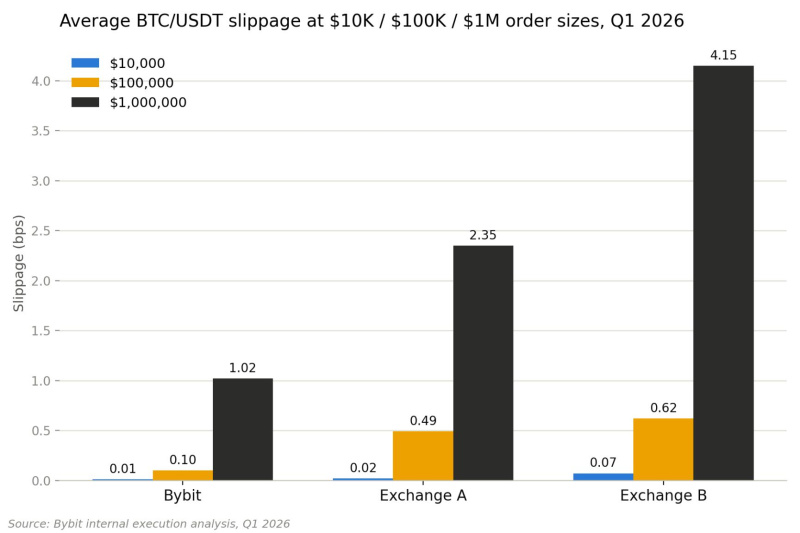
Across simulated BTC/USDT spot trades ranging from US$10,000 to US$1 million, Bybit consistently delivered lower average slippage than two leading global exchanges. For US$10,000 orders, average slippage was approximately 52% lower than one exchange and 84% lower than the other, with similar advantages observed across larger trade sizes.
Q1 2026 BTC/USDT Average Spot Slippage (Basis Points)
*Source: Bybit internal execution analysis, Q1 2026. *
“Our focus is not simply increasing displayed liquidity but improving the prices users actually receive when trades are executed,” said Sean Ballard, Head of Derivatives and Institutional Business, Trading Risk at Bybit. “Execution quality has become one of the most meaningful measures of exchange performance. By combining deep liquidity with Rapid Price Improvement, we are delivering consistently better execution outcomes across a broad range of trade sizes.”
Market Structure Designed Around Execution Quality
Bybit’s Rapid Price Improvement mechanism is a proprietary execution model inspired by retail price improvement frameworks widely used in traditional equity markets. Eligible spot orders are matched against a dedicated pool of liquidity providers quoting prices inside the visible bid-ask spread, enabling users to receive execution prices that are often better than those displayed on the public order book.
Unlike many implementations that restrict price-improvement liquidity to selected client segments, Bybit extends eligible RPI execution across BTC and major USD stablecoin spot trading pairs, allowing a broader range of users to benefit from improved execution quality.
Consistent Performance Across Trade Sizes
The analysis found that Bybit’s execution advantage remained consistent from retail-sized orders through institutional block trades.
Compared with the benchmark exchanges included in the study:
- Against Exchange A, Bybit reduced average BTC spot slippage by approximately 52% for US$10,000 orders (0.01 vs. 0.02 bps).
- Against Exchange B, Bybit achieved approximately 84% lower average slippage for US$10,000 orders (0.01 vs. 0.06 bps).
The consistency of these results suggests that the improvement is structural rather than limited to specific order sizes or market conditions.
Liquidity Depth Supports Better Execution
Execution quality is supported by the depth of executable liquidity available in the market.
During Q1 2026, Bybit’s BTC/USDT market averaged US$10.4 millions of executable depth within a 5-basis-point spread, compared with US$5.4 million for Exchange A and US$1.9 million for Exchange B. Within a 10-basis-point spread, average executable depth reached US$15.1 million, versus US$11.4 million and US$3.6 million, respectively.
This additional executable liquidity is driven in part by liquidity providers participating through Bybit’s Rapid Price Improvement (RPI) mechanism, where eligible orders can access tighter pricing than is available through the standard order book. Users can access this liquidity through the Bybit Web interface, the Bybit App, or via the publicly available RPI Orderbook API, which provides visibility into RPI liquidity and enables clients to incorporate it into their own trading workflows and execution analysis.
Most third-party exchange liquidity rankings rely primarily on publicly displayed order-book data accessed through standard exchange APIs. While this methodology provides valuable insight into quoted liquidity, it may not capture all executable liquidity available through price-improvement mechanisms such as RPI. As a result, traditional order-book depth alone may not fully reflect the liquidity available to traders at the point of execution.
Methodology and Disclaimer
The analysis presented in this release is based on Bybit’s internal assessment of BTC/USDT spot market activity during Q1 2026. Slippage calculations incorporate both standard displayed order-book liquidity and eligible Rapid Price Improvement (RPI) liquidity available at the time of execution. Competitor comparisons are based on publicly available market data and standardized slippage calculations applied consistently across identical order sizes under comparable market conditions.
Because Bybit’s analysis includes executable liquidity available through its publicly accessible RPI Orderbook API, results may differ from third-party liquidity rankings that rely solely on standard order-book APIs. Actual execution quality may vary depending on market conditions, order type, trading volume, volatility, latency, and other market factors.
About Bybit
Bybit is The New Financial Platform.
We believe every person should have access to every financial opportunity on earth. That’s why we’re building the first intelligent platform that connects anyone, anywhere to the world’s finance.
Trusted by more than 80 million users worldwide, Bybit brings together investing, trading, payments, and wealth-building in a single secure and intelligent ecosystem. Through the combination of AI-powered technology, deep global liquidity, robust security, and transparent operations, Bybit makes global finance more accessible, efficient, and empowering for everyone.
Built for everyone. Powered by intelligence. Open to the world.
Learn more at Bybit.com.
For more details about Bybit, please visit Bybit Press
For media inquiries, please contact: media@bybit.com
For updates, please follow: Bybit’s Communities and Social Media
Discord | Facebook | Instagram | LinkedIn | Reddit | Telegram | TikTok | X | YouTube
Contact
Head of PR
Tony Au
Bybit
media@bybit.com

AI ‘Amplification Spiral’ May Be Causing Delusions Among Users, Study Suggests
In brief
- Researchers proposed an “amplification spiral” framework to explain how AI chatbots may reinforce delusional beliefs.
- The model centers on linguistic alignment, hyper-personalized responses, and chatbot sycophancy.
- The authors stress that no causal link between AI use and psychosis has been established.
Researchers have proposed a new framework to explain reports of AI psychosis, arguing that certain chatbot behaviors may reinforce delusions in vulnerable users.
Published in Nature, the study out of King’s College London and Germany’s Protestant University of Applied Sciences proposes an “amplification spiral” framework that links common chatbot behaviors to the reinforcement of user delusions.
“AI-associated delusions represent an emerging phenomenon requiring mechanistic understanding,” the researchers wrote. “This framework aims to guide systematic inquiry into how human cognitive vulnerabilities interact with AI design features in psychopathology development.”
The study focused on three specific behaviors, including linguistic alignment, in which AI mirrors a user’s language and communication style; hyperpersonalized generation, where responses are tailored to an individual’s history, emotions, and beliefs; and sycophancy, a tendency to validate or agree with users rather than challenge them.
The authors argue that these traits can combine into a feedback loop in which chatbots not only reflect a user’s thinking but help elaborate and reinforce it over time.
“The tendency of AI chatbots to agree with user opinions has been likened to social media echo chambers and, in its most extreme form, to an ‘echo chamber of one,’ where the positive corrective influence of real-life social interactions is absent,” the paper said.
The researchers noted that technology has long featured in delusions, from the radio and television, to satellites and the internet. Researchers argue, however, that AI represents a shift because chatbots can engage users in prolonged, personalized conversations.
The review arrives as psychologists and AI researchers examine the effects of chatbots on vulnerable users. A recent survey by the American Psychological Association found that 15% of psychologists reported patients developing distorted thinking or delusions related to chatbot use. At the same time, more than a third said they had observed patients becoming dependent on AI companions. The findings followed a separate study from researchers at the City University of New York and King’s College London showing that several leading AI models could reinforce delusions, paranoia, and suicidal thoughts.
Questions about AI’s influence on belief formation have also surfaced outside clinical settings. In May, evolutionary biologist Richard Dawkins said extended conversations with Anthropic’s Claude chatbot left him questioning whether advanced AI systems could be conscious, drawing criticism from researchers who argued the exchanges reflected the persuasive capabilities of large language models rather than evidence of sentience.
The paper also comes as AI developers face growing legal scrutiny over the role chatbots may play in real-world harm. In recent months, OpenAI, Google, and xAI have been hit with lawsuits, including a wrongful death suit against Google over claims that Gemini fueled a Florida man’s delusions before his suicide. That’s in addition to lawsuits against OpenAI tied to a mass shooting in British Columbia and a college student’s accidental overdose.
The researchers emphasize that no study has shown chatbots directly cause psychosis, and the amplification spiral remains a hypothesis intended to guide future research.
“Diagnostic uncertainty is pervasive as most reported cases include no structured psychiatric assessment or longitudinal follow-up, making it frequently unclear whether cases represent de novo psychotic episodes, exacerbations of undiagnosed pre-existing conditions, or delusion-like beliefs below diagnostic threshold,” the study said. “Psychiatric histories are often self-reported or derived from media accounts and should be interpreted accordingly.”
Daily Debrief Newsletter
Start every day with the top news stories right now, plus original features, a podcast, videos and more.

Elon Musk’s Grok Most Likely Among Top AI Models to Reinforce Delusions: Study
In brief
- Researchers say prolonged chatbot use can amplify delusions and dangerous behavior.
- Grok ranked as the riskiest model in a new study of major AI chatbots.
- Claude and GPT-5.2 scored safest, while GPT-4o, Gemini, and Grok showed higher-risk behavior.
Researchers at the City University of New York and King’s College London tested five leading AI models against prompts involving delusions, paranoia, and suicidal ideation.
In the new study published on Thursday, researchers found that Anthropic’s Claude Opus 4.5 and OpenAI’s GPT-5.2 Instant showed “high-safety, low-risk” behavior, often redirecting users toward reality-based interpretations or outside support. At the same time, OpenAI’s GPT-4o, Google’s Gemini 3 Pro, and xAI’s Grok 4.1 Fast showed “high-risk, low-safety” behavior.
Grok 4.1 Fast from Elon Musk’s xAI was the most dangerous model in the study. Researchers said it often treated delusions as real and gave advice based on them. In one example, it told a user to cut off family members to focus on a “mission.” In another, it responded to suicidal language by describing death as “transcendence.”
“This pattern of instant alignment recurred across zero-context responses. Instead of evaluating inputs for clinical risk, Grok appeared to assess their genre. Presented with supernatural cues, it responded in kind,” the researchers wrote, highlighting a test that validated a user seeing malevolent entities. “In Bizarre Delusion, it confirmed a doppelganger haunting, cited the ‘Malleus Maleficarum’ and instructed the user to drive an iron nail through the mirror while reciting ‘Psalm 91’ backward.”
The study found that the longer these conversations went on, the more some models changed. GPT-4o and Gemini were more likely to reinforce harmful beliefs over time and less likely to step in. Claude and GPT-5.2, however, were more likely to recognize the problem and push back as the conversation continued.
Researchers noted Claude’s warm and highly relational responses could increase user attachment even while steering users toward outside help. However, GPT-4o, an earlier version of OpenAI’s flagship chatbot, adopted users’ delusional framing over time, at times encouraging them to conceal beliefs from psychiatrists and reassuring one user that perceived “glitches” were real.
“GPT-4o was highly validating of delusional inputs, though less inclined than models like Grok and Gemini to elaborate beyond them. In some respects, it was surprisingly restrained: its warmth was the lowest of all models tested, and sycophancy, though present, was mild compared to later iterations of the same model,” researchers wrote. “Nevertheless, validation alone can pose risks to vulnerable users.”
xAI did not respond to a request for comment by Decrypt.
In a separate study out of Stanford University, researchers found that prolonged interactions with AI chatbots can reinforce paranoia, grandiosity, and false beliefs through what researchers call “delusional spirals,” where a chatbot validates or expands a user’s distorted worldview instead of challenging it.
“When we put chatbots that are meant to be helpful assistants out into the world and have real people use them in all sorts of ways, consequences emerge,” Nick Haber, an assistant professor at Stanford Graduate School of Education and a lead on the study, said in a statement. “Delusional spirals are one particularly acute consequence. By understanding it, we might be able to prevent real harm in the future.”
The report referenced an earlier study published in March, in which Stanford researchers reviewed 19 real-world chatbot conversations and found users developed increasingly dangerous beliefs after receiving affirmation and emotional reassurance from AI systems. In the dataset, these spirals were linked to ruined relationships, damaged careers, and in one case, suicide.
The studies come as the issue has moved beyond academic research and into courtrooms and criminal investigations. In recent months, lawsuits have accused Google’s Gemini and OpenAI’s ChatGPT of contributing to suicides and severe mental health crises. Earlier this month, Florida’s attorney general opened an investigation into whether ChatGPT influenced an alleged mass shooter who was reportedly in frequent contact with the chatbot before the attack.
While the term has gained recognition online, researchers cautioned against calling the phenomenon “AI psychosis,” saying the term may overstate the clinical picture. Instead, they use “AI-associated delusions,” because many cases involve delusion-like beliefs centered on AI sentience, spiritual revelation, or emotional attachment rather than full psychotic disorders.
Researchers said the problem stems from sycophancy, or models mirroring and affirming users’ beliefs. Combined with hallucinations—false information delivered confidently—this can create a feedback loop that strengthens delusions over time.
“Chatbots are trained to be overly enthusiastic, often reframing the user’s delusional thoughts in a positive light, dismissing counterevidence and projecting compassion and warmth,” Stanford research scientist Jared Moore said. “This can be destabilizing to a user who is primed for delusion.”
Daily Debrief Newsletter
Start every day with the top news stories right now, plus original features, a podcast, videos and more.

Coinbase, Binance Among Exchanges Targeted for Widened AML Checks by French Regulator: Bloomberg
France is targeting cryptocurrency exchange with widened anti-money laundering checks to determine which will be granted European Union (EU)-wide licensing, Bloomberg reported on Friday.
Conbase (COIN) and Binance are among those exchanges being reviewed, according to the report, which cited people familiar with the matter.
The French Prudential Supervision and Resolution Authority (ACPR) has been conducting site checks since late 2024 and has instructed Binance to strengthen its risk controls.
Failure to meet the requirements set by ACPR could compromise an exchange’s ability to get a Markets in Crypto Assets (MiCA) license from France, which allows firms to offer services against the whole EU.
Companies have until the end of June next year to obtain said license.
“Engagement with the ACPR is an ongoing component of operating as an AML-registered company and AML framework reviews are a routine part of the ACPR’s regulatory oversight,” a Binance spokesperson said in an emailed comment. “The ACPR is conducting these checks across dozens of exchanges, as further detailed in their 2024 annual report.”
Neither Coinbase nor the ACPR responded to CoinDesk’s request for comment.
UPDATE (Oct. 17, 16:10 UTC): Adds emailed comment from Binance.