Hayes revealed his new role as Flop Labs CEO and teased a “massive airdrop” from the AI inference protocol in the fourth quarter of 2026.
Grand Cayman, Cayman Islands, June 23rd, 2026, Chainwire
Sui aims to transition more of Bitcoin’s $1.2T market cap into verifiable, productive onchain products.
Hashi, Sui’s native bitcoin finance primitive, gains more institutional support ahead of the scheduled launch of its global testnet this July.
Sui, where money moves as freely as messages, announced today that Cumberland, Fluid, and SwissBorg have joined the Hashi ecosystem, Sui’s native bitcoin finance primitive, weeks ahead of its scheduled global testnet launch this July. The expanding coalition addresses a critical bottleneck in crypto: solving the persistent capital inefficiency by unlocking over a trillion dollars of immobile BTC into DeFi safely.
Previous market cycles demonstrated the systemic dangers of relying on opaque, centralized credit intermediaries such as Celsius, Voyager, and Genesis to generate utility from dormant assets. Hashi replaces centralized balance-sheet trust with verifiable smart contract logic.
But with a strict separation for safety by design, Bitcoin remains securely on the native Bitcoin blockchain. Sui smart contracts handle the cryptographic and programmatic rights to enable its use as financial collateral.
“Hashi was built to unlock the productive use of Bitcoin at a scale the industry hasn’t seen before,” Adeniyi Abiodun, Co-Founder and Chief Product Officer of Mysten Labs, the original contributor to Sui. “We believe Bitcoin will become one of the largest sources of collateral in finance as the world moves onchain, and Hashi provides the foundation to make that possible on Sui.”
Built for Institutional Bitcoin Finance
Hashi is a foundational primitive setting a new standard for how builders can create bespoke, Bitcoin-backed financial products with risk parameters and loan terms that are fully verifiable onchain. In just a few weeks’ time, institutions, custodians, wallet providers, and developers can begin freely testing the infrastructure that will support Bitcoin-backed lending, borrowing, and credit origination on Sui.
Expanded Institutional Support
Three new powerhouses join the growing Hashi ecosystem, broadening support for institutional liquidity providers, market makers, and digital asset platforms:
These new builders join an industry-leading group of infrastructure providers, custodians, and DeFi protocols already working together to build a native Bitcoin financial ecosystem on Sui.
“Bitcoin is the world’s most liquid digital asset, but without native utility, it remains an off-chain asset,” said Paul Kremsky, Global Head of Business Development at Cumberland. “Hashi is exciting because it introduces a transparent, institutional-grade framework for BTC-backed credit that will replace synthetic workarounds with a product we are excited to use ourselves.”
“Our community has consistently sought native ways to lend and borrow against their Bitcoin,” said Cyrus Fazel, Founder & CEO at SwissBorg. “We’re thrilled to see Hashi delivering innovative solutions that make this a reality.”
“The next phase of the industry’s growth will come from bringing larger pools of capital onchain through infrastructure institutions can actually trust,” said Samyak Jain, Co-Founder & CEO at Fluid. “Hashi gets this right: Bitcoin stays on its native chain while verifiable contracts make it productive as collateral. Fluid’s lending infrastructure is built to turn that into deep, capital-efficient Bitcoin-backed credit markets on Sui.”
These additions expand the growing consensus of many partners announced earlier this year that Sui is where Bitcoin finance will take flight, thanks to Hashi:
Custody & Wallet Access
Lending, Trading & Liquidity Providers
DeFi & Lending Applications
Vaults & Asset Management
Index Oracle, Insurance & Security Auditing
The activation of the global testnet this July represents the ultimate rehearsal for fully changing Bitcoin Finance. This sandbox environment is designed for institutional engineers, Sui protocols and developers, and custody partners to test integration parameters, stress-test the code under simulated market volatility, and verify cryptographic integrity ahead of mainnet release.
Technical documentation and testnet access configurations will be hosted at https://www.sui.io/hashi.
About Sui
Sui, where money moves as freely as messages, is a next-generation Layer 1 blockchain built for scalable finance and global payments. Founded by the core team behind Meta’s stablecoin initiative and powered by an object-centric model, Sui makes assets, permissions, and user data programmable and ownable. Sui’s primitives offer builders everything they need to create high-performance payments and financial applications, including instant agentic payments. Users can learn more at sui.io.
Contact: media@sui.io
Sui Foundation
media@sui.io
NEW YORK, June 15, 2026 (GLOBE NEWSWIRE) — PageUp, a global leader in talent acquisition software, today announced the results of an independent audit by Warden AI, an AI assurance platform that helps organizations certify and continuously monitor AI systems for compliance and accountability. Monthly audits have confirmed that PageUp’s AI systems meet Warden AI’s highest standards of fairness and transparency, as well as those for disparate impact and consistency.
As hiring teams continue to incorporate AI-powered solutions into their daily workflows, demand has increased for more transparency and oversight into how those tools support hiring decisions. Warden AI’s audit and ongoing monitoring provide PageUp’s clients with evidence that their hiring systems operate fairly and compliantly. In the interest of total transparency, up-to-date testing results of the monitored platform are publicly available on Warden AI’s Assured Directory.
The audit evaluated elements of PageUp’s AI capabilities to ensure alignment with evolving employment-related AI regulations and civil rights requirements through independent benchmarking, ongoing technical audits, and dual-method bias testing methodologies, including disparate impact and counterfactual analyses. Warden AI tests for equality of outcomes across demographic groups and equal treatment of individuals. Because LLMs are constantly changing, systems audited by Warden AI are monitored on an ongoing basis to ensure continued compliance with both Warden AI’s standards and global standards, including NYC Local Law 144, the EU AI Act, Colorado SB205, and California FEHA.
“AI is moving faster than most organizations can evaluate it, especially in hiring, where the stakes are incredibly high,” said Eric Lochner, CEO of PageUp. “The industry has spent a lot of time talking about AI innovation but proving how these systems are being held accountable in real-world environments is often left by the wayside. Warden AI’s independent audit of PageUp’s solutions helps us move from promises to evidence, which is what enterprise customers are increasingly looking for from their providers.”
“Independent validation is critical to building trust in AI hiring technology. PageUp welcomed that scrutiny, and we are proud to welcome them to the Warden Assured ecosystem,” said Jeff Pole, co-founder & CEO at Warden AI.
PageUp’s continued investment in responsibly built AI spans the full hiring lifecycle, from sourcing and recruitment marketing through candidate matching, workflow automation, and onboarding. As enterprise organizations evaluate how to embed AI into hiring with confidence, PageUp remains committed to building it transparently, accountably, and on independent evidence.
About Warden AI
Founded in 2023 by Jeffrey Pole and Eduard Schikurski, Warden AI provides a platform that enables enterprises and vendors to audit AI using proprietary datasets, benchmarks, and real-time dashboards. This helps companies comply with regulations such as the EU AI Act and NYC Local Law 144. Warden AI’s mission is to safeguard the use of AI in HR by certifying systems for fairness and compliance. Headquartered in Austin, Texas and London, U.K., Warden AI is already used by leading HR tech platforms, including Greenhouse, Sense, and Beamery.
About PageUp
PageUp believes the most powerful talent acquisition technology is built on one simple principle: human connection. As the chosen talent acquisition partner for the world’s most trusted brands, PageUp delivers a world-class customer experience by building deep, lasting partnerships. This commitment is reflected in PageUp’s intelligent talent acquisition platform, an intuitive, AI-powered system that’s easy to use, adaptable to your unique hiring needs and always innovating. We strip away complexity so talent teams can focus on what matters—creating the strong, human connections that forge a resilient workforce.
For more information, visit http://www.pageuppeople.com.
Stockholm, Sweden, June 4th, 2026, Chainwire
Decentralized prediction market platform lets participants launch their own World Cup markets, trade with leverage of up to 2.5x, and earn fees on the markets they create.
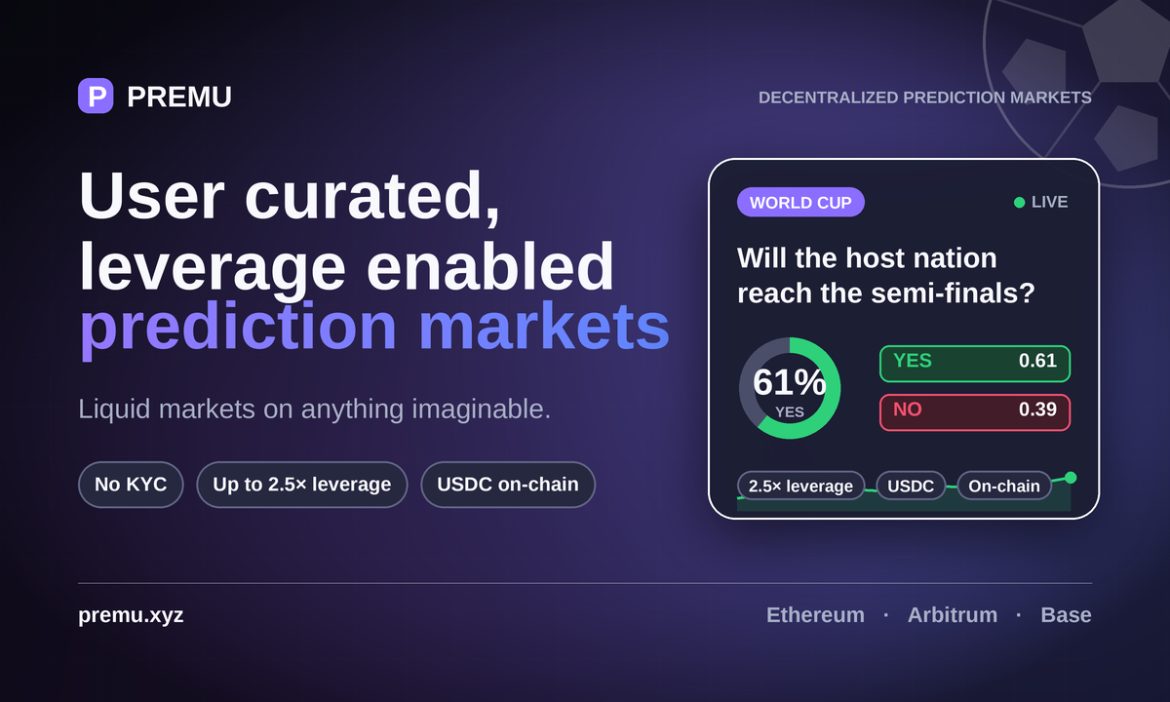
With the 2026 FIFA World Cup set to begin on June 11, Premu, a decentralized prediction market platform, is highlighting the feature that distinguishes it from centrally operated venues: any participant can create a market on a World Cup outcome, set it live, and earn a share of the fees generated by trading in that market.
Rather than waiting for a platform to list a contract, participants on Premu can launch a yes-or-no market on questions such as which team advances from a group, who reaches the final, or the result of a single fixture. Markets are created permissionlessly by posting a bond in USDC, and the creator earns a fee on every trade placed in the market. Positions can be traded with leverage of up to 2.5 times using isolated or cross margin, with activity settled on-chain in USDC across the Ethereum, Arbitrum, and Base networks.
The timing coincides with rising interest in prediction markets, which have moved from a niche tool into wider public view over the past year as participants turn to event-based markets for forecasting and information. Major sporting events have historically drawn some of the highest trading activity to these platforms, and the World Cup, a 104-match tournament running through July 19, ranks among the largest such events on the 2026 calendar.
“Sporting events like the World Cup tend to generate questions faster than any central team can list them,” said Chadi Farhat, Chief Technology Officer at Premu. “Allowing participants to create their own markets, and to earn from the activity they bring, means the platform can keep pace with each stage of a tournament as it unfolds.”
Comparisons such as Polymarket vs Kalshi have featured prominently in industry discussion, drawing attention to differences in market structure, regulatory approach, and how markets are listed across centralized and decentralized models. Premu positions itself as a decentralized prediction market in which the market list is defined by participants themselves rather than a central operator, an approach the company says suits fast-moving events where demand can shift between fixtures.
Beyond sports, the platform supports markets across cryptocurrency, politics, culture, technology, economics, and global events, including rapid five-minute markets on the price direction of assets such as Bitcoin, Ethereum, and Solana. Balances are held in on-chain vault contracts that can be independently verified, and deposits and withdrawals are recorded as on-chain events rather than processed through a custodial intermediary.
The Premu platform is available globally through its web application at https://premu.xyz.
About Premu
Premu is a decentralized prediction market platform that enables participants to create and trade markets based on real-world events. The platform combines permissionless, user-created markets with leveraged event trading and on-chain settlement in USDC across the Ethereum, Arbitrum, and Base networks, supporting a range of event categories.
Mr
Chadi
Premu
team@premu.xyz
Dubai, United Arab Emirates, May 21st, 2026, Chainwire
Bybit, the world’s second-largest cryptocurrency exchange by trading volume, today announced the listing of the SPCXUSDT Perpetual Contract, offering leveraged exposure to SpaceX (SPCX) before its highly anticipated initial public offering on June 12, 2026. The contract is now live on the platform with up to 10x leverage, providing early access to one of the most transformative technology companies in modern times.
This launch coincides with SpaceX’s historic IPO on the horizon. According to official filings, SpaceX is targeting a valuation of over $1.75 trillion to $2 trillion, and plans to raise approximately $75 billion in what would become the largest initial public offering in capital market history, surpassing Saudi Aramco’s previous record of $29.4 billion set in 2019.
SpaceX has fundamentally transformed the aerospace industry, reducing launch costs by orders of magnitude through its reusable rocket technology. Starlink, SpaceX’s satellite internet service, has grown to over 8 million active subscribers worldwide and generated approximately $7.7 billion in 2024 revenue. The company recently acquired xAI, Elon Musk’s AI venture, creating a vertically integrated enterprise spanning space exploration and satellite technology with AI. The valuation reflects SpaceX’s position as a defining force in both aerospace and AI-driven connectivity.
The underlying asset of Bybit’s SPCXUSDT perpetual contract is SPCX settled in USDT. Offering 24/7 access, the contract allows up to 10x leverage. The total estimated share count is 11.87 billion shares.
The SPCXUSDT listing reinforces Bybit’s commitment to supporting traders with early access to transformative investment opportunities. By bringing pre-IPO exposure to SpaceX, Bybit enables its global community to participate in high-growth markets and remain at the cutting edge of technological innovation.
Bybit’s perpetual contract offers traders multiple advantages over traditional equity markets:
Terms and conditions apply. Trading carries risk. Bybit’s products and services may not be available in all jurisdictions. For more information on contract details, eligibility and potential restrictions, users may visit: New listing: SPCXUSDT Pre-IPO Perpetual Contract, with up to 10x leverage
#Bybit / #CryptoArk / #NewFinancialPlatform
About Bybit
Bybit is the world’s second-largest cryptocurrency exchange by trading volume, serving a global community of over 80 million users. Founded in 2018, Bybit is redefining openness in the decentralized world by creating a simpler, open, and equal ecosystem for everyone. With a strong focus on Web3, Bybit partners strategically with leading blockchain protocols to provide robust infrastructure and drive on-chain innovation. Renowned for its secure custody, diverse marketplaces, intuitive user experience, and advanced blockchain tools, Bybit bridges the gap between TradFi and DeFi, empowering builders, creators, and enthusiasts to unlock the full potential of Web3. Discover the future of decentralized finance at Bybit.com.
For more details about Bybit, please visit Bybit Press
For media inquiries, please contact: media@bybit.com
For updates, please follow: Bybit’s Communities and Social Media
Discord | Facebook | Instagram | LinkedIn | Reddit | Telegram | TikTok | X | Youtube
Head of PR
Tony Au
Bybit
tony.au@bybit.com
The slowdown in on-chain activity echoes a similar lull last summer that came right before a huge rebound in Bitcoin.
The total fees paid on the Binance Smart Chain (BSC) recently fell to approximately $593,000, marking the network’s lowest usage cost since at least August 2025.
This collapse in transaction activity on one of crypto’s busiest highways is reviving memories of a similar demand drought last summer that immediately preceded a 95% rally in Bitcoin (BTC).
Blockchain fees are the clearest measure of user demand, representing what people pay to move tokens or use decentralized applications. When fees drop sharply, it signals reduced network congestion and waning speculative interest.
According to data from analyst Amr Taha, on February 23, BSC fees sank to $593,000, which is well below the $1.07 million trough recorded on August 7, 2025. At that time, Bitcoin was trading near $55,000, and, per Taha, the fee drop later helped form a major bottom before the asset embarked on a rally that saw its price shoot up by more than 95%.
The on-chain observer also flagged a steep drop in Bitcoin’s short-term holder realized market cap, which fell to about $386 billion on February 24, well below an earlier low of $440 billion recorded on April 8, 2025.
Historically, similar contractions have coincided with heavy capitulation phases that preceded rebounds, including the move that took BTC from around $78,000 to above $108,000 following the April 2025 low.
While the decline in spot activity signals caution, the derivatives market is undergoing a structural reset that could pave the way for the next move. According to XWIN Research Japan, open interest in Bitcoin futures has fallen sharply, reflecting a broad deleveraging phase. Analysts at the institution noted that the recent drop in price was accompanied by falling open interest, indicating that liquidations and derivatives-driven unwinds, rather than aggressive spot selling, drove the decline. This type of reset can stabilize the market, even if it does not immediately signal renewed demand.
Further complicating the outlook is the options market structure. Coinbase Institutional’s analysis shows a pronounced negative gamma band concentrated between $60,000 and $70,000. When dealers hold negative gamma, their hedging activity can amplify price moves, meaning a break below $60,000 could accelerate selling.
Despite the cautious tone, some on-chain indicators offer a glimmer of stability, with the Binance Fund Flow Ratio remaining low around 0.012, implying limited immediate sell-side pressure. During the recent drop toward the mid-$60,000 region, the ratio did not spike, meaning panic-driven spot inflows were absent.
However, as XWIN Research noted, weak inflows do not equal strong accumulation, and the medium-term trend of demand metrics has not yet turned decisively upward.
For a durable bottom to form, stronger spot volume support will be essential. As it stands, Bitcoin is trading just above $68,000 at the time of writing, down roughly 23% over the past month and more than 46% below its all-time high above $126,000.
LIMITED OFFER for CryptoPotato readers at Bybit: Use this link to register and open a $500 FREE position on any coin!
“Massive November pump, then straight off a cliff. Classic rug vibes,” one X user argued.
The list of altcoins that have posted substantial declines over the past week is quite long, and their poor performance coincides with the broader market decline that occurred a few days ago.
Internet Computer (ICP) is the worst performer (at least from the top 100 club), with its price slipping by 10% within that period. The question now is whether a further plunge is knocking on the door.
ICP currently trades at approximately $3.26 (per CoinGecko data), a substantial decrease from the local peak of almost $10 recorded towards the end of last year. Its downtrend has caught the eye of numerous analysts, some of whom believe the bulls are unlikely to regain control anytime soon.
X user Alisa noted the significant decline in recent months, arguing that ICP’s chart indicates “exit liquidity.” “Massive November pump, then straight off a cliff. Classic rug vibes,” they stated.
The market observer claimed that Internet Computer has always had a “sketchy” marketing, adding that the valuation has finally matched the hype – “garbage.”
Alisa questioned how the asset’s current market capitalization is approximately $1.8 billion, characterizing it as “dead coin walking” and warning investors not to catch this “falling knife.”
More Crypto Online also sounds quite pessimistic. The analyst thinks the current structure is bearish due to falling below certain important price levels, claiming that a plunge to multi-month lows is possible:
“From the recent support area, price has again produced only a 3-wave rally into the long-standing resistance zone between $4.48 and $7.52. This resistance has held repeatedly, while support levels continue to break, which increases the probability of further downside. In bearish environments, this pattern typically keeps pressure to the downside intact. As a result, a move toward lower levels, potentially even below the October 10th low near $1.51, cannot be ruled out.”
On the other hand, many other analysts continue to predict that ICP could be on the verge of a major rally. X user Nehal envisioned a 60% increase in the short term, seeing the price trading above $5 sometime in February.
Prior to that, Bitcoinsensus suggested that ICP has been coiling inside a falling wedge pattern. According to the X user, the price has been compressing within a multi-year wedge, while breaking the formation to the upside could lead to a price explosion above $20.
ICP’s recent exchange netflow supports the optimistic forecasts. Over the past several weeks, outflows have dominated inflows, meaning that investors have shifted from centralized platforms to self-custody methods. This, in turn, reduces the immediate selling pressure.
Aster (ASTER) has been trading sideways for nearly a month, showing limited volatility as it struggles to break through resistance.
The altcoin remains trapped under “The Void,” a previously untested resistance zone that must be cleared for meaningful recovery. However, whale accumulation hints at rising optimism among large investors.
Sponsored
Sponsored
Whales have become increasingly active over the past few weeks, signaling growing confidence in Aster’s long-term outlook.
On-chain data reveals that addresses holding between 1 million and 10 million ASTER have accumulated over 51 million additional tokens since the start of November, equating to roughly $53 million in value.
This surge in large-wallet accumulation suggests whales are positioning for potential upside. Historically, such accumulation phases precede sharp rallies, as these investors tend to buy at perceived market bottoms.
Want more token insights like this? Sign up for Editor Harsh Notariya’s Daily Crypto Newsletter here.
Sponsored
Sponsored
The Squeeze Momentum Indicator currently indicates a developing squeeze, marked by black dots that typically precede a significant price move. This setup often signals a volatility breakout, suggesting that Aster could soon see stronger directional movement. Currently, the indicator’s green bars indicate that bullish momentum is building within this phase.
If this bullish volatility expands, ASTER could finally escape its tight range, with buying pressure propelling it toward higher price levels. However, squeezes can occasionally flip bearish if market sentiment weakens or broader conditions turn negative.
ASTER’s price stands at $1.04, maintaining a stable position above the $1.00 psychological level. While this support has held firm, the more critical floor lies at $0.91, which has underpinned price action throughout the recent consolidation phase.
$0.91 and $1.25 make up the consolidation range for ASTER. Above $1.25 lies “The Void”, a previously untested resistance zone, breaching which is necessary to recover October’s 55% losses. The above-mentioned factors suggest this is likely for ASTER, which could push the price past $1.50 and towards $1.63.
If market sentiment weakens, however, Aster could extend its sideways pattern or fall below $0.91. Such a drop could trigger a decline toward $0.80, invalidating the current bullish thesis and delaying recovery prospects.
Rebeca Moen
Oct 19, 2025 09:01
VET price holds steady at $0.02 despite 0.47% daily decline, with technical indicators suggesting continued sideways movement as traders await catalyst for directional breakout.
• VET trading at $0.02 (down 0.5% in 24h)
• Range-bound consolidation continues in absence of major catalysts
• RSI at 34.70 suggests neither oversold nor overbought conditions
• Following broader crypto market weakness alongside Bitcoin decline
Trading on technical factors in absence of major catalysts has characterized VeChain’s recent price action. No significant news events in the past 48 hours have provided directional momentum for VET price, leaving technical analysis as the primary driver for short-term movements.
The broader cryptocurrency market weakness, with Bitcoin declining today, has contributed to the modest 0.47% drop in VET price. Trading volume on Binance spot market reached $2.54 million over the past 24 hours, indicating moderate but not exceptional interest from traders.
This consolidation phase reflects the market’s current uncertainty, with institutional and retail participants alike waiting for either technical breakouts or fundamental developments to drive the next significant move in VeChain’s valuation.
VeChain technical analysis reveals a tight consolidation pattern, with VET price hovering precisely at the $0.02 level across multiple timeframes. All major moving averages – from the 7-day SMA to the 200-day SMA – converge at this $0.02 price point, creating a unique technical setup where the asset is trading directly at long-term equilibrium.
The Bollinger Bands position shows VET near the lower band support with a %B reading of 0.1967, suggesting the price is closer to oversold territory without reaching extreme levels. This positioning often precedes either a bounce back toward the middle band or a decisive break below support levels.
The RSI reading of 34.70 places VeChain in neutral territory, avoiding both overbought and oversold extremes that typically signal imminent reversals. This measured reading suggests traders are neither aggressively buying nor selling, contributing to the current sideways price action.
MACD indicators present a mildly bearish picture with the histogram at -0.0003, though the signals remain close to neutral. The Stochastic oscillators at 50.35 (%K) and 50.98 (%D) further confirm the neutral momentum, with both indicators hovering near their midpoint values.
• Resistance: $0.03 (Bollinger Band upper boundary and strong technical resistance)
• Support: $0.01 (Bollinger Band lower boundary and psychological support level)
A break below the $0.01 support level could signal a deeper correction toward the 52-week low region, potentially testing investor confidence in VeChain’s medium-term prospects. Conversely, a move above $0.03 resistance would break the current consolidation pattern and target the 52-week high of $0.04.
The narrow trading range between $0.01 and $0.03 suggests that any catalyst-driven move could result in significant percentage gains or losses, given the compressed volatility reflected in the current ATR reading.
• Bitcoin: VET price is following Bitcoin’s decline today, maintaining positive correlation with the broader cryptocurrency market leadership
• Traditional markets: Limited direct correlation evident, though risk-off sentiment in equity markets may influence crypto sector broadly
• Sector peers: Trading in line with other utility and enterprise blockchain tokens in current market environment
A break above $0.03 resistance with increased volume could target the $0.04 level, representing a 100% gain from current levels. Positive enterprise adoption news or technical improvements to the VeChain ecosystem could provide the catalyst needed for such a move.
Failure to hold $0.01 support would signal technical breakdown, potentially leading to new 52-week lows. Continued Bitcoin weakness or broader crypto market selloff represents the primary downside risk.
Given the tight trading range, stop-losses below $0.015 would limit downside exposure while allowing room for normal volatility. Position sizing should account for the potential for sudden moves in either direction once the consolidation pattern resolves.
Image source: Shutterstock
The Bitcoin (BTC) mining difficulty fell to 146.7 trillion on Friday as the network hashrate, the average of the total computing power dedicated to securing the decentralized protocol, hit an all-time high of over 1.2 trillion hashes per second.
BTC mining difficulty is down by about 2.7% from the all-time high difficulty level of over 150.8 trillion reached during the previous adjustment period, according to CoinWarz.
However, network hashrate hit an all-time high on Tuesday, and remains elevated above 1.2 trillion, despite a small dip from Tuesday’s all-time high, data from CryptoQuant shows. CoinWarz also forecast:
“The next difficulty adjustment is estimated to take place on Oct 29, 2025, 08:14:49 AM UTC, increasing the Bitcoin mining difficulty from 146.72 T to 156.92 T, which will take place in 1,474 blocks.”
The rising hashrate signals that miners will have to expend ever-greater computing resources to add blocks to the Bitcoin ledger, placing even more pressure on beleaguered miners, who are grappling with trade policies, reduced block rewards, and competition.
Related: Bitdeer doubles down on Bitcoin self-mining as rig demand cools
Mining companies continue to search for alternative revenue streams to shore up shortfalls from mining digital currencies, including diversifying into AI data centers and other forms of high-performance computing.
Core Scientific, Hut 8, and IREN all re-allocated resources toward AI data centers in 2024 to boost profits and reduce reliance on revenue generated from crypto mining.
However, the pivot to AI data centers has created tension between miners and the AI infrastructure providers, as both energy-hungry industries compete for access to cheap energy sources to power their operations.
Despite the addition of new revenue streams, the mining industry continues to face regulatory challenges and fomenting supply chain issues, the latter of which stems from US President Donald Trump’s sweeping trade tariffs.
Tariffs increase the cost of acquiring mining hardware in jurisdictions that are subject to tariffs on those products, putting miners in those areas at a competitive disadvantage to miners who can acquire rigs without the added tariff costs.
Moreover, if trade tensions between the US and China continue to grow, export controls on computer processors, chips, and other electronics could make the hardware more difficult to acquire.
Magazine: 7 reasons why Bitcoin mining is a terrible business idea