The crypto exchange was reportedly looking to use the additional funding to regain market share following Binance’s 2023 settlement with US authorities.

 Live Chat
The crypto exchange was reportedly looking to use the additional funding to regain market share following Binance’s 2023 settlement with US authorities.
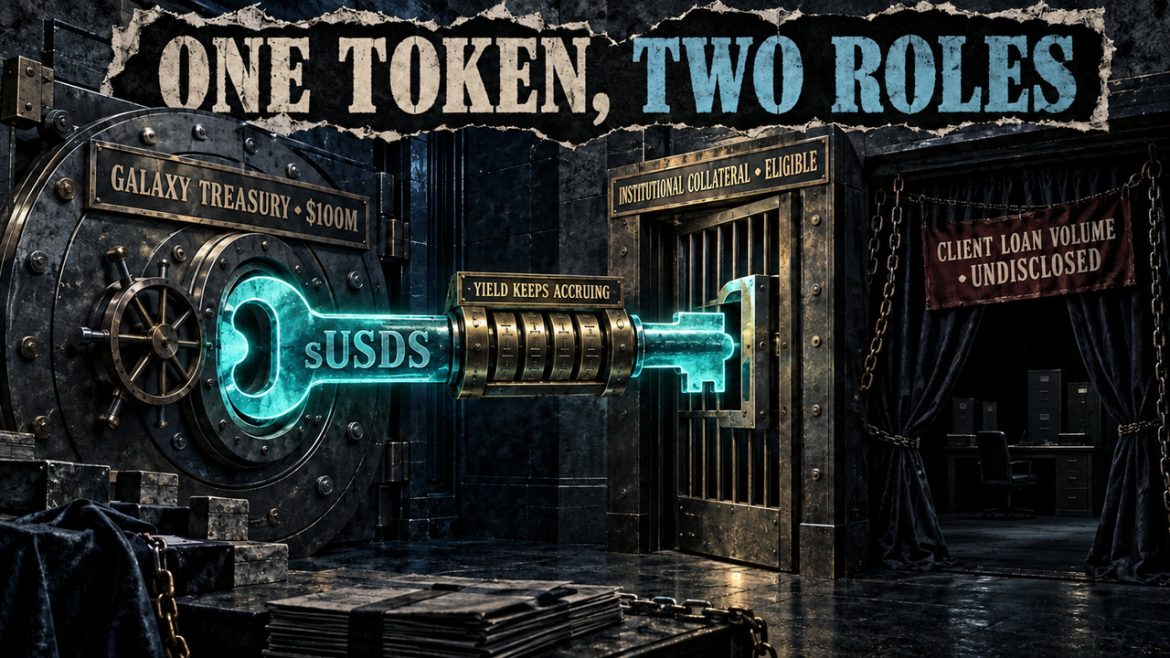
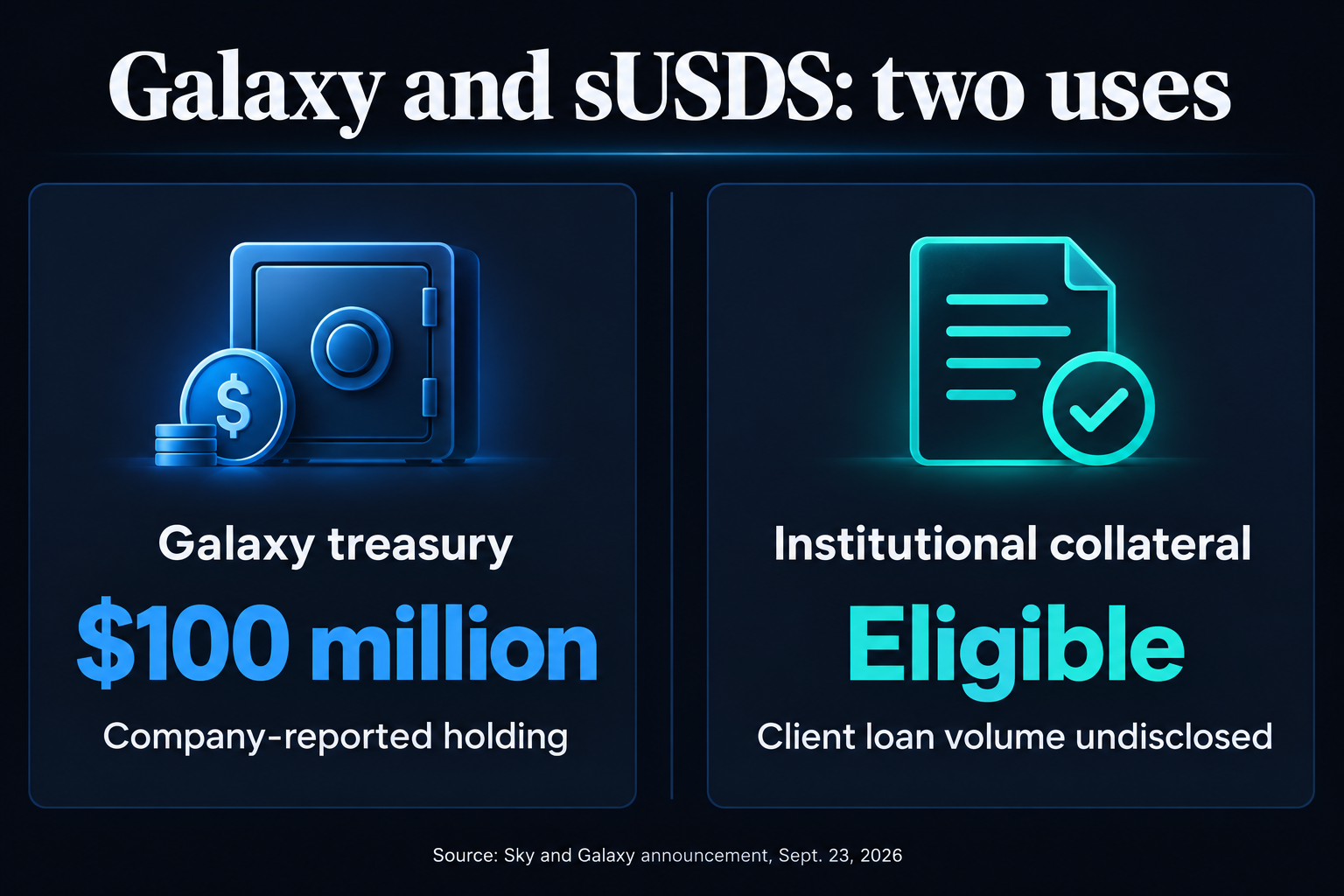
Galaxy Digital has added $100 million of sUSDS, Sky Protocol’s yield-bearing savings token, to its corporate treasury and approved it as collateral for institutional clients, the companies said Sept. 23.
Galaxy and Sky described the treasury position as complete, but their announcement gave no figure for client lending secured by sUSDS or the first completed loan. The decision makes the token eligible across Galaxy’s institutional trading business, with actual client uptake still undisclosed.
The attraction is a token that continues to accrue a savings return when pledged. Under the announced arrangement, clients who post sUSDS against a loan keep accruing the Sky Savings Rate on the full position while the loan runs.
Sky says governance sets that rate and funds it from aggregate protocol surplus, and that holders keep the same number of sUSDS tokens as the amount of USDS redeemable for each token increases as it accrues. The savings rate can change, so future accrual is not fixed.
For a borrower, that design could offer access to credit while retaining a savings position. The financial result would depend on the loan terms and the rate available over its life. The announcement does not provide those details for any completed sUSDS-backed borrowing, and it also leaves open how much collateral clients might eventually post.
The companies’ relationship already includes credit financing through Grove, a Sky ecosystem agent. In July, Grove announced a $500 million warehouse facility that supplies capital for institutional loans Galaxy originates.
Grove is the warehouse lender, supplying USDS capital, while Galaxy originates and services the loans. Borrower collateral in that facility is limited to Bitcoin and Ethereum, including staked forms of Ethereum.
A Sky Frontier Foundation update published Sept. 17 said Sky agents held about $304 million with Galaxy as of Sept. 1, driven by the Grove facility. That figure describes Sky-side exposure to Galaxy before the new announcement.
The treasury allocation gives the partnership a stated balance-sheet footprint today. The collateral approval could extend sUSDS into Galaxy’s client lending, where an identified loan or disclosed outstanding balance would show whether institutions use the token beyond Galaxy’s own holdings.

TON Foundation says Telegram Web3 mini-apps have passed 100 million monthly active users, marking another major distribution milestone for one of crypto’s most consumer-facing ecosystems.
That number is big enough to grab attention, but it needs a careful read.
Monthly active users in Telegram mini-apps can include off-chain bot interactions, app sessions, and wallet-adjacent activity. It should not be treated as the same thing as 100 million on-chain TON wallets all making direct transactions.
Still, even with that caveat, the scale is impressive.
TON has something most crypto networks badly want: access to a massive messaging platform where users already spend time.
For more details, visit the official Ton platform.
Crypto adoption usually struggles with distribution.
Projects build wallets, exchanges, apps, games, and payment systems, then spend huge amounts trying to attract users. TON starts from a different place because it is closely tied to the Telegram environment.
That does not guarantee adoption.
But it gives TON a user funnel most chains do not have. If people can discover mini-apps inside a messaging app they already use, onboarding feels less alien than downloading a new wallet and learning a new ecosystem from scratch.
That is a real advantage.
The mini-app category is broad.
Some apps may involve games, rewards, bots, payments, trading, social features, or wallet interactions. That means the 100 million MAU number is not a pure measure of on-chain financial activity.
And that is fine, as long as it is explained clearly.
The point is that Telegram-based Web3 apps are reaching a large user base. The next question is how much of that activity converts into durable wallet usage, transactions, payments, and application revenue.
TON Space gives the ecosystem a self-custody wallet route inside Telegram.
That matters because mini-app engagement becomes much more powerful if users can move from playing, earning, or interacting into actual wallet activity without leaving the environment. The smoother that step is, the stronger TON’s consumer crypto case becomes.
Most chains have to build consumer distribution from scratch.
TON can build inside a platform where communication and app discovery already happen.
The source materials note that MAU counts include off-chain Telegram bot interactions alongside direct on-chain wallet transfers.
That caveat should not be buried.
Bot-driven ecosystems can produce huge engagement numbers, but not every interaction has the same economic value. A user clicking inside a mini-app is different from a user holding assets, making payments, or interacting with DeFi.
The quality of activity matters.
Still, engagement is the first step. Without users, none of the deeper metrics can follow.
TON’s 100 million MAU milestone shows why the network remains one of the most interesting consumer crypto plays.
The number is not a clean on-chain wallet count, and it should not be treated like one. But it does show that Telegram mini-apps are operating at a scale most crypto products never reach.
Now the real test begins.
Can TON convert attention into lasting wallet adoption, useful payments, real transaction volume, and sustainable apps?
That is the question. But reaching 100 million monthly active mini-app users gives the ecosystem a serious platform to work from.
This article draws on TON Foundation materials and Tonstat ecosystem data.
This article was written by the News Desk and edited by Samuel Rae.

Editorial Process for bitcoinist is centered on delivering thoroughly researched, accurate, and unbiased content. We uphold strict sourcing standards, and each page undergoes diligent review by our team of top technology experts and seasoned editors. This process ensures the integrity, relevance, and value of our content for our readers.

Cryptocurrency exchange Kraken has expanded its derivatives trading offering in its home jurisdiction through a new acquisition.
Kraken acquired Small Exchange, a designated contract market maker (DCM), from the trading company IG Group for $100 million, the company announced on Thursday.
With the DCM licensed by the US Commodity Futures Trading Commission (CFTC), the Small Exchange acquisition authorizes Kraken to build markets for exchange-listed derivatives in the US.
“Under CFTC oversight, Kraken can now integrate clearing, risk, and matching into one environment that meets the same standards as the largest exchanges in the world,” Kraken co-CEO Arjun Sethi said.
The Small Exchange acquisition advances Kraken’s mission to build a unified trading platform, creating a foundation for a “new generation of US derivatives markets.”
The CFTC-licensed DCM helps Kraken connect spot, futures and margin trading products inside a single regulated liquidity system, reducing fragmentation and increasing the speed of trade execution, Sethi said.
The move is also part of a larger effort targeting global derivatives infrastructure, including Kraken’s derivatives platforms in the United Kingdom and the European Union.
“Together, these elements create a network that moves collateral in real time, nets exposure across jurisdictions, and reduces capital inefficiencies that have long held back US traders,” the co-CEO noted.
Kraken’s Small Exchange acquisition is not the first move by Kraken into derivatives markets in the US. The exchange launched a derivatives platform for US traders in July through a $1.5 billion acquisition of the futures trading platform NinjaTrader.
Announced in March 2025, the NinjaTrader acquisition enabled Kraken to offer Chicago Mercantile Exchange (CME)-listed crypto futures, alongside spot crypto products in a unified interface.
The expansion of derivatives products aligns with Kraken’s multi-year commitment to derivatives markets, including the acquisition of UK-based derivatives platform Crypto Facilities in 2019.
Related: Hyperliquid now allows anyone to deploy perpetual futures, for a price
In May 2025, Kraken launched derivatives trading in the European Union in compliance with the local crypto derivatives-related framework, Markets in Financial Instruments Directive (MiFID II).
Kraken’s ongoing efforts in creating a new generation of crypto derivatives come amid the derivatives segment holding momentum against spot trading on centralized exchanges (CEXs).
While spot trading volumes reportedly plummeted as much as 22% in the second quarter of 2025, derivatives were more resilient, experiencing a decline of about 4% and totaling $20.2 trillion.
According to Mark Jennings, head of Europe at Winklevoss’s crypto exchange Gemini, the global derivatives market has exploded in recent months and is expected to hit $23 trillion by the end of 2025.

With derivatives emerging as a key crypto trend in 2025, major derivatives platforms and CEXs have been rushing to expand their products.
In early October, CME Group said it will expand its services to offer always-on trading for crypto derivatives starting in 2026.
Coinbase, the largest US crypto exchange by trading volumes, has also been actively expanding into derivatives with the Deribit acquisition in May.
Magazine: Sharplink exec shocked by level of BTC and ETH ETF hodling: Joseph Chalom


