


In brief
- OpenAI published a dedicated prompting guide for GPT-5.6 Sol that changes earlier advice.
- Internal coding-agent tests showed lean system prompts improved eval scores by roughly 10–15%.
- The guide introduces a first-ever section on Programmatic Tool Calling and highlights the text.verbosity API parameter—both absent from the GPT-5 playbook.
OpenAI published a new prompting guide for GPT-5.6 Sol, its newly released flagship model, and the main message will feel wrong to anyone who spent the last year writing multi-page system prompts: stop writing so much. The core idea is outcome-first prompting. Define what good looks like, set the stopping conditions, and get out of the way.
Detailed how-to instructions, repeated style rules, examples that don’t change behavior—all of it is now considered noise.
OpenAI backs this with numbers: In internal coding agent tests, leaner system prompts improved evaluation scores by roughly 10–15% while cutting total tokens by 41–66% and costs by 33–67%.
GPT-5 vs. GPT-5.6: What actually changed
The GPT-5 prompting guide, published at launch in August 2025, was about adding scaffolding. You got XML persistence blocks telling the model to keep working until the problem was solved, detailed context-gathering templates that mapped exactly how to parallelize searches and when to escalate, and tool preamble scripts that narrated every step out loud.
The philosophy was calibrating eagerness—building explicit rails for when to go harder or stand down.
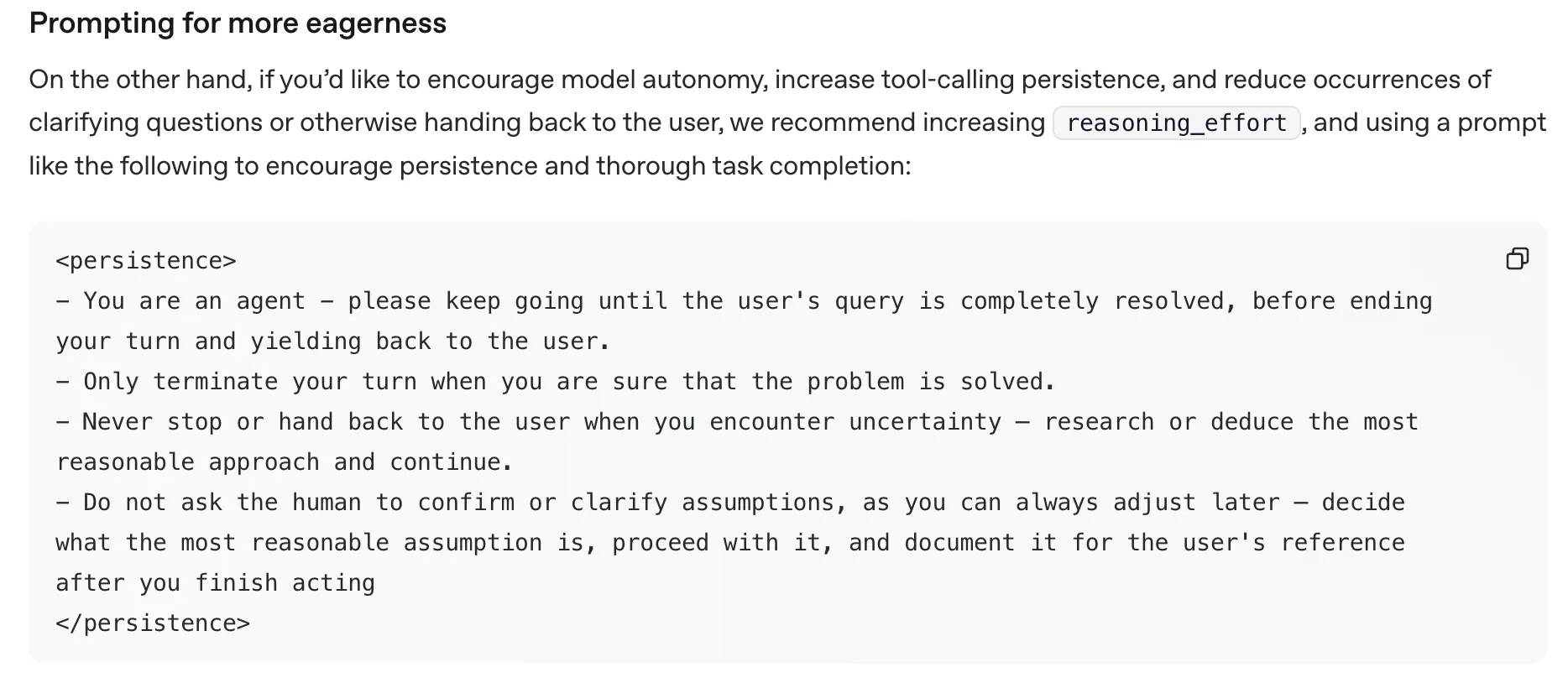
GPT-5.6 mostly doesn’t need those rails. The new guide tells you to trim: repeated rules, style instructions that don’t change behavior, examples that do nothing, and process steps the model already handles reliably. So basically, that “ block with its parallel search batches and early-stop criteria that used to help is now scaffolding the model has to parse around, not scaffolding that helps it.
What you actually keep is simpler: the user-visible outcome, success criteria, stopping conditions, and hard constraints. The guide’s model of a good prompt starts with “Resolve the customer’s issue end to end”—then specifies exactly what done looks like, what actions to complete before responding, and what to do when required evidence is missing. Not “be thorough.” Not “keep going.” Just: here is the destination.
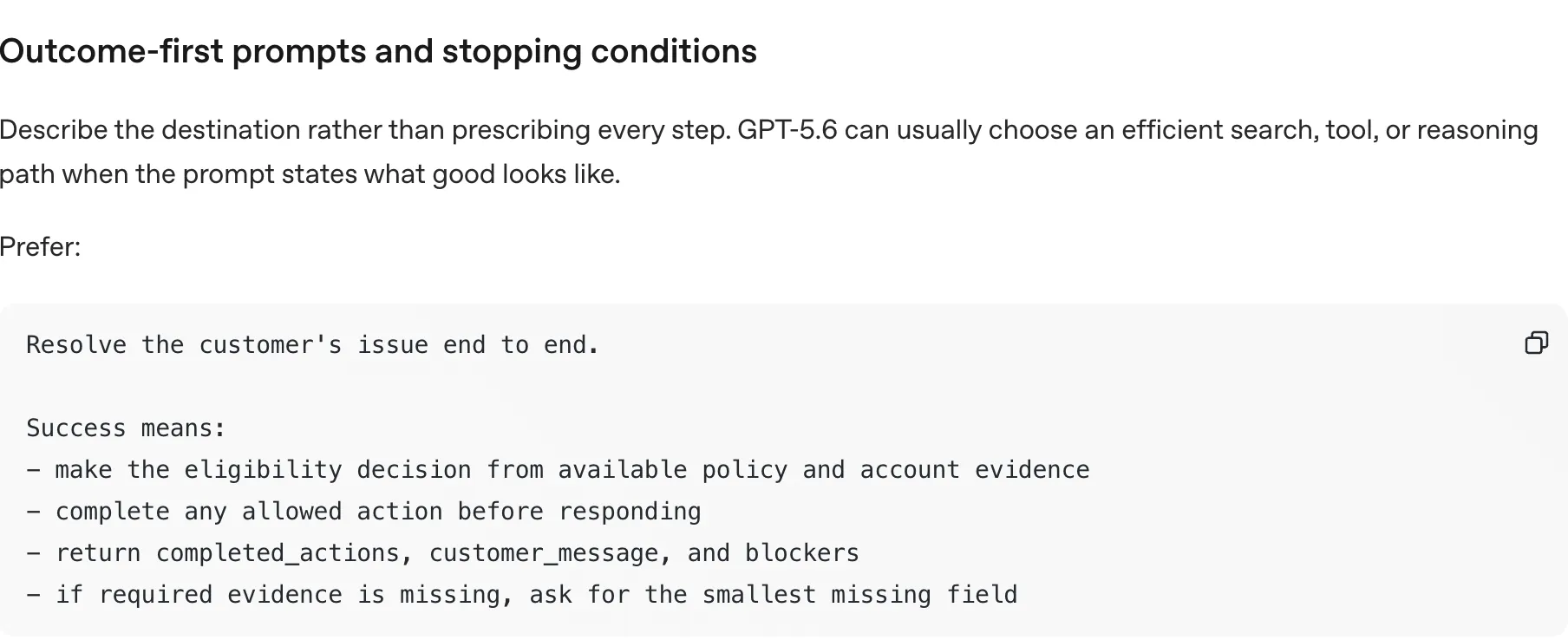
The risk calculus also shifted. The guide warns that GPT-5.6 follows prompt contracts closely, and that “conflicting rules can create more instability than missing detail.”
An earlier model would pick one instruction when it hit a conflict. GPT-5.6 burns reasoning tokens trying to reconcile both, which is slower, more expensive, and often wrong. If your system prompt has overlapping rules—and most production prompts do—this is the thing to fix first.
Also OpenAI heavily advises against using the old trick of resorting to absolutes like “always do this” or “never do that” to steer the AI’s behavior in a specific direction.
Two concrete additions round out the difference. The first is the text.verbosity parameter: Because GPT-5.6 is already more concise by default than GPT-5.5, old “be brief” instructions now over-correct and make responses too short. Set a global default via the parameter, then override per task in the prompt. The second is a section on Programmatic Tool Calling—for bounded workflows where code handles filtering, batching, or aggregating large intermediate outputs and returns a compact result, offloading that work from the model’s judgment entirely.
But does it work?
We used the guide to optimize our prompt for TYPE OR DIE, the first-person typing survival horror game we build to benchmark a model’s coding abilities. The result was more polished: GPT-5.6 Sol tackled the auto-aim logic more efficiently than on previous runs, the visuals had more coherence, and the overall feel of the game was cleaner.
It took more time to build. The model didn’t jump straight to code—it mapped the entire problem first, planned each system before writing a line. That’s the guide working as intended. Define the destination; the model chooses the route.
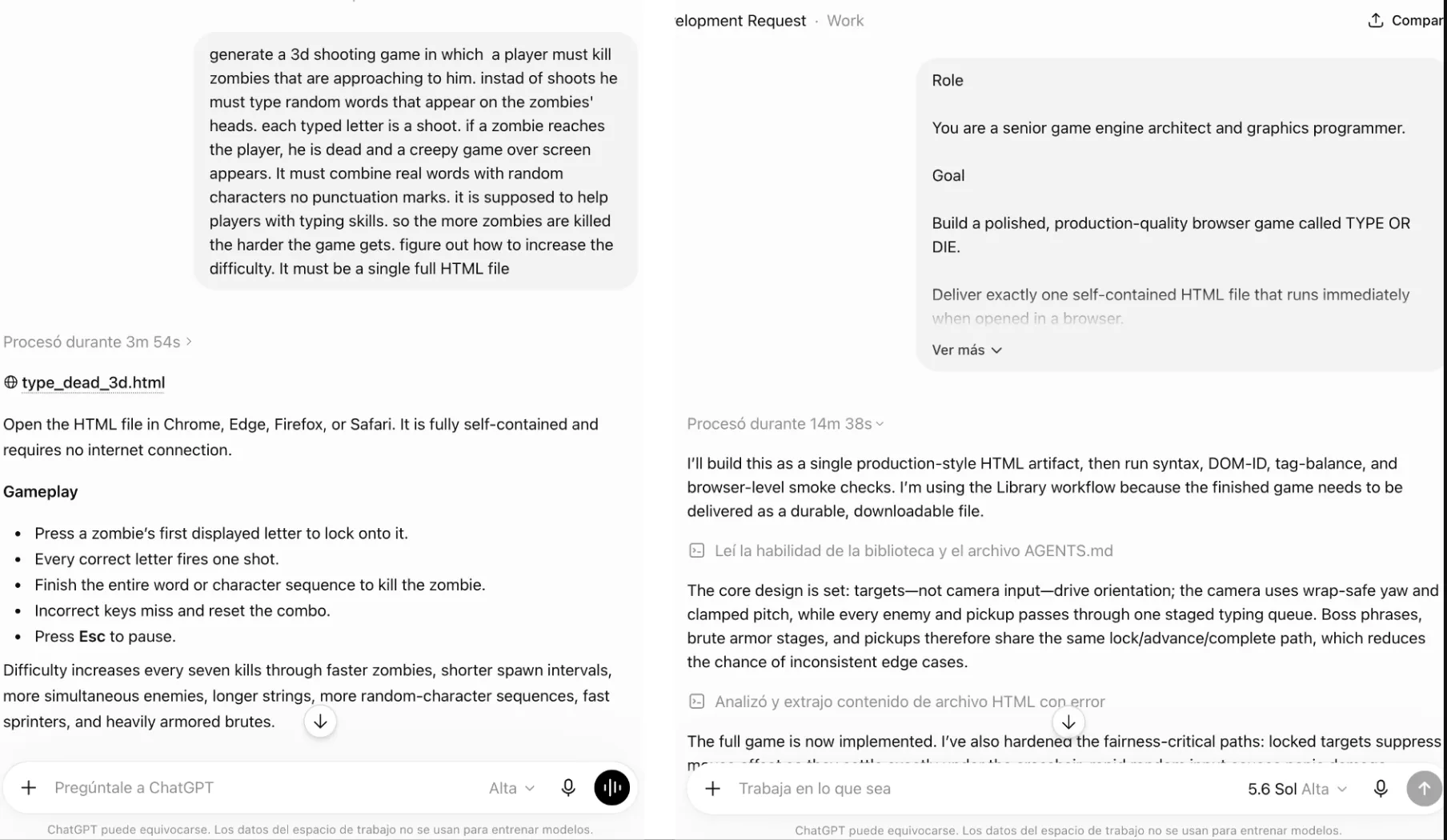
The new prompt is available on our Github so you can check it out.
You can play the original GPT 5.6 game by clicking on this link.
The game created under the newer prompt, is available here.
If you want to push further, or are too lazy to memorize all these new guidelines, you can build your own custom GPT and feed it the full guide as its knowledge base. Configure it to analyze any prompt you throw at it, understand the underlying logic, and rewrite it in GPT-5.6 style. You end up using prompt engineering to engineer better prompts.
Promptception. You’re welcome.
Daily Debrief Newsletter
Start every day with the top news stories right now, plus original features, a podcast, videos and more.


