Coinbase plans to expand its Singapore office from 150 to about 200 employees by the end of 2026 as it grows its presence in the Lion City.

 Live Chat

Coinbase plans to expand its Singapore office from 150 to about 200 employees by the end of 2026 as it grows its presence in the Lion City.

Start every day with the top news stories right now, plus original features, a podcast, videos and more.

Pakistan Virtual Assets Regulatory Authority (PVARA) chairman Bilal bin Saqib has called for continued dialogue on the treatment of digital assets under Islamic law after meeting prominent scholar Mufti Taqi Usmani, who backed a ruling against purchases made with crypto.
In a Saturday post, Saqib said the discussion covered blockchain technology, digital assets, stablecoins and tokenized real-world assets (RWAs), as well as the need to protect Pakistanis from fraud, exploitation and financial harm.
Saqib said the different categories of digital assets merit “careful technical assessment alongside rigorous Shariah examination, rather than being viewed through a single lens.”
The exchange highlights tension between Pakistan’s push to build a regulated crypto market and religious objections that could shape public acceptance. Religious views could carry significant weight in Pakistan, where about 231.7 million people, or 96.35% of the population, identified as Muslim in the 2023 census.
According to Pakistani newspaper Dawn, Usmani and five other scholars signed an Islamic legal ruling issued by Jamia Darul Uloom Karachi, a prominent Islamic seminary, on Friday.
The ruling reportedly said purchases made with crypto, including stablecoins such as USDT, were not permitted because digital tokens did not qualify as recognized property or wealth under their interpretation of Islamic law.
Saqib did not directly challenge the claim. Instead, he called for scholars, regulators and industry participants to continue discussing distinctions among digital-asset categories.
“I shared that blockchain, digital assets, stablecoins, and tokenized real-world assets represent a broad spectrum of technologies and use cases,” he said.
Related: PUSD stablecoin deploys on ADI Chain, targeting $3T Islamic finance market
The discussion comes as Pakistan shifts from years of restrictions toward a licensed virtual-asset sector. On April 15, the State Bank of Pakistan allowed banks to open accounts for virtual asset service providers (VASPs) licensed by the PVARA, ending an eight-year restriction on regulated institutions dealing with crypto.
The move followed the passage of Pakistan’s Virtual Assets Act 2026 in March, which established PVARA as the statutory body responsible for licensing and oversight of virtual asset activities.
Magazine: Bitcoin nearing late stages of bear market: Jamie Coutts, Real Vision

Have been using Fable 5 all day just continuing what I was doing with Opus
The findings are true
It’s completely nerfed
Politics has nuked civilian technological advancement once again https://t.co/Ed3jrqOxbK
— BharadwajC (@bwjbuild) July 2, 2026
FABLE 5 CAME BACK NERFED.
We re-ran the July 1st version of Claude Fable 5 on BridgeBench.
The results are brutal:
Debugging: 86.2 → 25.9
Refactoring: 73.6 → 38.4
Hallucination: 75.9 → 61.7The new guardrails are kicking in on way too many tasks and falling back to Opus… pic.twitter.com/tcUDDXpZMF
— BridgeMind (@bridgemindai) July 2, 2026
The community has been asking how Claude Fable 5 compares before vs. after its latest re-deployment.
We collected thousands of votes on the new endpoint across Arenas – Text, Vision, Document, Code, and Agent – and here’s an early score preview.
So far, scores look mostly… https://t.co/FKDaPpz10e pic.twitter.com/1nJDHqnlIj
— Arena.ai (@arena) July 2, 2026
Start every day with the top news stories right now, plus original features, a podcast, videos and more.
Cryptocurrency ATMs are fast disappearing from the American landscape as kiosk operators in two US states face bans and restrictions as new laws go into effect.
Crypto ATM laws passed by Tennessee and Georgia went into effect on Wednesday, imposing a complete ban in the former and requiring transaction limits and reporting in the latter. The measures by the two states followed bans in Indiana, which went into effect in March, and Minnesota, set to enforce an ATM ban on Aug. 1.
The Tennessee law, signed by Governor Bill Lee in April, bans the use and installation of cryptocurrency ATMs and kiosks, while the Georgia law requires that ATM operators cap money sent for new and existing users, issue warnings to customers and in some cases refund those who may have been the victim of fraud.
There were 185 crypto ATMs and kiosks operating in Tennessee before the statewide ban took effect on July 1. Source: CoinATMRadar
Many US state governments and municipalities have individually begun cracking down on crypto ATM operators in response to incidents of residents, particularly senior citizens, being conned into sending funds to scammers. Delaware and New Jersey lawmakers have proposed similar measures completely banning the machines.
Related: Massachusetts city to weigh crypto ATM ban, citing financial risks
The restrictions may have already contributed to at least one ATM operator going under. In May, Bitcoin Depot filed for Chapter 11 bankruptcy. The company had disclosed just days before that it had “substantial doubts” about its future amid a challenging regulatory environment and lawsuits.
“Bitcoin Depot’s bankruptcy is likely a preview of what the broader crypto ATM industry will face in the US over the next several years,” Roshan Dharia, CEO of Echo Base and a restructuring adviser, told Cointelegraph following the Chapter 11 filing. “The traditional model depended on high transaction spreads and limited regulatory scrutiny to offset unusually high compliance, cash logistics, fraud remediation, and retail revenue sharing costs. That equation is breaking down as states increasingly impose consumer protection standards that compress fees, expand operator liability for scam related activity, and raise expectations around transaction monitoring and reimbursement.”
Although not in effect yet, federal policymakers in Canada proposed a total ban on crypto ATMs across the country. The proposed policy, which would still allow Canadians to buy digital assets from brick-and-mortar money services businesses, was in response to what officials called the ATMs being the “primary method for scammers to defraud victims and for criminals to place their cash proceeds of crime.”
Magazine: Bitcoin slides to $58K, XRP hits $1 but onchain data promising: Market Moves

MUMBAI, India, June 26, 2026 /PRNewswire/ — Ten minutes is all it takes for KITABOO’s new AI capability to analyze a standard textbook PDF, isolate the exact concept students struggle with most, and engineer an interactive simulation around that specific learning friction point.
This automated pipeline instantly transforms flat text into an active digital environment: a physics chapter becomes a pendulum a student can control; an algebra lesson shifts into a digital balance scale; and a biology unit evolves into an ecosystem where students manipulate variables to observe cause and effect. The final output is delivered via a single, shareable URL that anyone can access instantly—no user accounts or logins required.
Publishers globally are sitting on years of curriculum content in PDF format. The quality of that content has never been the problem. The production cost of converting it into something genuinely interactive has been. A full conversion project has historically required a specialist team, a vendor engagement, and months of time. Most publishers have done the math and deprioritised it.
KITABOO’s new capability removes that constraint. By introducing an end-to-end automated pipeline, the platform allows publishers to bypass traditional development bottlenecks:
“K12 publishers have spent years building content that students deserve to actually interact with,” said Darshit Shah, K12 Lead at KITABOO. “What took a team and a production budget now takes ten minutes. That changes who can afford to go digital, and when.”
The timing matters. In the US, emergency federal education funding that kept many publisher production pipelines running ended in 2024. In Europe, governments are mandating digital transitions and accessibility compliance, while publishers are expected to absorb the cost from existing resources. The publishers who find a faster, lower-cost path to interactive content this year will be positioned for the adoption windows ahead. Those who wait are extending a gap that is already widening.
Publishers who want to test this with their own content can do so at: kitaboo.com/turn-textbook-into-interactive-learning
About KITABOO
KITABOO is a digital publishing and learning platform. The platform enables K12 publishers, educational institutions, and content providers to create, distribute, secure, and measure digital content across web and mobile platforms. KITABOO serves publishers in more than 25+ countries, supporting over six million active users across 7,000 school districts.
For more information, visit https://kitaboo.com.
Photo: https://web3wire.org/wp-content/uploads/2026/06/KITABOO_Live_Simulations.jpg
View original content to download multimedia:https://www.prnewswire.com/in/news-releases/kitaboo-converts-a-textbook-pdf-into-a-working-student-simulation-in-ten-minutes-with-no-human-involvement-302811517.html

Start every day with the top news stories right now, plus original features, a podcast, videos and more.
Cryptocurrency traders are no longer using Bitcoin (BTC) profits to buy altcoins as they did in previous bull cycles, raising doubts about whether a broad “altseason” can return.
Key takeaways:
The old altseason trade is no longer working the way it did in previous bull cycles, according to Ki Young Ju, CEO of CryptoQuant.
In a Saturday post, Ju said the Bitcoin-to-altcoin rotation trend has “basically disappeared,” citing CryptoQuant data showing BTC-pair altcoin trading volume has collapsed to its weakest levels since 2021.
Aggregated altcoin trading volume for BTC-priced pairs. Source: CryptoQuant
The metric excludes major altcoins such as Ether (ETH), XRP (XRP), BNB (BNB) and Solana (SOL), focusing instead on mid- and lower-cap altcoins traded against Bitcoin on centralized exchanges.
In simple terms, it shows whether traders are using BTC to buy smaller altcoins.
That flow surged in 2017 and 2021, helping fuel record altseasons. But Young Ju’s chart shows BTC-pair altcoin volume remains near post-2021 lows, suggesting Bitcoin is no longer the main liquidity source for altcoin speculation.
“The era of alts pumping just because BTC pumps may be over,” Young Ju said.
The wider altcoin market has become more concentrated, excluding stablecoins.
As of Saturday, the non-BTC, non-stablecoin crypto market was worth roughly $600 billion. The top 10 non-stablecoin altcoins accounted for about $483 billion of that total, or roughly 80.5%.
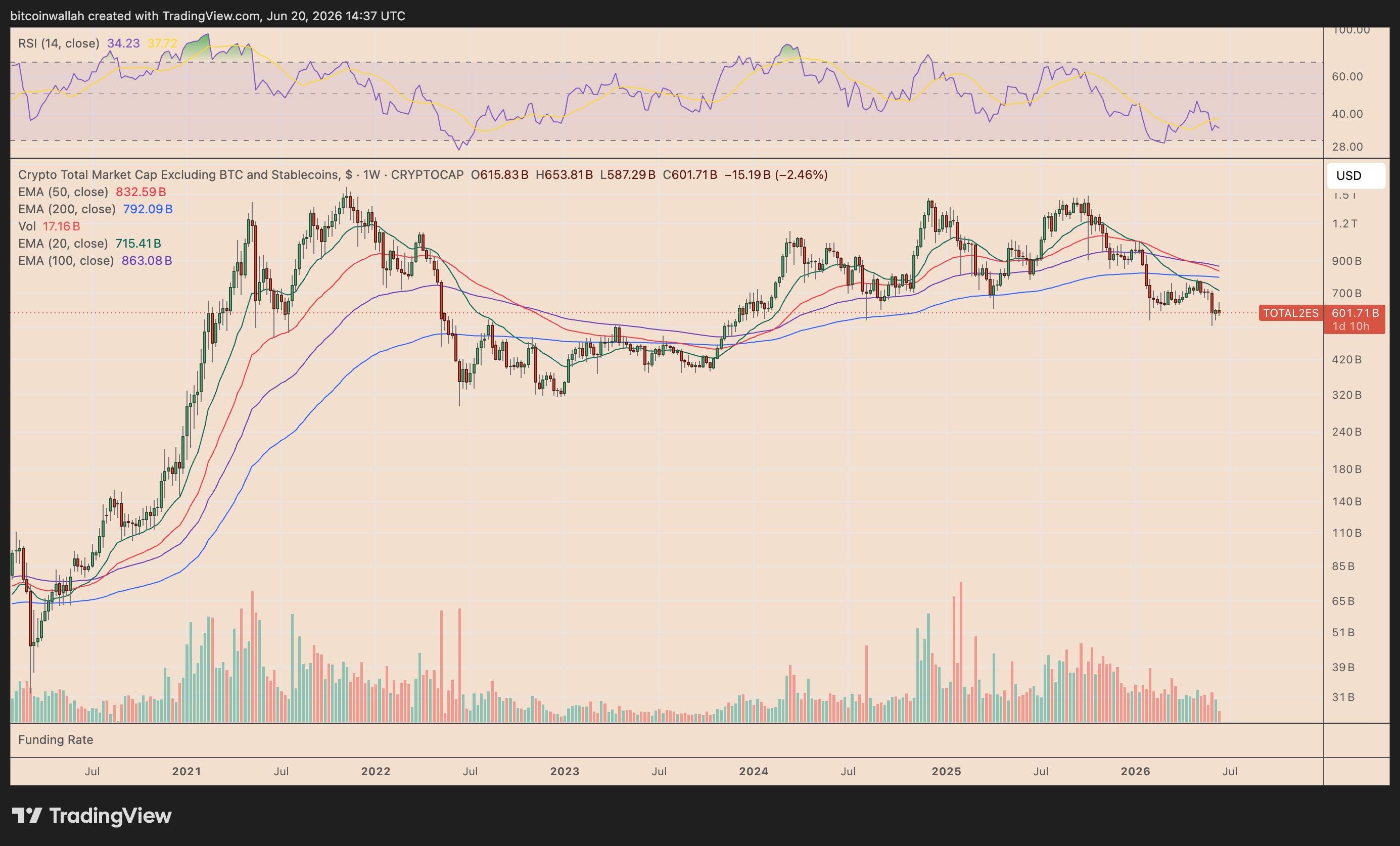
TOTAL crypto market excluding Bitcoin and all stablecoins. Source: TradingView
The number of large market-cap altcoins has also fallen sharply since the last bull cycle.
In 2021, roughly 106 altcoins had above $1 billion in market valuation, according to CoinMarketCap’s historical snapshot. That number fell to around 50 in June 2026.
This echoes Young Ju’s argument that capital is no longer spreading across the altcoin market the way it did in 2021. The market has not disappeared, but it is being comprised of fewer large altcoins.
In a separate thread, Young Ju said that “narrative-only altcoins” are losing relevance as the market matures.

Source: X/Ki Young Ju
Young Ju said hype alone is no longer enough. The stronger areas, he added, are tied to real businesses, revenue-generating DeFi, stablecoins, tokenized real-world assets, and AI agents.
That suggests the next altcoin cycle may be less about rotating into the whole market and more about finding tokens that can find applications and users across the aforementioned fields.
Bitcoin’s crypto market dominance (BTC.D) is also showing early signs of a rebound, which could delay a broader altcoin rally.
The BTC.D metric has bounced from its 100-week exponential moving average (100-week EMA, purple) and the lower trend line of an ascending channel, both aligning at the 58.75% level.
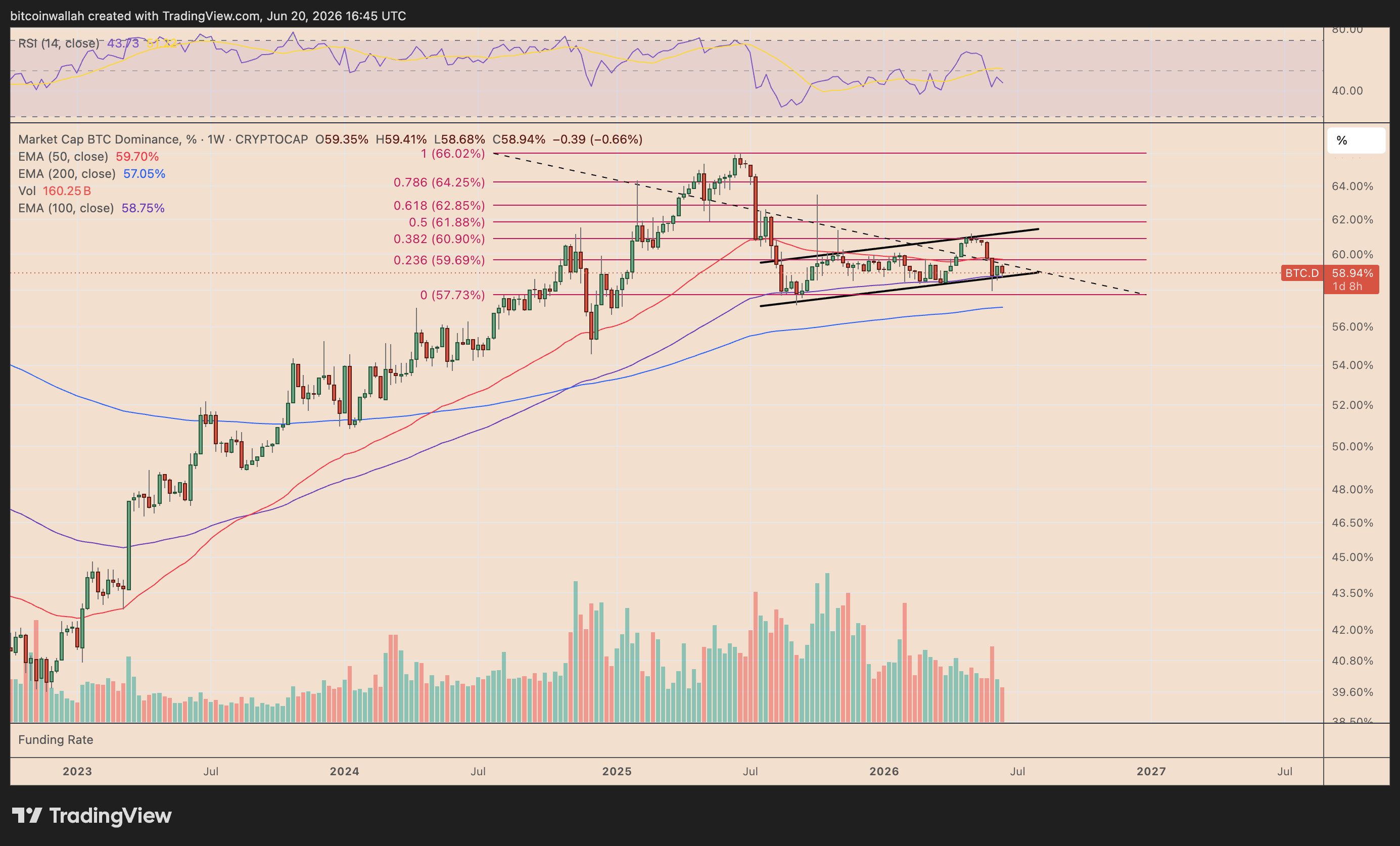
BTC.D weekly performance chart. Source: TradingView
It could rally toward the channel’s upper trend line near 60% if momentum persists.
A move toward 60% would mean Bitcoin is gaining market share against the rest of crypto. In market terms, that suggests capital may continue rotating from altcoins back into BTC, limiting the chances of a near-term altseason.
Analyst Rekt Capital shared a similar view, pointing to a bullish divergence on Bitcoin dominance, which suggests that the “altseason is postponed.”
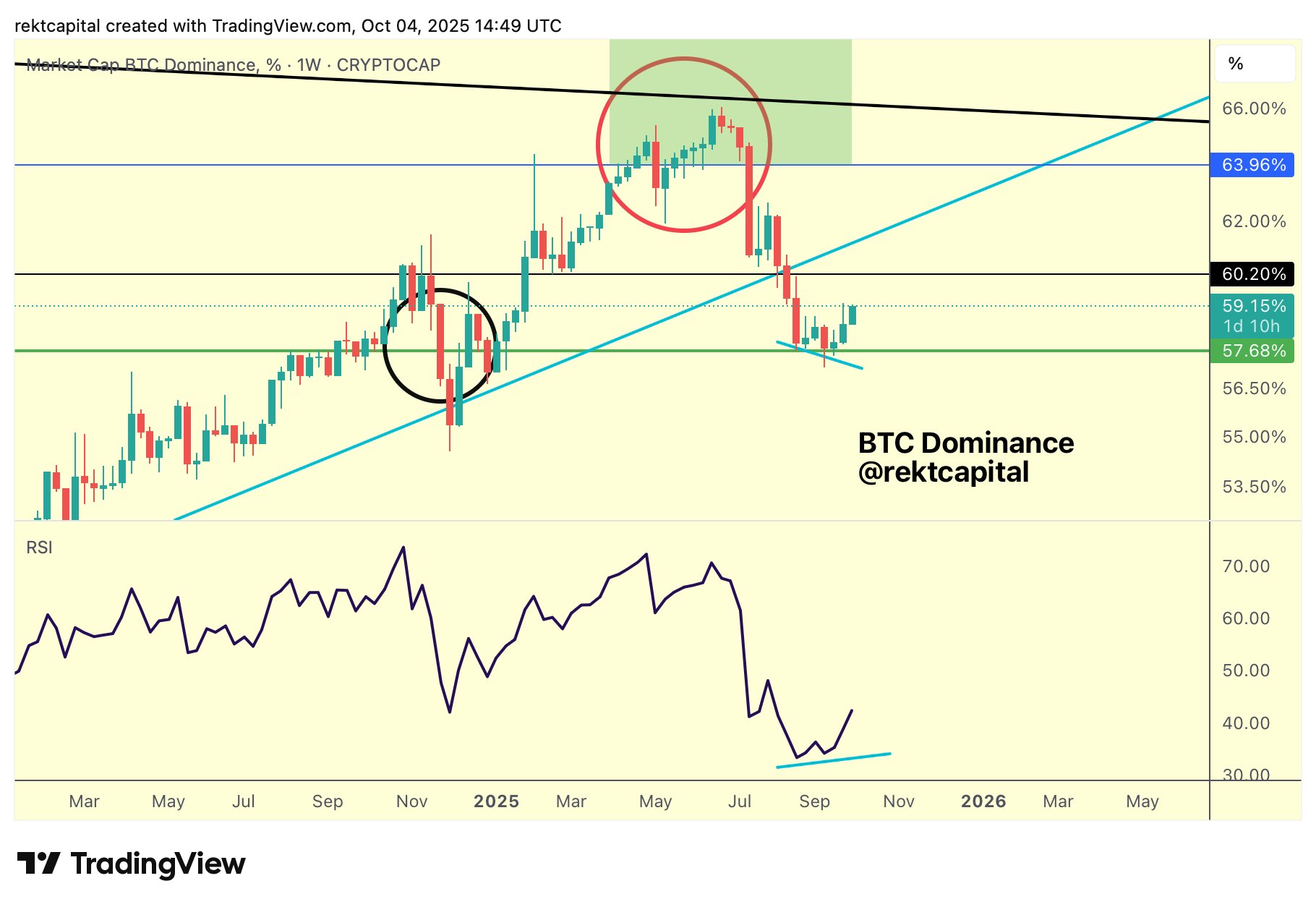
BTC.D weekly performance chart. Source: TradingView/Rekt Capital
A bullish divergence forms when the metric makes lower lows while its RSI makes higher lows. It often signals weakening downside momentum and a potential rebound.
Related: Altcoin selling tops $266B as capital rotates out of crypto: Is altseason extinct?
Nevertheless, Rekt Capital said Bitcoin dominance’s upside may be limited because the metric has already lost its macro uptrend. He said the current bounce may act as a post-breakdown relief rally before further downside.
Bitcoin’s dominance may drop toward its 200-week EMA at 57% if Rekt Capital’s bearish scenario plays out.

NEW YORK, June 15, 2026 (GLOBE NEWSWIRE) — PageUp, a global leader in talent acquisition software, today announced the results of an independent audit by Warden AI, an AI assurance platform that helps organizations certify and continuously monitor AI systems for compliance and accountability. Monthly audits have confirmed that PageUp’s AI systems meet Warden AI’s highest standards of fairness and transparency, as well as those for disparate impact and consistency.
As hiring teams continue to incorporate AI-powered solutions into their daily workflows, demand has increased for more transparency and oversight into how those tools support hiring decisions. Warden AI’s audit and ongoing monitoring provide PageUp’s clients with evidence that their hiring systems operate fairly and compliantly. In the interest of total transparency, up-to-date testing results of the monitored platform are publicly available on Warden AI’s Assured Directory.
The audit evaluated elements of PageUp’s AI capabilities to ensure alignment with evolving employment-related AI regulations and civil rights requirements through independent benchmarking, ongoing technical audits, and dual-method bias testing methodologies, including disparate impact and counterfactual analyses. Warden AI tests for equality of outcomes across demographic groups and equal treatment of individuals. Because LLMs are constantly changing, systems audited by Warden AI are monitored on an ongoing basis to ensure continued compliance with both Warden AI’s standards and global standards, including NYC Local Law 144, the EU AI Act, Colorado SB205, and California FEHA.
“AI is moving faster than most organizations can evaluate it, especially in hiring, where the stakes are incredibly high,” said Eric Lochner, CEO of PageUp. “The industry has spent a lot of time talking about AI innovation but proving how these systems are being held accountable in real-world environments is often left by the wayside. Warden AI’s independent audit of PageUp’s solutions helps us move from promises to evidence, which is what enterprise customers are increasingly looking for from their providers.”
“Independent validation is critical to building trust in AI hiring technology. PageUp welcomed that scrutiny, and we are proud to welcome them to the Warden Assured ecosystem,” said Jeff Pole, co-founder & CEO at Warden AI.
PageUp’s continued investment in responsibly built AI spans the full hiring lifecycle, from sourcing and recruitment marketing through candidate matching, workflow automation, and onboarding. As enterprise organizations evaluate how to embed AI into hiring with confidence, PageUp remains committed to building it transparently, accountably, and on independent evidence.
About Warden AI
Founded in 2023 by Jeffrey Pole and Eduard Schikurski, Warden AI provides a platform that enables enterprises and vendors to audit AI using proprietary datasets, benchmarks, and real-time dashboards. This helps companies comply with regulations such as the EU AI Act and NYC Local Law 144. Warden AI’s mission is to safeguard the use of AI in HR by certifying systems for fairness and compliance. Headquartered in Austin, Texas and London, U.K., Warden AI is already used by leading HR tech platforms, including Greenhouse, Sense, and Beamery.
About PageUp
PageUp believes the most powerful talent acquisition technology is built on one simple principle: human connection. As the chosen talent acquisition partner for the world’s most trusted brands, PageUp delivers a world-class customer experience by building deep, lasting partnerships. This commitment is reflected in PageUp’s intelligent talent acquisition platform, an intuitive, AI-powered system that’s easy to use, adaptable to your unique hiring needs and always innovating. We strip away complexity so talent teams can focus on what matters—creating the strong, human connections that forge a resilient workforce.
For more information, visit http://www.pageuppeople.com.

Start every day with the top news stories right now, plus original features, a podcast, videos and more.


