Five equity-backed notes issued through Luxembourg’s ORO II fund will trade against dollars, USDT and Bitcoin for eligible non-US investors.

 Live Chat

Five equity-backed notes issued through Luxembourg’s ORO II fund will trade against dollars, USDT and Bitcoin for eligible non-US investors.
The Ninth Circuit has dealt Kalshi one of its biggest legal losses yet, ruling that the platform’s sports-event contracts are sports bets—not swaps protected by the Commodity Exchange Act. The decision lets Nevada enforce its gaming laws against Kalshi’s sports products, deepens a circuit split with the Third Circuit, and raises the stakes for prediction-market operators facing state regulators around the country.
The United States Court of Appeals for the Ninth Circuit delivered a major win to Nevada Friday, and a major setback to Kalshi’s central legal argument for offering sports contracts nationwide.
In a published opinion, a unanimous three-judge panel affirmed the dissolution of Kalshi’s preliminary injunction against Nevada gaming regulators. The court held that Kalshi had not shown it was likely to prove that the Commodity Exchange Act preempts Nevada’s gambling laws as applied to its sports-event contracts.
The key conclusion was blunt: Kalshi’s sports products are sports bets, not Commodity Futures Trading Commission-regulated swaps.
That does not end Kalshi’s case altogether. The court remanded the dispute over Kalshi’s election contracts to the Nevada district court for separate consideration. But for the platform’s sports business, the part that made up more than 90% of Kalshi trades and 95% of its revenue in 2025, according to the opinion, the ruling is a serious legal problem.
The dispute began in March 2025, when the Nevada Gaming Control Board sent Kalshi a cease-and-desist letter. Nevada argued that the company’s sports-event contracts constituted an unlicensed sports pool under state gaming law.
Kalshi argued that it is not a sportsbook but a CFTC-registered designated contract market (DCM) listing federally regulated event contracts. It stated the CFTC’s authority over swaps preempted Nevada’s gaming rules. A district judge initially gave Kalshi a preliminary injunction, but later dissolved it after a separate Nevada ruling against Crypto.com reached the opposite conclusion on similar sports contracts.
Friday’s appeals decision backs Nevada’s position. The court held that the Commodity Exchange Act gives the CFTC exclusive jurisdiction over qualifying swaps traded on a DCM, but that Kalshi’s contracts on sports outcomes do not qualify as swaps in the first place.
The panel said a bet on whether a team covers a spread, wins a game, or hits a particular score is not materially different from the same wager at a conventional sportsbook. Kalshi’s market structure may differ from Caesars or MGM, the court said, but those differences do not change the legal substance of the product.
Kalshi’s argument centered on the broad statutory definition of a swap: a contract tied to the occurrence or nonoccurrence of an event or contingency that carries a potential financial, economic or commercial consequence.
The Ninth Circuit agreed that the CEA can preempt some state regulation of swaps traded on federally designated markets. But it rejected Kalshi’s view that every event contract listed on a DCM automatically receives that federal shield.
The court’s reasoning had three major pieces:
The judges also rejected Kalshi’s claims of conflict and field preemption. They said Kalshi could comply with Nevada law by geofencing users in Nevada, as other regulated entities do. They held that Congress had not clearly given the CFTC authority to displace states’ longstanding role in regulating gambling.
The ruling creates a direct and increasingly consequential split with the Third Circuit.
Earlier this year, the Third Circuit affirmed an injunction protecting Kalshi from New Jersey gambling enforcement, concluding that Kalshi’s sports-related event contracts could be treated as swaps under the CEA and that federal law preempted the state’s attempt to regulate them.
The Ninth Circuit explicitly disagreed with that approach. It said the Third Circuit read the term “event” too literally and failed to account for the statutory context, the CFTC’s prohibition on gaming, and the fact that Congress has historically treated sports gambling as an area for state and tribal regulation.
That leaves two federal appellate courts interpreting the same federal law differently. Kalshi may seek rehearing or Supreme Court review, particularly because the CFTC appeared as an amicus supporting the company’s position. But for now, the Ninth Circuit’s decision is controlling across a large portion of the West.
The American Gaming Association hailed the decision as a victory for state authority and the established gaming framework.
“The Ninth Circuit’s unanimous decision confirmed state and voter choices about sports betting in their communities,” the AGA said in a statement. “The American Gaming Association applauds Nevada’s leadership for protecting and preserving the state- and tribal-regulated gaming framework. This ruling is a significant win for consumer protections and taxpayers.
“It is a big loss for Kalshi and other backdoor sports gambling operations who defy state laws.”
The Nevada ruling is a major setback for prediction markets, but it does not settle the nationwide fight.
Kalshi has picked up preliminary-injunction wins in New Jersey, Tennessee and Arizona, while courts in Maryland, Ohio, New York and now Nevada have rejected or limited its preemption argument. The Fourth Circuit appeal from the Maryland decision is still pending, and the Ninth Circuit’s ruling notes that litigation remains active in multiple jurisdictions.
The immediate practical distinction is between sports contracts and other types of event contracts. The Ninth Circuit sent the question of Kalshi’s election markets back to the Nevada district court rather than deciding it, leaving political prediction markets outside the court’s core holding for now.

The planned rule would cover advisers and investment companies and clarify digital-asset custody, following the withdrawal of a separate 2023 proposal.
The Securities and Exchange Commission’s proposed rewrite of custody rules for investment advisers and investment companies entered White House review on Aug. 25, placing a new crypto-focused framework into regulatory review after the agency withdrew a separate 2023 safeguarding proposal.
The SEC’s 2026 regulatory agenda says the planned rule would clarify how investment advisers and investment companies can custody crypto assets under Commission requirements. The current adviser rule covers client funds and securities and generally requires a qualified custodian to maintain them in separate client accounts or accounts held by an adviser as agent or trustee.
The new agenda covers both investment adviser client assets and investment-company fund assets, and says the SEC intends to remove burdens from provisions it considers outdated. The separate 2023 proposal focused on registered investment advisers, would have expanded the custody rule to all client assets and proposed additional protections involving segregation and custodian insolvency.
OIRA’s current-review data lists RIN 3235-AN46, “Amendments to the Custody Rules,” at the proposed-rule stage with an Aug. 25 date. The SEC agenda identifies the same RIN as an SEC action under the Investment Advisers Act and Investment Company Act.
The OIRA entry and SEC agenda provide no proposed rule text. A 2025 White House order says agencies must continue following Executive Order 12866 processes for submitting regulations to OIRA for review. For this SEC action, the public records currently show the review entry and the agenda description, not the draft’s provisions.
The agenda says advisers and investment companies have raised questions about holding crypto assets in compliance with current custody requirements. It does not specify which entities would qualify to custody crypto, what controls would apply or which existing provisions the SEC would remove.
The earlier safeguarding proposal, issued in February 2023 under a different regulatory identifier, would have retained qualified custodians while broadening the adviser rule beyond funds and securities to all client assets, including crypto. It also proposed protections intended to segregate client assets and protect them if a custodian became insolvent, alongside updated recordkeeping requirements.
The Commission formally withdrew that proposal in June 2025 and said any future regulatory action in the area would require a new proposed rule. The current agenda targets October 2026 for a notice of proposed rulemaking and lists no legal deadline.
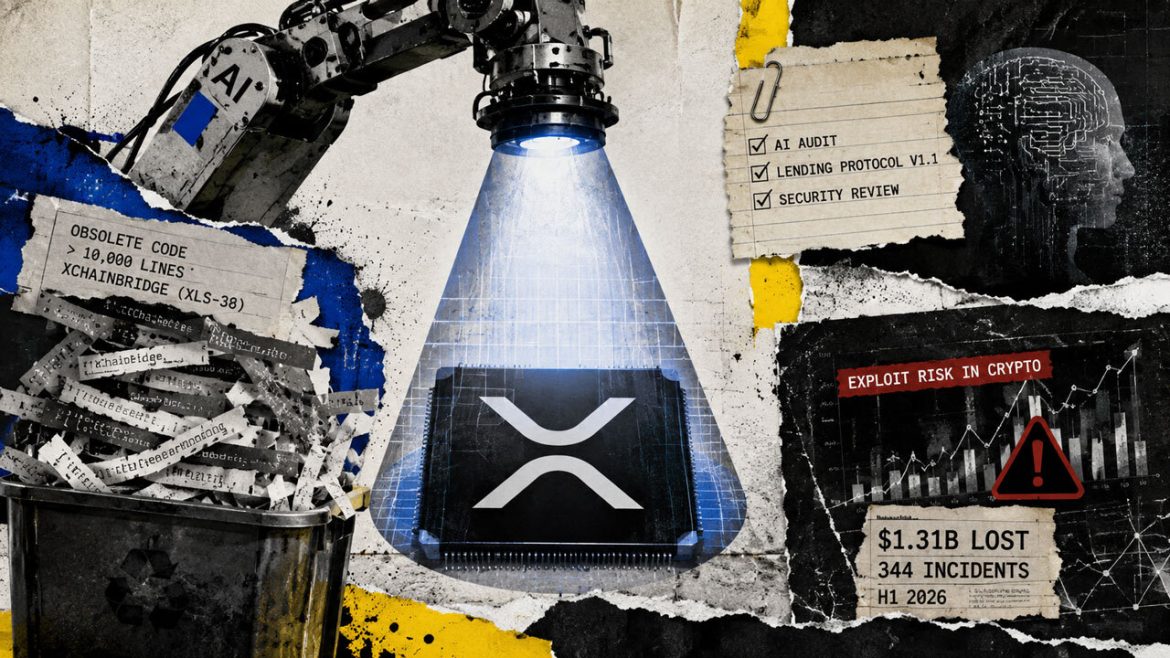
Ripple is moving to shrink the XRP Ledger’s (XRPL) attack surface as it prepares to expand native lending.
The company has recommended removing more than 10,000 lines of unused XChainBridge code while Lending Protocol V1.1 undergoes an AI-only security review through Sherlock’s Audit Engine.
The parallel efforts come as crypto platforms face renewed pressure to strengthen their defenses. More than $1.31 billion was lost across 344 security incidents in the first half of 2026, with code vulnerabilities remaining the industry’s most common attack category.
The original case for keeping XChainBridge (XLS-38) weakened after Ripple turned to Axelar for the XRPL EVM Sidechain and broader demand for the native bridge failed to materialize.
XLS-38 was designed to let assets move between XRPL and connected sidechains through witness servers that observe transactions and attest to activity across networks. The architecture was intended to support private, permissioned, and experimental sidechains, while also providing a bridge between XRPL mainnet and the EVM Sidechain.
Ripple ultimately chose Axelar for the EVM Sidechain after evaluating security, user experience, decentralization, and the operational demands of maintaining a bridge.
The company said the XLS-38 witness model carried trade-offs that became harder to manage as the value protected by a bridge increased. Expanding the witness set could improve decentralization but add coordination and governance complexity, while a smaller group would concentrate more trust among operators.
Ripple announced its decision to use Axelar in June 2024 but kept XLS-38 available for a validator vote and gave developers roughly 12 to 15 months to demonstrate demand for private sidechains that specifically required the amendment.
However, that demand failed to reach the level Ripple expected.
The result is a substantial block of inactive code that developers must continue maintaining and reviewing even though its principal use case has been handled elsewhere.
Ripple estimates that withdrawing XChainBridge and the related fixXChainRewardRounding amendment would eventually remove more than 10,000 lines from xrpld.
Ripple identified maintenance burden, contributor complexity, and attack surface as costs of retaining dormant functionality, arguing that XRPL should remain lean as the network evolves.
The recommendation does not remove XLS-38 immediately. Ripple controls one validator vote, and the proposal remains subject to the XRPL amendment process.
If the community supports the change, Ripple plans to first mark XChainBridge as obsolete. Validators adopting a software version containing that designation would stop voting for the amendment, allowing the code to be removed in a later release once the network converges.
Ripple also left open the possibility of reconsidering if developers can demonstrate concrete projects that still require XLS-38.
Reducing legacy code comes as XRPL prepares to introduce lending infrastructure with considerably more financial interactions to secure.
Lending Protocol V1.1 builds on Ripple’s push to bring native borrowing and lending capabilities to XRPL alongside Single Asset Vaults. The underlying architecture combines loan lifecycle management, interest-rate calculations, multi-party fee routing, credential-based permissions, and interactions with asset pools.
Ripple has described the lending system as one of the most financially complex additions developed for XRPL since the network launched.
On Aug. 27, Sherlock said that V1.1 had entered an intensive AI-only security review through its Audit Engine. The system combines multiple AI auditors and frontier models with specialized security capabilities, adjusting coverage and depth to the protocol being examined.
Sherlock has not disclosed any findings or a completion date. It said a fuller account would follow once the process is finished.
The review follows an unusually extensive security process for the earlier lending and Single Asset Vault codebase, where repeated testing found vulnerabilities even after previous rounds of scrutiny.
Ripple and Immunefi ran a $200,000 attackathon in late 2025 covering 35,498 lines of code. It drew 455 submissions from 131 researchers and ultimately produced 94 unique valid findings, including 15 classified as critical and 19 as high severity. Ripple said it addressed all identified issues.
The company subsequently subjected the lending system to additional audits, community testing, fuzzing, and an AI-assisted red-team program.
Between March and May, Ripple’s AI red team filed 20 lending-specific tickets and identified seven confirmed bugs that were fixed.
Among them were an inverted invariant that could have allowed phantom collateral to go undetected, a fee-free spam vector involving loan payments, and an integer-overflow issue that could have caused a node deadlock.
Those findings provide a practical reason for repeated testing as Ripple works on V1.1. The company said the enhancement incorporates partner feedback and lessons from the earlier implementation.
Ripple’s broader AI red-team program has also uncovered high-severity issues outside lending. A security-focused xrpld release earlier this year included fixes for public-facing crash paths, bounds-checking problems and cross-feature interactions identified through the program and associated testing.
The expansion of XRPL’s security program coincides with an industry-wide attack environment that has remained costly despite years of audits and bug-bounty programs.
In July, CertiK recorded $1.315 billion in losses across 344 security incidents during the first six months of 2026.
While that was lower than the headline figure from a year earlier, H1 2025 included the exceptional $1.45 billion Bybit breach. Excluding that event, CertiK calculated that comparable losses rose about 28% this year.
Code vulnerabilities were the most frequent attack type, appearing in 204 incidents. CertiK also found that attackers were increasingly returning to contracts more than a year old, showing how vulnerabilities can remain exploitable well after software has been deployed.
Some of the largest losses came from other weaknesses. Wallet compromises generated more than $444 million in losses, while the Kelp DAO RPC compromise and Drift Protocol breach together accounted for $576 million.
That distinction is significant because no code audit, AI-driven or otherwise, addresses every security threat facing a protocol or its users.
Ripple has consequently been using several layers of testing rather than relying exclusively on AI. Its lending development process has included independent audits, public security competitions, fuzzing, formal methods, community testing and AI-assisted vulnerability discovery.
Ripple’s own security researchers have also cautioned against treating AI as a replacement for expert review. The company said its AI pipelines produce false positives and that human validation remains particularly important for subtle bugs where a model can misinterpret how an invariant is supposed to behave.
That creates an additional test for Sherlock’s AI-only engagement. The review could show how far specialized models can extend protocol-security coverage, but its usefulness will ultimately depend on the vulnerabilities it identifies and whether those findings translate into fixes before V1.1 advances.
For now, Sherlock has released no results. Ripple is therefore trying to reduce known sources of unnecessary complexity in one part of XRPL while subjecting the next generation of financial functionality to increasingly aggressive scrutiny before more value depends on it.

Virtu Financial, M1X Global and Tradeweb completed an onchain repo transaction using a sovereign digital bond as collateral, with the full transaction settling on the Canton Network.
The transaction used USDM1, a US dollar-denominated sovereign bond issued onchain by the Republic of the Marshall Islands and backed 1:1 by short-term US Treasurys. The bond pays a coupon while being used as collateral and is structured under New York law as a fully collateralized sovereign obligation.
Both companies said it was the first repo to combine natively issued sovereign collateral with fully onchain atomic settlement. Executed between regulated counterparties on Tradeweb, the full repo and repurchase cycle was completed in under 10 minutes.
The transaction puts tokenized sovereign debt to use as collateral in an institutional financing transaction, rather than solely as an asset for issuance or trading, though it remains an early-stage example and it is not yet clear whether the model will see broader adoption across institutional repo markets.
USDM1 is available through electronic trading platform Tradeweb, with institutional custody provided by Anchorage Digital, BitGo and tZERO, according to the release.
Related: Digital Asset lands $355M as a16z doubles down on Wall Street blockchain rails
Canton is a blockchain network designed for institutional finance, with privacy and permissioning features aimed at regulated transactions and tokenized assets.
Thursday’s repo follows a July transaction in which Tradeweb facilitated the real-time transfer of a tokenized US Treasury from Franklin Templeton to Virtu Financial on Canton, settling the transaction against USDCx.
Network activity accelerated in August. FalconX and Interstice launched a cross-chain swap engine connecting Canton with Ethereum, Solana and Robinhood Chain, while World Liberty Financial launched its USD1 stablecoin natively on Canton.
Digital Asset and the American Idea Foundation, founded by former US House Speaker Paul Ryan, also announced plans this month for a 2027 pilot that would use Canton to distribute state-administered benefits across three US states.
Magazine: SHRINCS BIP published: Quantum-secure Bitcoin comes with a catch
The 2028 Democratic primary market is becoming a three-way race, but Gavin Newsom is no longer leading it. With $194 million now traded on Kalshi and nearly $1.3 billion on Polymarket, Alexandria Ocasio-Cortez and Jon Ossoff have surged past the California governor, an early sign that traders are pricing a Democratic future less defined by the old establishment and more by the party’s progressive and battleground-state wings.
California Gov. Gavin Newsom was the obvious 2028 Democratic presidential nominee trade for much of the last year.
At one point, he approached 40% on both major prediction markets, with traders treating him as the default successor in a party that had not yet settled on a post-Biden identity. That comes despite former Vice President Kamala Harris leading the pack in many pre-primary polls.
However, since June, prediction markets have changed dramatically for the 2028 Democratic presidential nominee.
New York Rep. Alexandria Ocasio-Cortez and Georgia Sen. Jon Ossoff are now alternating at the top of Kalshi’s Democratic nominee contract, each trading roughly between 17% and 19%, while Newsom has fallen to 12%.
The contract has grown to $194 million in volume, up from about $123 million in June, when Newsom was still in the low 20s and AOC and Ossoff were each around 10%.
Polymarket is telling an even clearer story. With nearly $1.3 billion traded, Ocasio-Cortez leads at 21%, Ossoff is at 15%, and Newsom is at 14%. It is still early, but traders no longer see a single front-runner.
They see at least three competing theories for where the Democratic Party goes next.
Ocasio-Cortez’s rise is the most obvious expression of the party’s shifting center of gravity. She has not announced a presidential campaign and has publicly left open whether she would run for president, seek the Senate or remain in the House.
Still, she has steadily built the kind of national profile that makes a presidential bid feel plausible rather than speculative. Her position in the market is not simply about ideological enthusiasm.
Ocasio-Cortez has made moves that look designed to broaden her coalition, including softening or revisiting some past positions that opponents had characterized as politically difficult for a national candidate.
Axios described the shift as part of an effort to shed the “woke” label and make her message more economically focused and electorally durable.
That is the core trade on Ocasio-Cortez. She represents the progressive energy that has shaped Democratic primaries during the 2026 midterm elections, but she is also showing signs of understanding the gap between winning a safe blue district and competing in a national primary.
Still, can she broaden her appeal without losing the activists who made her a national force in the first place?
There is still hesitation among Democrats. Some party figures worry that her national profile is larger than her coalition’s, and that the party could repeat an old mistake if it confuses online energy with general-election viability.
Ossoff’s rise is a different kind of story. He is not competing with Ocasio-Cortez for the progressive lane so much as offering a post-Trump Democratic alternative built around winning in a competitive state.
The Georgia senator has become more visible as he prepares for his own difficult 2026 reelection race, and a win over a Republican challenger would immediately strengthen his national case. And traders are now looking ahead to what a successful 2026 could mean, rather than simply pricing in his current name recognition.
Ossoff’s potential argument is straightforward. Democrats need candidates who can win the voters and states that determine presidential elections, and Georgia is one of the main battleground states in recent general elections.
His campaign style, relative youth, and experience in a true battleground make him an appealing market hedge against both California liberalism and ideological polarization.
The catch is that Ossoff has not said he is running, and his immediate political focus has to remain Georgia. A difficult Senate contest could make him look stronger if he wins, or remove him from the 2028 conversation entirely if he loses. Of note, he is at 92% to win on prediction markets heading into November.
Newsom has not disappeared, and at 12% on Kalshi and 14% on Polymarket, he remains one of the three dominant candidates in an enormous early market. But his decline from the near-40% range is meaningful because it shows traders are no longer treating him as nearly inevitable.
The market seems to be reassessing the limits of the Newsom case. He has money, national visibility, executive experience, and California’s infrastructure.
But he also carries the baggage of a state that remains a conservative target, a more conventional establishment profile, and a record Democrats outside the coasts may not see as the answer to the party’s current affordability and populism problems.
In other words, Newsom is still viable, but he is no longer the main default.
The scale of money now moving through these contracts is part of the news. Kalshi’s $194 million market and Polymarket’s nearly $1.3 billion contract make this one of the most actively traded long-range political bets in the country.
That volume does not mean traders have discovered the 2028 nominee two years early. Early presidential markets are especially sensitive to headlines, donor chatter, hypothetical polling and the availability of a compelling narrative.
A single endorsement, a surprise 2026 result, or a decision not to run could dramatically move these prices.
But volume does mean the market’s change is more than a few speculative trades. The AOC-Ossoff rise and Newsom decline reflect a meaningful repricing of the Democratic field.
In many polls throughout the year, Harris has led the field. That includes a poll released this week that shows her at 29%, ahead of Newsom and Pete Buttigieg.
In that most recent poll, Ocasio-Cortez sits at 9%, ahead of Pennsylvania Gov. Josh Shapiro and Arizona Sen. Mark Kelly.
Ossoff is not even listed.
But the field is enormous, as no one has officially jumped into the race and no primaries have even been held.
The early prediction markets give Democrats three paths:
That is a more interesting field than the one traders saw in June. It also mirrors the party’s 2026 midterm debate. Democrats are still deciding whether their future is best represented by a sharper left-wing economic message, a candidate proven in competitive terrain, or a more traditional establishment figure with the resources to build a national campaign.
For now, prediction markets are not choosing one answer. They are just saying Newsom is no longer the obvious one.
Withdrawals remain open, but Term’s Aug. 23 update did not quantify remaining vault assets and only said it would explore ways to address any shortfall.
Term Labs said all Term Meta Vaults have been shut down and DAO governance roles revoked after a governance exploit hit the vault product, while withdrawals remain open.
In an Aug. 23 update, Term said the shutdown is irreversible and permanently prevents further deposits. The update did not quantify assets remaining in the vaults. It said the company would “explore paths” to address any shortfall, leaving the amount depositors can recover unresolved.
Blockchain security firm PeckShield estimated that the attacker drained about 2,843 ETH, then worth $6.87 million, and 1.68 million USDC that was swapped into roughly 1.68 million DAI. PeckShield put the total at about $8.5 million; Term’s update did not give its own loss estimate.
Onchain records corroborate the transferred amounts. One successful Ethereum transaction sent 2,841.74 WETH to an address Etherscan labels “Term Finance Exploiter 1.” A second transaction sent 1.68 million USDC to an address labeled “Term Finance Exploiter 2.”
Yearn said Term’s vault contracts use its V3 architecture, but that the exploit occurred through Term’s custom governance wrapper. Yearn said the attack vector did not apply to standard Yearn vault setups.
Term’s governance documentation describes a proposal path from a Proposer Safe through a seven-day delay and Governor Safe to a vault. It says the governor role oversees governance actions, risk parameters and emergency controls.
Term said it revoked DAO governance roles following an incident involving Term Vault governance. However, the Aug. 23 update did not identify the revoked roles, affected contract addresses or revocation transactions. Without those details or a postmortem, the statement does not establish whether the precise permissions used in the exploit were removed. The separately confirmed shutdown prevents new deposits, while withdrawals remain available.
Term said its underlying protocol and direct borrowing and lending markets had not been affected based on its investigation so far, while it continued to verify the scope. Yearn separately said standard Yearn vaults were unaffected.
Term said it is coordinating with external security teams on remediation and recovery. “If a shortfall remains, we will explore paths to address it,” the company said. The update did not include a reimbursement commitment or recovery timetable.

A new Federal Reserve Bank of Cleveland working paper offers a provocative explanation for why cryptocurrency behaves so differently from traditional financial assets: Americans who buy crypto don’t simply have different demographics or risk appetites, they have radically different beliefs about digital assets’ future returns.
The finding could help explain both crypto’s persistent volatility and the way rallies can attract new buyers, potentially creating a feedback loop in which rising prices reinforce bullish expectations and pull more investors into the market.
Using repeated surveys of as many as 25,000 US households per wave, researchers Michael Weber, Bernardo Candia, Olivier Coibion and Yuriy Gorodnichenko found that expectations about crypto returns explain more of the variation in who owns cryptocurrency than a broad range of demographic characteristics.
The paper, titled “Do You Even Crypto, Bro? Cryptocurrencies in Household Finance,” also uses a randomized information experiment to show that simply giving people information about Bitcoin’s (BTC) recent performance can increase both their desired crypto allocation and their subsequent purchases.
Perceived risk of crypto by ownership. Source: Federal Reserve Bank of Cleveland
The researchers say the results point to a potential mechanism behind speculative bubbles: past gains can attract new investors, whose purchases push prices higher and potentially attract still more buyers.
“Positive returns attract new participants, which raises the price further,” the authors write
That dynamic is particularly striking because cryptocurrency remains poorly understood by a large share of the population. In the researchers’ 2021 survey, 87% of people who did not own crypto said they didn’t know what return to expect from it over the following year. Among crypto owners, the figure was still 54%.
Related: Canadian crypto ownership increases to 25%: Ontario survey
For those willing to make a forecast, however, the gap was enormous. Crypto owners expected an average 22% return over the following year, compared with just 7% among non-owners. Owners also tended to view crypto as less risky than non-owners did.
The researchers found that expected returns were unusually powerful in determining ownership. A one-percentage-point increase in an individual’s expected crypto return was associated with a 0.8-percentage-point increase in the probability of owning cryptocurrency. Expectations about returns and risk together explained considerably more variation in crypto ownership than observable characteristics such as age, income and gender.
That makes crypto an outlier compared with stocks, bonds and gold. For traditional assets, demographic and financial characteristics generally have much more explanatory power than differences in expected returns. Crypto reverses that relationship.
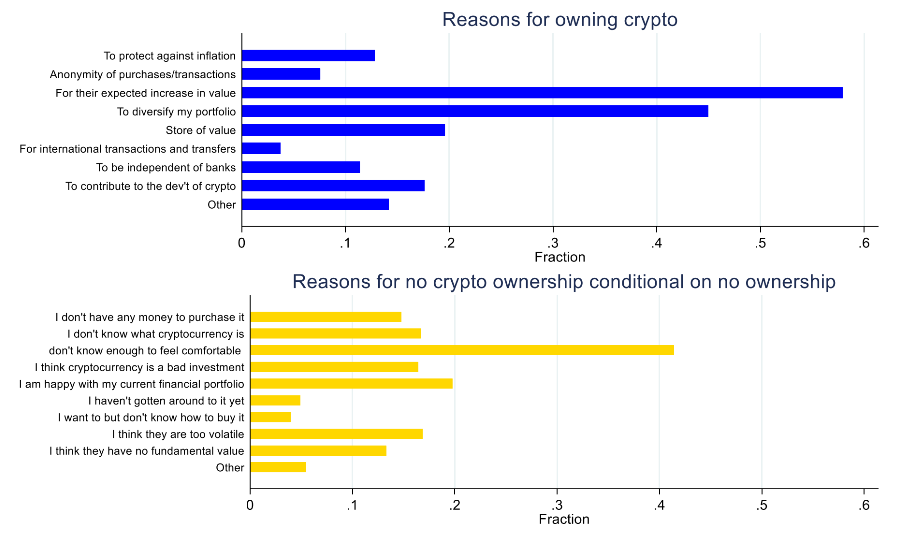
Source: Federal Reserve Bank of Cleveland
The demographic profile of crypto investors nevertheless remains distinctive. People under 40 were 13 percentage points more likely to own cryptocurrency than those over 60, even after controlling for other characteristics. Men were about 4 percentage points more likely than women to own crypto, while higher-income and wealthier households were also more likely to participate.
The experiment provides perhaps the paper’s most consequential finding for crypto markets.
In 2025, researchers randomly assigned households to receive information about BTC, stocks, GameStop or inflation. Participants who were shown Bitcoin’s previous 12-month return increased their desired crypto portfolio allocation by roughly 2 percentage points, or about a 47% increase relative to the 4.3% desired allocation among the control group. Actual subsequent crypto purchases also rose by about 2.5 percentage points.
The authors describe the result as “providing information about recent Bitcoin returns induces some households to start buying cryptocurrency.”
The effect was concentrated among people who said they didn’t own crypto because they lacked sufficient information. Those who already believed crypto was a bad investment generally did not respond to the information treatment.
The paper also finds that crypto wealth can spill into household consumption. A doubling in BTC’s price made a household whose entire financial portfolio was in crypto 1.4 percentage points more likely to buy a durable good, equivalent to roughly a 7% increase relative to the unconditional probability of such a purchase. But the effect did not persist into ordinary spending.
That led the researchers to a stark comparison: crypto gains appear to be treated more like “gambling income” or lottery winnings than a permanent increase in wealth.
The broader implication is that crypto’s volatility may be rooted partly in disagreement and learning rather than simply market fundamentals. The authors conclude that cryptocurrency stands out because it is poorly understood, investors form sharply different views about its prospects, and new information about past returns can change both expectations and behavior.
“The absence of common information and beliefs about crypto across investors,” they write, “suggests that price volatility will continue to be one of the most defining characteristics of this new asset for the foreseeable future.”
For crypto markets, that suggests a potentially uncomfortable conclusion: the next wave of retail demand may depend not only on Bitcoin’s price, but on what investors are told about the price that came before it.
Magazine: The 100x obsession: Fundamentals grow in importance as crypto matures

The CFTC is seeking public comment on how AI compute derivatives should be listed and overseen, including questions around liquidity, benchmark reliability, manipulation and customer protections, as Kalshi, CME, ICE, Polymarket US and Liquid Compute race to build markets around future computing costs
Polymarket US has self-certified a new class of contracts tied to the future price of artificial intelligence computing power, joining a growing race to build financial markets around one of the AI industry’s most important and expensive resources.
The filing comes as the Commodity Futures Trading Commission (CFTC) begins developing a regulatory framework for the emerging market. In a Bloomberg Television interview Thursday, CFTC Chair Michael Selig called compute “the most important commodity, I think, of our time” and “essentially a digital oil.”
“We want the prices to be discovered for this valuable commodity in the United States, the benchmarks to be here,” Selig said. “We’ve gotta have these markets here.”
Polymarket joins Kalshi, CME, ICE, Architect and prospective exchange Liquid Compute in pursuing different ways to trade or establish future prices for AI compute. The push comes as the CFTC’s new request for public comment raises questions about whether today’s fragmented and often opaque compute market is sufficiently liquid, standardized and resistant to manipulation to support a mature derivatives market.
AI compute refers to the processing capacity used to train and run artificial intelligence models. Much of the highest-value capacity today comes from GPUs, or graphics processing units, high-powered chips capable of performing huge numbers of calculations simultaneously. Nvidia‘s H100, H200 and newer B200 GPUs are among the chips most commonly used in large-scale AI infrastructure.
The emerging market is generally not about trading ownership of the chips themselves. AI companies, cloud providers and data-center operators buy or rent access to computing capacity, often priced by the GPU-hour, and the derivatives now being developed are designed to put a market price on what that access may cost in the future.
That could allow an AI company expecting to need large amounts of GPU capacity months from now to hedge against rising rental costs, while an infrastructure provider could manage the risk that future prices fall. The CFTC said in its request for comment that compute futures could aid risk management and price discovery and allow financial markets to “aggregate and reveal information about the future of the AI economy.”
Different exchanges are approaching that task in different ways. Conventional futures can track an index of GPU rental prices over time, while prediction market contracts can ask whether the price of a particular type of compute will be above or below a specified level on a future date. A series of contracts across different expiration dates can also be used to construct a forward curve, showing where traders collectively expect compute prices to be weeks or months ahead.
Selig put compute alongside prediction markets, crypto and other emerging products in his remarks at the CFTC’s Innovation Advisory Committee meeting Thursday, framing the initiative as “Winning the AI Race: Roadmap for Compute Market Dominance.” He tied the effort to the White House’s AI Action Plan, which calls for improving the financial market for compute to expand access to large-scale computing resources.
The CFTC is working with the Department of Commerce on that effort and plans to use feedback from its new request for comment to develop what Selig described as a “gold standard regulatory framework” for compute markets.
“Just as American markets helped establish the gold standard for trading the commodities that powered the industrial economy, we will do the same for the commodity that will power the intelligence economy,” Selig said in a separate statement Wednesday.
His Bloomberg comments a day later made clear that the objective extends beyond simply allowing exchanges to list new products. Selig said he wants the underlying price discovery and benchmarks established domestically, with compute trading on transparent U.S. markets and open order books.
“We’re working very hard together with Secretary (Howard) Lutnick and the Department of Commerce to set the standard here in the U.S.,” Selig said. “We want the best of the best, and we’re gonna lead in these markets.”
For all of Selig’s enthusiasm, the CFTC’s request for comment makes clear that regulators still see major challenges in turning compute into a mature derivatives market. The agency said compute pricing remains fragmented and is often set through “opaque bilateral transactions,” limiting the amount of public price data available to exchanges and regulators.
The Commission also questioned whether compute yet has the fungibility, standardization and liquidity typically associated with commodities underlying futures markets. Prices can vary widely depending on the GPU model, provider, region and contract terms, while dominant suppliers may have enough pricing power to influence the cash market or a benchmark derived from it.
One of the RFC’s sharpest questions asks whether trading should be permitted in a derivative whose settlement price relies on data the CFTC “may not be able to observe, verify, or surveil.” The agency is also asking what protections would prevent a compute provider from influencing an index by changing posted rates, directing capacity to or away from a venue or choosing whether to execute transactions during a settlement window.
The CFTC is seeking input on those issues along with customer protections, market surveillance and perpetual compute futures. Comments are due Oct. 20, after which Selig has said the agency will continue developing its regulatory framework for the market.
Polymarket US’s new filings cover binary contracts tied to future values of AI compute indexes. One specifically certified contract asks whether the Ornn Data H100 SXM GPU Price Index will be at least $2.50 per GPU-hour on March 15, 2027. A wider class certification would allow Polymarket US to list similar contracts tied to H100, H200, A100, RTX 5090 and B200 GPU indexes. The broader filing also covers Ornn indexes measuring the price of AI-model usage by the token.
The contracts can ask whether an index will be above, below, at least, at most, between or exactly a specified value at a future point. Polymarket said the products may be listed beginning Aug. 24, although it remains to be seen whether Polymarket will launch them immediately or whether the CFTC will intervene while its compute comment process is underway. That possibility is not purely theoretical: in July, the CFTC stayed a CME self-certified 24/7 crude-oil contract while a related agency comment process was underway.
Kalshi has been pursuing a related strategy. In July, the exchange said it was using weekly and monthly prediction markets extending as far as a year out to construct a compute forward curve, giving traders a view of where GPU rental costs are expected to move.
“We are using prediction markets to build the forward curve, which will provide the market a view of what compute costs will be in the future for different grades and time-frames of GPUs,” Kalshi Chief Risk Officer Udesh Jha told Bloomberg.
Jha said the curve could eventually support additional products, including futures and options. “It’s a key enabler for a lot of subsequent hedging, risk management and even speculative activities,” he said.
Prediction markets are only one part of the emerging competition. CME Group plans to launch H100 and B200 rental-index futures on Oct. 5, pending regulatory review, using benchmarks from Silicon Data. ICE has announced GPU compute futures based on Ornn indexes and a separate partnership with NATIVX for energy-normalized compute futures. Architect Financial Technologies is building a U.S. exchange for futures and options tied to GPU rental costs and other AI supply-chain inputs.
Another prospective exchange has been built around that idea from the start. DeFi Rate reported in February on the startup then operating as Pluto, whose pending designated contract market and clearinghouse applications are publicly listed under the names PMEX Markets and PMEX Clearing. The company has since rebranded as Liquid Compute, which describes itself as the “financial layer for AI compute” and is currently inviting market participants to request access while its U.S. exchange applications remain pending.
“The aim of the exchange is to turn compute into a financial asset just like oil, gold, (or) other commodities,” CEO Ronit Jain told DeFi Rate at the time. Liquid Compute has since highlighted an H100 OTC forward trade involving Wintermute and said this week that it is “live and booking swaps now.” The company has not publicly identified the entity or jurisdiction through which those transactions are being conducted.
The race now is to build the transparent, trusted pricing infrastructure needed for a mature AI compute market. The CFTC wants that market centered in the U.S., but its new comment process shows regulators are still deciding what standards those prices and products will need to meet.

Test in Prod, a core development team that says it is fully funded by the Optimism Collective, supplied the 8.486 million OP vote that secured approval.
Optimism governance approved a proposal to move 546.9 million OP tokens, valued at roughly $49.7 million at the time of the vote, from an allocation reserved for future user airdrops into a Strategic Ecosystem Fund administered by the Optimism Foundation.
The change removes the remaining dedicated pool for future user airdrops and authorizes the Foundation to deploy the tokens for partnership deals, incentives and other initiatives intended to grow OP Mainnet and OP Enterprise. The proposal said no additional airdrops are currently planned and that tokens already distributed through Airdrops 1 through 5 are unaffected.
Approval hinged on Test in Prod, an Optimism core development team, casting 8.486 million OP in favor with 16 minutes and 52 seconds left. The onchain vote finished with 17.974 million OP supporting the proposal and 10.931 million opposing it.
Test in Prod’s vote lifted support to 61.84% from 45.77%, according to CoinDesk’s review of the tally. Without the team’s position, final support would have been 46.47%.
Test in Prod described itself in a 2025 Optimism Security Council nomination as “a core development team of Optimism Collective” and said, “We are fully funded by the Collective.” The team has worked on the OP Stack since 2022, including its execution client, network upgrades and fault-proof infrastructure, according to the nomination.
The Optimism Foundation said it had distributed 269.1 million OP across five airdrops but that broad user acquisition no longer matched its current institutional strategy. The newly designated fund can finance deals involving chains, protocols, institutions and infrastructure, as well as incentives for activity and liquidity on OP Mainnet.
The reallocation drew opposition from delegates who agreed the unused airdrop reserve should be reconsidered but objected to the scope of the replacement fund. L2BEAT’s governance team said the mandate was “very open-ended” and called for clearer information about expected deployments, how they would be evaluated and what success would look like.
The approved proposal says the Foundation will update Optimism’s public token accounting and report cumulative deployments from the Strategic Ecosystem Fund through its yearly budget report. The 269.1 million OP already distributed in the first five airdrops will not be clawed back or reclassified.


