Zcash’s NU7 upgrade is now live on testnet, giving developers several weeks to assess 25-second blocks and other protocol changes before a planned November mainnet activation.

 Live Chat

Zcash’s NU7 upgrade is now live on testnet, giving developers several weeks to assess 25-second blocks and other protocol changes before a planned November mainnet activation.

Most of the attention a perpetual exchange gets goes to the people trading 100x.
Most of the capital on one does not belong to them.
ApeX Omni has quietly built a second layer for everyone else: a set of products where the return comes from the platform’s own activity, from other traders’ skill, or from a rules-based bot, and where the user’s job is to allocate rather than to trade.
Four pieces make up that layer, and each one has a specific source of yield worth understanding before committing capital.
ApeX Vaults connect skilled traders with capital providers in a decentralised, transparent structure.
A vault creator designs and executes the strategy; investors allocate funds and earn a proportional share of the profits without placing a single trade.
The creator earns up to 10% of the profits generated for investors, charged only on realised gains, so the incentive is aligned with investor outcomes rather than with activity.
The rules were opened up in April 2025: individual investment caps were removed, creators can attract unlimited investor capital, and the minimum deposit to launch a vault fell to 100 USDT.
Every vault discloses its historical daily, weekly, and monthly returns, current open positions and exposure, maximum drawdown, profit-and-loss attribution, and the creator’s track record, and top performers surface through the platform’s ranking tools.
Redemptions are available after a 24-hour holding period from the time of investment.
For creators running systematic strategies, a dedicated Vault Key enables full API trading on the vault’s capital, so bots and algorithmic systems can manage entries, exits, and rebalancing with the same speed and reliability as regular Omni Perps trading.
The most distinctive product in the stack is the official Protocol Vault, operated by ApeX Protocol itself.
Its yield source is real protocol revenue: 100% of the daily liquidation fees generated by Omni Perp trading across the platform.
Users deposit USDT, receive shares at the current net asset value, and their proportional share of that day’s liquidation-fee income is reflected in the NAV every day at 08:05 UTC.
The structure is deliberately simple. There is no lock-up; any amount can be redeemed at any time with principal and accrued yield returned to the Perp Account.
The minimum purchase is above 10 USDT, the per-user cap is 1,000,000 USDT, and the total vault cap was raised to 20,000,000 USDT in August 2025.
Because the yield is a function of liquidation activity, it rises and falls with how busy the platform’s perpetual markets are, which is exactly what makes it a bet on the venue rather than on any single trade.
New depositors get an accelerated introduction. The New User Initiative pays a 50% APY on a first-time depositor’s first 1,000 USDT for five days, after which principal and bonus interest roll automatically into the regular Protocol Vault.
The offer has no expiry date, applies to any account that has never subscribed to the official Protocol Vault before, and draws from a 300,000 USDT incentive pool that replenishes as each five-day allocation matures.
APEX staking distributes a direct share of platform revenue to long-term holders.
Since Staking 4.0 took effect in February 2025, all rewards are paid in APEX tokens funded by weekly buybacks from trading-fee revenue.
Per platform data, the buyback program has repurchased more than 16.5 million APEX to date, and staking distributions have totaled over 3 million USDC and 1.9 million APEX.
Rewards scale with three factors. The amount staked sets the base.
A lock-up multiplier rewards commitment: a 3-month lock earns the baseline, 6 months earns 2x, 12 months 4x, and 24 months 8x.
A trading-activity factor adds up to a further 0.5 for users who trade at least once a day on five days of the weekly epoch.
Epochs run Monday to Monday at 08:00 UTC, rewards begin accruing the day a stake is made, and claims open each Thursday.
Staked APEX also counts toward VIP fee-tier qualification, so the same tokens that earn yield reduce trading costs.
For users who want exposure to volatility without directional conviction, the Grid Bot automates the oldest range strategy in the book: laddered limit orders that buy low and sell high inside a defined price band.
It runs on every USDT perpetual pair on ApeX Omni, in Neutral, Long, or Short mode, with arithmetic or geometric grid spacing and take-profit and stop-loss levels that trigger as market orders.
Because the bot works primarily through resting limit orders, its fills typically earn maker rates.
Full functionality is available on web and in the mobile app, and multiple bots can run at once across different pairs or ranges.
None of these products is risk-free, and the platform’s own documentation is direct about it.
Community vaults carry the creator’s strategy risk, and past performance is disclosed precisely because it does not guarantee future results.
Protocol Vault yield depends on liquidation activity, which varies with market conditions.
Grid bots can be caught outside their range in a strong trend, and leverage applied to a bot amplifies liquidation risk.
Staking rewards depend on platform fee revenue and the staker’s share of the total pool. The right framing is that these are ways to earn from a busy exchange without trading on it, not substitutes for risk management.
ApeX Protocol is a decentralized, non-custodial trading platform for perpetual derivatives, incubated by Davion Labs.
ApeX Omni is the protocol’s flagship platform, consolidating crypto perpetuals, TradFi perpetuals, prediction markets, and yield products into a single multi-chain interface.
Its mission is straightforward: deliver the speed and depth of a centralized exchange without asking traders to give up custody of their assets.
To explore vaults and staking, visit ApeX Omni or read the documentation at the ApeX Protocol GitBook.

Iris Coleman
Sep 30, 2026 13:30 UTC
PLTR is coiling at a critical technical crossroads, trading at $186.56 with shorts slightly dominant and MACD momentum dead flat — but elite fundamentals and a record-shattering 93% revenue print m…
Let me be blunt: Palantir just delivered one of the most impressive earnings prints in the history of enterprise software, yet the stock is down on the day and sitting below a key resistance cluster. That’s the tension every trader needs to sit with right now.
At $186.56, PLTR is -0.68% on the day, chopping inside a 24-hour range of $184.82–$188.74. The pivot point sits at $186.71, which means price is fractionally below neutral gravity. The intraday price action is not the work of panic — there’s no conviction on either side. What we’re seeing is classic indecision following a massive run off the early July lows around $114. The stock has nearly doubled in under three months. Some digestion is not just expected — it’s healthy.
The fundamental catalyst underpinning this entire rally, however, is anything but ambiguous. Q2 2026 revenue surged 93% year-over-year to $1.935 billion. U.S. commercial revenue exploded 149% YoY. GAAP net income hit $1.062 billion — a 55% margin — meaning Palantir is printing real, hard GAAP profit at a scale that would have seemed impossible just two years ago. The company subsequently raised its full-year 2026 revenue guidance to $8.15–$8.158 billion, implying roughly 82% YoY growth for the full year. The Rule of 40 score sitting at 155% is not a data point — it’s a statement. CEO Alex Karp’s thesis on AI sovereignty is translating directly into enterprise wallet share, and this is the engine traders need to keep front of mind at Blockchain.news while the short-term chart noise plays out.
The September catalysts compound the bullish narrative. On September 17, the U.S. Army awarded Palantir a $48.1 million delivery order to replace nine legacy ammunition-management systems. Then, just one week later, Palantir added xAI’s Grok 4.7, OpenAI’s GPT-6 Sol, GPT-6 Luna and GPT-6 Astra, DeepSeek V4.1 Flash, models from Z.ai and Moonshot AI, and Google’s Gemini 3.8 Flash all into the AIP platform. This is the moat: Palantir doesn’t need to pick the winning AI model. It just needs to remain the irreplaceable orchestration layer that sits above all of them.
The technical structure here is genuinely mixed, and anyone painting it as simply bullish or simply bearish is lying to you. Here’s the honest read.
Price is sitting above every major moving average — the SMA 7 at $189.07 is the one exception, meaning very short-term momentum has rolled over slightly. But the SMA 20 at $180.56, SMA 50 at $178.27, and the 200-day at $148.11 are all well beneath current price. That 200-day gap alone — roughly $38 below the market — tells you the long-term trend is structurally intact and that any pullback into the $175–$178 zone would still be a higher-low within a dominant uptrend.
The EMA 12 at $185.73 and EMA 26 at $181.44 are in positive alignment, confirming the intermediate trend remains bullish. But the MACD histogram has gone to exactly zero — a warning that the bullish thrust driving this summer’s rally has fully exhausted. Momentum is not turning negative, but it has clearly flatlined, and that’s enough to put a ceiling on near-term upside until fresh catalysts enter the room.
The RSI at 59.37 reinforces this read. Not overbought, not oversold — sitting in the middle of the neutral zone. Buyers aren’t panicking, but they’re not pressing either. The Stochastic %K at 63.96 with %D at 51.17 shows we’re in a slow drift higher within the oscillator range, but no imminent reversal signal is firing.
The Bollinger Band picture is arguably the most informative piece of the puzzle right now. Price at $186.56 sits at a %B of 0.67, comfortably between the middle band at $180.56 and the upper band at $197.73. There’s room to expand toward the upper band, but you’d need a meaningful catalyst and volume surge to get there. On the downside, $163.39 is the lower band — a level so far away it’s largely irrelevant for the 7–30 day trade horizon.
The resistance levels are precise and actionable: immediate resistance is at $188.59, and the strong resistance cluster sits at $190.63. That $188.59–$190.63 band is the wall. Three separate tests of that zone over the past week without a sustained close above it puts sellers firmly in control of the near-term trend. Immediate support at $184.67 and strong support at $182.79 are the lines that matter for downside management.
One more piece deserves attention: the derivatives positioning. The global long/short ratio at 0.8034 means shorts are running the book at 55.5% vs. 44.5% longs. Top traders are similarly positioned at 53.2% short. These are not extreme readings — the market isn’t screaming one-way — but it does confirm that smart institutional positioning is leaning against the current price. However, the taker buy/sell ratio at 1.365 shows aggressive spot buyers are stepping in during weakness, with buy volume running at 137% of sell volume in the last hour. That’s real accumulation pressure beneath the surface.
This is where PLTR polarizes every room on Wall Street, and the debate is legitimate. With a trailing P/E of approximately 163x and a forward P/E of roughly 85x on a market cap of ~$449 billion, Palantir is priced for near-perfection. At a price-to-sales of around 80x trailing revenue, even the most aggressive growth investors have to pause and do the math honestly.
But here’s the counter-argument the bears keep underestimating: Palantir has already crossed the GAAP profitability threshold while growing revenue at 93% — a combination that essentially doesn’t exist anywhere else in enterprise software. The profit margin sitting at 54.86% in Q2 is not a GAAP trick; the company generated $9.2 billion in cash and Treasury securities on the balance sheet. The gross margin adjusted at 86% means every incremental dollar of revenue flows almost entirely to the bottom line. When growth is genuinely accelerating and profitability is simultaneously expanding, traditional P/E frameworks start to break down as analytical tools.
The analyst community remains divided — which in itself is useful information for positioning. According to Yahoo Finance consensus data, the 36 Wall Street analysts covering PLTR have a mean price target of $195.57 with a median of $205.05, a high of $255, and a low of $80. The distribution of ratings breaks down to 2 strong buys, 21 buys, 10 holds, and 3 sells — a moderately bullish consensus with meaningful skepticism baked in. UBS recently raised its target to $250, and Rosenblatt Securities reiterated a Buy with a $225 target as recently as this week, citing the FAA’s deployment of AI tools as a new government vertical catalyst. The bear case, concentrated in that $80 outlier, essentially requires Palantir’s AI growth to completely halt — an outcome that today’s fundamental data makes deeply difficult to justify.
The PEG ratio sitting around 1.85 is critical context often buried in the noise. For a company growing EPS at the rate Palantir is, a PEG below 2.0 is actually not the outrage valuation that trailing P/E makes it appear. Covered thoroughly in institutional research and cross-referenced by the analysis published on Blockchain.news, the market continues to debate whether PLTR deserves a software-infrastructure premium or merely a high-growth SaaS multiple. Given the AI sovereignty positioning and the government contract moat, this stock is increasingly being underwritten on a framework closer to the former.
The bull case has a probability I’d put at roughly 60% over the next 30 days. The setup requires PLTR to clear and hold $190.63 on a daily close, which would confirm the near-term resistance has flipped to support. A volume-driven break above that level, ideally on a macro catalyst like a positive Fed communication or another major government contract announcement, targets $197.73 first — the upper Bollinger Band — followed by the technical measured-move objective of $200–$205. If institutional momentum re-engages and the Q3 2026 earnings preview (expected around November 2, 2026) starts generating pre-announcement optimism, $210 becomes a credible 30-day target. Aggressive longs can enter on a decisive close above $190.63, with a stop at $182.50 to keep risk contained within 2 ATR units given the daily ATR of $4.39.
The bear case, which I’d assign a 40% probability near-term, plays out if PLTR fails to reclaim the SMA 7 at $189.07 and begins sliding through $184.67 support. A break below $182.79 on volume would signal that the digestion phase has turned into a genuine distribution event, opening a fast move toward $178–$175 where both the SMA 50 and prior consolidation structure provide the next meaningful floor. That area also corresponds to a 5–6% correction from current levels — uncomfortable for recent buyers but completely normal and healthy within the longer-term bull trend. Bears should treat $191 as the stop on any short position, as a reclaim above that level invalidates the thesis quickly.
The highest-conviction trade on a risk-adjusted basis is waiting. Let price either confirm the breakout above $190.63 or digest down toward $178–$175 and accumulate on weakness. Chasing here in no-man’s land between $184.67 support and $190.63 resistance, with MACD flatlined and shorts slightly dominant, is the worst risk-reward setup on the board. Patience is the edge. As Blockchain.news continues tracking the tokenized equity and AI sector intersection, PLTR remains one of the most watched instruments on both traditional and tokenized trading venues — and for good reason. The underlying business is exceptional; the chart just needs to catch its breath.
Fundamental data, analyst ratings and price targets are sourced from Yahoo Finance as of September 30, 2026 and reflect consensus estimates, not investment advice.
Image source: Shutterstock

The dollar isn’t letting up. Asian currencies took fresh hits Thursday as the greenback held near a two-month high, squeezing everything from the yen to the Vietnamese dong in a broad regional selloff.
The Japanese yen led the pain. Investors piled into dollar positions on bets that the Bank of Japan will stick with its dovish stance — no tightening, no hawkish pivot, probably nothing dramatic anytime soon. That calculus held even as inflationary pressures inside Japan refuse to go away. Traders stayed cautious, unwilling to bet on any sudden policy shift from Tokyo. The result? The yen kept sliding, drawing the most attention of any currency in the region. It’s a familiar story for yen watchers, but the magnitude of the move Thursday made people sit up.
It wasn’t just Japan. The Chinese yuan dropped too, weighed down by lingering worries about China’s economic growth trajectory. The South Korean won fell. The Indonesian rupiah eased. The Indian rupee softened. Pretty much the whole map of Asian FX went the wrong direction for anyone holding local currency. Traders pointed to one main culprit: expectations that the U.S. Federal Reserve will keep raising interest rates, or at least keep them elevated long enough to sustain dollar demand. That narrative has basically dominated the forex conversation for months now, and it’s not fading.
The Australian dollar and New Zealand dollar also came under pressure. Both currencies tend to act as proxies for global growth sentiment — when the world looks shaky, they fall. And right now the world looks at least a little shaky, especially across Asia. Their declines Thursday kind of confirmed what a lot of market participants already feared: the regional economic outlook isn’t strong enough to push back against a determined dollar.
Short and sharp: the Thai baht weakened too. Thailand’s own economic data hasn’t given traders much to cheer about, and it can’t offset what’s coming from Washington.
The Malaysian ringgit fell, though analysts there were quick to say the pressure is coming from outside, not from anything broken domestically. The ringgit’s direction is tied tightly to global sentiment, and right now global sentiment is dollar-bullish. Hard to fight that.
Singapore’s dollar dipped slightly — smaller move than most, but still moving in the same direction. Traders in Singapore stayed cautious, watching for any policy signal that might shift the picture. None came Thursday.
The Philippine peso declined as well, adding to the list. Analysts there pointed to the same driver everyone else cited: the dollar’s sustained strength, backed by expectations that the U.S. economy keeps outperforming. It’s not really a peso story. It’s a dollar story that the peso is stuck inside.
In Vietnam, the dong saw modest depreciation. Not a dramatic move, but it’s there. Market watchers are starting to think about what prolonged dollar strength does to trade balances across Southeast Asia — import costs go up, pressure on current accounts builds. The immediate impact is unclear, but the direction of concern is obvious.
Robust U.S. economic data is doing most of the work. Investors see strong numbers coming out of the American economy and they buy dollars. It’s that simple. The Federal Reserve’s potential rate adjustments add another layer — if rates stay high or go higher, dollar-denominated assets look more attractive, and capital flows accordingly.
No immediate comment came from the central banks of Japan, China, or South Korea on Thursday. That silence probably tells its own story. None of them seem ready to intervene or signal anything dramatic. Traders noticed.
The forex market stayed nervous throughout the session. Participants kept adjusting positions, watching for any data release or central bank statement that might crack the dollar’s momentum. So far, nothing has.
Currency traders are focused — maybe obsessed is the right word — on whatever comes next from major central banks. Any surprise announcement could jolt valuations fast. The dollar’s current momentum makes the stakes feel higher than usual. One unexpected dovish signal from the Fed, or one surprisingly hawkish move from the Bank of Japan, and the whole picture shifts.
But until something changes, the math stays the same: strong dollar, weak Asian currencies, cautious traders. The dong, the baht, the ringgit, the rupiah — they’re all stuck waiting for a catalyst that hasn’t shown up yet.
The Philippine peso closed Thursday down, per market data, with no central bank intervention announced.
The yen is dropping because investors expect the Bank of Japan to hold its dovish monetary policy despite ongoing inflationary pressures inside Japan, making the dollar comparatively more attractive.
The Chinese yuan, South Korean won, Indonesian rupiah, Indian rupee, Thai baht, Malaysian ringgit, Singapore dollar, Philippine peso, Vietnamese dong, Australian dollar, and New Zealand dollar all weakened against the U.S. dollar.
The continued strength of the dollar against Asian currencies, particularly the yen, reflects growing investor sentiment regarding divergent monetary policies between the U.S. and Japan. With the Bank of Japan maintaining its dovish approach amid persistent inflationary pressures, this scenario is likely to exacerbate capital outflows from Japan and increase volatility in regional markets. Such dynamics could further influence trade balances and economic stability across Asia, as countries grapple with the implications of a stronger dollar.

Her crypto work included a wide range of policy statements and guidance that clarified the agency’s position on various aspects of the industry, including mining, staking, memcoins and — most importantly — a series of definitions for classifying different types of crypto assets and which regulator would have dominion. More recently, the agency began proposing formal rules, beginning with one known as Regulation Crypto Assets, which set up a system for offering crypto assets without triggering stringent securities regulations.
The agency’s biggest splash, though, may have been its recent opening of the pathway for tokenizing securities. The effort known as the “innovation exemption” is meant to launch the tokenized securities era in a limited, five-year approach that will inform plans for eventual agency rules that make it more permanent.
“Maximizing people’s freedom to choose what is best for themselves and their families within sensible regulatory parameters designed to give them the confidence to transact with others is a delicate and vitally important task for the regulator,” Peirce, who’s going to be an associate professor at Regent University School of Law, wrote in her resignation.
Peirce acknowledged her nickname, “Crypto Mom,” in a 2019 speech during the industry-resistant era at the agency, and she also noted the agency had “hindered innovation and growth,” saying, “The only guidance out of the SEC is a parade of enforcement actions and a set of staff guidance documents and staff no-action letters.”
Bitcoin (BTC) was rejected near $87,000 on Wednesday as onchain data showed negative spot demand.
Key points:
Data from TradingView tracked a second attempt to break beyond $87,000 before BTC/USD fell to local lows under $84,000 into the Wall Street open.
BTC/USD one-hour chart. Source: Cointelegraph/TradingView
These levels marked the upper and lower boundaries of a narrow intraday range. Liquidity thickened on both sides of the spot price as traders attempted to force a breakout from the sideways range. Data from CoinGlass tallied liquidations over the four hours prior to the time of writing at $280 million.
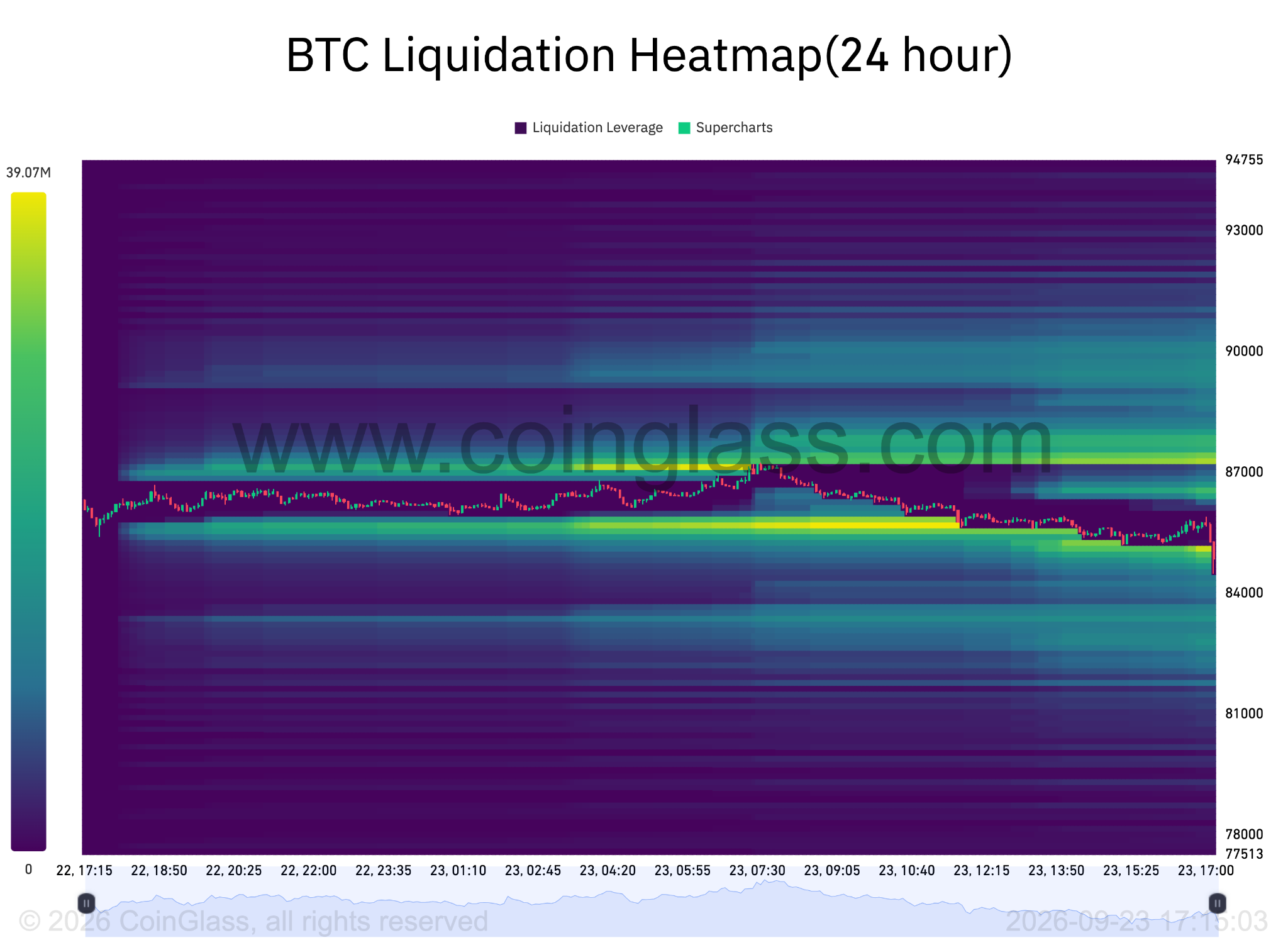
BTC liquidation heatmap. Source: CoinGlass
Commenting on the current landscape, trader and analyst Rekt Capital flagged $82,000 as a level for bulls to hold should the low-timeframe structure break down.
“For bullish continuation and to avoid reverting back into the $60k-$80k Range, Bitcoin would need to stay above or at minimum successfully retest ~$82k on any future dip,” he wrote in a post on X.
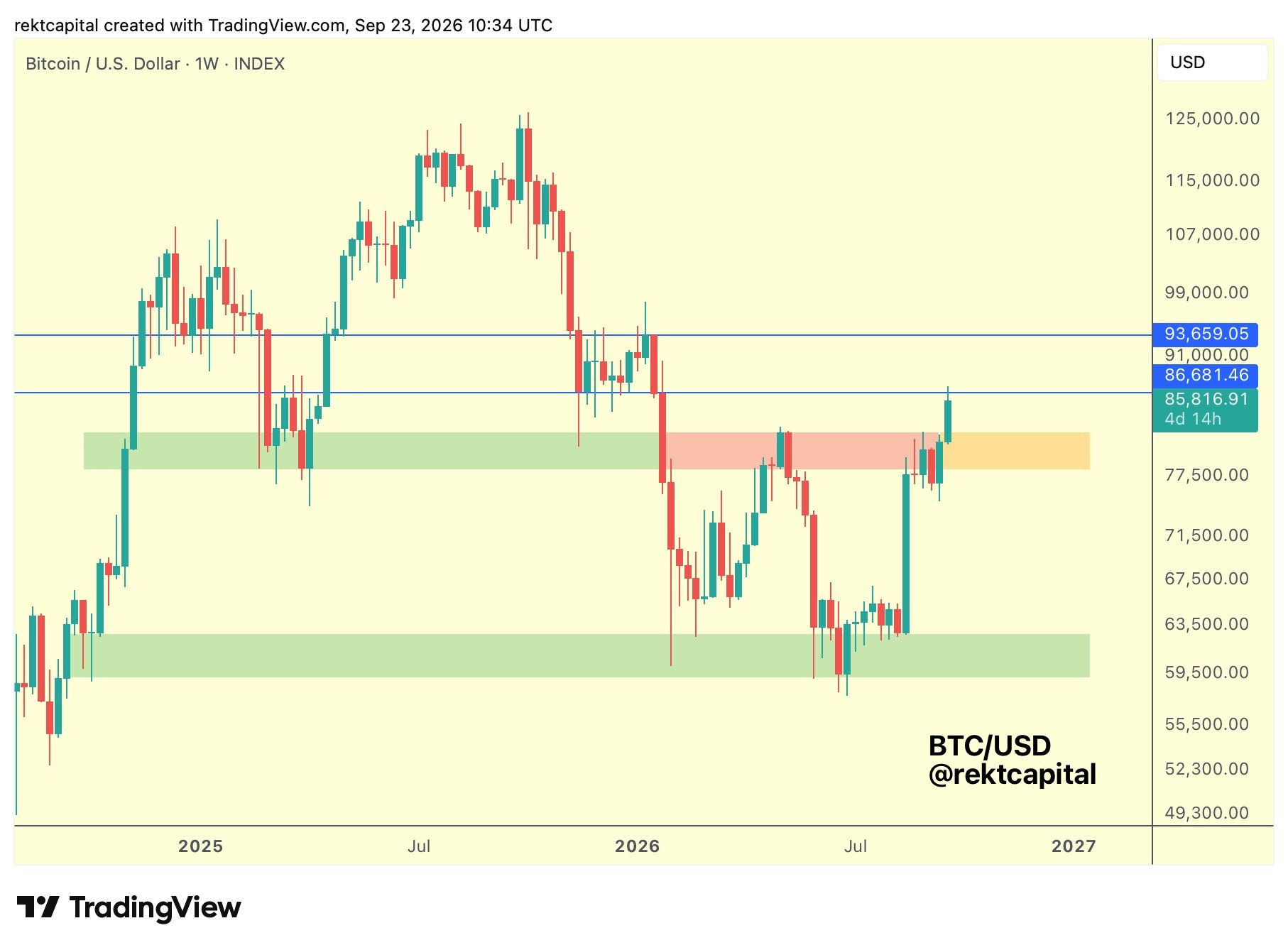
BTC/USD one-week chart. Source: Rekt Capital on X.com
As Cointelegraph reported, the current range has implications for certain investor cohorts. The US spot Bitcoin exchange-traded funds (ETFs) have their aggregate cost basis at just below $86,000.
Earlier, analysis highlighted $90,000 as the likely next area in which BTC/USD will consolidate due to the increased likelihood of profit-taking by traders.
Despite gaining over 35% since the week beginning Aug. 17, Bitcoin faces an ongoing struggle to attract spot-market demand.
Related: Crypto metric signals altseason as Bitcoin market-cap share stalls below 60%
In its latest research, onchain analytics platform CryptoQuant claimed that interest was still largely confined to derivatives markets.
“The negative value of $BTC spot demand has narrowed slightly, while futures demand continues to increase. Total demand is also showing a slight recovery compared to the previous day,” it reported in a blog post on the day.
An accompanying chart showed that cumulative 30-day apparent spot demand measured -180,000 BTC as of Tuesday. Negative values reflect supply outpacing demand over the 30-day lookback period.
“Although total demand remains in negative territory, the trend is shifting toward the positive. If the current momentum persists, spot demand will also flip to positive. That moment will mark the beginning of a more significant rally,” CryptoQuant added.
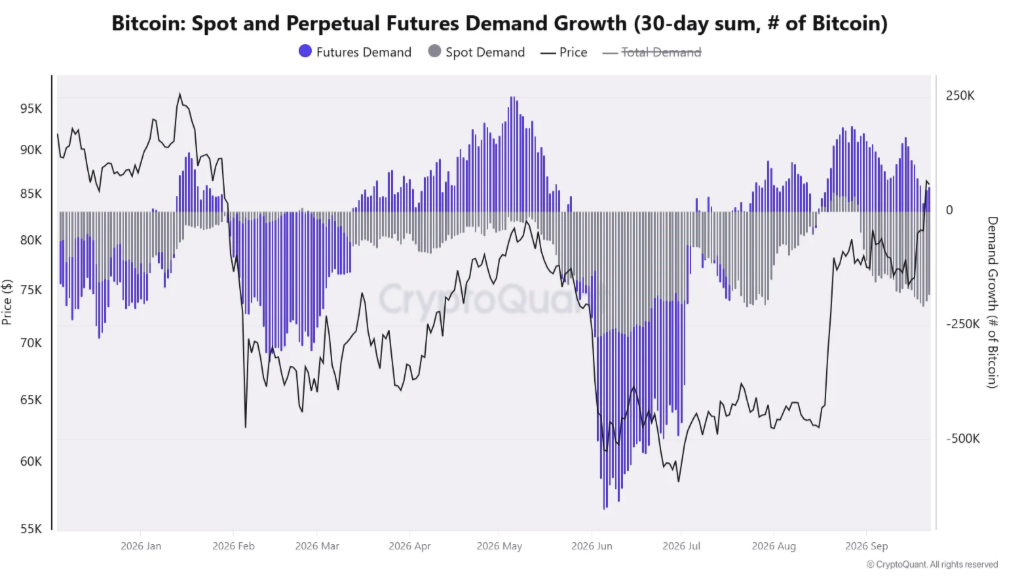
Bitcoin spot vs. futures apparent demand (screenshot). Source: CryptoQuant

Key takeaways
Avalanche’s AVAX token has climbed nearly 50% over the past week, reaching an eight-month high of $10.82 on Sunday as institutional tokenization developments renewed demand for the cryptocurrency.
One of the rally’s leading catalysts involves Intercontinental Exchange, the parent company of the New York Stock Exchange. ICE has reportedly spent about a year testing Avalanche as it explores infrastructure for round-the-clock trading of tokenized U.S. stocks and exchange-traded funds.
ICE has not selected Avalanche or announced a commercial partnership. However, Ava Labs President Charley Cooper said the company remains actively engaged with the network.
The development has strengthened expectations that Avalanche could play a role in bringing traditional financial assets onchain.
New York Life Investment Management provided another institutional catalyst by announcing plans to launch its first tokenized fund on Avalanche through Centrifuge.
The offering will bring the firm’s U.S. High Yield Corporate Bond Strategy onchain, giving eligible investors access to exposure tied to high-yield corporate debt.
Other financial companies are also expanding their involvement with Avalanche. Aave is developing an institutional real-world asset lending market on the network, while Paxos has added support for AVAX and USDC.
Asset manager Janus Henderson has also joined Avalanche as a validator, further strengthening the network’s institutional credentials.
Together, these developments reinforce Avalanche’s positioning as a blockchain for tokenized funds, credit products and other real-world assets.
Avalanche’s upcoming Helicon upgrade provides an additional potential catalyst for AVAX.
Scheduled for Sept. 22, the upgrade will reduce the minimum staking lockup period from 14 days to 48 hours. The change could make staking more flexible by allowing participants to commit their tokens for substantially shorter periods.
Helicon will also modify validator requirements and reward structures. Lowering the time commitment may encourage more users to participate in network validation, although the full impact will depend on how validators respond to the revised economics.
The timing of the upgrade, alongside growing institutional interest, has added momentum to AVAX’s recovery.
AVAX’s weekly chart is showing a potential long-term recovery setup after the price rebounded from the lower boundary of a large falling wedge that has developed since its 2021 peak.
Falling wedges are generally viewed as bullish reversal patterns when the price rebounds from the lower trendline and eventually breaks above descending resistance.
The latest recovery started around the $5.80–$6.50 region, a historical support zone that has repeatedly attracted buyers. AVAX subsequently climbed above its 20-week Exponential Moving Average near $7.97, strengthening the case for a broader recovery within the wedge.
If the rebound continues, the next major upside target lies between $19 and $20. The wedge’s descending upper trendline is converging in this area with the 0.236 Fibonacci retracement level near $19.86.
A move from approximately $10.50 to that resistance zone would produce an estimated gain of 85%–90%.
Before AVAX can approach $19, it must overcome resistance around its 50-week EMA. A rejection from this moving average could slow the recovery or send the token back toward lower support levels.

The broader bullish setup would weaken if AVAX loses the wedge’s lower trendline and falls decisively below $5.80. That level currently serves as the primary invalidation point for the recovery thesis.
AVAX’s outlook therefore remains constructive while it holds above the reclaimed 20-week EMA and maintains the wedge’s lower support.
However, the projected move toward $19–$20 remains conditional on the token clearing intermediate resistance and sustaining institutional-driven demand.

5) Thermocap multiple: The thermocap multiple is a measure like price to book that compares bitcoin’s market capitalization to the cumulative dollar value ever paid to miners, with each coin valued at its market price when it was mined. Prior crypto winters ended at single-digit multiples, but this cycle it only declined to 13 times, according to Glassnode data as of June 30, 2026. These levels are not a guarantee of future price action.
6) Price action: A 50% rally from the low has historically coincided with prior market troughs, although no such relationship guarantees future outcomes.
Once the next cycle does begin, we expect two key debates to persist throughout:
Will bitcoin reach a new high before the next halving? During both the 2012 to 2016 cycle and the 2016 to 2020 cycle, bitcoin did not surpass its prior cycle high until after the halving. However, in the 2024 cycle, bitcoin surpassed the 2021 high one month before the April 2024 halving, according to Bloomberg data.
Has AI replaced crypto as the market’s leading speculative/disruptive-technology narrative? In 2020 and 2021, crypto was one of the clearest expressions of a high-liquidity, disruptive-technology market. Since 2024, however, AI has become the dominant growth story.

US spot Bitcoin exchange-traded funds (ETFs) posted $462.7 million in net outflows last week, reversing after three consecutive weeks of inflows, while Ether ETFs moved the other way with nearly $197 million in net inflows.
According to Farside Investors, the withdrawals ran across all four trading sessions from Tuesday to Friday. The outflows followed the strongest three-week inflow run of 2026, which ended after the funds shed $166.8 million in the first two days of the holiday-shortened week.
The selling deepened on Thursday, when US spot Bitcoin ETFs recorded net outflows of $282.7 million, their largest daily withdrawal since July. Friday’s outflow slowed to $13.2 million, but still extended the negative streak to four trading days, according to SoSoValue.
Related: Bitcoin fails to reclaim $80K as Bessent fuels yen strength around 153 per dollar
ARK 21Shares Bitcoin ETF led weekly withdrawals with $234.2 million in net outflows, followed by Grayscale’s Bitcoin Trust ETF with $129.1 million. BlackRock’s iShares Bitcoin Trust ETF recorded $52.5 million in net outflows over the week, while Fidelity’s Wise Origin Bitcoin Fund lost $50.7 million.
Despite the weekly reversal, spot Bitcoin ETFs remain in positive flow territory for September, with about $307.3 million in net inflows through Friday.
On the flip side, US spot Ether ETFs recorded $196.9 million in net inflows over the same four-day period, according to Farside Investors.
The Ether funds had mixed flows earlier in the week, with $24.3 million in outflows on Tuesday, $34.7 million in inflows on Wednesday and $29.9 million in outflows on Thursday. The week turned positive on Friday, when the funds drew $216.4 million in net inflows.
BlackRock’s iShares Ethereum Trust ETF led Friday’s inflows with $148.8 million, followed by 21Shares Core Ethereum ETF, which added $29.1 million.
Magazine: Metaplanet equity backlash, SE Asia crypto funding doubles: Asia Express

Peter Zhang
Sep 11, 2026 22:12
Harvey’s new Contract Review Agents leverage AI to streamline legal workflows, improve contract outcomes, and adapt to real-world negotiation trends.
Harvey, an AI-driven legal technology company, has introduced Contract Review Agents, a new tool designed to help in-house legal teams review contracts with greater speed and precision. By integrating institutional knowledge such as past deals, negotiation guidelines, and team playbooks, these AI agents offer dynamic, data-informed recommendations for contract redlines and negotiations.
Unlike static playbooks, Harvey’s Contract Review Agents learn from both written and unwritten team practices. For example, the system can capture fallback clauses, liability caps, and deal-specific nuances—elements often missing from traditional contract review processes. The agents also adapt in real time, using completed deals to refine future recommendations and flag outdated standards.
Harvey’s agents go beyond merely spotting deviations from company guidelines. They benchmark redlines against previous deals, surfacing clause comparisons and citing specific precedents. This eliminates the need for manual searches when counterparties push back, a process that traditionally relies on memory or labor-intensive reviews of past agreements. By doing so, the system accelerates reviews while ensuring consistency and reducing risks.
For instance, if a counterparty proposes a term, the agent can instantly compare it to previously accepted terms, showing how it aligns with or diverges from past agreements. This feature provides legal teams with a clear, data-backed rationale for accepting or rejecting specific changes.
Contract Review Agents also address a common issue in legal teams: outdated playbooks. Negotiation positions often evolve faster than documented guidelines. Harvey’s system uses recent deal data to spot patterns, such as terms routinely accepted despite being flagged in reviews. When this happens, the agent recommends updates to the playbook, ensuring that future reviews focus on meaningful changes rather than outdated standards.
Harvey’s approach aligns with broader trends in the legal AI market. Tools like Google’s Gemini Enterprise and Thomson Reuters’ AI-driven contract software have also targeted inefficiencies in contract lifecycle management. However, Harvey’s emphasis on dynamic, adaptive agents that integrate institutional knowledge sets it apart.
The rise of AI in legal tech, particularly for contract review, reflects broader industry shifts. According to a March 2026 feature in the American Bar Association’s Law Practice Magazine, agentic AI systems can automate up to 70% of repetitive transactional tasks. These tools excel in structured workflows, such as NDAs, MSAs, and vendor agreements, where standardized documents and known risk positions dominate.
However, challenges remain. AI systems are not immune to errors like hallucinating legal conclusions or missing contextual nuances. Harvey mitigates these risks through human-in-the-loop deployment, where the agent provides recommendations but final decisions remain with legal professionals. This hybrid model ensures accuracy while maintaining the speed benefits of automation.
Harvey’s Contract Review Agents are currently available via an early access program. Legal teams interested in building customized agents can contact their Harvey account representatives to join the waitlist.
As legal AI adoption grows, tools like Harvey’s agents could redefine how contracts are reviewed and negotiated, particularly in high-volume transactional environments. By combining AI-driven insights with institutional knowledge, Harvey aims to not only streamline workflows but also improve the quality of negotiated outcomes over time.
Image source: Shutterstock


