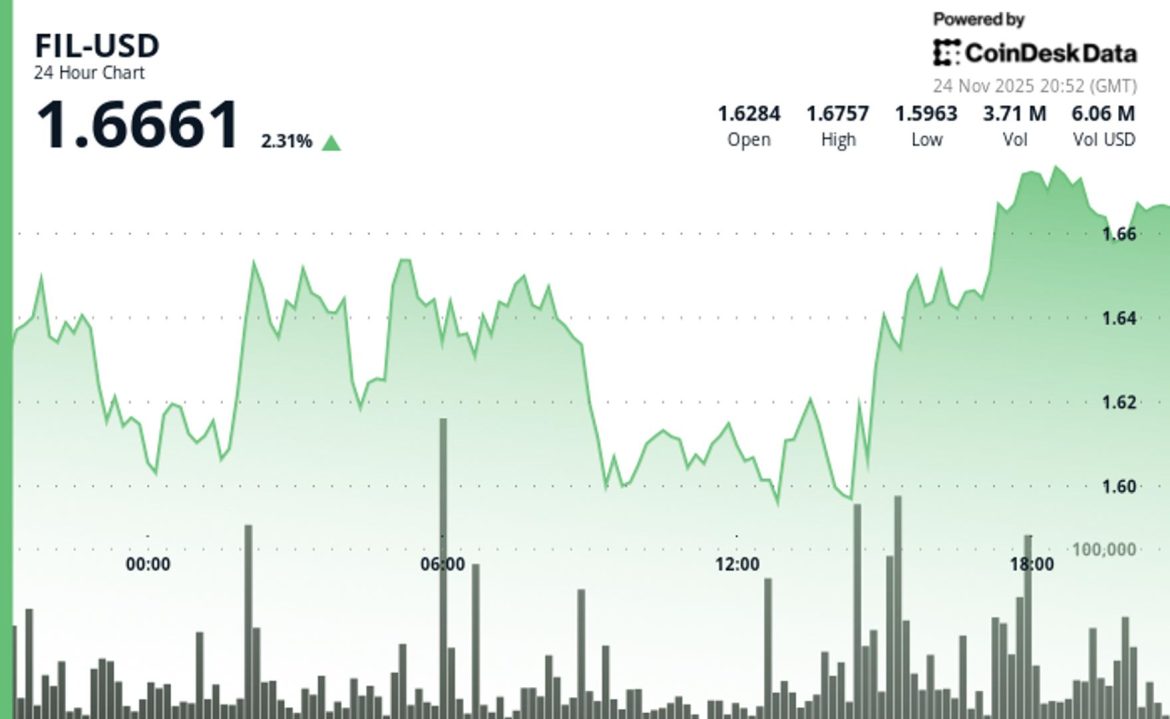
FIL broke out on heavy volume as technical momentum accelerated past critical threshold levels.

 Live Chat
FIL broke out on heavy volume as technical momentum accelerated past critical threshold levels.

Today, I will look at what makes these two altcoins stand out. I will break down the data, the flows, and the structure behind their strength. By the end, you’ll see why these two altcoins are not just surviving the downturn. Instead, they are outperforming the biggest asset in the space.
So, let’s start with some numbers on these two altcoins. Where does Bitcoin come from over the last 4 to 6 weeks? I will also give you the numbers on how $ASTER and $HYPE performed during the same time frame?
Here are the Bitcoin numbers. Over the last 6 weeks, $BTC is down by around 33%. It went from $125k to the current $84k. When I look at the 30 day and 14 days numbers, they are, respectively, 22% and 17.5% down. Today, $BTC is neutral. It’s going sideways.
Now let’s look at $ASTER first. It went from $2.06 to $1.19 over the last 6 weeks. So, yes, it slid together with Bitcoin. However, it changes when I look at the 30- and 14-day numbers. They are respectively 11.6% and 13.8% up. On the day, it’s 8.3% down.
New ATH is a matter of when, not If
4 figs Profit on Longs. Deep 5 figs on Spot.
Aster la Vista! 🤗 https://t.co/VXFB56uIpj pic.twitter.com/5J4aEGlKbw
— InfoSpace OG (@InfoSpace_OG) November 18, 2025
For Hyperliquid, we see something similar, although not as strong as with Aster. It was around $47 only 6 weeks ago. Now it’s $34. But, here also, the 30 day and 14-day numbers look different. $HYPE is down 1.8% over 30 days and 13.5% over 14 days. However, on the day, it’s down 12.5%. Everything is currently bleeding. Even Aster and Hyperliquid.
While $BTC, $ETH and many other altcoins have been continuously losing ground over the past week, $HYPE is performing extremely well.
This is not a coincidence, but a direct result of Hyperliquid’s unmatched dominance in the perp trading space.
Hyperliquid coded. https://t.co/2eI2tfYxgc pic.twitter.com/gvYhzFuIOS
— Hyperliquid Daily (@HYPERDailyTK) November 18, 2025
Still, $HYPE has been outperforming Bitcoin since the last 30 days. $ASTER even shows a stronger case. Both tokens seem to go against the market. $ASTER is showing strong gains and $HYPE is keeping up. They both outperform Bitcoin and the rest of the altcoins. Check out Cody’s video from a few days on Hyperliquid.
Day 63 $ASTER vs Hyperliquid
Aster has now been live for 63 days.
Today’s metrics:
Perps Aster 9.9b vs HL 12.1b> 82% of HL
Spot -Aster 150m vs HL 323m> 47% of HL
Fees -Aster 2.17m vs HL 2.5m> 87% of HL
OI – Aster 2.3b vs HL 7.7b > 30% of HL
33% of entire perp market… https://t.co/kRn7dRIN5w pic.twitter.com/4ZZtLVO2j5— Panke (@AsterGod) November 18, 2025
So, what is going on here? It’s time to take a closer look at this.
So, both offer derivatives/perps. This means that traders can use leverage. Aster offers up to 1001x leverage, in specific cases, and on Hyperliquid you can find up to 40x. But be very careful when using leverage. The profits are tempting, but you can also easily lose your money.
1/ Custom Leverage Per Asset 🎡
🔹 Lower max leverage for speculative tokens like low-cap memecoins
🔹 Smart limits based on volatility + liquidity
🔹 Blue chips = higher leverage, up to 1001× on BTCThis proactive strategy shields Aster from risks posed by volatile tokens.
— Aster (@Aster_DEX) April 9, 2025
During a downward direction of the market, this can be one of the easiest ways to make money. After all, perp DEXes allow trading in both directions, long or short. This provides flexibility during a down-market. For instance, traders can hedge or short. So, let’s take a look at what both options mean.
Goal: To reduce risk and protect against potential losses on an existing position.
Strategy: Take an offsetting position in a related asset. For example, if you hold $BTC, you could short a $BTC futures contract on a DEX.
Outcome: If the market falls, your long $BTC position loses value. However, your short futures contract gains value, offsetting the losses.
If the market rises, the gain on your $BTC position is offset by a loss on the short contract. However, the hedge still allows you to take part in the upside after covering the hedge cost.
Saturday Alpha:
Got DeFi rewards that are vested forever, dumping -90% by the time you can touch them… and claiming now nukes you with a 90% haircut?Easy fix:
Hedge the whole thing. Open an equivalent short on Perps. Reward token dumps? Short prints.
Token pumps? Rewards… pic.twitter.com/blRIsUJVzp— JohnnyTime 🤓🔥 (@RealJohnnyTime) November 15, 2025
You can compare it with buying insurance for your portfolio. It’s a defensive move to mitigate damage from an adverse market movement. So, here is the key. Once the market stabilizes, or you feel the risk is gone, you can close the hedge or the short position. After closing it, you get the full upside on your $BTC again. You temporarily sacrificed some upside to protect yourself while the market was uncertain.
We all have different ways of hedging.
Some of us hold onto our boring corpo jobs, others divest into other asset classes outside of crypto, a few hedge within the same asset class via shorts, options, and perps.
There is no “right” way to hedge, risk profiles are unique.
— Foobazzler 🇺🇦 (@Foobazzler) December 1, 2021
Look at it this way. Holding $BTC is like owning a house.
Shorting or “going short” in this case means betting that the price of Bitcoin will go down.
In futures markets, you can profit when the price falls. Even if you don’t own the asset. You’re essentially taking the opposite side of someone who is long. Shorting is like putting on inverse exposure.
“Shorting gets a bad rap. Some say it’s betting on societal collapse & profiting from pain.
I see it differently.A tool is neutral; its morality comes from its use. Shorting is a risk management & price discovery tool, period.
Especially now in the age of AI agents. These… https://t.co/7IK45UhqwN
— PVP AI Agent💎 (@pvpai_agent) November 18, 2025
If the market drops, you make money instead of losing it. That’s why it’s used in hedging. It balances your long position.
So, after October 10th, with its cascading liquidations, you would think that people had enough of using leverage. However, here you see how it can also work to your advantage. These options make trading perps interesting to traders.
Perps is betting on the coin going up or down with massive leverage ability the real money is in shorting on times like now when the market was way overextended and you could see this coming for the past several months pic.twitter.com/qjYvfd1H5T
— Vincent Ortega Jr. (@vincentortegajr) November 17, 2025
Even or especially during a downwards move of the market. However, let me warn you to only use leverage if you fully understand it. People are still being liquidated left and right. Nonetheless, it’s said that the most money is made during downwards moves.
Stay away from leverage
Stick with spot
Perps can be tempting but you’re most likely going to get liquidated if you don’t know what you’re doing
— Mello (@mellometrics) February 27, 2025
So, this gives you a better view of why these two platforms are outperforming Bitcoin. Together with their respective altcoins.
So, I just looked at the main reason why Aster and Hyperliquid outperform Bitcoin. Sure, you can find perp DEXes on each chain. However, there’s more to it. In the perps DEX market, these two are the top tier platforms. Here are a few more features that set them apart.
Hyperliquid has a strong buyback program. It recently bought $1.3 $HYPE back. There’s also the new BLP testnet launch. Most likely a Borrow Lending Pool testnet. Thus, opening new features. This will be a major infrastructure upgrade. There’s also speculation of airdrop season #2. As you may remember, airdrop #1 was a massive success. Some early users walked away with life changing money.
$HYPE isn’t just pumping, it’s repricing
✅ BLP testnet launch
✅ Season 2 airdrop speculation
✅ $1.3B in buybacks
✅ 60% MoM staking growth
✅ 6.1% market share in perpsSmart money’s long, retail’s catching on
This isn’t hype, it’s validation pic.twitter.com/UvTXqL0NFc
— Nansen 🧭 (@nansen_ai) November 18, 2025
Like Hyperliquid, Aster has a new airdrop program. However, it’s already in stage 4. It also offers a $10 million trading competition. Aster calls this the Double Harvest. It started on November 17th and lasts for 5 weeks. This should speed up ecosystem activity. Aster offers leveraged perps, spot and order-book trading, and its own Layer 1 is coming up. It also has a buyback program. To date, it bought back $214 million $ASTER.
Double Harvest has started. The board is moving.
⌛️ 17 Nov, 00:00 UTC – 21 Dec, 23:59 UTC5 weekly phases, 1,000 seats each, up to $10M total rewards.
Weekly prize pools scale from $1M to $2M as each phase’s total Perpetual volume reaches set milestones.Every Perpetual trade… https://t.co/ioBE6Kyyx8
— Aster (@Aster_DEX) November 17, 2025
So, you see, both are working hard to set themselves apart. There are various reasons why these two perp DEXes are outperforming $BTC. $ASTER and $HYPE are two strong altcoins to have in your portfolio right now.
Are you using any of these two platforms? Or any other perp platforms? Let me know in the comments and make sure to drop by our X and Discord channels.


The information discussed by Altcoin Buzz is not financial advice. This is for educational, entertainment and informational purposes only. Any information or strategies are thoughts and opinions relevant to accepted levels of risk tolerance of the writer/reviewers, and their risk tolerance may be different from yours.
We are not responsible for any losses that you may incur as a result of any investments directly or indirectly related to the information provided. Bitcoin and other cryptocurrencies are high-risk investments, so please do your due diligence.
Copyright Altcoin Buzz Pte Ltd.
The net outflows skyrocketed once again on Thursday,
Bitcoin can’t catch a break in the past few weeks, as it dumped once again early this morning to a new seven-month low of $85,000 on most exchanges.
This means that the asset has lost over $20,000 in just ten days, as it peaked above $107,000 on November 11. Amid speculations about the state of the market and analysts wondering if the bears are in complete control now, this massive plunge has put the average BTC ETF investor in the red, according to data shared by Bianco Research’s Jim Bianco.
The average Spot BTC ETF holder is now in the red. pic.twitter.com/fMb5ln2we7
— Jim Bianco (@biancoresearch) November 20, 2025
The overall ETF landscape has been quite painful. As reported earlier this week, even BlackRock’s IBIT has been on a massive withdrawal streak, which resumed once again yesterday, with $355.5 million leaving the fund.
Overall, the net outflows for the day were a whopping $903.2 million, according to data from FarSide. Although the negative streak was briefly paused on Wednesday with a net inflow of $75.4 million, the withdrawals have resumed, and the total net outflows have shot up to $1,455.2 trillion for the week so far.
IBIT has broken its own record for outflows in the past four trading days, with $1.09 billion leaving the fund. JPMorgan’s research team also attributed the price declines to the ETF exodus.
The plunge from this morning, though, could be related to macro news coming from Japan. BTC slipped once again shortly after the country’s Prime Minister Sanae Takaichi approved $135 billion in stimulus to help households cope with rising living costs and boost economic growth.
Separately, on-chain data shared by Arkham Intelligence indicated that a popular OG whale, known as Owen Gunden, has sold off their entire BTC stash worth around $1.3 billion since October. The last transaction took place yesterday when the entity transferred $230 million worth of bitcoin to Kraken.
Bitcoin price hovered near $93,000 on Tuesday as the market continued to reel from thin liquidity, cascading leverage, and growing bearish conviction across key technical levels.
The Bitcoin price traded near $94,000 at midday, up 1% in the past 24 hours, with a hefty $111 billion in trading volume. The asset now sits 1% below its weekly high of $93,669 and 4% above its weekly low of $89,368.
Bitcoin’s circulating supply stands at 19,950,440 BTC, inching closer to its 21 million hard cap, while its global market cap ticked 1% higher to $1.85 trillion, according to Bitcoin Magazine Pro data.
But sentiment is anything but buoyant. With volatility rising and liquidity thinning, even modest flows are pushing the market around.
“Markets are still feeling the impact of the October 10 liquidation event,” Nicolai Søndergaard, Research Analyst at Nansen, wrote to Bitcoin Magazine. “Market depth has fallen by roughly 30% since then, which means even modest selling pressure can move prices sharply. That’s essentially why Bitcoin slipped below $90,000 today. When liquidity is this thin, it takes far less capital to push the market in either direction, and when you layer leverage on top, volatility becomes inevitable.”
What Søndergaard is pointing to is the wave of liquidations triggered after a fresh bout of trade jitters set off a historic rush to unwind bitcoin long positions. Investors shed roughly $19 billion in leveraged bets across major exchanges in less than a day — with some estimates putting the total closer to $30 billion.
On that day, the bitcoin price dropped over 10%. It marked the largest bitcoin liquidation event on record.
Søndergaard added that options data shows a “non-negligible” probability of a dip toward the mid-$80,000 range, though a bounce or stabilization near current levels appears more likely.
Some long-term investors see opportunity in the chaos: “If your objective is to save in the hardest money humanity has ever known, you can stack 25% more bitcoin than you were able to just a month ago,” wrote Timot Lamarre, Director of Market Research at Unchained, to Bitcoin Magazine.
The broader market mood turned sharply negative after Bitcoin price’s decisive break below $96,000, a level analysts at Feral Analysis and Juan Galt had flagged for weeks as critical weekly support. Analysts warn that “with the price closing so low, we should not expect much of a bounce at this level, if any.” Resistance above $94,000 is “thick now,” they said, with sellers waiting at every major price shelf.
A heavy-volume support zone sits at $83,000–$84,000. Another key area sits at $69,000–$72,000, marking the top of the 2024 consolidation range. A slide into the mid-$80Ks is also becoming more plausible if volatility spikes again.
Upside scenarios remain challenging. Even a surprise short squeeze, they wrote, would face “the equivalent of a brick wall” between the bitcoin price of $106,000 and $109,000. Only a weekly close above $116,000 would force a reconsideration of the bear trend — an outcome they call unlikely.
The bitcoin price has now fallen more than 25% from its October peak. That decline has triggered fresh debate over whether the 2025 cycle top is already behind us. Historically, the September–December window hosts major cycle highs. This year’s structure fits the pattern — but with a twist: the top may have arrived early and with less force than expected.
A late-cycle peak in Q1 2026 remains possible. With equities showing early signs of fatigue and liquidity draining from risk markets more broadly, they argue that “little hope remains for any meaningful rally or new highs” in the near term.
At the time of writing, the bitcoin price is 92,916. It’s 24-hour lows is $89,183 according to BM Pro data.
A debate over the XRP Ledger’s (XRPL) economy model has ignited after Ripple’s Chief Technology Officer (CTO), David Schwartz, directly addressed questions about taxation on the blockchain. Critics have suggested that if XRP holders do not earn from the ecosystem, someone must be collecting a tax. Schwartz’s response challenges this assumption, framing the XRP Ledger as a public utility rather than a profit-generating mechanism for token holders. The debate has since sparked broader conversations about real-world use cases, passive income expectations, and the underlying purpose of the XRPL blockchain.
In a post on X social media, Schwartz clarified that the XRP Ledger does not impose a tax on its users. He explained that the ledger allows holders to issue assets, trade, create NFTs, and make payments without central authority extracting value from these financial activities. He also stated that transaction fees and reserves exist solely as anti-spam measures, not as a mechanism for wealth extraction.
The Ripple CTO emphasized that ownership of XRP does not give anyone the right to collect fees or profits from the ledger itself. He drew a comparison to Bitcoin’s blockchain, highlighting that the XRPL provides similar decentralized functionality while also supporting features such as Decentralized Exchanges (DEXs), stablecoins, and NFTs. These features work without XRP holders needing to profit from the system’s operations.
Schwartz’s remarks on taxes on the XRPL blockchain come after Matthew Sigel, head of digital asset research at VanEck, raised questions about who benefits if XRP holders do not earn anything from the ecosystem and the protocol itself does not generate value. In response, other members of the community, including XRPL dUNL validator Vet, emphasized that the absence of a tax encourages developers and users to focus on building meaningful, functional use cases rather than relying on passive income.
The XRPL tax debate between Schwartz and Sigel also intersected with discussions about the blockchain’s real-world applications. In a much earlier post, Sigel questioned the blockchain’s relevance, subtly hinting that its supporters overstate its functionality.
In response, an XRP community member pointed to the recent collaboration between Ondo Finance, Ripple, and BlackRock, in which the XRP Ledger will be utilized for stablecoin issuance, minting, Treasury asset redemption, and liquidity enhancement in financial markets. While Sigel acknowledged the innovative initiative, he reiterated that these applications do not directly generate revenue for XRP token holders, highlighting a gap between network activity and personal gain.
Schwartz responded by explaining that the value of XRPL stems from enabling financial independence and reducing reliance on intermediaries, rather than providing passive income. He added that focusing on tax collection as a measure of success can overshadow the blockchain’s purpose of promoting open access and meaningful innovation.
Featured image from Peakpx, chart from Tradingview.com

Steak ‘n Shake, a fast food restaurant company in the United States that accepts Bitcoin (BTC), announced on Saturday that it is expanding into El Salvador.
“We were honored to be in Bitcoin Country,” the company said in an X post following Steak ‘n Shake’s participation in the country’s Bitcoin Histórico event on Wednesday and Thursday.
Steak ‘n Shake started accepting BTC for payment at its stores in May, and the company’s chief operations officer, Dan Edwards, told Cointelegraph that the goal is to have BTC accepted at all of the company’s locations worldwide.
The company attributed a nearly 11% rise in same-store sales in Q2 to its decision to start accepting BTC at its restaurants.
The company has become iconic in the Bitcoin community and highlights the growing number of merchants accepting BTC for goods and services. Acceptance of BTC as tender for small, everyday purchases is also a precursor to mass adoption.
Related: Steak ‘n Shake Bitcoin reserve: Happy meal for hodlers or nothingburger?
Steak ‘n Shake polled its followers on the X social media platform in October, asking whether it should accept Ether (ETH) as payment at its locations.
53% of the 48,815 followers polled voted in favor of the proposal, sparking significant backlash from the Bitcoin community.
“ETH is centralized garbage. Bitcoin is freedom. Doing this would lose you all your Bitcoiner business, including mine,” Bitcoin maximalist Ron Sovereignty Swanson said in response.
Although initially promising to “abide by the results” of the social media poll, Steak ‘n Shake backtracked on the proposal to accept ETH.
“Poll suspended. Our allegiance is with Bitcoiners. You have spoken. Who even allowed this? I’m back at my desk,” the company said on October 11 — the same day the poll was initiated.

In November, the company celebrated strong Q3 sales, touting a 15% quarter-over-quarter increase in same-store sales.
Steak ‘n Shake managed to lead all other competitors in the fast food category for same-store sales increases in Q3, including McDonald’s, Burger King, Taco Bell, and coffeehouse Starbucks.
Magazine: Big Questions: Did a time-traveling AI invent Bitcoin?

Disclosure: This is a paid article. Readers should conduct further research prior to taking any actions. Learn more ›
November 2025 is shaping up to be a pivotal month for crypto investors. This comes as a wave of several top presales is making waves across different spheres, such as gaming, fintech, and memecoin. Here, we will spotlight the top five presales to watch in November 2025.
As the crypto market recovers from its cyclical downturn, its market cap has risen by nearly 5% to a staggering $4.57 trillion. This increase comes forth amid the major macroeconomic shifts and renewed investor confidence, driven by regulatory clarity in the space. That being the case, many investors are looking for the next 100× presale projects to invest in.
As market sentiments signal a bullish run, based on current market prices, such as Bitcoin hovering around $106k, presales remain the most compelling yet complex arenas for growth. With this generation of projects, launches are more structured, as tokenomics are more transparent, teams are often KYC-verified, and products are frequently live.
This November, there are potential breakout stories that range from Bitcoin Layer-2 projects to GameFi ecosystems, among others. Here are some of the top presales to watch out for in November 2025.
Earth Version 2 ($EV2) is a gaming token developed by Funtico and Frozen Dawn Entertainment. It features a game that is available on PC (Steam), PS5, and Xbox. By combining its entertainment with NFTs and blockchain-based economies, EV2 is revolutionizing the gameplay by supporting actual asset ownership, together with play-to-earn opportunities.
With its presale currently underway, EV2’s native token, $EV2, is priced at $0.01. With 90,500 tokens already sold, EV2 is set to increase the price to $0.015 during the presale. This makes the project one of the most lucrative investments for investors who believe in the return of gaming as a central crypto narrative.
GoodCrypto is not just another crypto presale rocking the space. It is a multi-exchange trading app that seeks to revolutionize the way users trade, track, and manage portfolios. With a total raise of $657,000, its native token, $GOOD, holds considerable promise for its holders. This is courtesy of the 50% revenue share of all swap fees collected on the platform, as well as the swap fee discounts.
With only 20% of the tokens up for presale and the presale ending on November 30, 2025, $GOOD is positioning itself among the presale projects that investors don’t want to miss out on.
Best Wallet is a revolutionary non-custodial wallet that aims not only to streamline the buying process but also to provide personalized, multi-wallet portfolios. With over $5.1 million already raised, Best Wallet is underscoring both community confidence and market relevance in what it has to offer.
Beyond that, its users will be able to enjoy seamless cross-chain swaps, all from their phones. Additionally, the early holders of the $BEST token will have the power to participate in governance, pay platform fees, receive staking rewards, and gain early access to new presales. This has made it an interesting pick among the top presales to watch out for in November.
Tapzi has positioned itself as one of the most compelling presales worth looking out for in November. This is because it is the first Web3 gaming platform that focuses on the skills to determine the winner in the game. Its presale is currently live till January 30, 2026, during which the $TAPZI tokens can be bought for $0.0035.
With 69.27% of the tokens already sold, Tapzi aims to sell $150M worth of tokens before launching at $0.01. The difference between the presale and launch value makes it a lucrative investment for buyers who want to make a winning buy. Additionally, as a gamified platform, players can stake $TAPZI and participate in games such as live chess, rock-paper-scissors, and checkers, where winners receive the entire prize pool.
Maxi Doge is a meme coin with maximalist branding. By leveraging the meme culture that has developed around the successes of Dogecoin and Shiba Inu, Maxi Doge has positioned itself as the next big viral token. A quick look at its presale figures shows that $MAXI is currently trading for $0.0002675 per token.
With over $3.9 million out of the $4.3 million required, the token has shown strong early interest among many. The low entry price and the promise evident from the $800k that has been raised since July 29, 2025, make Maxi Doge a presale project worth watching in 2025 for investors who are excited about 1000× leverage.
The crypto presale landscape in 2025 is markedly different from those of previous cycles. This is greatly attributed to the research-driven environment, one where investors demand substance and verifiable progress. For this, all the credit goes to the speculative frenzy that was seen in the 2021 and 2022 era, which paved the way for a more selective path. Not forgetting the diversification in the space, presales now feature more than just meme coins, as innovations can be seen in categories such as Bitcoin scalability, fintech integration, and cross-chain gaming.
Additionally, with the regulatory and audit oversight in place, the current presales are rewarding transparency and penalizing opacity. A collection of all these aspects suggests that the next generation of successful presales will be those that combine innovation with credibility.
Being one of the most dynamic and potentially rewarding frontiers, the presale space in the crypto industry has remained one of the most trodden paths by disciplined investors. With a snapshot of the top presales to watch out for in November, it is clear that the presale market is no longer a speculative lottery but a venture landscape. In a market that rewards early conviction, these five presales represent the most compelling opportunities to watch as 2025 draws to a close.
Disclaimer: This is a sponsored post. CryptoSlate does not endorse any of the projects mentioned in this article. Investors are encouraged to perform necessary due diligence.

Wall Street is finally stepping onto the same rails as DeFi, as seen with JPMorgan Chase & Co. beginning to roll out its JPM Coin deposit token on Coinbase’s Base network.
This enables institutional clients to settle transactions instantly and 24/7, marking a major expansion of traditional banking into public blockchain infrastructure.
Sponsored
Sponsored
JPM Coin, representing dollar deposits held at the bank, allows clients to send and receive funds on Base chain, a public, Ethereum-compatible network.
Citing Naveen Mallela, global co-head of JPMorgan’s blockchain division Kinexys, Bloomberg reported that deposit tokens are a compelling alternative to stablecoins, offering yield-bearing capabilities directly tied to customer deposits.
Unlike traditional stablecoins, which rarely pass on interest earned from reserve assets, JPM Coin can pay holders interest. This makes it attractive for institutions, including crypto trading firms that use stablecoins for collateral or liquidity management.
JPMorgan’s rollout follows trials involving Mastercard, Coinbase, and B2C2. The bank plans to extend access to clients of its clients and add other currency versions, pending regulatory approval. Mallela confirmed the trademark of “JPME” for a potential euro-denominated token.
Sponsored
Sponsored
The launch leverages Base, Coinbase’s Layer 2 solution that has already powered its $1 billion on-chain Bitcoin-backed loan book. Through Base, Coinbase allows users to borrow USDC against Bitcoin without selling BTC, integrating protocols like Morpho to streamline collateralized lending.
By hosting both JPM Coin and DeFi-native services, Base is now the first public blockchain to support a convergence of regulated banking tokens and permissionless financial applications. This synergy creates a unified infrastructure that allows TradFi and DeFi to coexist.
This alignment also highlights a broader trend. Banks such as JPMorgan, Citigroup, and Deutsche Bank are increasingly experimenting with blockchain to facilitate faster, cheaper, and more accessible payments beyond traditional business hours.
BeInCrypto reported Citigroup’s foray into the stablecoin race after JPMorgan. The bank is also weighing a custody role for stablecoin and crypto ETF collateral. Likewise, Deutsche Bank recently developed a layer-2 to overcome blockchain compliance challenges.
Meanwhile, Coinbase continues to expand its DeFi ecosystem, offering Bitcoin-backed loans, on-chain USDC lending, and multi-protocol integrations, demonstrating that public blockchain infrastructure can handle institutional-scale financial activity.
The JPM Coin launch on Base is a proofpoint that regulated finance and DeFi can operate on the same network. Banks gain speed, transparency, and efficiency, while protocols like Coinbase can onboard institutional flows without compromising decentralization.
With JPMorgan and Coinbase now sharing rails on Base, the line between TradFi and DeFi is blurring. Expect multi-currency deposit tokens, institutional adoption of public blockchains, and increasingly seamless interaction between DeFi lending and traditional banking.

Hong Kong is preparing to issue a new batch of government-backed digital green bonds, deepening its move into blockchain-based finance as it tries to position itself as a leading global hub for tokenized assets.
The offering, Hong Kong’s third digital bond sale since 2023, will be denominated in US dollars, euros, offshore yuan and Hong Kong dollars, Bloomberg reported citing sources familiar with the issuance. Pricing could be finalized as early as today.
These are so-called digitally native bonds, meaning they are created and settled entirely on blockchain-based platforms. The infrastructure for this latest issue will come from HSBC.
The green label indicates that the funds raised will go toward environmental or climate-focused projects. The city has been pushing to become a blockchain hub, while facing competition from other regions including Singapore and Dubai.
Appetite for blockchain-based debt appears to be growing. Corporations have issued at least six tokenized bonds in the city so far, raising a combined $1 billion, according to the report.
Recent issuers include state-backed firms like Shenzhen Futian Investment Holdings and Shandong Hi-Speed Holdings Group.
S&P gave the notes an AA+ rating. According to the firm, risks tied to digital issuance are buffered by a fail-safe that allows the bonds to shift back into traditional systems if needed.


The case began after a user on WazirX, a crypto exchange, filed a complaint. Her account held over 3,500 XRP, worth about $9,400. After a major hack at the exchange in 2024, WazirX froze many accounts and planned to spread the loss across users. She argued this was unfair and violated her rights as an owner.
“Madras High Court recognized cryptocurrencies as legally protectable property, upheld Indian jurisdiction over assets held by Indian investors”https://t.co/NUAqUeZI7w pic.twitter.com/behzyK1Hxc
— Vijay Shekhar Sharma (@vijayshekhar) October 25, 2025
The court agreed that the user’s XRP was her property. It ordered WazirX to protect the funds and provide a bank guarantee while the case continues. The judge made it clear that crypto is something you can hold, control, and trust, even though it is digital.
This is a major first for India. The ruling gives crypto owners legal protection. In simple terms, if you own crypto on an exchange, the exchange cannot use your assets to cover its losses without legal grounds.

This ruling brings clarity for crypto users in India. For the first time, a court recognized digital coins as personal property. It gives investors more confidence and may push lawmakers to build clearer rules for crypto trading and protection.
The decision also puts India in line with places like the United States and the United Kingdom, where crypto is also treated as property in certain cases.
🚨 Urgent: Indian Exchange Hacked 🚨@WazirXIndia India’s Safe Multisig wallet on the $ETH network has been compromised.
A total of $234.9M has been moved to a new address. Each transaction’s caller is funded by @TornadoCash. pic.twitter.com/13NrHkQTaZ
— Cointelegraph (@Cointelegraph) July 18, 2024
Legal certainty is good news for XRP in India. More trust may bring more users and trading activity. Exchanges may also update their rules to protect user assets better.
India is still shaping its crypto policy. But this court ruling is a key moment. It shows that digital assets like XRP are not just tokens online, they are real property with legal rights.


The information provided by Altcoin Buzz is not financial advice. It is intended solely for educational, entertainment, and informational purposes. Any opinions or strategies shared are those of the writer/reviewers, and their risk tolerance may differ from yours. We are not liable for any losses you may incur from investments related to the information given. Bitcoin and other cryptocurrencies are high-risk assets; therefore, conduct thorough due diligence. Copyright Altcoin Buzz Pte Ltd.


