The Zcash protocol remains unaffected despite the governance clash and restructuring with Bootstrap.

 Live Chat

The Zcash protocol remains unaffected despite the governance clash and restructuring with Bootstrap.

Nexo has launched a zero-interest crypto lending product that allows Bitcoin and Ether holders to borrow against their assets through fixed-term loans.
According to a company announcement, the product, called Zero-interest Credit, offers fixed-term loans for users who hold Bitcoin (BTC) and ETH (ETH), with repayment conditions set in advance. Loans are settled at maturity and can be repaid using either stablecoins or collateral, depending on market conditions.
The offering expands a structured lending model that had previously been available only through Nexo’s private and OTC channels, where it facilitated more than $140 million in borrowing during 2025, according to the company.
Borrowers choose the loan size and duration up front, with terms that prevent liquidation before maturity and define the repayment range. At the end of the term, loans can be settled using either stablecoins or collateral, with the option to renew under new terms.
Nexo is a crypto financial services company founded in 2018 that offers crypto-backed loans, trading and savings services to users across 150 jurisdictions.
In April 2025, the company said that it would reenter the US market after withdrawing in late 2022 and settling a case with the Securities and Exchange Commission for $45 million in early 2023.
Related: Babylon receives $15M from a16z Crypto to expand Bitcoin-native lending
Crypto lending has evolved significantly since 2022, when companies such as Celsius and BlockFi were widely blamed for amplifying market contagion and deepening the fallout from the FTX collapse.
In 2025, centralized lenders including Nexo, Ledn, Xapo Bank and Coinbase expanded their crypto lending offerings under more conservative, fully collateralized structures, while decentralized finance (DeFi) protocols also recorded strong growth.
According to DefiLlama data, DeFi lending products grew from about $48.15 billion in total value locked (TVL) on Jan. 1, 2025, to a peak of $91.98 billion on Oct. 7, 2025.
Although the market trended lower following the Oct. 10 crypto liquidation event, activity stabilized in November and total value locked (TVL) currently stands at around $66 billion.
The DeFi lending market is led by Aave, with more than $22 billion in outstanding loans backed by over $55 billion in deposited assets, according to DefiLlama data.
Morpho ranks second, supporting roughly $3.6 billion in outstanding loans backed by about $10 billion in supplied liquidity.
Magazine: How crypto laws changed in 2025 — and how they’ll change in 2026

World Liberty Financial (WLFI) became the latest firm on Wednesday to apply for a national trust bank charter. It joined digital asset companies like Circle, Ripple, Fidelity Digital Assets, BitGo, and Paxos in a move that would allow it to expand stablecoin services.
However, the announcement caused significant concern. Established banks argue that it represents an effort to secure federal recognition while sidestepping the stricter regulatory and supervisory requirements that apply to fully licensed national banks.
Sponsored
The Trump-backed crypto venture WLFI announced that its affiliate, WLTC Holdings LLC, has submitted a de novo application to the Office of the Comptroller of the Currency (OCC) to establish the World Liberty Trust Company, National Association (WLTC).
The planned institution would function as a national trust bank with a primary focus on stablecoin-related activities. Such charters allow firms to operate across the US under a single federal framework, eliminating the need for individual state licenses.
Trust banks differ from full banks in that they generally can’t take deposits or make loans.
In anticipation of an approval, WLFI stated that WLTC will operate under full federal supervision and comply with the GENIUS Act, implementing strict AML, sanctions screening, and cybersecurity standards.
Sponsored
Customer assets will be segregated, with reserves independently managed, and operations subject to regular examinations. Mack McCain, General Counsel of World Liberty Financial, is set to serve as Trust Officer.
Banking industry groups have pushed back, warning that issuing trust charters in this way could increase systemic risk while eroding the integrity and original purpose of the charter framework.
One of the most contentious aspects surrounding the riskiness of these actions focuses on regulatory and supervisory gaps.
While crypto firms may receive bank-like status, they are not subject to the full suite of prudential regulations that traditional banks face. These include comprehensive capital, liquidity, and risk-management standards.
Sponsored
Given the increasing popularity of crypto firms seeking these licenses, banks have started to raise alarms.
“The conditional approvals of five national trust bank charters from the OCC further stretches the national trust bank charter beyond its statutory and historical purpose, endangers consumers, and creates institutions the OCC is not equipped to resolve in an orderly way,” said Rebeca Romero Rainey, the president and CEO of the Independent Community Bankers of America, in a December statement.
Traditional banks have also warned that this could create regulatory arbitrage, where crypto firms benefit from federal oversight without the same safeguards. In turn, consumer protection and financial stability become points of weakness.
Sponsored
Meanwhile, national trust charters do not automatically include Federal Deposit Insurance Corporation (FDIC) insurance for customer assets in the same way retail banks do.
If a crypto-chartered bank fails, customers might not have the same insurance protections, potentially leading to losses for individuals and institutions that misunderstand the risk.
This could undermine trust in the broader financial system if widely used crypto-bank services experience stress or failure.
The OCC typically requires 12 to 18 months to evaluate applications for national trust bank charters, meaning WLFI is unlikely to receive a final decision before 2027.

Ambiguous resolution criteria resulted in a controversial market settlement, upsetting several Polymarket traders.
When is an invasion not an invasion? Irate traders on Polymarket want to know.
The leading global blockchain-based prediction market platform found itself mired in controversy over its “Will the U.S. invade Venezuela by Dec. 31?” trading market.
Polymarket determined that the United States’ Jan. 3 military operation, where U.S. forces captured Venezuelan President Nicolás Maduro and his wife, Cilia Flores, at their home in Caracas, did not qualify as an “invasion.”
In the lead-up to the raid, the exchange had accrued more than $10.5 million in trading volume, with “by January 31” attracting the highest trading volume. MarketWatch, which first reported Polymarket’s decision not to resolve the exchange, notes that at least one trader would have scored a huge payday, with “positions on that contract worth nearly half a million dollars.”
Many traders thought that Maduro’s capture would qualify as an “invasion,” especially since one trader netted over $400k over predicting the timing of his capture (which sparked controversy of its own in the form of allegations of insider trading). However, Polymarket clarified that the contract will be resolved as Yes only if the U.S. “commences a military offensive intended to establish control over any portion of Venezuela.”
Polymarket also stated that the resolution source for the market will be “a consensus of credible sources,” most likely mainstream news sources (or if U.S. President Donald Trump announces a full-scale invasion of the South American country). They further clarified by adding an Additional Context note:
This market refers to U.S. military operations intended to establish control. President Trump’s statement that they will “run” Venezuela while referencing ongoing talks with the Venezuelan government does not alone qualify the snatch-and-extract mission to capture Maduro as an invasion.
The decision didn’t go over well with many of Polymarket’s traders, who vented their frustrations on social media:
The “Will the U.S. invade Venezuela by…?” market is closing in on $11 million in volume, with $6.24M just on a January 31 deadline. Previously, $2.7M was traded on whether it would happen by Dec. 31, 2025.
While most Polymarket markets have more clear-cut resolutions (like those over the next Fed interest rate decision or the 2028 U.S. presidential election winner), this recent exchange fracas shows that nuance (and ambiguity) can prevent a market from going a trader’s way.
This is not Polymarket’s first controversy surrounding the Venezuela raid. Chatter of “insider trading” arose when an anonymous user created an account on Dec. 26 and placed a series of wagers on four markets related to the U.S.’s actions in Venezuela.
This user bet more than $32k that Maduro would be removed from power by the end of January. At the time, the “yes” position was trading at an average of 7 cents, implying a 7% likelihood. It was, essentially, a long shot, but one that paid off. After Maduro’s capture, Polymarket paid out the trader more than $400k profit.
The timing of the bet raised some eyebrows, including those of New York Representative Ritchie Torres, who introduced a bill on Jan. 5 titled the Public Integrity in Financial Prediction Markets Act of 2026. The legislation would ban government employees from using prediction markets when they have access to nonpublic information.
Polymarket doesn’t have restrictions against insider trading; CEO Shayne Coplan has argued that the platform “creates this financial incentive for people to go and divulge the information” to the public and that any restrictions against it would do more harm than good. However, Polymarket’s biggest competitor, Kalshi, does list insider trading prohibitions on a per-market basis.

The reiteration of the payment company‘s plans not to pursue a public offering followed a $500 million fundraise in November, leading to a $40 billion valuation for Ripple.
Ripple Labs president Monica Long has ruled out an IPO for the company, saying it was in a “really healthy position” without going public.
In a Tuesday interview with Bloomberg, Long addressed rumors that Ripple was planning to go public after the company reached a $40 billion valuation in November. The Ripple president said the company was focused on growth following the $500 million fundraise headed by Citadel Securities and Fortress Investment Group that led to its valuation.
“Currently, we still plan to remain private,” said Long, expanding on her comments in November after the fundraise. “Often the strategy driving an IPO is to get the access to the investors and the liquidity of the public markets […] We’re in a really healthy position to continue to fund and invest in our company’s growth without going public.”
The comments from Long going into 2026 came months after the US Securities and Exchange Commission announced it would wind down its enforcement actions against Ripple, fueling speculation about an IPO. Long has repeatedly denied reports that Ripple was pursuing a public offering.
Related: SEC now fully Republican, set for pro-crypto rulemaking in 2026
At the time of writing, the price of XRP (XRP) was $2.20, having dropped by about 6% in the previous 24 hours. The token is the fourth largest cryptocurrency by market capitalization.
In December, the US Office of the Comptroller of the Currency (OCC) conditionally approved applications from Circle and Ripple for national trust bank charters. BitGo, Fidelity Digital Assets and Paxos also received conditional approval to convert their existing state-level trust companies into federally chartered national trust banks.
Ripple’s application said its charter would “not be a stablecoin issuer” for its US dollar-pegged coin, Ripple USD (RLUSD), while the other companies will provide a variety of digital asset custody services to users. Of the applicants, BitGo has announced plans to go public, and Circle launched an IPO in May.
Magazine: How crypto laws changed in 2025 — and how they’ll change in 2026
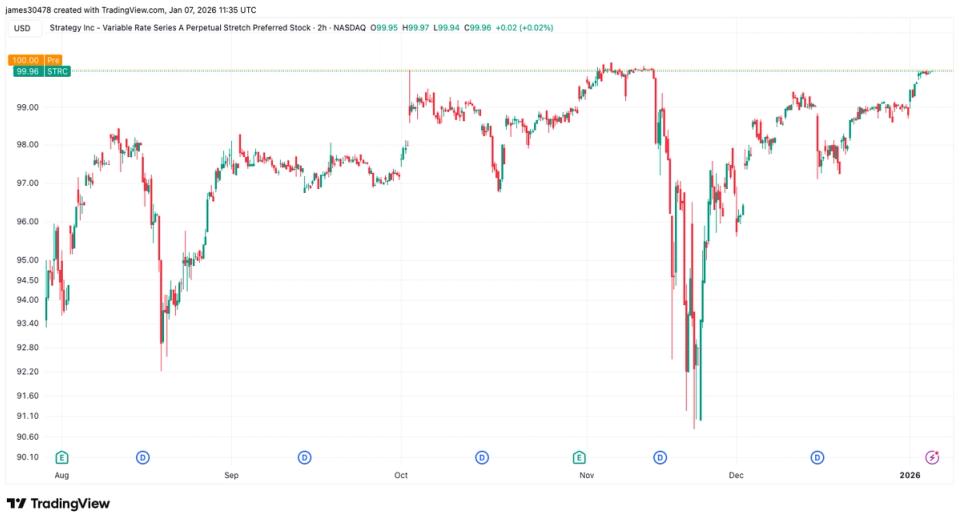
Stretch (STRC), the perpetual preferred equity issued by Strategy (MSTR), the largest corporate holder of bitcoin
STRC last traded at that level between Nov. 4 and Nov. 13, before falling to a low near $90. The return to par allows Strategy to issue shares through at-the-market (ATM) offerings tied to the product.
The equity is branded as short-duration, high-yield credit. It currently pays an 11% annual dividend, distributed monthly in cash. The dividend rate is reset monthly to encourage trading around the $100 par value and to help reduce price volatility.
Since inception, STRC has risen 16% and offers an effective yield of roughly 11%. The annualized yield is calculated as the current dividend divided by the STRC share price.
MSTR raised the dividend rate on STRC to 11% at the start of the year, marking the fifth dividend increase since the product was introduced in July. The company’s common stock is up 4% in pre market trading to $165, while STRC is up 0.03% at $100.

Welcome to Asia Morning Briefing, a daily summary of top stories during U.S. hours and an overview of market moves and analysis. For a detailed overview of U.S. markets, see CoinDesk’s Crypto Daybook Americas.
Crypto markets are starting the year in recalibration mode rather than retreat, with bitcoin consolidating above $90,000 and ether regaining relative strength as institutional positioning resets.
As Hong Kong began its Wednesday trading day, BTC slipped modestly on short-term frames but remained range-bound after clearing the psychologically important $90,000 level.
“With stocks, gold and other precious metals at all time highs, we see the situation as a battle between price correcting higher to be in line with all the other assets vs price moving lower over the next few months to respect the 4-year cycle,” George Mandres, a crypto analyst at trading firm XBTO, told CoinDesk in a note, adding that the latter “can very quickly turn into a self-fulfilling prophecy.”
So far, neither force has dominated price action. Instead of a sharp correction, bitcoin has moved sideways, suggesting digestion rather than distribution. Mandres pointed to the calendar effect as a key difference from late 2025.
“What is different now vs a few weeks ago, besides the [btc] price, which has gone above $90k, is the fact that a new year has started and therefore PNLs reset to 0, and investors need to allocate capital to attractive risk/reward opportunities,” he continued.
Ethereum tells a slightly different story. While ETH has outperformed bitcoin over weekly and monthly windows, futures data suggests positioning has cooled.
Bradley Park, founder of DNTV Research, said CME ethereum futures open interest offers useful context beyond spot charts.
“Rising open interest has increasingly reflected institutional participation via DAT-style, ETF arb trades, while falling open interest suggests an unwind,” Park said in a note to CoinDesk.
That unwind now appears well advanced.
“The recent pullback looks less like a structural break and more like a loss of momentum, with positioning resetting to roughly July 2025 levels,” Park added.
Importantly, that reset has not been accompanied by a sharp spot selloff.
A recent report from Glassnode reinforces the same theme across assets. Options markets have de-risked aggressively, with open interest contracting and volatility expectations rising, while U.S. spot ETF flows have flipped back to net inflows, signaling renewed institutional demand but also increasing sensitivity to near-term profit-taking.
Taken together, the signals point to consolidation and rotation rather than a broad risk-off move. Bitcoin is absorbing competing macro narratives without breaking trend, while Ethereum looks less crowded and better positioned if institutional flows re-engage.
BTC: Bitcoin is trading sideways above $90,000, with price action reflecting consolidation after a recent advance rather than renewed selling pressure, as macro support and cycle-driven caution continue to offset each other.
ETH: Ether is trading around $3,247, edging lower on short time frames but remaining up strongly on weekly and monthly views, underscoring resilience despite a recent cooling in futures positioning.
Gold: After a nearly 65% rally in 2025, banks see gold pushing to new records in 2026 on falling rates, central bank buying and geopolitical risk.
Nikkei 225: Japan’s Nikkei 225 fell 0.45% on Wednesday as Asia-Pacific markets traded mixed, with Australia’s ASX 200 rising 0.38% after inflation data came in below forecasts.

The US isn’t doing enough to stack its sats.
That’s according to one of Washington’s most pro-Bitcoin senators, Cynthia Lummis, who said Tuesday that she was “deeply concerned” about the government reportedly liquidating seized coins.
Following a report by Bitcoin Magazine that the Department of Justice had gotten rid of the Bitcoin seized in a criminal case, Senator Lummis said on X that the feds should be doing more to build up their crypto reserves.
“Why is the US gov still liquidating Bitcoin when @POTUS explicitly directed [that] these assets be preserved for our Strategic Bitcoin Reserve?” Senator Lummis wrote, referring to the Samourai Wallet case.
Why is the U.S. gov still liquidating bitcoin when @POTUS explicitly directed these assets be preserved for our Strategic Bitcoin Reserve? We can’t afford to squander these strategic assets while other nations are accumulating bitcoin. I’m deeply concerned about this report. https://t.co/XW5WxsfliA
— Senator Cynthia Lummis (@SenLummis) January 6, 2026
“We can’t afford to squander these strategic assets while other nations are accumulating Bitcoin. I’m deeply concerned about this report,” she added.
Samourai was a coin mixing app available on the Google Play store which allowed users to hide their Bitcoin transactions.
But feds in 2024 arrested developers Keonne Rodriguez and William Lonergan Hill and shut down the website, with the US Department of Justice alleging it was an “unlicensed money transmitting business” used by criminals.
Citing court documents Monday, Bitcoin Magazine reported that the US Marshall Service appeared to have sold the $6.3 million worth of Bitcoin that Rodriguez and Hill paid the Department of Justice as part of their guilty plea.
The magazine went on to say that this may have violated Executive Order 14233, which mandates that Bitcoin acquired via criminal or civil asset forfeiture proceedings should be held as part of the United States’ Strategy Bitcoin Reserve.
After the publication of this story, the United States Marshals Service told DL News that it “has not sold the Bitcoin mentioned” and it has “no idea how Bitcoin Magazine would get that information. But they did not fact check nor contact us for information.”
“USMS cryptocurrency liquidations go through a multi-level approval process to ensure only forfeited digital assets that meet the requirements of Section D of Executive Order 14233 are disposed,” the agency said.
US President Donald Trump in March 2025 signed an order for a Strategic Bitcoin Reserve — a bill Senator Lummis sponsored.
The idea, according to the bill, is that while the government won’t buy more Bitcoin, it also won’t sell the seized digital asset.
President Trump campaigned to help the industry and one of his promises was to establish a reserve of digital coins. The US government already has the biggest stash of crypto out of nation states, largely from seizures.
The DOJ did not immediately respond to DL News’ request for comment; Senator Lummis’ office would not respond to further questions.
Republican Senator Lummis earned the name “Bitcoin Senator” over the years for her pro-crypto approach on Capitol Hill.
The lawmaker — who announced her retirement in December — sponsored the Bitcoin Act for a Bitcoin strategic reserve, and was co-sponsor of the 2025’s GENIUS Act to regulate stablecoins.
A close ally of Trump, Lummis also in 2025 introduced legislation for a tax exemption on small Bitcoin transactions.
Update, January 6: This story has been updated with comments received from the United States Marshals Service.
Mathew Di Salvo is a news correspondent with DL News. Got a tip? Email at mdisalvo@dlnews.com.

Start every day with the top news stories right now, plus original features, a podcast, videos and more.

After a year of steady decline, the “memecoin dominance” ratio, a key metric tracking the sector’s share of the total altcoin market, has abruptly reversed course from historic lows.
This came as the total capitalization of meme assets reclaimed the $50 billion mark and tokens such as PEPE, BONK, and FLOKI posted outsized double-digit gains to start the year.
The surge is forcing institutional managers and retail traders alike to confront a critical question: Is this a fleeting spasm of post-holiday speculation, or the early bellwether for a broader market rotation?
Data from market intelligence firm CryptoQuant highlights the severity of the shift. Following the “memecoin mania” that peaked in November 2024, the sector’s dominance within the altcoin market began a long slide.
At its height, meme tokens accounted for 11% of the total altcoin market capitalization, a ratio of 0.11. By December 2025, that figure had collapsed to just 3.2% (0.032), a historical floor.
However, analysts note that the last time the ratio touched these levels, it preceded a massive expansion in speculative liquidity that eventually dragged the broader altcoin complex higher.
Speculative investors are now viewing the current bounce from that bottom as a potential leading indicator.
If the trend sustains, it suggests that the market’s appetite for risk is returning faster than anticipated, potentially setting the stage for a new altcoin season that could influence blockchain activity and listing standards throughout 2026.

According to data from analytics platform Santiment, the collective market capitalization of meme coins jumped more than 20.8% in the first week of the year, pushing the sector’s total value above $45.3 billion.
CoinGecko data puts the figure even higher, estimating the total value of the “joke economy,” spanning dog and frog themes and political satire, at roughly $51.6 billion.
The rally has been led by familiar names that dominated previous cycles. In the past seven days alone, PEPE and the self-deprecatingly named USELESS token have each surged 54%. MOG climbed 38%, while the Solana-based heavyweight BONK added 34%.
Even legacy assets like Dogecoin and Shiba Inu have joined the fray, with Shiba Inu jumping 13% on Sunday amid renewed trading frenzy.
Santiment analysts attributed the timing of the bounce to a classic contrarian signal. The rally began shortly after Christmas, precisely when “FUD” (fear, uncertainty, and doubt) about speculative assets reached its peak among retail traders.

As sentiment hit rock bottom and casual traders wrote off the sector, smart money appeared to step in, capitalizing on the capitulation to accumulate positions at discounted valuations.
For fund managers who spent 2025 shifting allocations toward “quality”, the resurgence of the meme sector presents a dilemma.
The move tests how far the industry is willing to lean back into leverage. Ignoring the rally risks missing the first leg of a risk-on phase, while chasing it requires re-entering the most volatile assets in the digital ecosystem.
Unlike previous meme cycles driven almost entirely by offshore exchanges and decentralized swaps, the 2026 rebound has a regulated dimension.
The approval and launch of complex crypto exchange-traded funds (ETFs) in the US have created new transmission channels for speculative mania to reach traditional brokerage accounts.
Bloomberg Intelligence ETF analyst Eric Balchunas noted that some of the best-performing products to start the year were leveraged memecoin ETFs.
Specifically, the 21Shares 2x Long Dogecoin ETF (TXXD) has logged standout performance, indicating that demand for meme exposure is not limited to crypto-native “degens” using on-chain wallets.

This institutionalization of the “joke economy” changes the stakes for the broader market. When billions of dollars flow into meme-themed assets, the impact ripples outward.
It influences listing decisions at major centralized exchanges, which rely on trading fees from high-volume tokens to subsidize other operations. It also exerts pressure on asset managers to broaden their product pipelines.
If a $50 billion asset class begins to set the cycle’s tempo, the industry’s infrastructure is forced to adapt to the liquidity demands of assets once dismissed as ephemeral gags.
Meanwhile, the sector is also diversifying internally. CoinGecko data breaks down the $51.6 billion meme economy into distinct sub-sectors, revealing a complex hierarchy.
“The Boy’s Club” (Matt Furie-inspired characters like PEPE) and “Frog-Themed” tokens now command 10.9% and 10.7% of the meme market, respectively, challenging the historical dominance of “Dog-Themed” coins, which sit at roughly 6.1%.

Newer categories like “PolitiFi” (political finance tokens) and “AI Memes” have carved out multi-billion dollar niches, suggesting the sector is evolving its own internal rotation dynamics.
The resurgence of memecoins is also acting as a stress test and a growth driver for the underlying blockchain networks, particularly Solana and Coinbase’s layer-2 network, Base.
On Solana, the “memecoin launchpad” ecosystem has hit a three-month high in activity. Metrics for daily volume, tokens launched, and “daily token graduations,” coins that gain enough traction to move from launchpads to decentralized exchanges, are all spiking.

This activity revives the “fee war” narrative, where competing chains battle to become the preferred venue for high-frequency speculative trading.
Last year, platforms like Pump.fun and LetsBonk drove massive revenue for the Solana network; the early 2026 data suggests this trend is re-accelerating.
This dynamic has drawn commentary from industry leaders who view the phenomenon as more than just gambling.
Jesse Pollak, lead developer for Coinbase’s Base network, argued that these assets serve a functional purpose in the crypto economy. Pollak described memes as “coordination points for community” that bring people together and create a context for collective creation.
“We need more memecoins because we need more creativity, community, and collective action,” Pollak said, framing the assets as a top-of-funnel mechanism that onboards users who eventually migrate to other on-chain applications.
For the blockchain networks themselves, the stakes are tangible. A sustained meme rally drives demand for the network’s native token (used to pay gas fees), tests network throughput, and attracts liquidity providers.
Despite the narratives of community and decentralized fun, available data reveal significant risks regarding concentration.
While the price action suggests a broad-based frenzy, ownership of the top assets remains heavily centralized.
Santiment data on Shiba Inu, one of the sector’s stalwarts, shows that the 10 largest wallets control nearly 63% of the total supply. The single largest wallet holds approximately 41% of the supply, a position currently valued at roughly $3.3 billion.

This level of concentration is not unique to Shiba Inu, as many high-flying tokens in the “Solana Meme” and “Frog-Themed” categories exhibit similar distributions.
This creates a perilous environment for late-arriving retail investors. With liquidity concentrated in the hands of a few “whales,” the risk of a coordinated sell-off remains high.
CryptoQuant analysts cautioned that while the setup mirrors previous pre-bull run signals, “it is still very early to say for sure” if the trend will hold.
For speculative investors, the current moment represents a high-risk, high-reward signal. The bounce from historical lows in dominance suggests the market is waking up, but the market’s structure, which is heavily concentrated and driven by leverage, remains fragile.


