Advances in compact proofs have erased Poseidon’s previous performance advantage, according to researcher Justin Drake.

 Live Chat


Advances in compact proofs have erased Poseidon’s previous performance advantage, according to researcher Justin Drake.

A Washington court order calls for Kalshi to block contracts tied to sports, elections, politics, entertainment, culture, technology, science and mentions, with GeoComply geofencing required by Sept. 2
Kalshi must halt most of its event contract operations in Washington under a sweeping preliminary injunction that extends well beyond the sports contracts targeted by most other states.
An order signed Wednesday finalizing the injunction’s terms bars Kalshi from offering or facilitating Washington trades involving sports, elections, politics, entertainment, culture, technology and science, and mention markets. Contracts involving commodities, climate, economics and finance may remain available.
“They were allowing bets on pretty much every aspect of American life,” Washington Attorney General Nick Brown said in a video posted to X on Thursday, citing markets involving sports, natural disasters and measles cases.
“We sued, and we won,” Brown said. He later acknowledged that the preliminary injunction does not resolve the underlying lawsuit: “This case isn’t over. There’s still a long way to go, but this is a great early win for us.”
The order phases in the restrictions over the next three weeks. By Aug. 19, Kalshi must use IP addresses and customer residency information to prevent people in Washington from opening positions in prohibited contracts, including through third-party intermediaries carrying its markets.
By Sept. 2, Kalshi must deploy multi-source geolocation technology provided by GeoComply. If the system is not operational by then, Kalshi could face penalties of $120,000 per day. The company can instead submit an affidavit describing its implementation efforts, leaving the court to determine whether it exercised sufficient diligence and whether penalties are warranted.
Kalshi must also stop advertising the prohibited contracts specifically to Washington consumers and make good-faith efforts to exclude the state from nationwide campaigns when technologically feasible.
Washington users can still exit existing positions and withdraw their funds. Kalshi must also preserve records connected to those customers while the litigation continues.
Brown sued Kalshi on March 27 after the Washington State Gambling Commission declared in December that event contract markets were not authorized in the state. The complaint alleges violations of Washington’s Gambling Act and Consumer Protection Act.
Kalshi immediately removed the case to federal court, arguing that the Commodity Exchange Act gives the CFTC exclusive jurisdiction over its federally regulated exchange. A federal judge returned the case to state court in May, and the Ninth Circuit denied Kalshi’s request to pause the proceedings during its appeal.
King County Superior Court Judge John McHale granted Washington’s request for a preliminary injunction in July, finding that the state was likely to prove its claims and that continued operations could substantially harm consumers. He then directed the parties to propose the language and scope of the restrictions.
“States don’t have jurisdiction to regulate prediction markets,” Kalshi said after that ruling, according to Reuters, pointing to federal decisions supporting CFTC exclusivity. Kalshi appealed the injunction, but must now implement geofencing while continuing to challenge the state’s authority and the breadth of the restrictions.
Washington’s injunction appears to be the broadest court-ordered restriction on Kalshi’s product range to date. Before the Washington order, Michigan and Nevada were the only states to implement active court-ordered restrictions, while a Massachusetts injunction remained paused during Kalshi’s appeal.
The Michigan restriction applies only to sports contracts. Nevada’s order blocks sports, election and entertainment contracts. Washington reaches those subjects and adds politics, culture, technology and science, plus mention markets, leaving only a handful of expressly permitted categories.
The action could also have implications beyond Kalshi. The Gambling Commission’s December notice applied broadly to event contract markets, although Washington has not filed a comparable enforcement case against another platform.
Robinhood filed a preemptive federal lawsuit against Brown and the commission on March 30, three days after Washington sued Kalshi. Robinhood argued that the state’s actions created an imminent threat to its event-contract business, which distributes markets from Kalshi and ForecastEx.
Crypto.com-owned Nadex followed on July 22, two days after McHale granted the preliminary injunction. Crypto.com’s OG platform similarly argued that Washington’s action against Kalshi demonstrated a “concrete and imminent threat” that the state would pursue other federally regulated platforms.
For now, Kalshi remains Washington’s only direct prediction-market enforcement target. But the breadth of the injunction gives the state a potential roadmap for pursuing significantly more than sports contracts on competing platforms if the order survives appeal.

Coinbase has launched futures, options, and perpetuals for professional clients in the United Kingdom, expanding its derivatives offering through its MiFID authorization.
The rollout is not for UK retail users. Eligibility is limited to users classified as Professional Clients, which means they must meet criteria tied to trading activity, portfolio size, or relevant professional experience.
That is the most important detail.
Crypto derivatives can offer hedging, leverage, and more sophisticated trading strategies, but regulators draw a clear line between professional and retail access. Coinbase’s UK expansion gives qualifying clients more tools, while keeping retail users outside the product set.
For more details, visit the official Coinbase platform.
The UK has a complicated relationship with crypto derivatives.
Retail access has been heavily restricted, but professional and institutional markets continue to develop through regulated structures. Coinbase’s move fits into that gap: more advanced products for clients who meet professional standards.
For qualifying users, derivatives can be useful.
They allow traders to hedge spot exposure, manage risk, express views without holding the underlying asset, or structure more complex strategies around volatility and timing.
For Coinbase, the offering helps deepen its institutional and professional trading business in a major financial market.
The eligibility criteria matter because “professional” is not just marketing language.
Elective professional status typically requires users to meet certain thresholds. These can include trading frequency, portfolio size above €500,000, or relevant professional experience in financial markets.
That means a casual UK crypto user should not expect access.
This distinction protects the accuracy of the story and the regulatory framing. Coinbase is not reopening crypto derivatives to everyone in the UK. It is expanding access within a defined professional-client framework.
That may still be commercially meaningful, but it is not a retail mass-market launch.
Spot trading is only one part of a mature market.
Derivatives are where many professional traders manage exposure. Futures and options can support hedging, basis trades, volatility strategies, and risk transfer. Perpetuals, while crypto-native, are also central to liquidity and price discovery in digital assets.
Offering these products to UK professionals gives Coinbase a more complete trading stack.
It also helps the exchange compete with other venues serving institutional and sophisticated crypto clients.
The more regulated venues offer derivatives, the more professional flow may move away from purely offshore platforms.
The announcement may be especially relevant for larger assets such as Bitcoin and Ethereum, because professional derivatives demand usually starts with the most liquid markets.
Institutions are more likely to trade products where spreads are tight, liquidity is deep, and risk models are mature. That tends to favor BTC and ETH first, before moving further into altcoins.
Over time, derivatives access can help build more efficient markets around major crypto assets.
But efficiency cuts both ways. Leverage can support liquidity, but it can also amplify volatility when positioning gets crowded.
Coinbase’s expansion is another sign that the UK crypto market is becoming more segmented.
Retail users face one set of rules. Professional clients face another. Regulated firms are building inside those boundaries rather than waiting for a single open market.
That may frustrate some users, but it is likely how crypto integrates into traditional finance.
The immediate takeaway is clear: Coinbase is giving UK professional clients access to a broader derivatives suite, but ordinary retail investors are not included.
Crypto derivatives are expanding in the UK, but only through the professional lane.
This article is based on Coinbase’s official UK derivatives announcement.
This article was written by the News Desk and edited by Samuel Rae.
MUTSAMUDU, Comoros, August 13th, 2026, Chainwire
MEXC, a pioneer in 0-fee digital asset trading, has released its July TradFi trading data. Monthly trading volume in Stock and Index Futures increased by 64%, while the number of available instruments exceeded 285. Storage-related Futures volume rose by more than fivefold and accounted for nearly 20% of total TradFi Futures volume for the month, making storage the largest contributor to growth in July.
Storage Emerges as the Main Growth Driver in Futures Trading
Trading trends across AI-related instruments on MEXC diverged sharply in July. Storage-sector volume increased by 575% month over month, while computing-chip volume declined by 18%, indicating a shift in trading interest from computing chips toward data storage.
Growth within the storage segment was concentrated among leading names. SanDisk (SNDK) recorded a 1,573% month-over-month increase and ranked first by trading volume among Stock and Index Futures. Micron (MU) trading volume rose by 130%, placing it third, while SK Hynix (SKHYNIX) increased by 1,274% to rank fifth, and Samsung (SAMSUNG) climbed by 1,406% to rank ninth. By contrast, NVIDIA trading volume declined by 38%, ranking it tenth.
The shift may reflect growing market attention beyond AI computing chips toward the storage layer of AI infrastructure. As AI training and inference require greater data capacity and more high-bandwidth memory, segments such as HBM and NAND are attracting increased interest.
Trading interest in the AI sector also expanded beyond individual stocks to sector and regional market instruments. The leveraged semiconductor ETF SOXL posted a 912% month-over-month increase and ranked seventh, while the leveraged South Korea ETF KORU rose by 3,044% to rank eighth, the largest increase among the top 10 instruments.
Beyond U.S. and South Korean stocks, MEXC has also listed Japan’s Kioxia and China’s ChangXin Memory Technologies. Through individual stocks, industry ETFs, and regional market ETFs, users can access different parts of the global AI value chain with USDT from a single account, without switching between multiple regional brokers.
Trading activity also increased in AI application-layer instruments. Volume in robotics and automation rose by 129% month over month in July. However, the segment remains relatively small, and market participation is still at an early stage. On July 31, MEXC listed Pre-IPO Futures for Unitree Robotics, enabling users to participate in trading before a potential public listing. With the continued addition of related instruments, MEXC TradFi Futures now span multiple parts of the AI value chain, including models, chips, storage, energy, and robotics.
Outside the AI segment, U.S. stocks with close ties to the crypto market also gained traction in July. Trading volume across the group increased by 66% month over month, led by Strategy (MSTR) at 85%, followed by Coinbase at 59%, Circle (CRCL) at 48%, and Robinhood at 35%.
Tokenized Stocks Account for 62% of TradFi Spot Volume
Tokenized stocks became the largest category within MEXC’s TradFi spot market in July, accounting for 62% of total spot trading volume. The number of available instruments increased by 11% month over month.
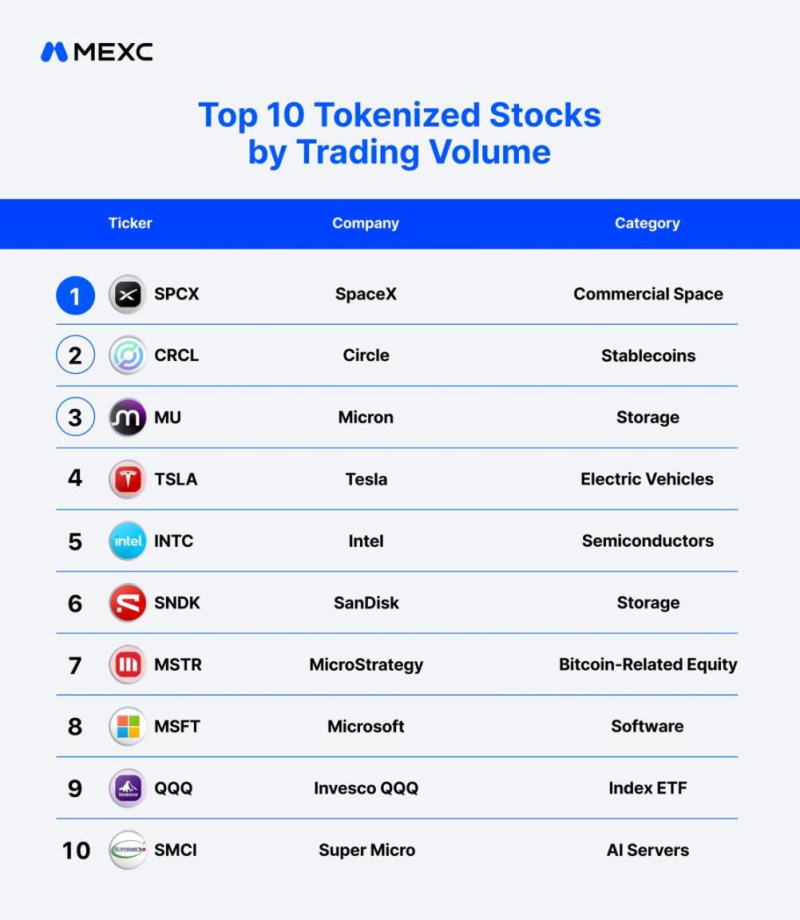
Unlike the more concentrated trading activity in Futures, spot-market activity was distributed across a broader range of themes. SpaceX (SPCX), the most actively traded tokenized stock, accounted for only 1.7% of tokenized-stock volume, while the top 10 instruments together represented less than 9%.
The top 10 covered nine categories: commercial space, stablecoins, storage, electric vehicles, semiconductors, Bitcoin-related equities, software, index ETFs, and AI servers. The distribution reflects more diversified trading demand in the spot market.
MEXC now offers a stock-related product suite spanning Pre-IPO Futures, Stock and Index Futures, tokenized stocks, and RealStocks. The platform provides more than 285 Stock and Index Futures, over 200 tokenized U.S. stock instruments, and access to more than 7,000 U.S. stocks and ETFs through RealStocks. Users can access these different forms of stock-related trading using USDT from a single account.
On August 8, MEXC launched its first annual brand campaign, MEXC 0808: Stock Season. During the campaign, users can trade Stock Futures, tokenized stocks, and RealStocks with 0 trading fees, alongside a total prize pool of $500,000. The campaign runs through August 28.
MEXC CEO Vugar Usi said, “Interest across the AI value chain and global equity markets is evolving at an unprecedented pace, as investors look beyond traditional asset boundaries for the next generation of opportunities. At MEXC, we believe access should evolve with them. By combining 0-fee trading, USDT settlement, two-way Futures, and broader asset coverage, we are reducing the friction of moving between markets and building a more connected trading experience where investors can discover opportunities, express conviction, and manage exposure from one platform.”
About MEXC
MEXC is the world’s fastest-growing cryptocurrency exchange, trusted by more than 40 million users across 170+ markets. Built on a user-first philosophy, MEXC offers industry-leading 0-fee trading and access to over 3,000 digital assets. As the Gateway to Infinite Opportunities, MEXC provides a single platform where users can easily trade cryptocurrencies alongside tokenized assets, including stocks, ETFs, commodities, and precious metals.
MEXC Official Website| X | Telegram |How to Sign Up on MEXC
MEXC PR team
media@mexc.com

Former Xero engineering executive Nigel Fernandes will lead Pepperstone’s push to own more of its technology as the business expands into crypto and new markets.
MELBOURNE, Australia, Aug. 13, 2026 /PRNewswire/ — Melbourne-based Pepperstone, a global online trading and fintech provider serving clients in more than 160 countries, today announced the appointment of Nigel Fernandes as Chief Technology Officer (CTO), effective 1 October 2026. The appointment comes as Pepperstone accelerates its shift toward owning more of its own technology, building a broader fintech ecosystem spanning crypto, AI-native engineering and institutional-grade infrastructure.
Fernandes brings more than 20 years of technology leadership experience across financial services, retail, media and enterprise software. He will join from Xero, where he serves as SVP and Executive General Manager of Engineering leading a global organisation across cloud platforms, customer identity and data. Prior to Xero, he held senior leadership roles at Publicis Sapient, Coles Group, SEEK and Envato.
“I’m excited to be joining Pepperstone at such a pivotal time for the business,” said Fernandes. “My focus will be building on the quality global brand that traders have trusted for years, investing in the technology we own to scale an AI-native engineering foundation that gives clients faster, more reliable access to the tools they need.”
“The technology underpinning our client experience is core to everything we do. We’re expanding Pepperstone into a genuine fintech ecosystem that opens access to crypto and new markets, while investing in our own technology to give clients a more personalised experience,” said Tamas Szabo, Group CEO of Pepperstone. “Nigel’s track record building high-performing engineering teams at some of the world’s best technology companies makes him the right leader to help us build that.”
As CTO, Fernandes will lead engineering, architecture, security and data globally, reporting to Group CEO Tamas Szabo. He will be based at Pepperstone’s global headquarters in Melbourne.
About Pepperstone
Pepperstone is a global fintech and CFD broker serving traders in more than 160 countries. The company provides access to forex, indices, commodities, shares, ETFs and digital asset markets through industry-leading platforms, competitive pricing and a strong regulatory framework.

An Australian Securities Exchange (ASX) shareholder plans to seek Federal Court permission to sue certain former ASX officers and directors over alleged breaches of duty connected to its failed blockchain-based clearing and settlement overhaul.
On Wednesday, ASX said Rosherville Pty Ltd had notified the exchange that it proposes to apply for leave to commence a statutory derivative action under sections 236 and 237 of Australia’s Corporations Act. If approved, Rosherville would bring the proceedings on ASX’s behalf.
The exchange said there were no allegations against ASX itself. It did not identify the former officials targeted, describe their alleged breaches in detail or disclose the remedies Rosherville intends to seek, while the court has not considered whether the proposed case can proceed.
The proposed lawsuit could test whether shareholders can hold former ASX leaders accountable for overseeing one of Australia’s costliest financial-technology failures.
ASX began exploring a replacement for its Clearing House Electronic Subregister System, or CHESS, in 2016 and selected a distributed-ledger system developed with New York-based Digital Asset. In December 2017, ASX was expected to become the first securities exchange to use blockchain for its core services.
The intended launch was repeatedly postponed. In November 2022, ASX paused the project after an Accenture review found significant problems with its design and ability to meet the exchange’s requirements. In May 2023, ASX had formally abandoned blockchain for the replacement and would consider more conventional technology.
Related: Australia orders Cryptolink Bitcoin ATMs offline over ‘basic reporting’ failures
The Australian Securities and Investments Commission (ASIC) sued ASX in August 2024, alleging it lacked a reasonable basis for telling the market in February 2022 that the project was “progressing well” and on track for an April 2023 launch. At the time, ASIC called the episode a collective failure by ASX’s board and senior executives.
In June 2026, ASX admitted to misleading conduct linked to the blockchain replacement project. On July 3, the Federal Court ordered the company to pay a $14.4 million penalty and $2.1 million toward ASIC’s costs, closing the regulator’s case weeks before Rosherville notified the exchange of its proposed action against former officials.
Magazine: Inside the fake crypto startup that fooled North Korean IT workers

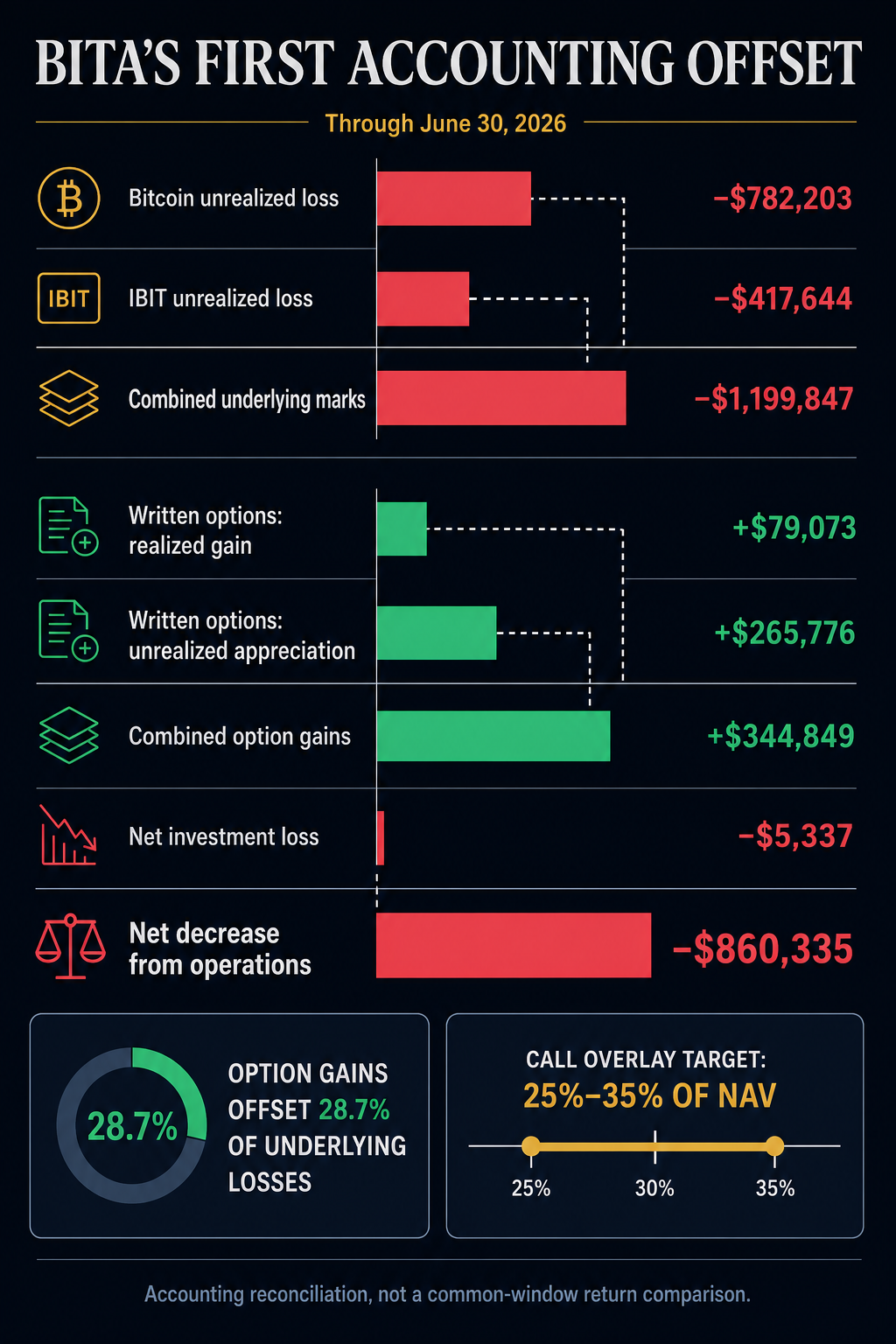
BlackRock’s iShares Bitcoin Premium Income ETF (BITA) recorded $79,073 of realized gains and $265,776 of unrealized appreciation on written options in its first operating period, helping offset losses on its Bitcoin holdings and shares of the iShares Bitcoin Trust ETF (IBIT).
BITA posted an $860,335 decrease in net assets from operations through June 30, its first quarterly filing shows. IBIT is BlackRock’s spot Bitcoin fund and one of BITA’s underlying investments.

BlackRock’s BITA recorded $782,203 of unrealized losses on Bitcoin and $417,644 on IBIT, for a combined $1,199,847. Its $344,849 of realized and unrealized option gains offset about 28.7% of those marks. A $5,337 net investment loss resulted in an overall decrease from operations of $860,335.
Comparative downside protection remains unmeasured because the performance figures use different windows.
BITA’s financial-statement NAV per share fell 3.08%, from $50 on the April 21 seed date to $48.46 on June 30. The filing separately says Bitcoin fell 4.43% and IBIT fell 4.75% from the fund’s initial purchases on June 9 through quarter-end.
A direct comparison requires one common start date, and the filing’s three metrics cover different periods. Its third figure is a negative 5.61% total return from the June 12 start of public trading through June 30.
The options entries show how the income strategy affected BITA’s accounts while Bitcoin and IBIT were falling. Relative performance over a common window remains unmeasured.
BITA’s prospectus targets written-call notional equal to 25% to 35% of NAV. Selling those calls produces premiums that can offset losses, and the covered holdings retain their downside exposure while surrendering gains above the options’ exercise prices.

A roughly three-week record is too short to establish how that trade-off behaves through a major drawdown, a rapid rebound or a full Bitcoin market cycle.
BITA ended June with $42.6 million in net assets, but capital contributions created that scale. The fund received $43.5 million as shares rose from 2,000 to 880,000, including 198,000 additional seed shares and 680,000 created shares.

A July 1 filing declared a $457,924.72 distribution for premiums or other income received from June 9 through June 30. That was $113,075.72 more than BITA’s combined GAAP option gains.
BITA’s first period shows that option gains can absorb part of an underlying loss inside the fund. The record remains too short to tell whether that relief compensates investors for the upside they surrender.

Circle National Trust custodies the backing, while published Bitcoin addresses and Chainlink Proof of Reserve provide onchain visibility; Arc support remains forthcoming.
Circle renewed its push for cirBTC as neutral institutional collateral in an Aug. 12 post, but the product is not a new launch. It has been live on Ethereum since June 8 and had only about 40 tokens outstanding at the time of review, compared with more than 116,000 WBTC and 97,000 cbBTC.
cirBTC exists onchain and can be minted and redeemed by eligible institutional participants, but distribution remains limited. An Etherscan page for the contract showed a maximum total supply of 40.01955869 cirBTC and 11 holder addresses. CoinGecko labels the asset “preview only” and says it is unavailable on the centralized and decentralized exchanges it tracks.
Circle says Circle Mint provides the institutional workflow for minting and redeeming cirBTC. Ethereum is currently the only live chain Circle identifies for the token; Arc is the next named deployment, with broader multichain support planned.
cirBTC is issued by Circle International Bermuda Limited, which Circle identifies as a Class F digital asset business regulated by the Bermuda Monetary Authority. The underlying bitcoin is held through Circle’s Bermuda affiliate and custodied by Circle National Trust for the exclusive benefit of cirBTC holders, according to Circle. The company describes Circle National Trust as a federally chartered national trust bank and qualified custodian supervised by the Office of the Comptroller of the Currency.
Circle’s June launch post also said the underlying BTC is segregated from the company’s corporate assets.
A Circle reserve dashboard timestamped Aug. 11 at 8 a.m. showed 40.02159077 cirBTC in supply against 42.5070808 BTC in reserves. The dashboard lists the BTC reserve addresses and their individual balances, allowing counterparties to inspect the holdings on the Bitcoin blockchain.
Circle says cirBTC uses Chainlink Proof of Reserve rather than a monthly attestation model. Chainlink describes the system as publishing verified reserve data onchain so users and protocols can monitor whether tokenized assets remain collateralized.
Circle’s neutrality claim is commercial rather than a claim of decentralized issuance. The company defines neutrality as not operating a competing centralized exchange, decentralized exchange or lending protocol. Minting and redemption run through Circle Mint, while Etherscan identifies the cirBTC token as a proxy contract.
CoinGecko put WBTC at 116,132 tokens in circulation and a $7.362 billion market capitalization at the time of review. Coinbase Wrapped BTC had 97,231 tokens in circulation and a $6.162 billion market capitalization.
The incumbents also have broader chain footprints. WBTC’s official site identifies Ethereum, Solana, Tron, BNB Chain, Base, Kava and Osmosis as native networks. CoinGecko lists cbBTC deployments on Ethereum, Base, Monad, Solana and Arbitrum.
cirBTC, by comparison, does not yet have a tracked CoinGecko price or market capitalization. For now, Ethereum is the only live chain Circle identifies, while Arc support is “coming soon,” subject to applicable regulatory approvals.

Key takeaways
Uniswap (UNI) faces intense selling pressure on Wednesday, falling nearly 9% after recording a 5% decline the previous day.
The pullback comes despite Uniswap’s continued product expansion, including the introduction of Continuous Clearing Auctions on Avalanche. The feature allows blockchain projects to conduct fully on-chain token auctions and establish initial liquidity through Uniswap v4.
However, declining social activity and derivatives demand suggest the launch has not been enough to offset the cryptocurrency market’s broader risk-averse mood.
Uniswap’s Continuous Clearing Auctions provide Avalanche developers with a new mechanism for launching tokens and bootstrapping liquidity onchain.
The model is designed to reduce friction during token distribution by allowing teams to conduct auctions transparently through smart contracts. Projects can then connect their newly distributed tokens with Uniswap v4 liquidity.
The launch expands Uniswap’s presence on Avalanche and strengthens its role as infrastructure for token issuance, trading and liquidity management.
It follows the recent launch of the TradePools platform on Robinhood, which allows users to deposit USDC, USDT or ETH in pursuit of yield.
While these developments may support Uniswap’s long-term utility, they have yet to produce a meaningful improvement in near-term demand for UNI.
Retail interest in Uniswap is weakening as traders prepare for the release of July’s US Consumer Price Index report, scheduled for Wednesday at approximately 12:30 GMT.
The CPI reading could influence the Federal Reserve’s next interest-rate decision and affect demand for risk assets. A hotter-than-expected report could strengthen expectations for tighter monetary policy, while softer inflation could improve sentiment across cryptocurrency markets.
Santiment data shows Uniswap’s social dominance fell to 0.08% on Tuesday from 0.19%. Social volume also declined to 40 from 152.
The sharp contraction indicates that UNI accounts for a smaller share of cryptocurrency discussions and is attracting less attention from retail traders.
Uniswap’s derivatives market reinforces the decline in retail participation.
CoinGlass data shows UNI futures open interest fell more than 3% over the past 24 hours to $261.60 million. The decline indicates traders are closing positions and reducing their leveraged exposure.
Long liquidations reached $2.88 million during the same period, significantly exceeding short liquidations of just $1,950. The imbalance shows that falling prices have disproportionately forced bullish traders out of their positions.
However, UNI’s open-interest-weighted funding rate improved to 0.0016% from negative 0.0054% the previous day.
The return to positive funding indicates that the remaining leveraged market carries a slight bullish bias. Still, falling open interest and heavy long liquidations suggest overall sentiment remains fragile.
Uniswap is testing its 100-day Exponential Moving Average at $3.55, an important near-term support level.
UNI remains below the 50-day EMA at $3.65 and the 200-day EMA at $3.93. These moving averages create overhead resistance and reinforce the prevailing bearish structure.
The Relative Strength Index has declined to 40, placing it below the neutral midpoint of 50 and indicating growing selling momentum. However, the indicator remains above the oversold threshold of 30.
The Moving Average Convergence Divergence indicator has also fallen below its signal line, while its expanding bearish profile suggests downside momentum is strengthening.
A decisive daily close below the 100-day EMA at $3.55 could extend Uniswap’s decline toward the 50% Fibonacci retracement level at $3.25. This level is measured from UNI’s advance between $2.31 and $4.57.

A successful defense of $3.55 could allow buyers to attempt a recovery. However, UNI must reclaim the 50-day EMA at $3.65 to ease immediate selling pressure.
Above that level, the 23.6% Fibonacci retracement at $3.89 and the 200-day EMA at $3.93 form a significant resistance cluster.
Until Uniswap recovers above these moving averages with stronger trading activity, the short-term outlook is likely to remain bearish.
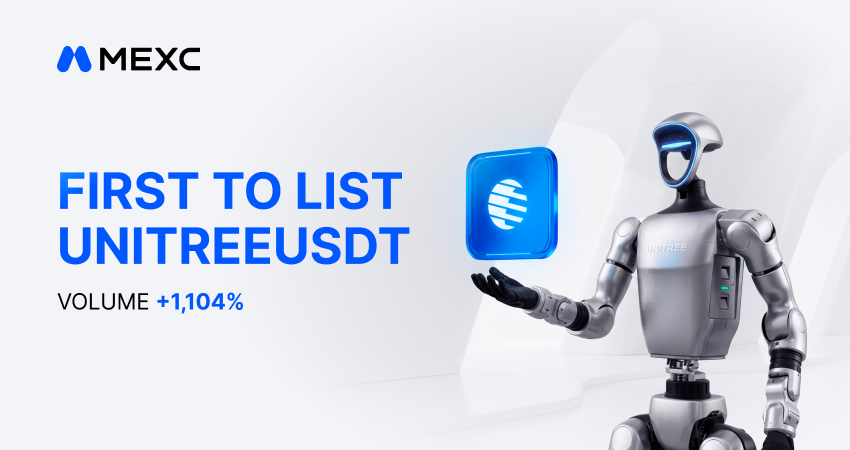
Mutsamudu, Comoros, August 12, 2026 –MEXC, a pioneer in 0-fee digital asset trading, has released interim trading data for its Asian AI Pre-IPO Futures. Daily trading volume for UNITREEUSDT rose by as much as 1,104% day over day following its launch, while KIMIUSDT recorded a 562% day-over-day increase in trading volume on its second day.
MEXC became the first centralized exchange to list UNITREEUSDT Pre-IPO Perpetual Futures on July 31, approximately 10 days before Unitree formally opened subscriptions for its STAR Market offering on August 10. The early listing gave eligible users a way to trade market expectations surrounding the company’s pre-listing valuation before the traditional allocation process began.
Unitree is a Chinese embodied-intelligence unicorn whose product portfolio includes humanoid and quadruped robots. Based on its offering price, the company is expected to have a post-listing market capitalization of approximately RMB 61 billion. Direct access through the conventional offering process, however, remained highly limited: the final online allocation rate was approximately 0.018%, and one successful lot required the purchase of 500 shares and a payment of about RMB 75,400.
Against this backdrop, UNITREEUSDT provides eligible users with an alternative route to trade expectations related to Unitree’s pre-listing valuation. Users do not need to wait for an IPO allocation result and can take either long or short positions based on their market view. As of August 9, the the contract was trading 64.44% above its launch price. The rapid increase in trading volume also reflects rising attention to both Unitree’s listing process and the broader embodied-intelligence sector.
Trading activity in UNITREEUSDT aligns with broader momentum across MEXC’s robotics segment. MEXC data for July showed that trading volume in robotics and automation futures increased 129% month over month, significantly outpacing the 64% overall increase recorded by Stock and Index Futures. Alongside continued market interest in chips and data storage, robotics and embodied intelligence are emerging as another major area of interest within AI-related asset trading.
MEXC expanded its Asian AI Pre-IPO coverage on August 6 with the launch of KIMIUSDT Pre-IPO Perpetual Futures, extending access from embodied intelligence to foundation models. The consecutive launches of UNITREEUSDT and KIMIUSDT allow users to trade pre-listing expectations across two core areas of Asia’s AI industry on a single platform.
Both contracts support 24/7 long and short trading with leverage of up to 25x. Maker and taker fees are 0.01% and 0.04%, respectively. MEXC also provides deep order-book liquidity and tight bid-ask spreads, enabling eligible users to participate with USDT without opening brokerage accounts in multiple markets. Beyond Asian AI companies, MEXC continues to expand its Pre-IPO Futures coverage across high-profile private companies. The platform has also introduced exclusive first listings for additional assets, including Londian Wason, broadening the range of global private-market expectations that users can trade.
MEXC CEO Vugar Usi said, “Asia is producing a new generation of globally competitive AI companies, yet global users still have limited tools to trade on related market expectations before these companies reach the public markets. The growth in UNITREEUSDT and KIMIUSDT trading demonstrates genuine demand for exposure to Asia’s frontier AI assets. MEXC will continue expanding its coverage of cutting-edge technology assets and provide global users with more timely and flexible cross-asset trading access, helping them capture infinite opportunities.”
About MEXC
MEXC is the world’s fastest-growing cryptocurrency exchange, trusted by more than 40 million users across 170+ markets. Built on a user-first philosophy, MEXC offers industry-leading 0-fee trading and access to over 3,000 digital assets. As the Gateway to Infinite Opportunities, MEXC provides a single platform where users can easily trade cryptocurrencies alongside tokenized assets, including stocks, ETFs, commodities, and precious metals.
MEXC Official Website| X | Telegram |How to Sign Up on MEXC
For media inquiries, please contact MEXC PR team: media@mexc.com


