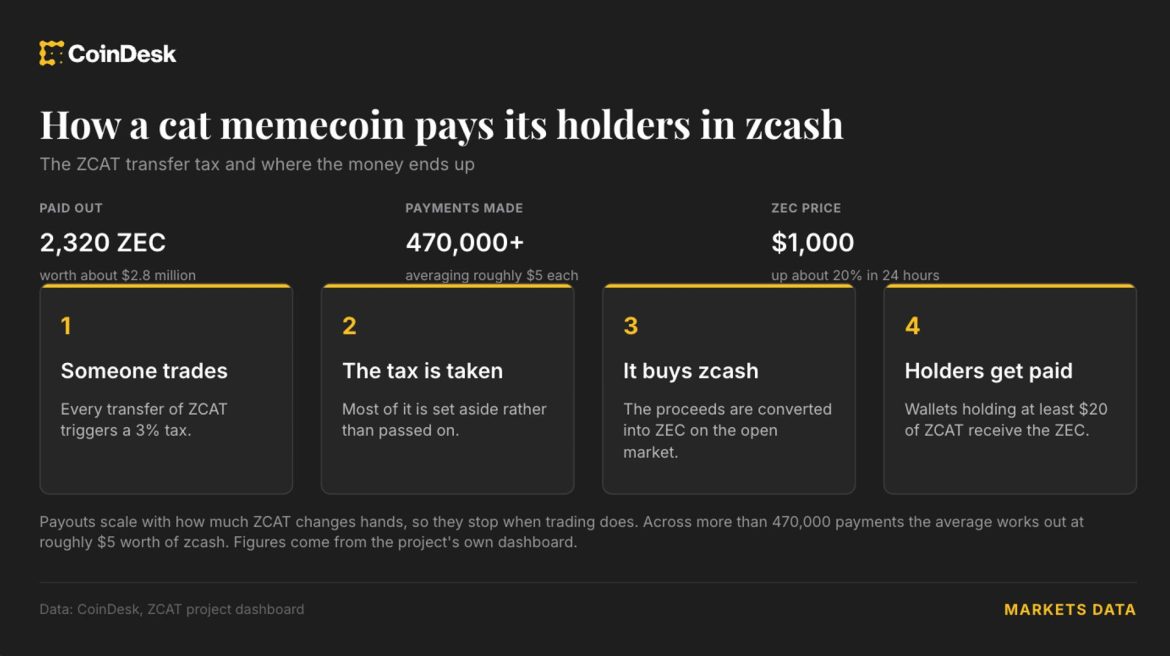
A brand new ZCAT token charges a 3% tax whenever the token moves and uses the proceeds to distribute ZEC to holders, creating an unusual link to one of crypto’s hottest assets.

 Live Chat

A brand new ZCAT token charges a 3% tax whenever the token moves and uses the proceeds to distribute ZEC to holders, creating an unusual link to one of crypto’s hottest assets.
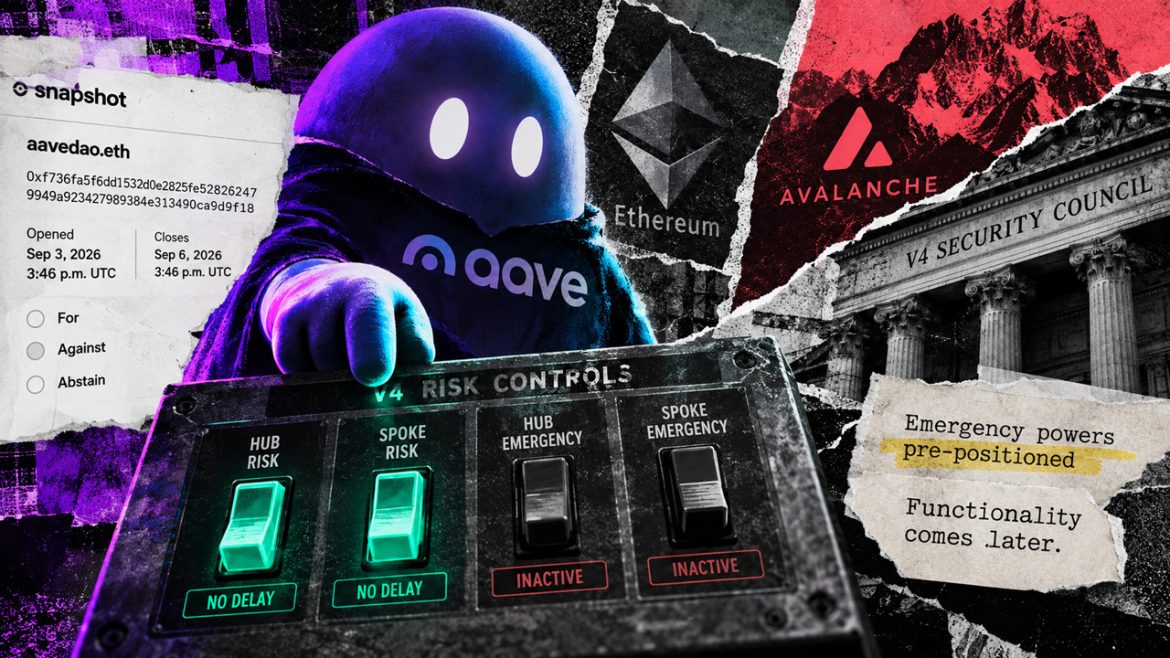
Aave DAO voters are deciding whether to delegate limited V4 risk controls on Ethereum and Avalanche to Risk Stewards, tools that let approved operators make constrained changes without taking every update through a full governance vote. The proposal would also assign no-delay emergency roles that the current steward software cannot use.
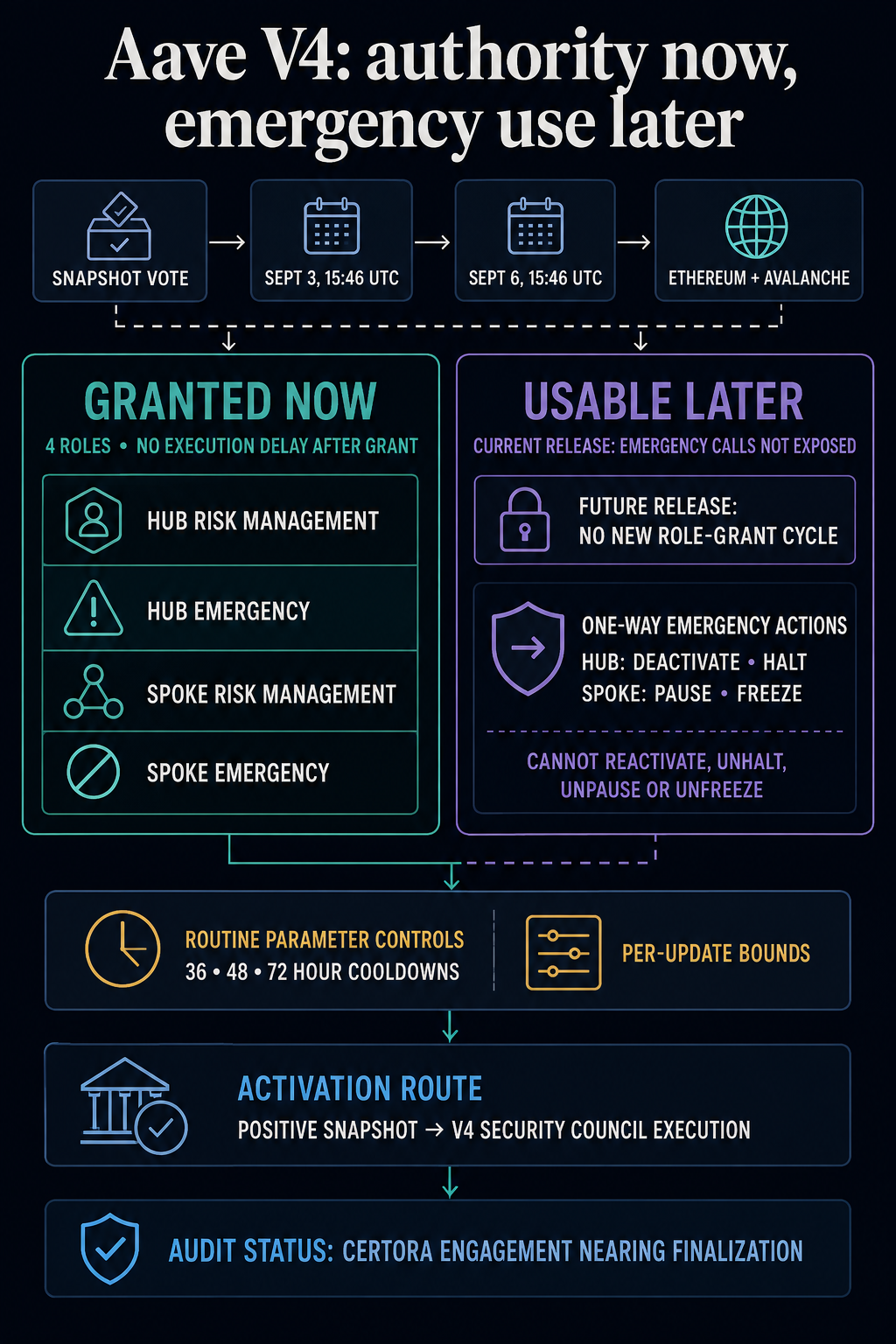
The Snapshot vote opened Sept. 3 at 3:46 p.m. UTC and is scheduled to close today, Sept. 6, at the same time. Approval would not activate the system by itself. Aave Labs said the corresponding payloads would still need to be executed through the V4 Security Council.
The code is also not being presented as fully audited. In its governance proposal, Aave Labs said the Risk Steward contracts were undergoing a Certora audit and that the engagement was nearing finalization.
The proposal’s central tension is between authority assigned now and functionality available later. Each Risk Steward would receive Hub and Spoke risk-management roles plus Hub and Spoke emergency roles. Those four roles would have no execution delay after they are granted.
However, the release under consideration calls none of the emergency selectors, and the current steward documentation does not expose those methods. The emergency permissions would remain inert until a future release adds support. Assigning the roles now would allow that later version to respond to an emergency without waiting through another governance cycle for access.
The wider permission redesign would split each V4 instance’s Hub and Spoke configurator controls into five granular categories: two flag-control roles, a listing role, an emergency role and a risk-management role. Selectors outside those categories would remain with residual domain-admin roles. Existing domain admins would receive the new roles so their current reach is preserved.
The proposed role definitions limit the emergency category to one-way safety actions. Hub calls can deactivate or halt assets and Spokes. Spoke calls can pause or freeze individual reserves or all reserves. Those functions cannot reactivate, unhalt, unpause or unfreeze the affected market. The separate flag-control roles, which can change states in both directions, would not be granted to the Risk Stewards.
Routine parameter updates would operate under different controls. The proposal sets minimum cooldowns of 36, 48 or 72 hours, depending on the parameter, and caps how far each update may move it. The same bounds would apply on Ethereum and Avalanche and cover interest-rate settings, collateral factors, liquidation settings and oracle caps. They do not constrain the emergency selectors.
That separation explains why the plan can combine slower bounded maintenance with immediate emergency authority on paper. It also creates an accountability question because the zero-delay roles would be in place before the steward can exercise them. Forum participants asked for public rationales, post-action reports, periodic reviews and reporting on the frequency and size of steward actions. None of those measures is a requirement in the current proposal.
If the Snapshot passes and the Security Council executes the payloads, the immediate change would be no-delay access to bounded parameter controls. The one-way emergency powers would be pre-positioned for a future steward release, but they would not yet be usable.
US-listed spot Bitcoin exchange-traded funds (ETFs) have recorded their strongest three-week inflow stretch of 2026 as Bitcoin traded around $80,000.
The funds attracted $986.9 million in the week ending Friday, bringing net inflows over the past three weeks to $3.8 billion, according to SoSoValue data.
Total net assets across the funds stood at $101.3 billion on Friday after briefly rising to $103.3 billion a day earlier, while cumulative net inflows reached $55.6 billion.
ETF demand marks a sharp turnaround from heavy outflows earlier in 2026, though year-to-date net flows remain roughly $1 billion negative.
US spot Bitcoin ETFs attracted $174.6 million in net inflows on Friday, down sharply from the nearly $731 million recorded a day earlier.
BlackRock’s iShares Bitcoin Trust (IBIT), the largest spot Bitcoin ETF by assets, drew $117.4 million on Friday, accounting for about 67% of the day’s total net inflows, according to Farside Investors data.
Daily spot Bitcoin ETF flows from Monday through Friday. Source: SoSoValue
Fidelity’s Wise Origin Bitcoin Fund (FBTC) was the only other fund to record net inflows, attracting $57.2 million, while all other US spot Bitcoin ETFs recorded no net flows for the day.
Related: Surprise nonfarm payrolls print sends Bitcoin back below 80K
The slowdown came as Bitcoin fell from around $81,200 to briefly below $79,000 on Friday. Bitcoin traded at $79,716 at the time of publication, still up about 2.6% over the past seven days, according to CoinGecko.
Compared with the previous week, Bitcoin ETF inflows increased about 7%, while inflows into US spot Ether and XRP ETFs fell about 74% and 83%, respectively.
Spot Ether ETF inflows dropped to $218.4 million from $824.4 million, while XRP ETF inflows declined to $19 million from $110.5 million, according to SoSoValue.
Despite weaker inflows, Ether and XRP ETFs remain in positive territory for the year. US spot Ether ETFs have recorded about $863 million in net inflows year-to-date, while XRP ETFs have attracted roughly $515 million.
Magazine: BTC will hit $1M by 2030… but Arthur Hayes is buying ETH instead


BitcoinBTC · USD
$79,962+0.53%
04:15 AM10:15 AM04:15 PM10:00 PM04:00 AM
$80.1k$79.9k$79.7k$79.5k
24h HighHigh$80,147
24h LowLow$79,459
VolVol$732.1M
Market projectionsOdds by Myriad
Start every day with the top news stories right now, plus original features, a podcast, videos and more.

Jessie A Ellis
Sep 05, 2026 10:18
PLTR is sitting at $175.10 with 61% of futures positioning stacked short — yet taker buy flow is winning on the tape right now. Either the $177 pivot gets reclaimed and this thing rips to $185+, or…
The chart is telling a split story, and how you read it determines whether you’re long or short into next week. Price at $175.10 is sitting beneath both the 7-day SMA at $179.07 and the 20-day SMA at $178.47 — that’s the immediate overhead wall. Momentum has gone completely flat; the MACD histogram has converged to zero, meaning the near-term bullish impulse that drove price up from the 50 SMA region at $158.94 has fully exhausted itself. Buyers and sellers are in a dead heat right now, and that stalemate won’t last.
The Bollinger Band picture reinforces the caution. At a %B of 0.34, PLTR is drifting in the lower third of its band range, well off the upper band ceiling at $189.04 and edging toward the lower band at $167.89. That’s not panic territory yet, but it’s not a setup that screams “buy the dip” without confirmation either. The RSI hovering just above 50 tells the same story — no directional conviction from the bulls despite a technically intact longer-term uptrend, with the 50-day SMA ($158.94) and the 200-day SMA ($143.70) both providing a wide structural cushion far below current price.
The daily ATR of $7.36 is worth watching closely. It means any decisive move — either a crack through $171.82 or a reclaim of the $180.27 resistance — will cover serious ground quickly, likely triggering stops and accelerating the move in whichever direction it breaks. As tracked across real-time market data aggregators including Blockchain.news, tokenized equity positions like PLTR trade around the clock, meaning those break points can trigger at any hour, not just during Wall Street’s 9:30–4:00 window.
Here’s where it gets genuinely interesting — and where the bears should be sweating. The derivatives market is screaming crowded short. Both retail traders (61.2% short) and top-tier whale accounts (61.3% short) are positioned on the same side of the book. That kind of alignment is rare, and historically it’s the setup that precedes violent, painful short squeezes rather than clean, orderly breakdowns.
And yet, look at what the actual tape is doing: the 1-hour taker buy/sell ratio is sitting at 1.28, with buyers outnumbering sellers nearly 1.3-to-1 in aggressive market orders. Someone is accumulating into this weakness while the short crowd piles on. Open interest jumped 8.77% in the past 24 hours — that’s not short covering, that’s fresh capital entering new positions. The neutral 0.0000% funding rate means there’s no funding cost punishing either side, so these short positions are sitting comfortable — for now.
The conflict is plain: positioning says down, but actual order flow says up. When those diverge this sharply, the resolution tends to be explosive. The 24-hour volume at roughly $22.1 million on Binance spot reflects a market that’s active but not yet at the fever pitch that typically accompanies a confirmed directional move. That changes the moment price touches a key level.
With no specific KOL calls or institutional analyst reports available in the verified data window, the fundamental narrative falls squarely back on what Palantir actually is: one of the most polarizing AI infrastructure plays in the US equity market. The company’s AI Platform (AIP) has been the engine driving its commercial segment growth, converting enterprise AI spending into recurring revenue in a way that few pure-play government-data companies have managed before. Government contract tailwinds — particularly from defense and intelligence agency procurement — remain the structural bedrock, and in an environment where AI defense spending isn’t slowing down, that foundation is hard to shake.
The bull case for PLTR has always rested on the compounding nature of its data moat, and that thesis hasn’t changed. Analysts who have been covering this name know that valuation remains the friction point — PLTR has never been cheap, and at elevated price levels, any macro wobble or earnings miss creates outsized drawdowns because there’s no valuation floor to catch it. The $175 range, sitting meaningfully above the 50-day and 200-day SMAs, implies the market is still pricing in significant forward growth, which means execution risk is front and center heading into the next earnings cycle.
For traders following the 24/7 tokenized market on platforms covered by Blockchain.news, the key distinction is that news drops — contract wins, earnings pre-announcements, Fed commentary — can hit PLTR’s price action in the middle of the night, bypassing the traditional pre-market buffer that equity traders use to position themselves.
Two clear scenarios dominate the next 7 to 30 days, and I’m giving the squeeze path higher probability right now — approximately 60/40 in favor of the upside scenario — based purely on the taker flow divergence from short positioning.
The Bull Squeeze Path (60% probability): Price reclaims the $177.00 pivot within the next 48–72 hours, likely triggered by a continuation of the aggressive buy flow or a macro catalyst from US equity markets. Once $177 flips to support, the $180.27 immediate resistance becomes the next magnet. With 61% of the book short, a sustained move through $180 doesn’t just test resistance — it forces stop-outs and margin calls on a crowded trade, launching price toward the $185.45 strong resistance level. In a full squeeze scenario with decent volume follow-through, the upper Bollinger Band at $189.04 comes into play within 2–3 weeks. Target zone: $185–$189 on a 14–21 day horizon.
The Bearish Flush Path (40% probability): If the $171.82 immediate support breaks on any real volume — a disappointing macro data print, sector rotation out of AI names, or simply exhausted buy-side flow — the next hard stop is $168.55. Below that, the Bollinger lower band at $167.89 is unlikely to hold given the velocity of a genuine breakdown. In that scenario, look for a possible flush toward the $160–$163 zone over 2–4 weeks before the 50-day SMA reasserts itself as structural support. The current 24h low of $173.72 is already testing near that first support cluster — this trigger is closer than most bears realize.
The single most important level to watch is $177.00. It’s not flashy, but it’s the pivot that determines whether PLTR shorts are heroes or kindling. Stay disciplined around that line. Position sizing matters here more than directional conviction given the $7.36 daily ATR — this name can hand you a full week’s expected move in a single session once it decides to break.
As reported across crypto-equity crossover markets on Blockchain.news, tokenized stock instruments like PLTR increasingly function as round-the-clock proxies for institutional sentiment on the underlying equity — meaning the price action you’re seeing right now at 10:16 UTC is the market’s real-time verdict on Palantir’s fundamental story, not a delayed echo of it.
Fundamental data, analyst ratings and price targets are sourced from Yahoo Finance as of September 05, 2026 and reflect consensus estimates, not investment advice.
Image source: Shutterstock

Polish lawmakers have again failed to secure the three-fifths majority needed to overturn President Karol Nawrocki’s veto of legislation aimed at strengthening oversight of the country’s crypto market.
The Sejm, Poland’s lower house of parliament, on Friday voted 241-198 in favor of overriding the veto, with three abstentions, falling 25 votes short of the 266 needed.
The vote was yet another attempt to advance Poland’s crypto market rules after President Karol Nawrocki vetoed crypto legislation three times, arguing that the proposed rules would overregulate the industry.
The regulatory dispute comes amid a deepening scandal involving defunct crypto exchange Zondacrypto, with its Estonian operator declared bankrupt and Prime Minister Donald Tusk citing an expanding criminal investigation to push for tighter crypto oversight.
The vetoed legislation was designed to establish Poland’s national framework for applying the European Union’s Markets in Crypto-Assets Regulation (MiCA), including placing oversight of the crypto market under the Polish Financial Supervision Authority (KNF).
KNF said Friday that the country still lacks a designated authority responsible for supervising the cryptoasset market, despite MiCA already applying across the European Union.
Nawrocki has said he supports crypto regulation but argues that Poland’s proposed rules go too far, citing concerns over regulatory costs and authorities’ powers to block websites.
Ahead of Friday’s vote, Tusk disclosed excerpts from what he said was testimony by a key witness in the Zondacrypto investigation, alleging payments and attempts to influence politicians linked to Poland’s previous government.
Tusk said the witness alleged a 2 million Polish zloty ($550,000) payment arrangement involving a foundation linked to former Justice Minister Zbigniew Ziobro. In separate testimony cited by Tusk, the witness alleged that an unnamed person had promised to secure a presidential pardon if the witness was convicted.
Related: Polish Olympic chief charged in Zondacrypto probe, justice minister says
Polish prosecutors are investigating suspected fraud and money laundering connected to Zondacrypto. In July, they merged the case with a probe into the 2022 disappearance of Sylwester Suszek, founder of BitBay, which was later renamed Zondacrypto.
Prosecutors in April said losses linked to Zondacrypto were estimated at no less than 350 million Polish zlotys ($95 million).
Zondacrypto’s operator, BB Trade Estonia, was officially declared bankrupt by an Estonian court in August, with the first creditors’ meeting scheduled for Sept. 17.
Magazine: MiCA is coming for DeFi vaults, but regulation will be difficult

Key points:
According to data released on Friday, the US economy added 162,000 nonfarm payroll jobs in August, significantly outperforming economists’ consensus expectations of roughly 56,000 jobs. In response to the announcement, Bitcoin (BTC) sold off from $81,300 to local lows of $78,600. At the time of writing it stands at $79,500.
Recent economic data carries added weight, given how divided rate outlooks remain ahead of the next Federal Open Market Committee (FOMC) meeting on Sept. 15-16. Under previous Federal Reserve chairs, expectations ahead of the FOMC were mostly well-anchored. However, the lack of forward guidance from Chair Kevin Warsh, along with potential dissenters in the committee, has resulted in added uncertainty.
After Fed Governor Christopher Waller said on Thursday that he would favor a rate pause pending upcoming inflation data, Polymarket probabilities swung to 60% in favor of a pause and 40% for a 25 basis-point interest rate hike. Friday’s labor market data however, drove the implied probabilities back to a 50/50 split.
Implied Probabilities for the Sep. 16 FOMC rate decision. Source: Polymarket
In response to the strong labor market data, US President Donald Trump leveled new rate-cut demands. “The Fed Board, with its great new leader, must get smart – BE PATRIOTS for a change,” he stated in a Truth Social post and continued: “High interest rates put the U.S.A. at a very unfair disadvantage, and I won’t allow that to happen!”
Trump had frequently criticized former Chair Jerome Powell for not cutting rates, but had held back from making similar statements toward Warsh until Friday.
When the BIP-110 soft fork activated on Aug. 7, the Bitcoin network briefly split into two competing chains: one enforcing BIP-110’s new rules and another continuing under the existing rules. The BIP-110 side largely stalled because miners did not devote enough computing power to extending that chain.
BIP-110 supporters viewed miners’ refusal to follow the user-activated soft fork (UASF) as evidence that Bitcoin’s mining layer has become too centralized. That criticism was sharpened by the absence of an organized counter-effort from the Bitcoin Core side, such as a user-rejected soft fork (URSF). Only five mining pools control the vast majority of Bitcoin’s hashrate, concentrating significant influence over which chain is extended and which transactions are included in blocks.
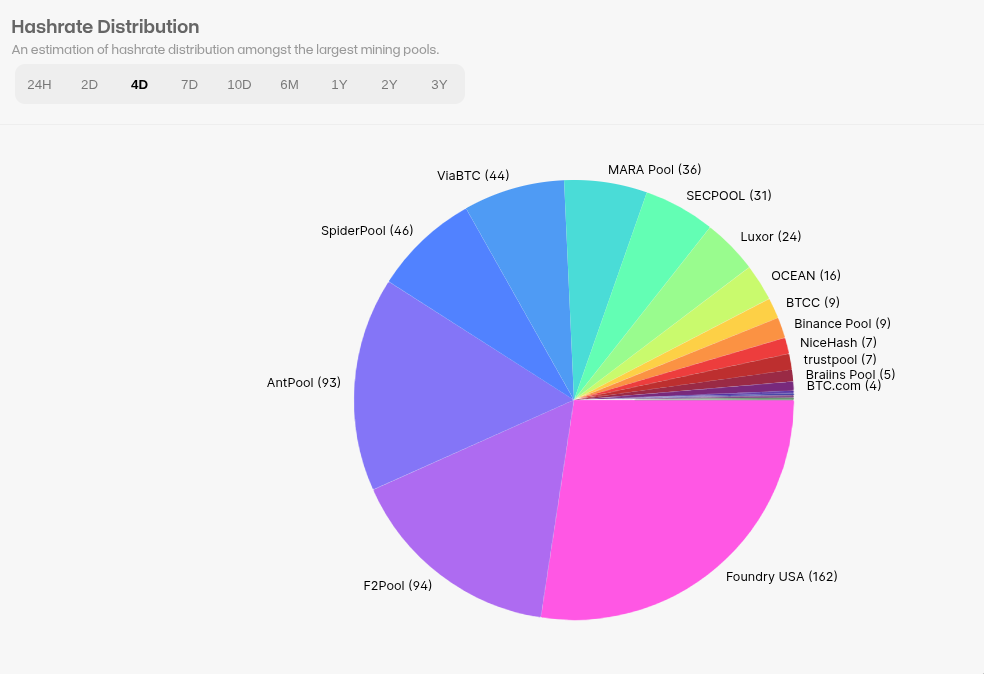
Bitcoin Network Hashrate Distribution. Source: Blockchain.com
In response, a subset of BIP-110 supporters, led by LukeDashjr, decided to continue the BIP-110 chain with a change in the proof-of-work algorithm to Blake2b to allow for a new, more decentralized set of miners to emerge using DATUM gateway technology. The corresponding hard fork was initiated on Aug. 30. Every address that held SHA-256 Bitcoin before Aug. 7 (and possibly after) will hold an equivalent amount on the Blake2b version of Bitcoin. So far, the only exchange listing Blake2b Bitcoin is Neoxa. While liquidity remains thin, Blake2b coins are currently trading at $350 against USDC with a 1.1% spread.
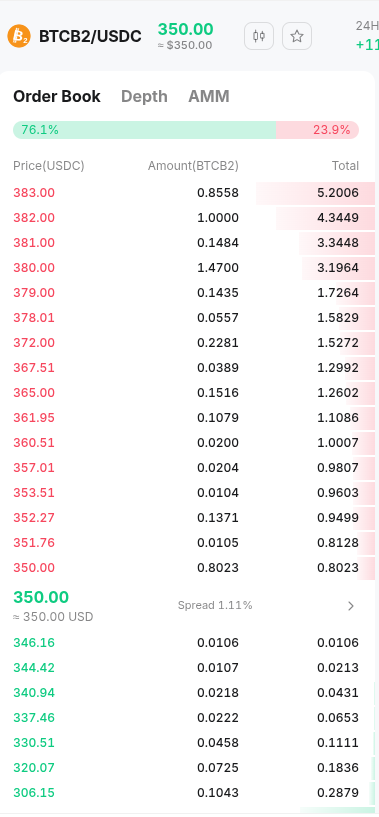
BTCB2/USDC orderbook. Source: Neoxa Exchange
Related: Crypto Biz: AI took a back seat when Bitcoin started climbing

Post-quantum infrastructure company QuFi Network has launched a verification platform designed to protect digital assets against future quantum computing threats without requiring changes to existing blockchain settlement networks.
The platform separates verification from settlement, using a decentralized network of nodes to validate transactions with post-quantum cryptography before they are settled on existing blockchain networks.
QuFi also launched uBTC, a proof-of-concept that applies the verification system to Bitcoin (BTC) and is currently operating on Bitcoin Testnet4. The uBTC system verifies BTC collateral and generates cryptographic proofs governing how value moves between settlement environments, while redemptions ultimately settle as standard Bitcoin transactions.
The platform uses three post-quantum cryptographic standards — ML-DSA-65, SLH-DSA and ML-KEM-1024 — for digital signatures and secure key exchange.
QuFi said the external verification layer is intended to avoid the added storage, bandwidth and computing demands that can come with adopting larger post-quantum signatures directly on individual blockchains.
Related: Crypto’s first quantum attack will look like unexplained breach: Quantus founder
The platform arrives amid a series of recent efforts to prepare blockchain networks for potential quantum computing threats.
In August, StarkWare tested a quantum-resistant Bitcoin transaction on mainnet without requiring a fork. However, the transaction took hours of computation and cost roughly $150 to $200, and its nonstandard format required direct submission to a miner.
Jonas Nick announces the BIP SHRINCS proposal on Aug. 26. Source: Jonas Nick
The same month, banks and regulators across Europe, the Middle East and Asia joined a pilot testing post-quantum wallets and onchain transfers using ML-DSA-65, one of the same cryptographic standards incorporated into QuFi’s platform. Meanwhile, the Ethereum Foundation dropped the Poseidon hash function from its planned post-quantum architecture in favor of established alternatives such as SHA or BLAKE.
Bitcoin developers are also exploring protocol-level defenses. In August, Blockstream researchers published a Bitcoin Improvement Proposal for SHRINCS, an experimental post-quantum signature scheme designed to reduce the size and performance costs associated with quantum-resistant signatures.
The approach comes with trade-offs. SHRINCS uses stateful signatures to reduce their size, requiring wallets to track previously used signing keys. The scheme remains in an early stage without a completed security proof, and its design adds complexity and potential user failure modes.
Magazine: Bitcoin’s new quantum defenses, 18.9M SOL cancelled: Hodler’s Digest

Crypto’s August rally put corporate conviction to the test. Bitcoin (BTC) miners that spent much of the crypto downturn courting AI investors are once again trading like leveraged bets on BTC, while Strategy and Strive are adding thousands more Bitcoin to their balance sheets.
The same concentration is playing out elsewhere. Bitmine is closing in on owning 5% of Ether’s (ETH) circulating supply despite billions in unrealized losses, while 21 major financial institutions are taking a different approach by developing stablecoins for payments and settlement.
Bitcoin’s August rally lifted beaten-down mining stocks by as much as 67%, reversing a trend that had favored miners pivoting to AI and underscoring the sector’s continued sensitivity to BTC market conditions.
BlocksBridge Consulting reported in a recent newsletter that Bitcoin’s roughly 23% rally in late August outpaced most AI-linked infrastructure stocks. Canaan, American Bitcoin and Cango gained between 41% and 67%, compared with about 21% for CoreWeave, 17% for Nebius and 15% for IREN. Meanwhile, some miners with greater exposure to AI and high-performance computing were flat or declined.
BlocksBridge cited three catalysts for the rally: an expansion of US Treasury liquidity-supporting buybacks, renewed regulatory optimism following a White House crypto meeting and a sharp short squeeze that liquidated more than $1.6 billion in positions.
The outperformance suggests investors may once again be rewarding direct Bitcoin exposure, although the sector still faces risks from the high costs of building out AI data-center capacity.
Strive and Strategy added billions of dollars’ worth of Bitcoin to their corporate treasuries in the final week of August, with Strive buying 1,800 BTC for approximately $143 million and Strategy acquiring another 4,603 BTC.
Strive’s purchases between Aug. 24 and Aug. 28 lifted its holdings to 23,156 BTC, making it the fifth-largest publicly traded corporate Bitcoin holder. The company paid an average of $79,431 per BTC, including fees and expenses, after buying 1,110 BTC the prior week at an average price of $73,409.
Strategy, meanwhile, resumed buying, acquiring 4,603 BTC at an average price of $80,318 and lifting its holdings above 845,000 BTC after four sales since May.
The purchases coincided with a broader digital asset recovery that began Aug. 19, after the US Treasury announced plans to double certain long-term bond buybacks.
A consortium of 21 major financial institutions, including Bank of America, Goldman Sachs and Citi, plans to establish a new company to develop and issue stablecoins, marking another sign of traditional finance’s push into digital dollars as regulatory frameworks take shape.
The group intends to launch a US dollar-denominated stablecoin in the first half of 2027 before expanding to other G7 currencies, with a euro offering next. The stablecoin will target wholesale, institutional and retail markets for cross-border payments and digital asset settlement.
The venture builds on an initiative announced last October by 10 banks exploring a 1:1 reserve-backed digital money on public blockchains. The consortium now spans North America, Europe, East Asia, the Middle East and Africa, and intends to comply with both the US GENIUS Act and the EU’s MiCA regulation.
Bitmine has extended its Ether buying streak to 65 consecutive weeks, adding 53,501 ETH last week as a broader crypto market recovery lifted the value of its digital asset portfolio.
The latest purchase brought Bitmain’s holdings to more than 5.9 million ETH, valued at roughly $14.8 billion based on an Ether price of $2,511 as of Sunday. The company now owns 4.9% of Ethereum’s 120.7 million circulating supply, putting it within striking distance of its stated 5% goal.
Bitmine chairman Tom Lee said Ether, Bitcoin and Solana have been the three best-performing major assets since June 30, with ETH leading gains.
“We believe this sets the stage for institutions to add to their crypto holdings given the substantial outperformance versus other macro assets,” Lee said.
Despite the accumulation, Bitmine is sitting on roughly $5.1 billion in unrealized losses on its Ether holdings, according to DropsTab data, reflecting sustained buying through the downturn that began in late 2022.
Crypto Biz is your weekly pulse on the business behind blockchain and crypto, delivered directly to your inbox every Thursday.

Toronto, Canada, September 4th, 2026, Chainwire
CoinRabbit has been named Best Crypto Lending Platform 2026 by International Business Magazine, highlighting a lending product that has issued more than $1.45 billion in loans since 2020.
About the International Business Magazine Award
The International Business Magazine Awards recognize companies and executives making a significant impact across global industries. The selection process combines public nominations with jury review, with nominees assessed on their work, progress, and contribution to their respective industries.
For CoinRabbit, the award comes at an important stage in the company’s development. It is moving beyond borrowing against crypto and building a broader ecosystem for managing digital-asset capital.
Why CoinRabbit Was Named the Best Crypto Lending Platform
The Best Crypto Lending Platform 2026 award recognizes the work CoinRabbit has put into its ecosystem. The platform provides borrowers with fast access to liquidity and confidence that their funds remain secure. CoinRabbit maintains a clear no-rehypothecation policy, giving clients greater certainty that their collateral is not being reused or lent out elsewhere.
That focus on a predictable borrowing experience has remained central as CoinRabbit has expanded the product. There is no traditional credit check because crypto collateral does the underwriting, and the lending process takes about 10 minutes whether a client is borrowing a few hundred dollars or managing a six-figure position.
The award jury also highlighted CoinRabbit’s Private Program as a high-touch approach for clients with significant balances. Designed for portfolios of $500,000 and above, it offers a more personalized way to manage assets around each client’s financial goals, liquidity needs, and timing. As part of CoinRabbit’s broader digital-asset ecosystem, the program gives clients a more private banking-style experience.
Capital Preservation at the Core
CoinRabbit is expanding into capital management, but lending remains at the core of the business. By giving clients access to liquidity without a need to sell their crypto, it helps preserve capital and keep assets invested for the long term.
Walter Barrett, Chief Strategy & Growth Officer at CoinRabbit, commented:
“We’ve spent years building and refining the product, and it’s rewarding to see that work recognized. At the same time, CoinRabbit is becoming more than just a lending platform. With the Private Program, we’re bringing a private credit approach to managing crypto. Clients can work directly with a success manager to find the right strategy for their needs, with a more tailored way to build crypto capital. We also continue to improve the core lending product, keeping it simple. For us, the goal is to make both sides of the business stronger as we grow.”
As CoinRabbit evolves, capital preservation remains a central idea behind the company’s products and services.
About CoinRabbit
CoinRabbit is a crypto asset management platform built for long-term capital preservation. It provides flexible liquidity management across multiple environments. Instant payments and lending, yield and trading products, and also the Private Program are available from a single platform. Since 2020, CoinRabbit has maintained a 100% capital reserve model, ensuring that client assets are fully reserved and never rehypothecated.
CoinRabbit
marketing@coinrabbit.io


