“Given everything happening with safety, right now would be an ill-advised moment to go public,” OpenAI CEO Sam Altman told Fortune.


 Live Chat

“Given everything happening with safety, right now would be an ill-advised moment to go public,” OpenAI CEO Sam Altman told Fortune.

Binance’s Changpeng Zhao predicted IPOs will move on-chain. However, this is pointing to a shift that’s already underway industry wide. Experts argue synthetic and wrapped products won’t carry the industry forward; real issuance will happen on-chain from day one.
Earlier this week, co-founder and former CEO of prominent cryptocurrency exchange Binance, Changpeng Zhao (CZ) released a bold statement on Twitter that took the cryptocurrency industry by storm: “IPOs will move onchain”.
An initial public offering (IPO) is the process by which private companies go public on the stock market for the first time, typically through a stock exchange. Moving that process on-chain would mean companies issue and settle their shares on a blockchain.
However, this is not an entirely new phenomenon. French aerospace and defence supplier ST Group completed a tokenized IPO through Paris-based Lightning Stock Exchange in April, and Hyperliquid experimented with the launch of a pre-IPO for SpaceX in May.
“What CZ is probably pointing towards is the idea that, eventually, the IPO process itself becomes on-chain rather than taking place through the traditional infrastructure and being tokenized afterwards. And that is the big change,” Albert Castellana, co-founder and CEO of GenLayer Labs, told DeFi Rate.
According to experts, what the industry has seen so far in the on-chain IPO space were wrappers around companies that already listed through a stock exchange. Moving the process completely on-chain, as per CZ’s remarks, would also bring the listing of shares and records on-chain.
France did that in April, the DTCC ran live production tests in July, and the New York Stock Exchange filed for a rule change to trade tokenized shares inside the existing system. Coinbase also launched tokenized stocks through its Ethereum Layer2 network, Base, in August, held one-for-one in custody rather than issued natively on-chain.
Vivek Raman, the co-founder and CEO of Etherealize, a company that connects the traditional finance industry with the Ethereum ecosystem, highlighted that synthetic and wrapped products will not carry the industry forward.
“The version worth building issues the asset on-chain at the point of creation, and that requires a network with real liquidity and credible neutrality underneath it.”
One of the biggest perks of moving any aspect of traditional finance (TradFi) on-chain is accessibility.
“You could potentially get 24/7 trading, fractional ownership, faster settlement and easier global participation,” Joshua Kim, the CEO and founder of DonaFi, said.
He added, however, that more notably, moving IPOs on-chain could also lead to higher interoperability – a big pain point in Web3, especially tokenization.
“… Shares could eventually interact with stablecoins, lending markets and other decentralized financial infrastructure instead of remaining stuck inside traditional brokerage systems.”
The accessibility argument is not limited to who can trade, as it extends to who can list their shares in the first place. In order to go public, companies must spend a lot of money on legal fees, accounting, and underwriting, which smaller companies often cannot afford to pay.
“A tokenized venue can afford to list a business that the traditional process prices out, and the French listing is the template,” Ryan Day, the CMO of Solstice Finance, said.
Ahead of its official Nasdaq listing, Hyperliquid launched synthetic pre-IPO perpetual futures for SpaceX, which allowed users to speculate on the company’s valuation before its public market debut.
The contract suffered a 45% flash crash on May 28, 2026, plunging from $2,277 to $1,254 and liquidating over $1.5 million in positions.
According to Etherealize’s Raman, the instance was related more to the instrument itself than to on-chain markets since the contract was a synthetic referencing a private company with no public price.
“Its mark depended on an off-chain data feed, and the feed mishandled a share split. Thin liquidity and leverage did the rest.”
SpaceX had run a five-for-one stock split to lower its per-share price and expand investor access, a routine event. However, the outside data provider feeding prices into the market got the per-share math wrong, which caused the quoted price to collapse.
GenLayer Labs’ Castellana framed this as a stress test.
“A blockchain can work perfectly and still produce the wrong outcome if the information coming into it is wrong,” he said, pointing to private companies, mergers, and stock splits as cases where “the answer has to be interpreted from real-world information” rather than read off a live price feed.
However, if IPOs were to move on-chain, how can we ensure the same problem does not arise?
“The answer is issuing the asset on-chain with a real registry behind it, so the ownership record itself is the source of truth. That requires a settlement layer with deep liquidity and credible neutrality that every counterparty is willing to hold positions on it,” Raman said, noting Ethereum could be a good solution for this.
The CLARITY Act still faces a procedural vote in the Senate, expected on September 15, and the US Securities and Exchange Commission (SEC) has announced its plans to modernize the rules and forms governing registered transfer agents.
According to Etherealize’s Raman, who previously testified in Congress on matters of crypto regulation in the US, the SEC’s own rulemaking on tokenization and market structure is the more immediate signal, alongside institutional adoption already moving forward under the GENIUS Act’s framework.
“What the market needs, as I told Congress in June 2025, is clear delineation of when an issuance triggers securities law, and registered ATSs and broker-dealers that can operate on blockchain rails.”
As the SEC moves towards clearer messaging, some players in the industry are already taking charge. ARK Investment Management applied to the SEC to record shares of its venture fund on a digital ledger, and BlackRock filed for tokenized share classes of its money market funds.
According to Solstice Finance’s Day, if these clear, “the first wave [will be] institutional, with verified investors trading through registered venues”. He added that retail will also enter this playing field once it is better established.
“Coinbase’s Brian Armstrong has argued the industry gets a workable rulebook either way, from the bill or from agency rulemaking. Either outcome beats the gray zone we have now.”
Yet, according to GenLayer Labs’ Castellana, noted that issues may arise once regulated assets start to sit on decentralized infrastructure.
“Regulators will obviously still care about disclosure, custody, investor protection, and who can own or trade particular securities. But once those assets live on open infrastructure, it becomes much harder to control everything people build around them.”

North Korea (DPRK) is now using remote workers from third countries, including Iran and Lebanon, to aid its efforts to infiltrate US companies and obtain money to fund its weapons programs, NBC reported on Friday.
An alert issued in July by the US government and several foreign agencies said North Korean IT workers “seek out contracts with the intent of remitting their salaries to their parent North Korean agencies. They also pose an insider threat to companies and are involved in data exfiltration, cryptocurrency theft, and theft of sensitive information.”
As the US and other governments have moved to counter North Korea’s efforts, the DPRK has turned increasingly to third-country IT workers to pass job interviews, the report said. After work contracts are obtained, the positions are usually taken over by North Korean operatives.
NBC reported that foreign IT workers had been scouted on LinkedIn, with some offered $500 monthly in cryptocurrency to work part-time as “interview associates.”
Related: Consensys unknowingly outsourced developer work to North Korean
The DPRK’s increasingly sophisticated tactics may be meeting with some success.
Cointelegraph reported in May, citing cybersecurity company CrowdStrike, that North Korean state-affiliated hackers and threat actors were responsible for more than $2 billion in crypto losses in 2025, a 51% year-on-year increase.
The Bank of Korea estimates North Korea’s GDP increased 3.5% in 2025 in spite of global sanctions.
Magazine: Bitcoin adoption metrics say one thing, price action says another

One hundred and three of the 125 largest non-stablecoin tokens were lower on the day after August producer prices came in at 0.4% and the 30-year Treasury yield passed every close of the past five years. Bitcoin traded at $77,120. Ether.fi rose 14.2% on a buyback vote that closed a week ago.
Almost every large crypto token fell through the overnight sessions and into Thursday’s U.S. open, as an oil shock drove long-dated Treasury yields to multi-year highs and traders raised the odds of a Federal Reserve rate increase next week to 64%.
Traders put a quarter-point September increase at 52.5% at 8 a.m. ET. The Bureau of Labor Statistics published August producer prices at 8:30 a.m. The same contract traded at 62.5% by 11 a.m. and 63.5% by early afternoon. Brent crude, up 11.7% in eight sessions, sits underneath both the inflation print and the yield move.
Bitcoin last changed hands at $77,120, down 2.1% over 24 hours and 5.1% over seven days, after trading between $76,748 and $78,774, CoinGecko data shows. Ether was at $2,448.88, down 1.9% on the day and 2.7% on the week. XRP fell 4.8% to $1.35; Solana declined 3.6% to $99.69; BNB dropped 4.4% to $708.37. Total crypto market value stood at $2.64 trillion on $94.2 billion of volume, with bitcoin dominance at 58.5%.
Brent crude traded at $106.83 a barrel on Thursday afternoon, up 5.6% on the day and its highest level since May 19. The contract has risen 11.7% since Sept. 2, when it settled at $95.63.
U.S. Central Command said on Sept. 8 that its forces “destroyed five Iranian crude oil carriers, Sept. 8, after the Islamic Revolutionary Guard Corps (IRGC) targeted a U.S. Navy warship with ballistic missiles twice over the past two days,” according to the command’s public release. The release names the M/T Kaviz, M/T Charminar, M/T Horizon 1, M/T Riesco and M/T Derya. It places four of the strikes in the Gulf of Oman and one near Kharg Island, and says crews were directed to abandon ship before the vessels were hit. It does not mention the Strait of Hormuz. A Sept. 5 release describes three earlier tanker strikes.
The U.S. Maritime Administration published advisory 2026-011 on Sept. 9, stating that “Iran continues to threaten and conduct strikes on commercial vessels transiting the Persian Gulf, Strait of Hormuz (SoH) and Gulf of Oman.” The advisory replaced 2026-004, which expired the same day, so it is a scheduled six-month renewal rather than a response to this week’s strikes.
The Energy Information Administration’s Weekly Petroleum Status Report for the week ending Sept. 4 publishes at 12 p.m. ET Thursday, delayed from Wednesday by the Sept. 7 federal holiday, according to the agency. The most recent report, for the week ending Aug. 28, recorded commercial crude inventories down 4.5 million barrels to 424.5 million. It predates both sets of strikes.
The Bureau of Labor Statistics reported that “the Producer Price Index for final demand moved up 0.4 percent in August, seasonally adjusted,” against 0.1% in July and a 0.1% decline in June, in its Sept. 10 release. Final demand prices rose 5.4% over 12 months. Core prices, excluding foods, energy and trade services, rose 0.3% on the month and 4.7% over the year.
“The figures reinforced concerns that inflation remains persistent, particularly given the combination of elevated oil prices and a labour market that has proved to be more robust than anticipated,” said Thadeu Dos Santos, regional director at brokerage Infinox, in commentary sent to The Defiant on Thursday morning.
Bond yields went with it. The 10-year Treasury yield reached 4.92% on Thursday, its highest since Oct. 25, 2023. The 30-year reached 5.34%, above every daily close of the past five years. Treasury’s official daily curve put the 10-year at 4.83% and the 30-year at 5.28% at Wednesday’s close, both the highest readings of the month.
Polymarket priced a quarter-point increase at the Sept. 15-16 FOMC meeting at 63.5% and no change at 36.5%, with a half-point or larger increase at 0.85% and a quarter-point cut at 0.35%, on $113 million of volume across the event. The quarter-point increase contract alone has traded $21.6 million. That contract was at 41.5% on Sept. 3 and first crossed 50% on Sept. 4. The Defiant reported on Aug. 31 that traders had made a September increase the favorite, when the same contract was at 55.5%.
The European Central Bank’s Governing Council “decided to raise the three key ECB interest rates by 25 basis points” on Thursday, taking the deposit facility to 2.50%, the main refinancing operations rate to 2.65% and the marginal lending facility to 2.90%, effective Sept. 16, according to the decision.
Equities and gold also fell. The S&P 500 traded at 7,606 on Thursday afternoon, down 0.4% from Wednesday’s close, and the Nasdaq Composite at 26,163, down 0.3%. Gold was at $4,405 an ounce, down 1.3%.
One hundred and three of the 125 largest non-stablecoin tokens fell over 24 hours, 21 rose and one was unchanged, measured from a single snapshot at 1:10 p.m. ET. The count excludes stablecoins, wrapped assets and liquid-staking derivatives.
The decline concentrated in the mid-caps. Bitcoin fell 2.1% and ether 1.9%, while each of the ten largest decliners among the 150 biggest tokens fell more than 10%.
DeFi total value locked declined 1.6% over 24 hours to $87.13 billion, DefiLlama data shows, from $88.54 billion on Wednesday. It is still 1.9% higher than a week ago. Stablecoin supply barely moved, at $311.83 billion against $311.98 billion on Wednesday, for a 0.37% gain over seven days and 1.67% over 30 days — about $1.2 billion of net issuance on the week, or 0.4% of supply.
The Crypto Fear & Greed Index read 69, or greed, on Thursday, up from 66 on Wednesday and down from 74 on Sept. 4, according to Alternative.me. The index has not left greed since Aug. 20.
U.S. spot bitcoin ETFs recorded $120.2 million of outflows on Wednesday and $46.6 million on Tuesday, according to Farside Investors. Thursday’s figures publish after the U.S. close. The two days follow $174.6 million of inflows on Sept. 4 and $730.8 million on Sept. 3.
Spot ether ETFs took in $2.1 million on Wednesday after $24.3 million of outflows on Tuesday. Neither complex traded Monday, a federal holiday.
| Token | Price | 24h | 7d |
|---|---|---|---|
| Ape and Pepe (APEPE) | $0.00000143 | +20.4% | +23.0% |
| Ether.fi (ETHFI) | $0.6920 | +14.2% | +15.5% |
| Falcon Finance (FF) | $0.1652 | +9.8% | +65.2% |
| Provenance Blockchain (HASH) | $0.008454 | +5.9% | +4.8% |
| Bitway (BTW) | $0.4755 | +5.8% | +0.8% |
| VeChain (VET) | $0.008010 | +4.1% | +16.3% |
The ether.fi DAO approved a proposal titled “Programmatic ETHFI Buybacks & Ecosystem Growth” in a Snapshot vote that opened Aug. 30 at 01:31 UTC and closed Sept. 3 at 01:31 UTC. It carried 1,141,999 votes for, none against and none abstaining, according to the proposal record. The text commits the foundation to buying ETHFI on a weekly cadence through automated TWAPs and states that “no new ETHFI is minted and circulating supply does not increase from this proposal.”
Ether.fi has not published an execution date. Its blog carries no post since Aug. 13. The buyback program page records no completed purchases and no schedule. Whether any ETHFI has been bought under the mandate is unverified.
Ether.fi’s total value locked fell to $4.87 billion on Thursday from $4.97 billion on Sept. 7, DefiLlama data shows, a 2% decline over three days. ETHFI gained 15.5% over the same week.
Falcon Finance’s FF has the widest gap between price and collateral on the list. Its total value locked has held within 0.1% of $1.176 billion since Aug. 28 while FF rose 65.2% over seven days. Falcon’s own news page carries nothing since Aug. 31.
VeChain’s chain TVL rose to $1.58 million on Thursday from $1.22 million on Sept. 5. Against a $688 million market value, the DeFi footprint is too small to account for the move. VeChain’s blog has published nothing since Aug. 6.
Ape and Pepe, the day’s largest gainer, turned over $16 million against a $301 million market value, a 5% ratio. No project announcement accompanied the move.
| Token | Price | 24h | 7d |
|---|---|---|---|
| Hunter Biden’s Laptop (LAPTOP) | $0.6088 | -64.9% | 0.0% |
| Pump.fun (PUMP) | $0.003828 | -20.1% | -14.6% |
| Pons (PONS) | $0.5862 | -17.1% | -1.3% |
| Starknet (STRK) | $0.028880 | -14.1% | +5.0% |
| Dash (DASH) | $55.75 | -13.5% | +17.4% |
| Bitcoin Cash (BCH) | $226.75 | -12.3% | -12.2% |
| Plasma (XPL) | $0.085590 | -11.8% | -8.5% |
| Jupiter (JUP) | $0.222724 | -11.3% | -5.4% |
| Zcash (ZEC) | $1,132.09 | -11.2% | +18.3% |
| Bonk (BONK) | $0.00000268 | -10.6% | -16.2% |
Hunter Biden’s LAPTOP fell for a second day, losing 64.9% over 24 hours to $0.6088 and a $212 million market value. The Defiant covered the token’s Sept. 9 launch.
Buyers outnumbered sellers as it fell. The three LAPTOP/USDC pools on Base recorded roughly 10,700 buys against 6,700 sells in the deepest pool and 13,200 against 10,400 in the smallest, on total pool liquidity of $1.33 million. The token’s site shows zero tokens burned and zero dollars sent to charity. It has published no statement since launch.
Pons was the third-largest decliner, five days after reaching a record $0.971 on Sept. 5. Pons said on Sept. 3 that Uniswap Labs had bought PONS “for long-term alignment,” without disclosing the size, price or wallet, which The Defiant reported. UNI fell 9.6% on Thursday alongside it. Pons’ homepage carries an undated notice that “we are upgrading the backend ahead of a new rollout” and that “launches and market data may load slowly or read out of date.”
Pump.fun’s revenue rose while its token fell. Daily fees reached $1.41 million on Wednesday, the highest since Sept. 1 and 10.9% above Tuesday, according to DefiLlama, as PUMP dropped 20.1%. The protocol let creators launch coins priced in tokenized stocks on Wednesday, which The Defiant covered, and the token has fallen through the announcement.
The privacy names that ran hardest gave back the most. Dash fell 13.5% while holding a 17.4% weekly gain built around DashCon 2026 on Sept. 3, its first conference since 2019. Zcash fell 11.2% against an 18.3% week. Monero, which did not run, fell 0.5%.
Bitcoin Cash and Uniswap have no token-specific catalyst. “Bitcoin Cash” appears in six filings on the SEC’s full-text search between Sept. 4 and Sept. 10, all fund prospectuses or corporate filings that mention the token in a list. None is an action on it. Uniswap’s blog has published nothing since Aug. 24 and its Snapshot space has carried no proposal since July 26. Its daily fees have run between $6.89 million and $8.29 million every day this month, and rose to $7.81 million on Wednesday from $7.43 million on Tuesday, DefiLlama data shows.
Prices and market data as of 1:10 p.m. ET on Sept. 10, 2026. CoinGecko’s aggregate 24-hour change in total crypto market value read -4.93% at the same moment, a figure inconsistent with its own component data, and is omitted.

In a post on Friday, Vlad Tenev said securities issuers should control shareholder rights, but not separate products that track their publicly traded shares.

Coinbase and Ledger Breaches
Start every day with the top news stories right now, plus original features, a podcast, videos and more.

Peter Zhang
Sep 11, 2026 22:12
Harvey’s new Contract Review Agents leverage AI to streamline legal workflows, improve contract outcomes, and adapt to real-world negotiation trends.
Harvey, an AI-driven legal technology company, has introduced Contract Review Agents, a new tool designed to help in-house legal teams review contracts with greater speed and precision. By integrating institutional knowledge such as past deals, negotiation guidelines, and team playbooks, these AI agents offer dynamic, data-informed recommendations for contract redlines and negotiations.
Unlike static playbooks, Harvey’s Contract Review Agents learn from both written and unwritten team practices. For example, the system can capture fallback clauses, liability caps, and deal-specific nuances—elements often missing from traditional contract review processes. The agents also adapt in real time, using completed deals to refine future recommendations and flag outdated standards.
Harvey’s agents go beyond merely spotting deviations from company guidelines. They benchmark redlines against previous deals, surfacing clause comparisons and citing specific precedents. This eliminates the need for manual searches when counterparties push back, a process that traditionally relies on memory or labor-intensive reviews of past agreements. By doing so, the system accelerates reviews while ensuring consistency and reducing risks.
For instance, if a counterparty proposes a term, the agent can instantly compare it to previously accepted terms, showing how it aligns with or diverges from past agreements. This feature provides legal teams with a clear, data-backed rationale for accepting or rejecting specific changes.
Contract Review Agents also address a common issue in legal teams: outdated playbooks. Negotiation positions often evolve faster than documented guidelines. Harvey’s system uses recent deal data to spot patterns, such as terms routinely accepted despite being flagged in reviews. When this happens, the agent recommends updates to the playbook, ensuring that future reviews focus on meaningful changes rather than outdated standards.
Harvey’s approach aligns with broader trends in the legal AI market. Tools like Google’s Gemini Enterprise and Thomson Reuters’ AI-driven contract software have also targeted inefficiencies in contract lifecycle management. However, Harvey’s emphasis on dynamic, adaptive agents that integrate institutional knowledge sets it apart.
The rise of AI in legal tech, particularly for contract review, reflects broader industry shifts. According to a March 2026 feature in the American Bar Association’s Law Practice Magazine, agentic AI systems can automate up to 70% of repetitive transactional tasks. These tools excel in structured workflows, such as NDAs, MSAs, and vendor agreements, where standardized documents and known risk positions dominate.
However, challenges remain. AI systems are not immune to errors like hallucinating legal conclusions or missing contextual nuances. Harvey mitigates these risks through human-in-the-loop deployment, where the agent provides recommendations but final decisions remain with legal professionals. This hybrid model ensures accuracy while maintaining the speed benefits of automation.
Harvey’s Contract Review Agents are currently available via an early access program. Legal teams interested in building customized agents can contact their Harvey account representatives to join the waitlist.
As legal AI adoption grows, tools like Harvey’s agents could redefine how contracts are reviewed and negotiated, particularly in high-volume transactional environments. By combining AI-driven insights with institutional knowledge, Harvey aims to not only streamline workflows but also improve the quality of negotiated outcomes over time.
Image source: Shutterstock

“A short-lived move toward $0.50 is plausible, but without a major listing or explosion in genuine usage, I don’t see it approaching $1,” ChatGPT stated.
Earlier this year, Pi Network’s native token surged to nearly $0.30 after Kraken allowed trading services with it. Since then, the asset has been in a steep downtrend and now trades around $0.09.
The big question is whether the price can rise above the $0.30 mark again before the end of 2026, or whether that was the maximum for this year. Here’s what three of the most widely used AI-powered chatbots think on the matter.
According to ChatGPT, PI can exceed $0.30 and spike to as high as $0.60 sometime this year, but such a major increase will depend on vital catalysts rather than speculation alone. OpenAI’s platform suggested potential positive factors include listings on leading crypto exchanges or a broader altcoin rally.
PI began trading at the start of 2025 and is available for trading on platforms like Bitget, Kraken, OKX, and others. However, the industry’s heavyweights Binance and Coinbase have not yet embraced the token. Recall that the former asked its community whether they want to see PI on the exchange, and the vast majority answered “yes.”
In conclusion, the chatbot suggested that PI’s highest price in 2026 will most likely be around $0.35-$0.45, with $0.42 set as a specific estimate.
“A short-lived move toward $0.50 is plausible, but without a major listing or explosion in genuine usage, I don’t see it approaching $1,” it added.
Google’s Gemini took a similar stance, saying a pump above $0.30 and a new local peak of $0.36 are possible “under favorable market conditions.” According to it, the main drivers include mainnet ecosystem expansion, real-world utility adoption, and broader bullish momentum across the entire crypto sector.
Perplexity was much more pessimistic, claiming that a new rise above $0.30 before the end of the year is highly unlikely. At the same time, it assumed that a solid resurgence may still occur given the upcoming protocol 27, which is about to be implemented on September 15. However, the team has not always met its deadlines, so delays remain a possibility.
X user Crypto With Gopal recently opined that PI is printing a double-bottom formation, with buyers defending the 0.08-$0.09 support zone and the price slowly building higher lows.
He believes a breakout above the $0.10-$0.12 range could ignite the next rally, saying bulls have shown signs of reclaiming control.

Pump.fun announced its new Custom Pairs feature on Sept. 9, letting new memecoins trade against tokenized stocks, major crypto assets, and other quote assets, expanding the familiar settlement menu beyond SOL and stablecoins.
If a meme trades against a tokenized stock, traders must acquire or supply that stock token to enter the market. Launchpads can become distribution rails for assets that already exist on-chain but still need reasons for people to hold and transact with them.
Retail speculation could perform the first job in a longer adoption process by creating transactions and inventory. Separate lending markets, collateral systems, and managed vaults can perform the next one by giving that inventory uses beyond trading.
Institutions could eventually interact with those products without touching the memecoin market that helped create the activity.
The causal bridge from meme trading to deeper lending liquidity or institutional use remains hypothetical, but moves such as Pump.fun’s Custom Pairs makes that potential connection timely enough to test.
| Platform / market | Date cited | What changed | Quote asset expansion | Evidence in article | Forward-looking implication |
|---|---|---|---|---|---|
| Pump.fun | Sept. 9 | Announced Custom Pairs for new memecoins | Tokenized stocks, major crypto assets, and other quote assets | New memecoins no longer need to trade only against SOL or stablecoins | Launchpads could become distribution rails for tokenized assets that need transactional demand |
| Raydium LaunchLab | Sept. 6 | Enabled a newly issued token to pair with any supported quote token | Any supported quote token on Raydium | LaunchOnSF named as first integration | Custom quote assets may become a category-wide feature across Solana launch venues |
| Robinhood Chain memecoin pairs | Sept. 2 | Memecoins traded against tokenized stock tokens | Tokenized stocks used as settlement assets | $217 million in trading volume on Sept. 2 | Retail speculation can create stock-token activity before deeper financial utility emerges |
| Hyperliquid / xStocks | Aug. 10 | Five tokenized stocks and ETFs launched as native spot markets | Tokenized stocks and ETFs | xStocks said future HyperEVM composability could include lending, collateral, and structured products | Tokenized assets may move from spot trading into programmable financial infrastructure |
Tokenization turns exposure to an equity, exchange-traded fund, or another real-world asset into a transferable blockchain token. Issuance alone doesn’t solve demand, market depth, or collateral utility.
In a market where a meme is quoted in a tokenized stock, the stock token becomes the settlement side of the trade. A buyer may want the meme rather than equity exposure, but entering the pair still creates transactional demand for the tokenized asset and puts more of it into wallets or pools.
Memecoin pairs using tokenized stock tokens on Robinhood Chain generated $217 million in trading volume on Sept. 2. That result shows activity but leaves persistence and migration into other financial products unresolved.
Raydium announced on Sept. 6 a newly issued token to pair with any supported quote token and named LaunchOnSF as the first integration.
The moves suggest custom quote assets are becoming a category feature, so a tokenized stock can become necessary inventory inside a market sought for an entirely different reason, broadening its route to users beyond deliberate equity exposure.
More transactions can spread that inventory across traders and pools, giving liquidity providers and market makers more opportunities to support the asset. Meanwhile, volume and wider distribution remain weak proxies for execution quality.
The next stage depends on whether protocols can safely use the token as collateral and whether borrowers and lenders show sustained demand.
In February, Ondo Finance said its SPYon and QQQon tokenized ETFs had entered Morpho lending markets on Ethereum.
A tokenized ETF begins as blockchain-based market exposure. Once accepted as collateral, it can support borrowing and other capital-efficient strategies without requiring the holder to sell that exposure.
Flowdesk, stablecoin issuer Agora, and xStocks announced a Morpho strategy that accepts the AUSD stablecoin and allocates capital to a market using tokenized S&P 500 exposure (SPYx) as collateral.
The vault opened with an $18 million cap, while Flowdesk handles curation, liquidity, and ongoing risk monitoring.
Morpho’s live interface listed over $6.3 million in deposits around Sept. 8 and Sept. 9 and identifies Limitless Frontier Corp. as the operator.
The balance shows real use while also noting the gap between available capacity and deposited capital.
| Stage | What happens | Article example | Main user created | Metric to watch | Unresolved risk |
|---|---|---|---|---|---|
| 1. Issuance | A tokenized stock, ETF, or other asset exists on-chain | Ondo tokenized ETFs; xStocks tokenized stocks and ETFs | Eligible holder | Minting and redemption activity | Asset exists but may lack organic demand |
| 2. Custom pair trading | A memecoin trades against the tokenized asset instead of SOL or stablecoins | Pump.fun Custom Pairs; Raydium LaunchLab | Retail trader | Pair volume, transaction count, wallet distribution | Volume may be temporary or speculative |
| 3. Liquidity provision | LPs and market makers hold both the meme asset and the tokenized quote asset | Stock-token meme pools on Robinhood Chain | LP / market maker | Pool depth, slippage, fee revenue | Inventory can grow without reliable price discovery |
| 4. Collateral market | The tokenized asset is accepted as collateral for borrowing | Ondo SPYon and QQQon entering Morpho lending markets | Borrower / lender | Borrow demand, loan-to-value ratios, liquidations | Oracle failure or thin exit liquidity can create lending losses |
| 5. Managed vault | A vault uses tokenized-asset collateral markets to generate yield | Flowdesk, Agora, and xStocks AUSD equity strategy vault on Morpho | Vault depositor | Deposits, cap utilization, risk parameters | Deposits may remain below capacity if demand is weak |
| 6. Institutional access | Professional users interact with structured products, collateral systems, or managed exposure | Flowdesk risk monitoring; HyperEVM future integrations | Institutional or professional participant | Liquidity durability, redemption reliability, compliance eligibility | Institutions may avoid assets without predictable entry and exit routes |
A meme trader may acquire a tokenized stock because it is the quote asset for a desired coin, while a liquidity provider may hold both sides of the pair to earn fees.
At the same time, a borrower may keep the stock token for its market exposure while using it as collateral, a vault depositor may care about the yield generated by borrowing demand, and a professional risk manager may focus on caps, oracles, and liquidation routes.
That progression explains how retail speculation could reach institutional infrastructure without requiring institutions to trade memes. Different groups can use the same underlying inventory through different products.
On Aug. 10, xStocks launched five tokenized stocks and ETFs as native spot markets on Hyperliquid’s HyperCore order books. It said full composability on HyperEVM, Hyperliquid’s smart-contract environment, would follow and could include lending, collateral, and structured-product integrations.
If custom pairs spread across launchpads and chains, they could repeatedly introduce tokenized assets to traders and liquidity providers. A broader base of transactions and inventory could make new lending markets, portfolio collateral, and managed strategies more attractive to build. Added utility could then create another reason to acquire the asset.
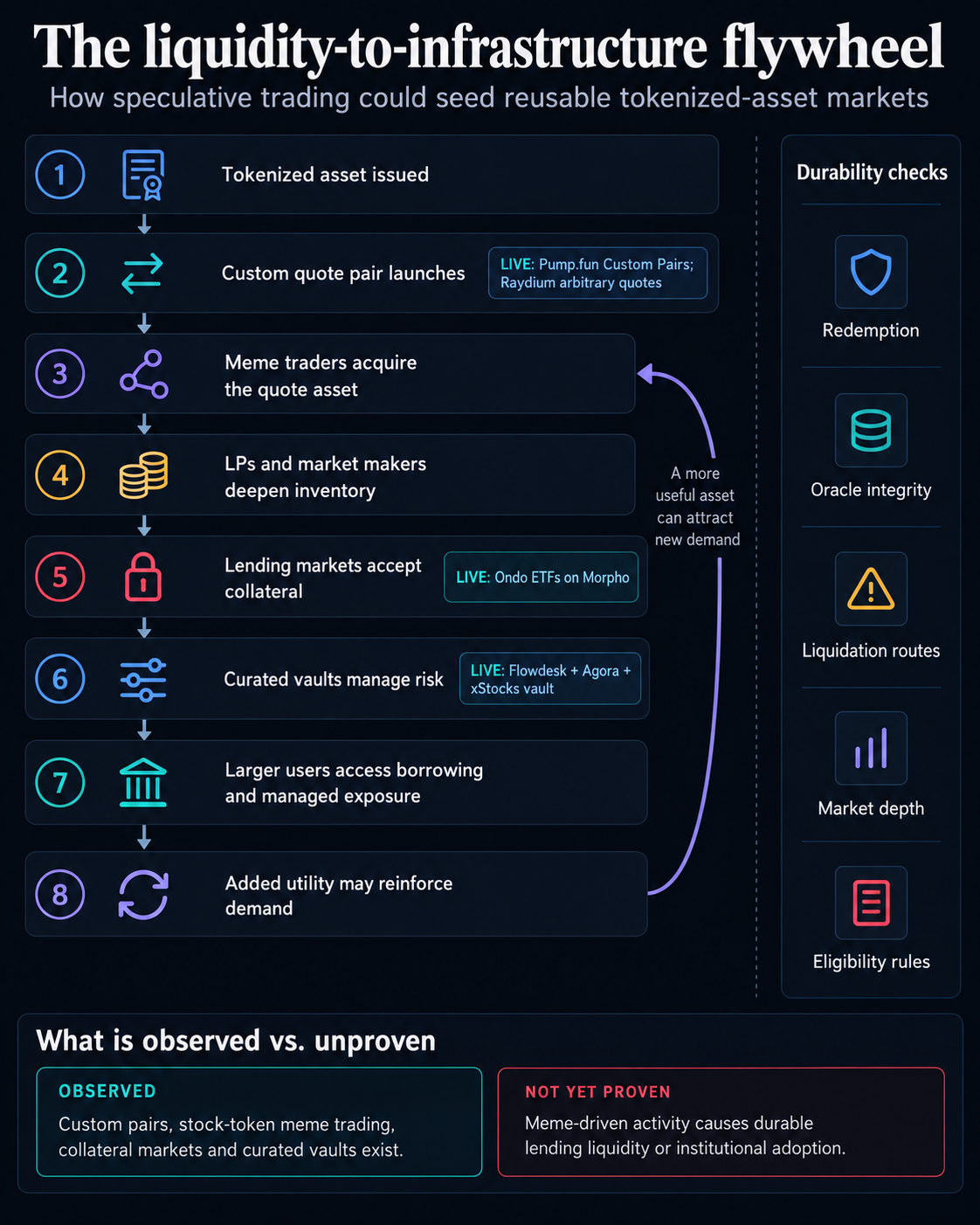
Transaction counts remain an incomplete measure of liquidity depth, pricing reliability, and holder stability. A tokenized asset also needs dependable minting and redemption, clear legal and eligibility rules, robust price feeds, predictable liquidation mechanics, and enough market depth for lenders to exit collateral without disorderly losses.
Ondo’s tokenized-stock framework connects eligible users to minting and redemption against underlying market exposure, subject to geographic and onboarding restrictions. Gauntlet and Flowdesk add collateral parameters, caps, monitoring, and liquidation design around specific lending products.
If the quote asset is thin, a fast meme rally can produce inventory without producing trustworthy price discovery. If redemption is limited or an oracle fails during volatile trading, lenders face risks that no amount of trade count can offset.
Institutional users need predictable routes into and out of positions alongside visible activity.
| Durability check | Why it matters | What strong evidence would look like | Failure mode | Article example |
|---|---|---|---|---|
| Persistent liquidity | Lending and vault products need more than one-day trading spikes | Sustained depth across pools, order books, and lending markets | Meme activity fades and liquidity disappears | Robinhood Chain stock-token meme pairs produced $217 million in volume on Sept. 2, but persistence remains unresolved |
| Redemption reliability | Holders and lenders need confidence that tokenized exposure can be exited | Clear minting and redemption routes for eligible users | Tokens trade at unreliable premiums or discounts | Ondo’s framework connects eligible users to minting and redemption |
| Legal and eligibility rules | Institutions need clarity on who can hold, redeem, or use the asset | Defined geographic, onboarding, and compliance restrictions | Activity grows in markets that larger capital pools cannot access | Ondo’s tokenized-stock framework is subject to geographic and onboarding restrictions |
| Oracle quality | Collateral markets depend on accurate pricing | Robust feeds that hold up during volatility | Bad prices trigger incorrect liquidations or unsafe borrowing | Article flags oracle failure as a key risk during volatile trading |
| Liquidation depth | Lenders need collateral that can be sold without disorderly losses | Liquid markets with predictable exit routes | Collateral cannot be liquidated cleanly in a downturn | Article notes lenders need enough market depth to exit collateral |
| Risk-managed lending design | Caps and parameters prevent early markets from scaling too aggressively | Conservative collateral factors, caps, monitoring, and liquidation design | Borrowing grows faster than the market can support | Flowdesk handles curation, liquidity, and ongoing risk monitoring for the AUSD strategy |
| Use beyond trading | Infrastructure status depends on whether inventory has utility after speculation cools | Borrowing demand, vault deposits, structured products, and collateral integrations | Tokenized assets remain speculative settlement tokens only | Morpho lending markets and the AUSD strategy vault show early non-trading use cases |
Custom pairs would give users a reason to touch tokenized assets and seed the transactions and inventory from which deeper markets might grow. DeFi’s role is to determine whether that activity can be transformed into borrowing capacity, managed exposure, and collateral that remains useful after speculative attention moves elsewhere.
Current evidence shows material stock-token meme trading on Robinhood Chain, a fresh custom-pairs push on Solana, and separate tokenized-equity lending products with real deposits and professional controls.
Memecoins may provide the spark, while redemption, risk management, collateral design, and persistent liquidity will decide whether the result becomes infrastructure.

Dubai, United Arab Emirates, September 10th, 2026, Chainwire
Tech entrepreneur and angel investor Alessio Vinassa today announced the expansion of his investment framework focusing on the convergence of artificial intelligence and cybersecurity, applying strategic risk-mitigation model lessons derived from managing high-pressure financial turnarounds to emerging enterprise technologies. Before he began investing across artificial intelligence, cybersecurity, Web3 and innovative finance, he faced a financial collapse that changed how he understood risk.
Alessio reached a point where approximately €180,000 was due while only about €2,200 remained in his bank account. The situation left him facing the possibility of bankruptcy and forced him to confront the consequences of growth without sufficient protection, diversification or structural discipline.
The experience became more than a difficult chapter in his entrepreneurial career. It influenced how he would later evaluate businesses, support founders and approach emerging technology.
Today, Alessio has more than fifteen years of operating and investment experience and has backed more than 40 ventures across cybersecurity, artificial intelligence, Web3 and innovative finance. His current work reflects a strategic reality that businesses can no longer afford to ignore artificial intelligence and cybersecurity are becoming increasingly intertwined.
Artificial intelligence is changing how companies interpret information, automate work and make decisions. Each capability can also introduce another form of dependence. Systems require access to data. Automated tools may influence customer interactions, financial activity and internal operations. The more authority companies give these technologies, the more important security, transparency and accountability become.
For Alessio, this is where innovation must meet discipline.
“AI should amplify executive judgment, not replace it,” he says.
Technology can increase speed and capability, but leaders remain responsible for determining how that capability should be used, which risks are acceptable and where human oversight must remain.
Cybersecurity provides part of the foundation for that trust. As artificial intelligence becomes embedded in important business processes, security extends beyond protecting networks from external threats. Companies must also understand who can access information, how automated actions are monitored and what happens when a system produces an unexpected result.
Businesses that address these questions early may be better positioned to earn the confidence of customers, investors and commercial partners. Those that treat security as an addition after adoption risk allowing operational exposure to grow alongside their success.
Alessio’s technology and investment perspective was shaped by learning what can happen when momentum is mistaken for stability. His financial collapse revealed that creating value and protecting it require different capabilities. A company may appear successful while becoming increasingly dependent on favourable conditions, concentrated decisions or systems that have not developed at the same rate as its growth.
The same lesson applies to emerging technology. A product can attract attention and investment before proving that it can operate securely, respond to failure or sustain customer trust.
Alessio evaluates opportunity through more than technical novelty. His approach considers whether a technology addresses a meaningful problem, whether customers can adopt it consistently and whether the company has the governance required to support expansion. In his published investment commentary, he has identified cybersecurity, artificial intelligence governance, identity solutions and enterprise automation as areas where technology is addressing essential infrastructure needs.
The leadership teams behind these products are equally important. Alessio has spoken about the value of founders who can identify where their businesses are exposed, explain how their systems will respond under pressure and recognise which evidence would require them to change direction.
“Good governance makes companies faster, not slower,” Alessio says.
Governance is sometimes treated as a restriction on innovation. Alessio views it as the structure that allows innovation to scale responsibly. Clear decision rights, reliable reporting and defined accountability enable companies to move without depending on one person to resolve every issue.
This perspective has particular relevance as businesses adopt artificial intelligence at increasing speed. Competitive pressure can encourage companies to introduce tools before they fully understand the information those tools access or the decisions they influence.
Alessio does not argue that innovation should slow by default. His position is that speed becomes commercially valuable only when the systems supporting it can be trusted. The objective is not to eliminate every possible risk. It is to understand exposure before customers, employees and operations become dependent on the technology.
His progression from financial collapse to investing across emerging technology also informs his broader work on leadership. The lesson was not simply that an entrepreneur can recover after losing money. Recovery became meaningful because it changed the structures and decisions that followed.
Alessio is developing these ideas further in his book, No One Is Coming: The Mental Operating System for Leaders Under Pressure. The book examines how founders, executives and operators make consequential decisions when certainty is unavailable and responsibility cannot be transferred to someone else.
As artificial intelligence and cybersecurity continue to converge, that responsibility will extend beyond technology teams. Investors will need to examine the security behind innovation. Boards will need to understand the systems on which their organisations depend. Founders will need to build trust as deliberately as they build capability.
The €180,000 turning point gave Alessio’s investment philosophy a personal foundation. It taught him that unmanaged exposure can remain hidden while confidence is high and growth is still visible. His work today applies that lesson to a new technological era: innovation creates lasting value only when the structures protecting it are built to endure.
About Alessio Vinassa
Alessio Vinassa is an entrepreneur, angel investor, technology builder and author with more than fifteen years of experience across cybersecurity, artificial intelligence, Web3, innovative finance and business leadership. He has backed more than 40 ventures and works with founders and executives on investment, strategy, organisational development and leadership under pressure. He operates between the UAE and Europe.
Alessio Vinassa
info@alessiovinassa.io


