The first reserve-yield payment awaits transfer to the Assistance Fund, adding buyback funding tied to USDC balances rather than trading volume…. Read the full story at The Defiant

 Live Chat

The first reserve-yield payment awaits transfer to the Assistance Fund, adding buyback funding tied to USDC balances rather than trading volume…. Read the full story at The Defiant

Statement assembly for Jack Butcher’s Credits opened on October 1, 2026 at 8pm ET. If you hold Credits—or you’re watching how trust, burn mechanics, and on-chain composition keep evolving after Checks—this is the phase that turns a payment artwork into a Statement.
Primary project page: jack.art/credits
Credits is described on the official page as “an artwork made from acts of trust,” tracing back to Latin credere: to believe, to trust.
Mechanics, as published by Butcher:
OpenSea’s Currents digest (September 25, 2026) places the launch on September 20, 2026, and notes the same payment-to-grid pipeline and the burn path into Statements.
The collector decision is now concrete:
That is not a roadmap rumor—it is the live rule set on jack.art/credits. The culture thesis is familiar to anyone who followed Checks: composition through irreversible choices, scarcity that emerges from belief rather than a marketing soft-cap alone.
On September 29, Butcher previewed Statement treatments on X: every Statement has eight views, with the default/marketplace view set by its compositor and resettable with every overprint.
Butcher published the Credit Ratings methodology at jack.art/credits/rating. The reference set is the frozen original allocation of 122,154 unique Credits. Counts stay fixed when works trade or burn; ownership and burn status are not part of the score.
In plain language from that page:
Treat that as a descriptive index—exactly how the project frames it—not as a floor, a valuation, or a promise of secondary demand.

Butcher’s arc on NFT Culture already runs through Checks, Checks Elements, and moments of cultural stewardship—including helping preserve Foundation history during the Foundation × Blackdove fracture.
Credits → Statements continues that lineage:
For creators, the interesting move is distribution through X Money coupled with Ethereum composition. For collectors, the useful question is not “what is the floor,” but whether you want eighty Credits to stay eighty artworks—or become one Statement you will keep composing.
We are not publishing secondary volume or floor figures here. If you need market data, check a live marketplace and treat it as ephemeral.
More in NFT News, including earlier Jack Butcher / Checks coverage:
Real-world asset tokenization is moving into a category that rarely appears beside Treasury bills and private credit: film production.
Polymath and CineCity Studios announced on October 1 that they will explore a tokenized film-investment platform designed to connect independent productions with investors through regulated digital securities.
The idea attacks a genuine financing problem. Independent films often rely on bespoke private deals, a small network of backers and complicated legal structures that make participation difficult to broaden.
Under the proposed model, Polymath would provide the technical infrastructure for issuing digital securities, onboarding investors, managing compliance workflows and maintaining investor records over the life of an investment.
CineCity would bring the production side. Its Chicago campus has hosted work connected to major studios and entertainment companies, giving the project a route into an industry where financing is often fragmented.
The blockchain component does not magically make film investment liquid or low risk. A token representing a regulated security still sits behind real legal rights, project economics and transfer restrictions.
What tokenization can potentially improve is administration: who owns what, who is allowed to buy, how transfers are recorded and how distributions are managed.
That broader infrastructure build is visible in the SEC’s crypto fundraising proposal and its movement toward a clearer digital-asset taxonomy.
Tokenized Treasuries and money-market products were a natural starting point because they already have standardized cash flows and well-understood legal structures.
Film finance is much less uniform. Returns can depend on production budgets, distribution agreements, box office performance, streaming rights and a long chain of contractual claims.
That complexity is exactly why the Polymath-CineCity experiment is interesting. If regulated tokenization can work for an asset class this bespoke, it broadens the range of markets that might eventually move onto programmable ownership rails.
The same shift toward onchain capital-market plumbing is visible in projects such as 24-hour trading infrastructure and institutional tokenized securities.
Neither company says the platform is already open to investors.
The announcement describes a collaboration to explore the model. Regulatory structure, product design, project selection and distribution still have to turn that idea into an investable offering.
That status makes the story more credible, not less. Tokenization has no shortage of grand claims. A measured pilot around a difficult real-world financing market may ultimately tell us more about where the technology is useful than another promise to put everything onchain overnight.
—
This article was written by the News Desk and edited by Samuel Rae.
Most of the attention a perpetual exchange gets goes to the people trading 100x.
Most of the capital on one does not belong to them.
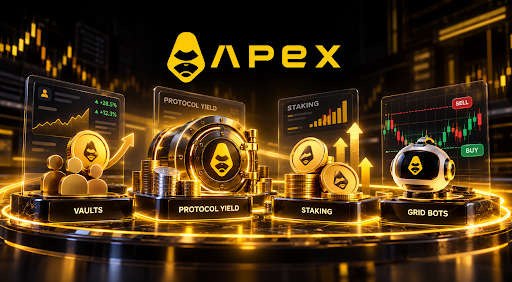
ApeX Omni has quietly built a second layer for everyone else: a set of products where the return comes from the platform’s own activity, from other traders’ skill, or from a rules-based bot, and where the user’s job is to allocate rather than to trade.
Four pieces make up that layer, and each one has a specific source of yield worth understanding before committing capital.
ApeX Vaults connect skilled traders with capital providers in a decentralised, transparent structure.
A vault creator designs and executes the strategy; investors allocate funds and earn a proportional share of the profits without placing a single trade.
The creator earns up to 10% of the profits generated for investors, charged only on realised gains, so the incentive is aligned with investor outcomes rather than with activity.
The rules were opened up in April 2025: individual investment caps were removed, creators can attract unlimited investor capital, and the minimum deposit to launch a vault fell to 100 USDT.
Every vault discloses its historical daily, weekly, and monthly returns, current open positions and exposure, maximum drawdown, profit-and-loss attribution, and the creator’s track record, and top performers surface through the platform’s ranking tools.
Redemptions are available after a 24-hour holding period from the time of investment.
For creators running systematic strategies, a dedicated Vault Key enables full API trading on the vault’s capital, so bots and algorithmic systems can manage entries, exits, and rebalancing with the same speed and reliability as regular Omni Perps trading.
The most distinctive product in the stack is the official Protocol Vault, operated by ApeX Protocol itself.
Its yield source is real protocol revenue: 100% of the daily liquidation fees generated by Omni Perp trading across the platform.
Users deposit USDT, receive shares at the current net asset value, and their proportional share of that day’s liquidation-fee income is reflected in the NAV every day at 08:05 UTC.
The structure is deliberately simple. There is no lock-up; any amount can be redeemed at any time with principal and accrued yield returned to the Perp Account.
The minimum purchase is above 10 USDT, the per-user cap is 1,000,000 USDT, and the total vault cap was raised to 20,000,000 USDT in August 2025.
Because the yield is a function of liquidation activity, it rises and falls with how busy the platform’s perpetual markets are, which is exactly what makes it a bet on the venue rather than on any single trade.
New depositors get an accelerated introduction. The New User Initiative pays a 50% APY on a first-time depositor’s first 1,000 USDT for five days, after which principal and bonus interest roll automatically into the regular Protocol Vault.
The offer has no expiry date, applies to any account that has never subscribed to the official Protocol Vault before, and draws from a 300,000 USDT incentive pool that replenishes as each five-day allocation matures.
APEX staking distributes a direct share of platform revenue to long-term holders.
Since Staking 4.0 took effect in February 2025, all rewards are paid in APEX tokens funded by weekly buybacks from trading-fee revenue.
Per platform data, the buyback program has repurchased more than 16.5 million APEX to date, and staking distributions have totaled over 3 million USDC and 1.9 million APEX.
Rewards scale with three factors. The amount staked sets the base.
A lock-up multiplier rewards commitment: a 3-month lock earns the baseline, 6 months earns 2x, 12 months 4x, and 24 months 8x.
A trading-activity factor adds up to a further 0.5 for users who trade at least once a day on five days of the weekly epoch.
Epochs run Monday to Monday at 08:00 UTC, rewards begin accruing the day a stake is made, and claims open each Thursday.
Staked APEX also counts toward VIP fee-tier qualification, so the same tokens that earn yield reduce trading costs.
For users who want exposure to volatility without directional conviction, the Grid Bot automates the oldest range strategy in the book: laddered limit orders that buy low and sell high inside a defined price band.
It runs on every USDT perpetual pair on ApeX Omni, in Neutral, Long, or Short mode, with arithmetic or geometric grid spacing and take-profit and stop-loss levels that trigger as market orders.
Because the bot works primarily through resting limit orders, its fills typically earn maker rates.
Full functionality is available on web and in the mobile app, and multiple bots can run at once across different pairs or ranges.
None of these products is risk-free, and the platform’s own documentation is direct about it.
Community vaults carry the creator’s strategy risk, and past performance is disclosed precisely because it does not guarantee future results.
Protocol Vault yield depends on liquidation activity, which varies with market conditions.
Grid bots can be caught outside their range in a strong trend, and leverage applied to a bot amplifies liquidation risk.
Staking rewards depend on platform fee revenue and the staker’s share of the total pool. The right framing is that these are ways to earn from a busy exchange without trading on it, not substitutes for risk management.
ApeX Protocol is a decentralized, non-custodial trading platform for perpetual derivatives, incubated by Davion Labs.
ApeX Omni is the protocol’s flagship platform, consolidating crypto perpetuals, TradFi perpetuals, prediction markets, and yield products into a single multi-chain interface.
Its mission is straightforward: deliver the speed and depth of a centralized exchange without asking traders to give up custody of their assets.
To explore vaults and staking, visit ApeX Omni or read the documentation at the ApeX Protocol GitBook.

Cardano’s “bank the unbanked” push went live with RealFi, putting real-world credit behind a new dollar-token system.
On Oct. 1, RealFi launched USDrf and its yield-bearing counterpart, sUSDrf, on Cardano, moving a project Cardano’s founder Charles Hoskinson has spent years describing as a bridge between blockchain finance and lending in emerging markets into production.
Eligible retail users can acquire USDrf and stake it for sUSDrf, which offers variable returns generated from the underlying portfolio. Direct minting and redemption with the issuer are reserved for verified institutional partners, creating different exit rights depending on who holds the token.
Hoskinson said in July that he had invested several million dollars in RealFi and that the team had serviced loans in Kenya and Uganda while building the platform largely outside public view. He described it as the first part of Cardano’s effort to “bank the unbanked,” with returns generated from lending outside crypto markets rather than primarily through token incentives.
The launch also arrives at a consequential moment for Cardano. Its stablecoin base is expanding toward a record even as capital committed to decentralized-finance applications has contracted sharply.
Over the past year, Cardano has moved away from building isolated native solutions for every financial function and toward competing directly for the more sophisticated DeFi flows concentrated on Ethereum, its Layer-2 networks and Solana.
That shift has become more pressing as Cardano’s own DeFi footprint shrinks.
Data from DeFiLlama shows that the network has about $67 million in total value locked, down more than 50% from roughly $150 million in May. Ethereum and Solana, by comparison, continue to support DeFi markets measured in the billions of dollars.
Stablecoins tell a different story. Dollar-linked tokens on Cardano are approaching an all-time high near $70 million, leaving the network with almost as much stablecoin liquidity as capital locked across its DeFi applications.
RealFi gives that growing dollar base another potential destination.
USDrf connects stablecoin capital to a portfolio that RealFi says can include direct loans, private-credit funds, public credit, investment-grade collateralized loan obligation ETFs, Treasuries and money-market instruments. Users willing to take additional risk can stake the token into sUSDrf for a share of the income generated by those assets.
That fits Cardano’s broader push to attract financial activity that does not depend solely on trading native tokens. If RealFi can turn stablecoin balances into lending and yield activity, it would add another source of demand to an ecosystem whose DeFi liquidity has been moving in the opposite direction.
But access to the product and access to the issuer’s balance sheet are separate.
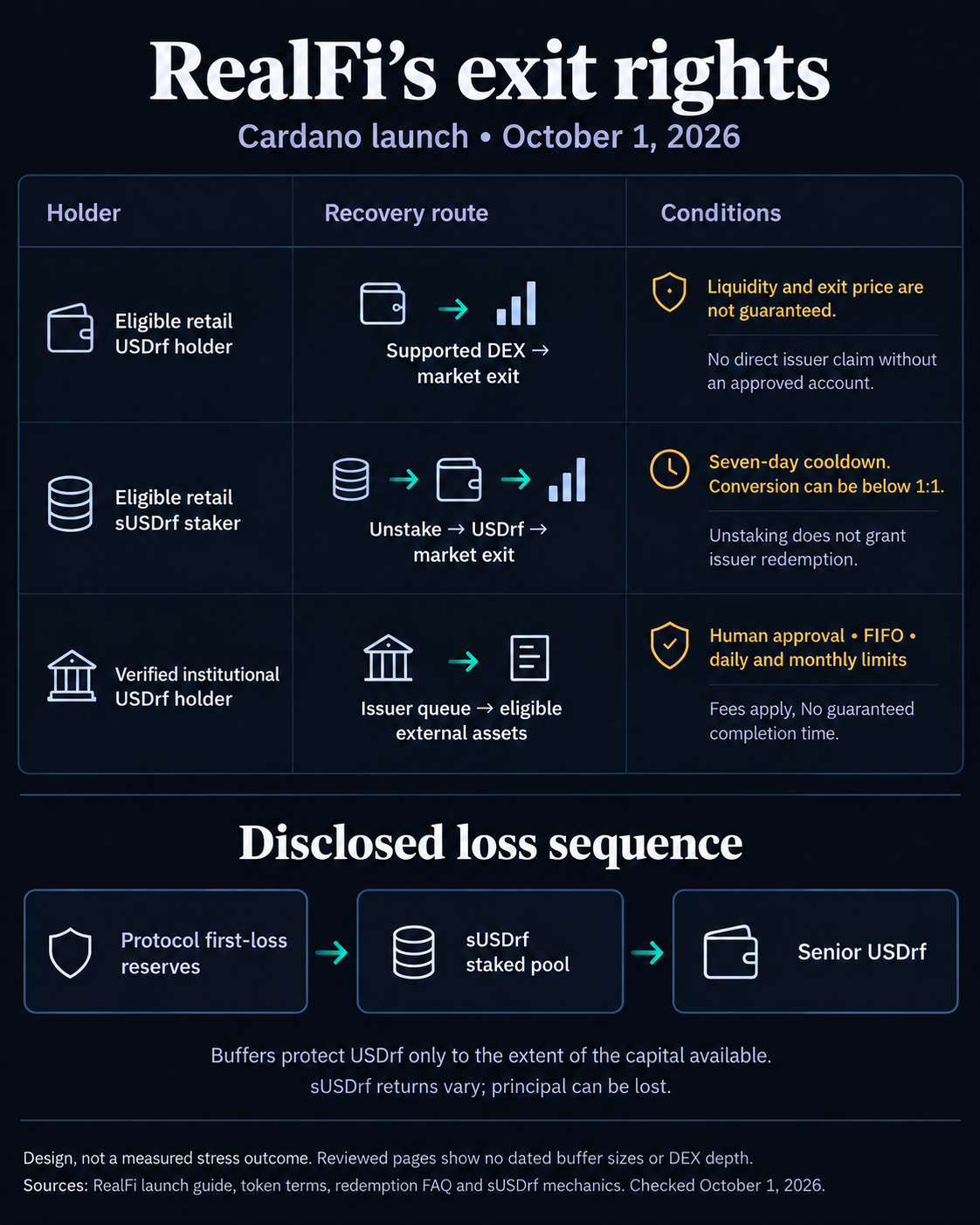
Eligible retail users can buy USDrf, but they generally cannot redeem it directly with RealFi Reserve for dollars.
Instead, RealFi directs retail holders toward supported decentralized exchanges, making their exit dependent on available liquidity and the market price of USDrf at the time.
Verified institutional entities get a different route. After completing checks and obtaining an approved account and whitelisted address, they can mint USDrf directly and request redemption at a nominal value of $1 per token, or its equivalent in eligible assets, less applicable fees.
Those redemptions are still subject to controls.
RealFi says institutional requests can enter a first-in-first-out queue and face daily or monthly limits. The issuer can suspend minting or redemptions under conditions including reserve or liquidity stress, sanctions concerns, security incidents and wider market disruption.
Stakers face another layer of friction. Leaving sUSDrf requires a seven-day cooldown before holders can claim USDrf, and the conversion amount is not guaranteed to remain one-for-one.
That matters because sUSDrf sits below the base token in RealFi’s loss hierarchy.
Protocol first-loss reserves absorb credit losses initially. If those buffers are exhausted, sUSDrf holders take losses before senior USDrf holders are affected. The number of sUSDrf tokens in a wallet may remain unchanged even as each token becomes redeemable for less USDrf.
RealFi explicitly describes sUSDrf as a junior loss-absorbing instrument whose yield can fall to zero and whose principal can be impaired.
USDrf receives more protection, though it remains neither an insured bank deposit nor a guaranteed dollar exit for retail holders.
The size of those protections remains difficult to quantify from the public information available at launch.
RealFi describes liquid reserves, underwriting controls, a stability fund and other mechanisms designed to support redemptions and absorb portfolio losses. Its public reserve-attestation page names HT Digital, but as of Oct. 1 did not display a dated reserve quantity.
Its disclosures also did not provide enough current figures on first-loss capital and settled staking balances to calculate how much credit deterioration sUSDrf could absorb before USDrf came under pressure.
RealFi currently excludes users from the United States, EU and European Economic Area, United Kingdom, Hong Kong and other restricted jurisdictions. Where local law restricts retail offerings of capital-markets products, sUSDrf is limited to accredited, institutional or other eligible investor categories.
That leaves RealFi’s next phase dependent on more than attracting deposits.
Hoskinson has already outlined a broader roadmap connecting the product with Bitcoin DeFi and privacy platform, Midnight.
Under that vision, users could borrow against Bitcoin-linked assets, deploy the proceeds into RealFi and use privacy-preserving credentials to satisfy identity requirements without relying on a conventional banking relationship.
Those integrations remain ahead.
The nearer-term commercial test will come as RealFi’s credit portfolio seasons, and users begin moving meaningful amounts through the system. Loan repayments, defaults, DEX liquidity, and institutional redemption queues will show whether Cardano’s growing stablecoin base can turn into durable credit activity rather than simply another pool of idle dollars.
Traditional financial markets have always been dependent on physical assets, custodians, legal agreements, and intermediaries to establish ownership and transfer value. Real-world asset tokenization transforms the way such assets are represented and managed by bringing them onto blockchain networks as digital tokens. But building a token is just the beginning. A reliable system also requires a complete infrastructure for asset verification, compliance, smart contracts, etc. This is where understanding RWA tokenization architecture becomes essential.
A well-curated RWA architecture connects the physical or off-chain asset with its digital representation while maintaining legal and operational control. Further, the following architecture might include a series of interconnected layers. Understanding such layers makes it easier to see how a tokenization platform can turn an asset into a blockchain-based representation.
Real-world asset tokenization platforms are built on three foundational layers, and they are the asset layer, the legal layer, and the blockchain layer. Each of these layers tackles certain challenges and needs that must be fulfilled for the platform to operate effectively. The RWA architecture layers connect the underlying asset with its digital representation while handling legal rights, ownership, transactions, and compliance.
The biggest advantage of such architecture is that it can connect traditional assets with blockchain-based infrastructure without treating token creation as an individual process.
The following platform must establish a reliable connection between the off-chain asset and the blockchain-based token. You can understand the basic real-world asset architecture by going through the major steps involved in bringing an asset on-chain.
Strengthen your expertise in real-world asset tokenization with 101 Blockchains Certifications curated to maximize your blockchain knowledge while fueling your career growth.
Master RWA Tokenization: Advanced Concepts & Applications—enroll today and learn how institutions bring real-world assets on-chain.
As institutional adoption is increasing, the demand for experienced tokenization platform development companies is also growing. Selecting the right technology partner is necessary because your RWA platforms need expertise in blockchain architecture, compliance frameworks, smart contracts, investor onboarding, asset management, and secondary market integration. However, the right infrastructure mainly depends on the legal structure, asset type, target investors, blockchain requirements, and the level of control an issuer needs over the token lifecycle.
This is one of the most recognized names in digital securities and asset tokenization. Moreover, the company offers proper real-world asset architecture for issuing, trading, and managing tokenized securities while focusing on regulatory compliance and institutional adoption. Their specializations include fund tokenization, security token issuance, investor management, compliance automation, etc.
This is a Luxembourg-based company known for its security token infrastructure. Its eligible RWA tokenization architecture enables you to issue compliant digital securities while maintaining investor protection standards.
This has emerged as one of the top platforms for RWA tokenization architecture development. This helps businesses tokenize their real-world assets through enterprise-level blockchain solutions. Further, the company offers end-to-end tokenization services that cover asset structuring, smart contract development, compliance automation, onboarding systems, and secondary market integration. This company specializes in building platforms for real estate, carbon credits, commodities, and much more.
This is a blockchain network specifically curated for regulated assets and tokenization. In addition to this, its infrastructure offers features for ownership and transfer rules, token issuance, distribution, compliance, corporate actions, and reporting. So, instead of treating compliance as an external add-on, Polymesh incorporates rules-based controls into its asset infrastructure.
Start building your RWA tokenization expertise with 101 Blockchains’ Career Paths featuring quality learning resources curated specially by industry experts.
Build your identity as a certified blockchain expert with 101 Blockchains’ Blockchain Certifications designed to provide enhanced career prospects.
Compliance is one of the major parts of any real-world asset tokenization architecture. This is because blockchain transactions might include regulated assets, financial activities, and investors. Different architectures handle such requirements in different ways depending on the asset, investor type, jurisdiction, etc. Some use permissioned networks and identity-based access. On the other hand, many places embed compliance controls directly into smart contracts or use external compliance services. Here are the main approaches mentioned below.
A tokenization platform can connect wallets and investors with verified identities instead of allowing completely anonymous participation. So, KYC checks can verify your identity before allowing access to a tokenized asset. The platform might also perform KYB checks when any institutional entities participate. Once the verification process is completed, the user’s wallet or account can be linked to an approved identity.
Some RWA architectures prevent who can hold or transfer particular tokens. So, smart contracts can maintain lists of investors containing wallets that have passed the necessary eligibility verification. When such a transfer is attempted, the contract can verify whether the sender and recipient satisfy the predefined conditions. If either party is not authorized, the following transaction can be rejected.
Tokenized assets might have restrictions as per investor category, investment limits, location, and applicable regulations. So, a compliance layer can store or reference such eligibility conditions and apply them before an investor receives or transfers tokens. Such controls can be implemented through smart contracts, identity providers, or a combination of both, depending on the architecture.
Enroll in the Real-World Asset (RWA) Tokenization Fundamentals Course and gain the skills to master blockchain, smart contracts, and digital asset infrastructure. Start your journey today!
KYC is just a part of your compliance. Tokenization platforms might also incorporate Anti-Money Laundering controls to assess transactions and identify suspicious activity. Wallet screening and transaction-monitoring tools can identify addresses or transfers related to known risks. Depending on the platform design, such checks might happen before a transaction or continuously throughout the asset’s lifecycle.
Smart contracts can transform regulatory and business rules into automated transaction conditions. For example, a contract can prevent transfers to wallets that have not completed verification or enforce restrictions on who can receive a token. It can also handle functions like insurance, redemption, transfer, and distribution as per predefined rules.
Compliance doesn’t end when tokens are issued. Tokenized assets might need ongoing ownership records, investor reporting, histories, corporate actions, and other regulatory processes. So, a proper RWA tokenization architecture connects blockchain records with administrative and reporting systems.
Understanding the technical architecture behind RWA tokenization makes it clear that putting an asset on a blockchain includes much more than creating digital tokens. The architecture must connect the underlying asset, identity, legal rights, compliance, custody, smart contracts, and blockchain infrastructure into a coordinated system. So, what is real-world asset RWA tokenization? It is the process of representing rights or interests in real-world assets through blockchain-based tokens. A well-curated architecture helps ensure that these digital representations remain connected to the assets.
*Disclaimer: The article should not be taken as, and is not intended to provide any investment advice. Claims made in this article do not constitute investment advice and should not be taken as such. 101 Blockchains shall not be responsible for any loss sustained by any person who relies on this article. Do your own research!
Tether says it helped authorities freeze nearly $550 million in Iran-linked USDT during 2026, highlighting the growing role of stablecoins in sanctions enforcement while drawing renewed scrutiny from U.S. lawmakers.
The company disclosed on September 28 its actions against wallets connected to Iran’s central bank and other sanctioned networks. The announcement followed a report from Democratic investigators on the Senate Permanent Subcommittee on Investigations alleging that USDT has become a major channel for Iranian entities to move money outside the traditional financial system.
The developments underscore a tension at the heart of stablecoins: the same infrastructure that enables fast cross-border transfers also gives investigators a transparent record of transactions.

Tether said it froze more than $344 million in USDT across two addresses in April after receiving information from the U.S. Treasury Department’s Office of Foreign Assets Control (OFAC) and U.S. law enforcement. OFAC added both addresses to its sanctions designation for Iran’s central bank the following day, citing links to the Islamic Revolutionary Guard Corps-Qods Force and Hezbollah.
In July, Tether froze more than $130 million across four TRON wallets after Treasury added those addresses to the same designation. Together, the two actions account for most of the company’s roughly $550 million in Iran-linked freezes this year.
The company stressed that freezing cryptocurrency is different from a government seizure. A freeze prevents USDT held at a specific address from being transferred, while ownership can be transferred to the government only through a separate legal process.
Tether CEO Paolo Ardoino said the company’s ability to respond to law enforcement requests shows the value of public blockchains in tracking financial activity.
“Tether has consistently demonstrated that USDT is not a haven for sanctioned actors, terrorist organizations or criminal networks,” Ardoino said.
Tether added that its cooperation with authorities worldwide has helped freeze more than $4.9 billion in assets, including more than $2.4 billion connected to U.S. authorities.
The Senate investigation takes a more critical view of USDT’s role in Iran-linked financial activity. Investigators examined 846 cryptocurrency wallets sanctioned or targeted for seizure over their connections to Iran and its proxies, and found that 84% had transacted exclusively or nearly exclusively in USDT. They also traced more than $600 million in USDT through the accounts of two sanctioned Iranian oil smugglers between 2021 and 2025.
The report argues that USDT’s liquidity and wide availability make it an important payment rail for Iranian networks seeking to bypass banking restrictions, and says some transactions connected Iranian banks with financial networks associated with Hezbollah and the Houthis.
Senator Richard Blumenthal called on the Treasury and Justice departments to investigate potential sanctions violations and examine Tether’s role in transactions involving Iranian networks.
The Senate findings are investigative allegations, not a legal determination that Tether violated U.S. law. Tether has rejected the characterization that USDT provides a safe haven for sanctioned actors, pointing instead to its cooperation with authorities and its record of freezing identified wallets.
The dispute comes as Washington expands its use of sanctions against Iran-linked cryptocurrency activity. In August, the Treasury Department launched Operation Economic Outcast, targeting financial networks supporting Iran, with digital assets included alongside technology, gold, aviation and shipping among the sectors facing expanded measures.
The campaign continued in September, when OFAC sanctioned BitBank, an Iranian digital-asset venture, along with its software developer and several associates of financier Babak Zanjani. Treasury alleged that Zanjani’s network used digital-asset businesses to move funds for the Islamic Revolutionary Guard Corps.
A separate Justice Department case shows how a Tether freeze can lead to forfeiture. In September, federal prosecutors sought forfeiture of about $61 million in USDT across 10 TRON addresses that Tether had previously frozen, alleging the funds were proceeds from Iranian oil sales intended to benefit Iran’s government and military-linked organizations. That case is not included in Tether’s $550 million figure.
The developments come as USDT continues to operate at enormous scale across global cryptocurrency markets. That scale creates a difficult compliance challenge. Stablecoins move value quickly across borders, and public blockchains leave records that help investigators trace suspicious flows. But the volume of activity means monitoring systems must flag sanctioned addresses and suspicious patterns before funds can be moved elsewhere.
That challenge could grow as faster blockchain infrastructure expands stablecoin payment capacity. StableChain, for example, has targeted speeds of up to 10,000 transactions per second, potentially supporting much larger payment flows.
For Tether, issuer-level controls remain a key enforcement mechanism. The blockchain itself does not determine whether a transaction complies with sanctions; issuers, exchanges, regulators and law enforcement each play a role in identifying and restricting illicit activity.
The Iran case highlights both sides of USDT’s growing importance. Blockchain transparency gives authorities a powerful tool for tracking illicit flows, while USDT’s liquidity and global accessibility can make it attractive to sanctioned networks.
Tether’s nearly $550 million in freezes shows that issuer intervention can block substantial funds once authorities identify targeted wallets. The Senate investigation, however, raises a broader question: whether those controls can keep pace with the growing use of stablecoins in sanctions-sensitive markets.
As U.S. authorities sharpen their focus on digital assets, Tether’s compliance practices are likely to face increasing scrutiny.

Las Vegas, NV, October 1st, 2026, Chainwire
Lowest Fee Bitcoin ATMs announced the launch of more than 400 cryptocurrency ATMs across the United States. The machines allow customers to purchase Bitcoin, Ethereum, USDT and USDC with cash at a stated flat 5% fee. Customers can also pre-register online before visiting an ATM.
Lowest Fee Bitcoin ATMs, a new nationwide low-fee Bitcoin ATM operator, launched today with an initial rollout of more than 400 Bitcoin ATMs across the United States, a footprint that places it amongst the largest Bitcoin ATM operators in the country on its first day. It also launched with a name that does most of the marketing department’s job for it. The brand charges a flat 5% Bitcoin ATM fee to buy Bitcoin, Ethereum, USDT or USDC with cash, displays the fee and exchange rate on screen before the customer confirms, and, as of today, lets first-time customers register online in about two minutes so they can skip onboarding at the machine entirely.
400+ Bitcoin ATM locations on day one
Most Bitcoin ATM operators in the U.S. run a few dozen machines. Lowest Fee Bitcoin ATMs opens with more than 400 Bitcoin ATM locations in the convenience stores, gas stations and shopping centers people already visit, with machines in Florida, California, Arizona and Texas among other states, as the first phase of a larger rollout.
“Four hundred machines is not a pilot. It’s a network,” said Quincy Mathis, Operations Manager at Lowest Fee Bitcoin ATMs. “We wanted to be one of the biggest Bitcoin ATM operators in the country on the day we opened, because a low fee only matters if there’s a machine near you. This is phase one.”
Buy Bitcoin, Ethereum, USDT and USDC with cash: coins, limits and one fee
Every Lowest Fee Bitcoin ATM sells Bitcoin (BTC), Ethereum (ETH), Tether (USDT) and USD Coin (USDC) for cash, all at the same 5% fee, all sent directly to the customer’s own wallet. No bank account or credit card is needed. The machines are non-custodial: the company never holds customer funds.
Bitcoin ATM daily limits are set by verification tier:
Bitcoin ATM fees compared: what $1,000 buys
The typical Bitcoin ATM in the United States charges roughly 12% to 15% to buy, and some of the largest national brands charge 20% or more. Here is what that looks like when a customer walks up with $1,000 in cash:
Illustrative, based on posted percentage fees only and before exchange rate. Many operators add an exchange-rate markup on top of the posted fee; Lowest Fee Bitcoin ATMs shows both the fee and the rate on screen before a transaction is confirmed. Industry figures reflect publicly reported U.S. Bitcoin ATM fee ranges. See how the Bitcoin ATM fees compare.
At a 20% machine, one dollar in every five never becomes crypto. At Lowest Fee Bitcoin ATMs, it’s one in twenty. The name is not subtle; neither is a 20% fee.
“We wanted a rate people can look at on the receipt and feel good about, not one they have to make peace with,” said Quincy Mathis. “Five percent, shown up front, with the exchange rate right next to it. That’s the whole pitch.”
Stablecoin ATMs are becoming the way people send money overseas
A growing share of customers are using the machines as USDT and USDC ATMs, buying dollar pegged stable coins to send money to family and friends overseas and to pay suppliers and contractors abroad. A customer inserts cash, the stable coins arrive in the recipient’s wallet within minutes, and the recipient holds dollars they can keep or cash out locally. No wire counter, no multi-day wait, and no bank account needed to send.
That makes the fee gap matter more, not less. Someone sending $1,000 home once a month pays about $600 a year in fees at a 5% machine, $1,440 to $1,800 at a typical machine, and $2,400 at a 20% machine. The difference is real money to the people who can least afford to lose it, which is why low fees matter most to remittance customers.
“The people using stable coins to support family abroad are exactly the people who shouldn’t be paying 20% for the privilege,” said Quincy Mathis.
How to use a Bitcoin ATM: four steps, under two minutes, now with online pre-registration
New with today’s launch is online Bitcoin ATM pre-registration. First-time customers can pre-register online before they ever visit a machine, so the first visit is as fast as the tenth. At any of the 400+ machines, they simply enter their phone number.
Customers who would rather register at the machine still can. It just takes a little longer, and the company would like to gently point out that it no longer has to. A full walkthrough of how a Bitcoin ATM works is on the company’s website.
Compliance, briefly
Lowest Fee Bitcoin ATMs is a FinCEN-registered money services business, and every machine operates in compliance with federal and state regulations. Customer data is encrypted, and transactions are non-custodial and irreversible. No government agency, bank, utility or tech-support line will ever ask anyone to pay them at a Bitcoin ATM; if someone does, it is a scam. Common questions are answered in the company’s Bitcoin ATM FAQ.
Find a low-fee Bitcoin ATM near you
Lowest Fee Bitcoin ATMs are live now at 400+ locations across the United States, with further phases of the rollout to follow. Customers can find a Bitcoin ATM near them and pre-register at lowestfeebitcoinatms.com. New customers can use code LOWEST at the machine for 20% off the transaction fee, which brings the fee on that $1,000 transaction down to $40.
About Lowest Fee Bitcoin ATMs
Lowest Fee Bitcoin ATMs is a nationwide low-fee Bitcoin ATM operator whose initial network of more than 400 machines ranks among the largest in the United States. Customers can buy Bitcoin, Ethereum, USDT and USDC with cash for a flat 5% fee, with the fee and exchange rate displayed on screen before every transaction. The company is a FinCEN-registered money services business. Users can learn more at lowestfeebitcoinatms.com.
Marketing Director
Brian S. Smith
Lowest Fee Bitcoin ATMs
support@lowestfeebitcoinatms.com

More than 50,000 Europeans have urged the European Commission to loosen restrictions on stablecoin rewards as part of its review of the bloc’s Markets in Crypto-Assets (MiCA) framework, according to crypto advocacy group Stand With Crypto EU.
The campaign came as the Commission closed its MiCA review consultation on Wednesday, with Stand With Crypto EU pushing for regulated stablecoin providers to be allowed to offer incentives including cashback, loyalty benefits and fee reductions.
The group said more than 50,000 supporters wrote to the Commission during the consultation, while more than 126,000 people have separately signed its petition calling for a more permissive EU approach to stablecoins.
Stand With Crypto EU campaign vehicle outside the European Parliament in Brussels, Belgium. Source: Stand With Crypto EU
MiCA prohibits issuers and crypto service providers from paying interest on stablecoins, a restriction Stand With Crypto argues puts the products at a disadvantage to bank deposits and other e-money products that can offer benefits to customers.
Stand With Crypto said the campaign generated more than six times the 8,221 responses submitted to the European Central Bank’s (ECB) digital euro consultation and far exceeded the 198 responses received during the Commission’s 2020 consultation on crypto rules.
“We are calling on the Commission to use the MiCA review to allow regulated stablecoins to offer rewards to holders,” Stand With Crypto EU general manager Harry Pearce Gould told Cointelegraph.
Asked whether Europe should look to regulatory models outside the EU, Pearce Gould pointed to the US:
The US has made a clear choice to back stablecoins as the settlement layer for tokenisation. Europe doesn’t need to copy that, but it does need to compete with it.
He added that allowing rewards could help euro-denominated stablecoins gain adoption and compete with dollar stablecoins.
“Strong euro stablecoins matter for the euro’s global standing and the EU’s payment sovereignty,” he said.
Related: Binance’s EU services face scrutiny over licensing exemption: Report
The campaign comes as European central banks are pushing for broader changes to MiCA’s treatment of stablecoins.
In a Sept. 22 response to the European Commission’s MiCA review, the European System of Central Banks (ESCB) called for the existing prohibition on stablecoin interest to extend to lending, borrowing and staking arrangements that generate yield.
The ESCB also proposed replacing MiCA requirements that stablecoin issuers hold a minimum share of their reserves in bank deposits with liquidity thresholds. The central banks argued that the existing rules could strain lenders if a stablecoin run forced an issuer to rapidly withdraw deposits.
The ECB has separately highlighted a potential liquidity mismatch, noting in June that stablecoins settle around the clock while their reserve assets may still operate on traditional settlement timelines.

Source: European Central Bank
The proposals come amid broader concerns from the ECB over stablecoins’ potential impact on financial stability.
In May, ECB President Christine Lagarde warned that a shift of deposits from banks into stablecoins could weaken bank lending and monetary policy transmission, while arguing that Europe should instead prioritize tokenized financial infrastructure anchored by central bank money.
Magazine: Peter Brandt says Bitcoin may hit $600K by 2029, calls XRP a ‘fool coin’

A US federal judge has dismissed most claims brought against Chainalysis by Celsius Network’s litigation administrator, but allowed one to proceed.
The surviving claim alleges Chainalysis helped Celsius insiders breach their fiduciary duties.
US District Judge Margaret Garnett denied Chainalysis’ bid to dismiss the aiding-and-abetting claim in a ruling issued Tuesday. She found that the complaint sufficiently alleged that Chainalysis knew a 2020 Celsius press release contained false statements and helped disseminate them.
The judge dismissed 12 other claims with prejudice, preventing the plaintiffs from amending them in this case.
Three consumer-protection claims were dismissed without prejudice. The plaintiffs have until Oct. 20 to amend those claims or tell the court they will not do so.
Celsius, a crypto lender, filed for bankruptcy in July 2022 during the crypto market crash. It froze withdrawals a month earlier, leaving customers unable to access about $4.7 billion in assets. The Chainalysis lawsuit is part of the estate’s effort to recover funds for creditors.
Chainalysis told Cointelegraph it was unable to comment. Celsius’ litigation administrator had not responded before publication.
In 2020, Celsius enlisted Chainalysis to help calculate its assets under management using the company’s Reactor software and later publicized the results as an audit.
According to the complaint as summarized by the court, a Celsius executive initially calculated about $1.18 billion in assets using Reactor before changes to the methodology increased the figure to roughly $3.3 billion.
A Dec. 9, 2020 press release announced an “audit” confirming about $3.3 billion in Celsius assets using Chainalysis Reactor, based on transactions, total deposits and total withdrawals since Celsius launched the service in 2018.
Related: Federal prosecutors blast ex-Celsius CEO’s motion to vacate as ‘without merit’
The complaint alleges Chainalysis helped draft, edit and approve the release and knew that statements describing the work as an “audit” and “independent verification” were false or materially misleading.
The allegations have not been proven, and Chainalysis sought to have the complaint dismissed in its entirety.
Blockchain Recovery Investment Consortium, or BRIC, brought the lawsuit. It acts as litigation administrator and recovery manager for the Celsius estate and is pursuing claims on behalf of Celsius and certain former customers.
Magazine: Could THORChain face prosecution over stolen Bitget funds? Legal opinion


